21-10-2026
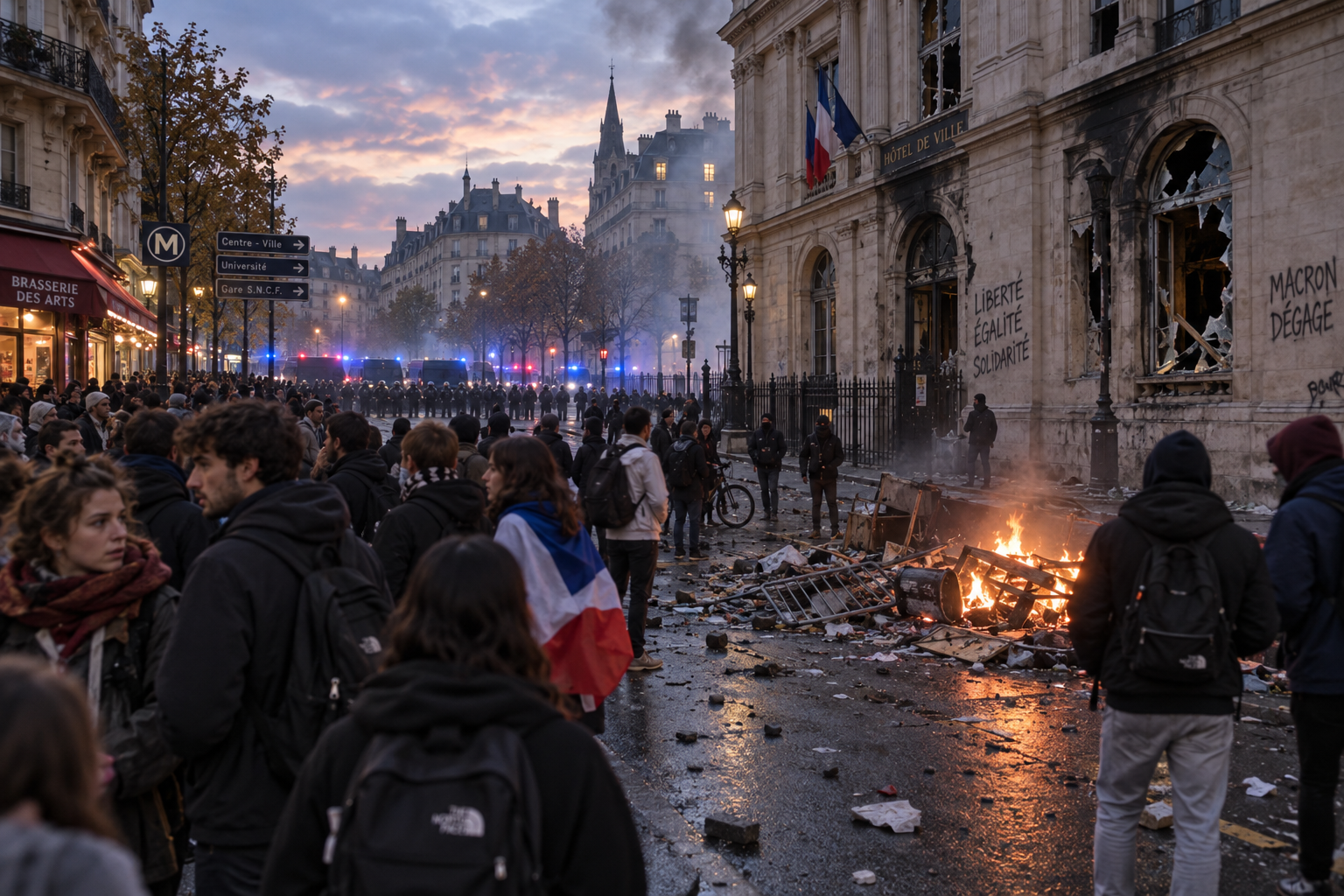
The article examines competing explanations for the violence and looting that followed student protests in France, and the political arguments that have grown around it. Reporting from Paris, BBC Europe Editor Katya Adler describes residents’ distress at the destruction while stressing that no single explanation accounts for events. French officials, including Prime Minister Sébastien Lecornu and Interior Minister Laurent Nuñez, have accused far-left or ultra-left groups of planning or intensifying violence. An intelligence report cited by Le Figaro alleges that radical-left groups and student organisations manipulated demonstrations, and names La France Insoumise (LFI) as pursuing violence as an electoral strategy. LFI and Jean-Luc Mélenchon reject these accusations; student organiser Lisa Cordat says student anger arose independently and that claims of political manipulation are insulting. The article distinguishes the apparently planned attacks on police from largely opportunistic looting of more than 3,000 businesses. Authorities are investigating footage and online resale listings, while former prime minister Gabriel Attal has called for temporary social-media blackouts. Similar concerns about online-amplified violence have been raised in Belgium.
The unrest has become entangled with France’s approaching presidential election. Politicians accuse one another of exploiting the violence, failing to prevent it, or using it to distract from protests demanding better public services. Mélenchon has suggested Lecornu may have allowed disorder to strengthen the government’s law-and-order image; the government has acknowledged a shortage of police officers and President Emmanuel Macron has demanded explanations and a new policing strategy. Marine Le Pen, already leading in polls, blamed Mélenchon and the government in a video address and presented her party’s law-and-order message as an alternative. Residents and teachers quoted in the article fear that politicians are using the violence to campaign while neglecting the protests’ underlying causes. The article concludes that distrust of political institutions is growing, particularly among younger people, while noting that multiple factors—not a simple partisan explanation—are at play.
Entities: Katya Adler, Elisabeth, Yaël Braun-Pivet, Emmanuel Macron, Sébastien Lecornu • Tone: analytical • Sentiment: negative • Intent: analyze
21-10-2026
France is extending overnight curfews and deploying more police after demonstrations over rising living costs and deteriorating public services escalated into widespread looting and arson. Prime Minister Sébastien Lecornu announced a “massive” police presence ahead of further protests scheduled for October 24. Interior Minister Laurent Nuñez acknowledged that officials had underestimated the unrest, while authorities reported more than 2,500 people in custody by Monday evening. The violence included the burning of a historic town hall in Limoges. Curfews have been imposed in parts of Paris, Lyon and other cities; Paris and Lyon reported no major incidents on Monday night.
The protests began in mid-September with students and teachers raising concerns about overcrowded classrooms, deteriorating school buildings and teacher shortages. Trade unions and Yellow Vest activists later joined, broadening the movement into a challenge over living costs and declining public services. The government has promised additional police and offered some education concessions, including more than 3,000 substitute teachers and several hundred additional hires. President Emmanuel Macron has said the government will hear peaceful protesters’ demands while holding rioters accountable, and blamed radical far-left groups and criminals for the violence.
The article describes significant barriers to broader reforms: France’s public debt was nearly 3.6 trillion euros, or 119% of annual economic output, at the end of June, and the government expects a 5.4% deficit this year. Rising interest costs are expected to further constrain public spending. Macron’s allies also lack a parliamentary majority, and the current budget passed only after the government advanced it without a final vote, surviving two no-confidence motions. With Macron’s approval rating at 15% and a presidential election due in April, polls show far-right leader Marine Le Pen ahead of other potential candidates. Macron cannot seek a third term.
Entities: Emmanuel Macron, Sébastien Lecornu, Laurent Nuñez, Gérald Darmanin, Paris • Tone: analytical • Sentiment: negative • Intent: inform
21-10-2026
France 24’s liveblog preview reported that French Prime Minister Sébastien Lecornu was preparing to meet trade union organisations on Wednesday, October 21, 2026. The meeting was expected to address security at protests and responses to the high school students who started demonstrations that had since spread nationwide. The protests were linked to the cost of living, while violence and looting over the preceding weekend had prompted curfews in cities across France.
The article’s recap of the previous day’s developments said Lecornu accused ultra-left radical groups of pursuing an “insurrectionary plan” that led to violent rioting alongside the protests. It also reported that fresh curfews had been imposed in central Paris and Lyon after the first quiet night following some of France’s most destructive rioting in years. Looking ahead, Lecornu said a “massive” security operation would be deployed for protests planned for Saturday, with the military reinforcing police.
The supplied page contains only a brief liveblog introduction and a summary of prior developments; it does not include subsequent live updates. The article credits FRANCE 24 and cites Reuters, the Associated Press and Agence France-Presse as sources for the recap.
Entities: Sébastien Lecornu, France, Paris, Lyon, French government • Tone: analytical • Sentiment: neutral • Intent: inform
21-10-2026
French Prime Minister Sebastien Lecornu is due to meet representatives of five trade unions on Oct 21, as the government responds to a wave of riots and prepares for further demonstrations over rising living costs. He has acknowledged that the security response to the recent unrest fell short and promised a “massive” police deployment for protests planned on Oct 24. Another demonstration has been called for Nov 5 by labour unions. High school students, who are also planning protests, were not invited to the meeting.
The unrest included looting, arson and clashes in several cities. Authorities imposed partial curfews and restrictions on gatherings in Paris and elsewhere, while police temporarily prohibited people from carrying cans or bottles of petrol or gas. Nearly 150 people had been jailed and more than 800 brought before the courts. An arrest was made in connection with the burning of a historic town hall in Limoges, an incident that became a symbol of the violence.
The government has faced criticism across the political spectrum. Interior Minister Laurent Nunez offered to resign after saying police had lost control, but President Emmanuel Macron rejected the resignation. Lawmakers agreed to launch an inquiry into the unrest, examining possible intelligence failures, policing tactics and government preparedness. Lecornu has blamed ultra-left radical groups for what he described as an “insurrectionary plan,” while Marine Le Pen called the disorder a warning of a broader crisis of authority.
The unrest has also raised concern beyond France. The United States, China and Germany issued travel advisories, and investors have sold French debt amid doubts about the government’s ability to control spending. Demonstrations over prices have also occurred elsewhere in Europe. US President Donald Trump blamed migrants, jihadists and communists for France’s violence, but analysts cited in the article said immigration was not a driving force behind the unrest.
Entities: Sebastien Lecornu, Emmanuel Macron, Marine Le Pen, Jean-Luc Melenchon, Laurent Nunez • Tone: analytical • Sentiment: negative • Intent: inform
21-10-2026
France is experiencing a major wave of anti-government unrest that began in September as largely peaceful, student-led protests over public education. By the weekend described in the article, demonstrations had escalated into widespread clashes, fires, looting and damage to public buildings. The French Interior Ministry reported more than 2,000 arrests and nearly 1,000 injured police officers. Authorities imposed curfews and restrictions on public gatherings in parts of several cities, including Paris, Nice, Lille and Lyon, while additional demonstrations were planned for October 24, October 31 and November 5.
Paris was a central focus of the violence, with clashes around Place de la Republique, Les Halles, Place de la Bastille and Place de la Concorde. Marseille, Lyon and other cities also experienced unrest and damage. Despite this, many areas of Paris had returned to a calmer routine by October 20: streets had been cleared, parks were peaceful, and cafes, tourists and guides were active. A local guide recommended staying on the Left Bank, which is generally quieter during protests, and said tour schedules were being adjusted around demonstrations.
Most major Paris attractions, including the Eiffel Tower and Arc de Triomphe, remained open, though authorities could close sites at short notice. The Louvre had shut after protesters blocked its entrance, and its reopening date was not announced. Visitors were advised to check attraction and local updates before travelling. Demonstration days could bring closed metro stations and roads, reduced bus and tram services, and a possible nationwide transport strike on November 5. The article recommends avoiding protest areas, following local media and official updates, and anticipating disruption. It also notes that standard travel insurance often excludes civil unrest; reimbursement may depend on policy terms or having “cancel for any reason” coverage.
Entities: France, Paris, Marseille, Lyon, French Interior Ministry • Tone: analytical • Sentiment: negative • Intent: inform