19-10-2026
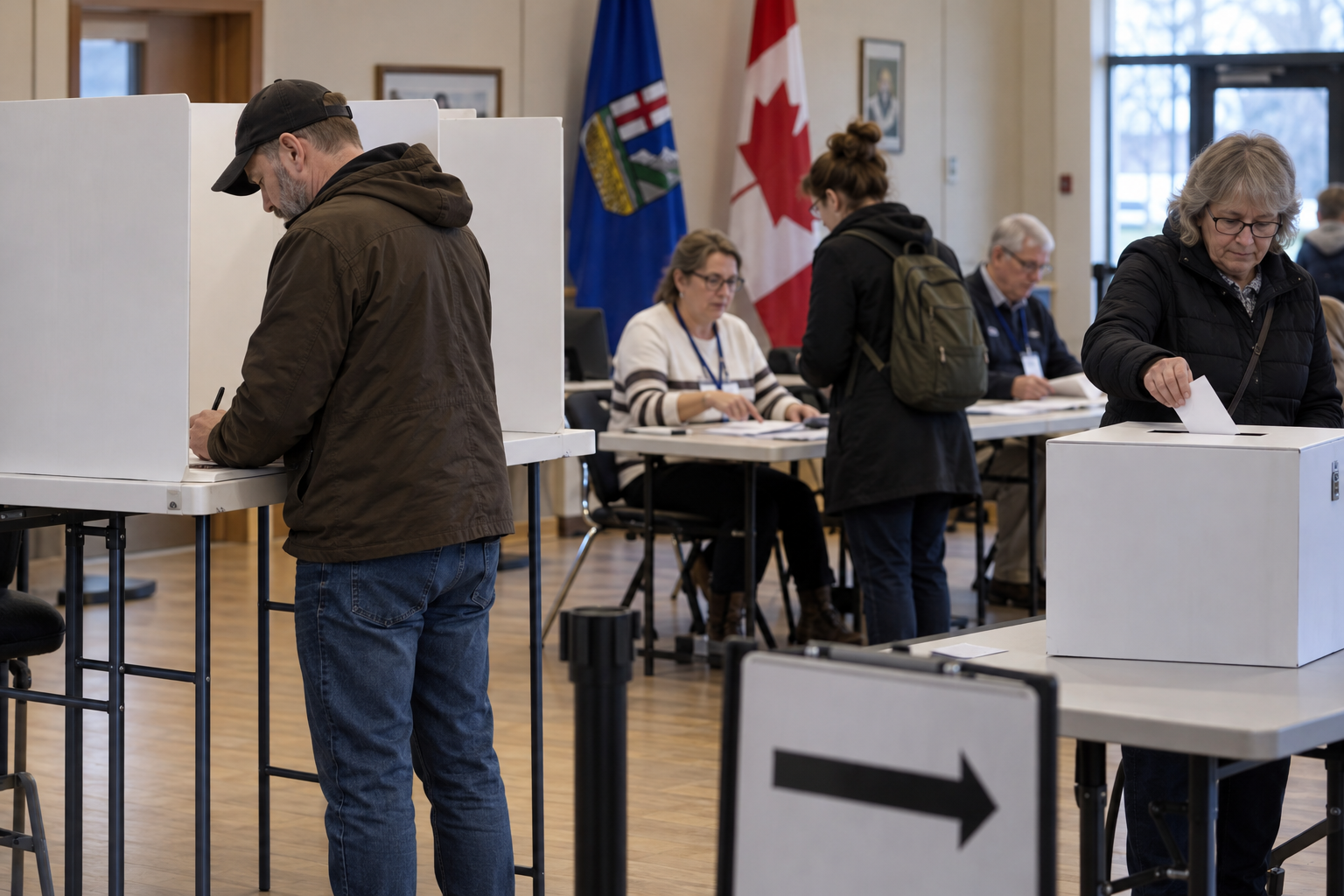
Albertans are voting on whether the provincial government should begin the legal process for a future binding referendum on separation from Canada. The vote, called by Premier Danielle Smith after a grassroots petition gathered about 300,000 signatures, does not itself decide whether Alberta will become independent. If voters support proceeding, a binding referendum could take place as soon as 2027. A court blocked the original pro-separation petition, ruling that it had not consulted Indigenous First Nations whose lands could be affected. Smith, who says she opposes separation, argues that the vote gives residents a chance to express their views. First Nations groups have criticized her decision to proceed as undemocratic and authoritarian.
Separatists argue that federal environmental policies have constrained Alberta’s oil and gas industry and economic growth, and that independence would allow the province to retain more of its wealth. The movement is associated with the Alberta Prosperity Project and campaigners Mitch Sylvestre and Jeffrey Rath. Supporters say the debate itself has already brought attention to Alberta’s concerns. Opponents warn that an independent Alberta would inherit billions of dollars in debt and that uncertainty could drive jobs and investment away, drawing comparisons to the UK’s Brexit vote.
Public opinion polling has indicated that most Albertans would prefer to remain in Canada, and a petition opposing separation attracted more than 400,000 signatures. At rallies in Edmonton, some residents said they felt unheard by Ottawa or wanted the province to assert its rights; others stressed their Canadian identity and argued that separation was a costly distraction. Prime Minister Mark Carney urged voters to decisively reject separation, warning that external pressures make national unity important. Albertans are also voting on nine other questions, several concerning provincial control over immigration. Early voting was strong, and officials plan to count ballots by hand, with results expected early Tuesday.
Entities: Alberta, Canada, Danielle Smith, Mark Carney, United Conservative Party of Alberta • Tone: analytical • Sentiment: neutral • Intent: inform
19-10-2026
Alberta voters are casting a nonbinding vote on whether the province should begin the legal process toward a future referendum on separation from Canada. It is the first time Alberta has put separation to a public vote, and the ballot includes 10 questions: nine on matters such as immigration, public services and constitutional changes, and a final question asking whether Alberta should remain in Canada or pursue the process toward a separation referendum. Polls suggest most voters will reject beginning that process, while roughly one in five Albertans support separation. The vote has nevertheless brought longstanding western alienation and dissatisfaction with federal policy into sharper public view. Support has intensified for some residents since COVID-19 lockdowns and vaccine mandates. Separatist advocates say Alberta should retain more of its revenue rather than contribute to federal redistribution, while Prime Minister Mark Carney has warned that a vote against Canada could bring uncertainty and lost opportunities. Alberta is wealthy and holds substantial oil reserves, but independence would require more than a referendum. Under the Supreme Court’s position, the province would have to negotiate with the federal government and the other provinces to amend the Constitution. The Clarity Act, passed after Quebec’s 1995 sovereignty referendum, sets conditions for secession negotiations but does not define a fixed threshold for a clear majority. Any process would also need consultation with First Nations. An Alberta court ruled that a separatist petition violated Indigenous rights because the province had not consulted First Nations; Alberta has appealed. A University of Calgary report estimates separation could cost as much as 170 billion Canadian dollars over five years, with Alberta assuming a share of federal debt and facing higher interest payments. Pro-unity campaigners also cite Quebec’s economic experience as a warning. If voters support pursuing a separation referendum, Premier Danielle Smith has said she will respect the result and begin the process subject to legal requirements.
Entities: Alberta, Canada, Elections Alberta, Danielle Smith, Mark Carney • Tone: analytical • Sentiment: neutral • Intent: inform
19-10-2026
Alberta voters are being asked whether the province should remain in Canada or proceed toward a second, binding independence referendum. The vote follows years of separatist complaints that Ottawa treats Alberta unfairly and limits the province’s ability to develop its oil and gas resources. A deadly fire at CFB Wainwright shortly before the vote has muted campaigning, while the referendum has revealed fractures both across Alberta politics and within the separatist movement.
Premier Danielle Smith called the referendum after pressure from members of her United Conservative party, but has not campaigned for independence. She has warned that separation could cost hundreds of billions of Canadian dollars to arrange, with substantial ongoing expenses. Opponents also emphasize financial uncertainty. The campaign has drawn unusual cross-party opposition to separation, including former premiers Jason Kenney and Rachel Notley, and Prime Minister Mark Carney, who invokes the economic disruption following Brexit and argues that a break with Canada would bring prolonged uncertainty.
Energy policy and a longstanding sense that Alberta’s wealth flows eastward form the historical backdrop to separatism. Yet the movement itself is weakened by rivalries, controversies involving prominent figures, and disagreement about how quickly independence could be achieved. Separatist planner Keith Wilson portrays the transition as manageable and predicts Canada would be reluctant to disrupt trade. Other separatists, including Bill Jones, warn that the province lacks essential institutions and could become a failed state.
The ballot also includes nine measures unrelated to separation, prompting competing campaigns over how voters should respond to them. Overall, the article presents a consequential vote shaped by economic concerns, regional grievances, political divisions, and uncertainty about the practical costs and feasibility of independence.
Entities: Alberta independence referendum, Alberta, Canada, Danielle Smith, Mark Carney • Tone: analytical • Sentiment: neutral • Intent: analyze