17-07-2026
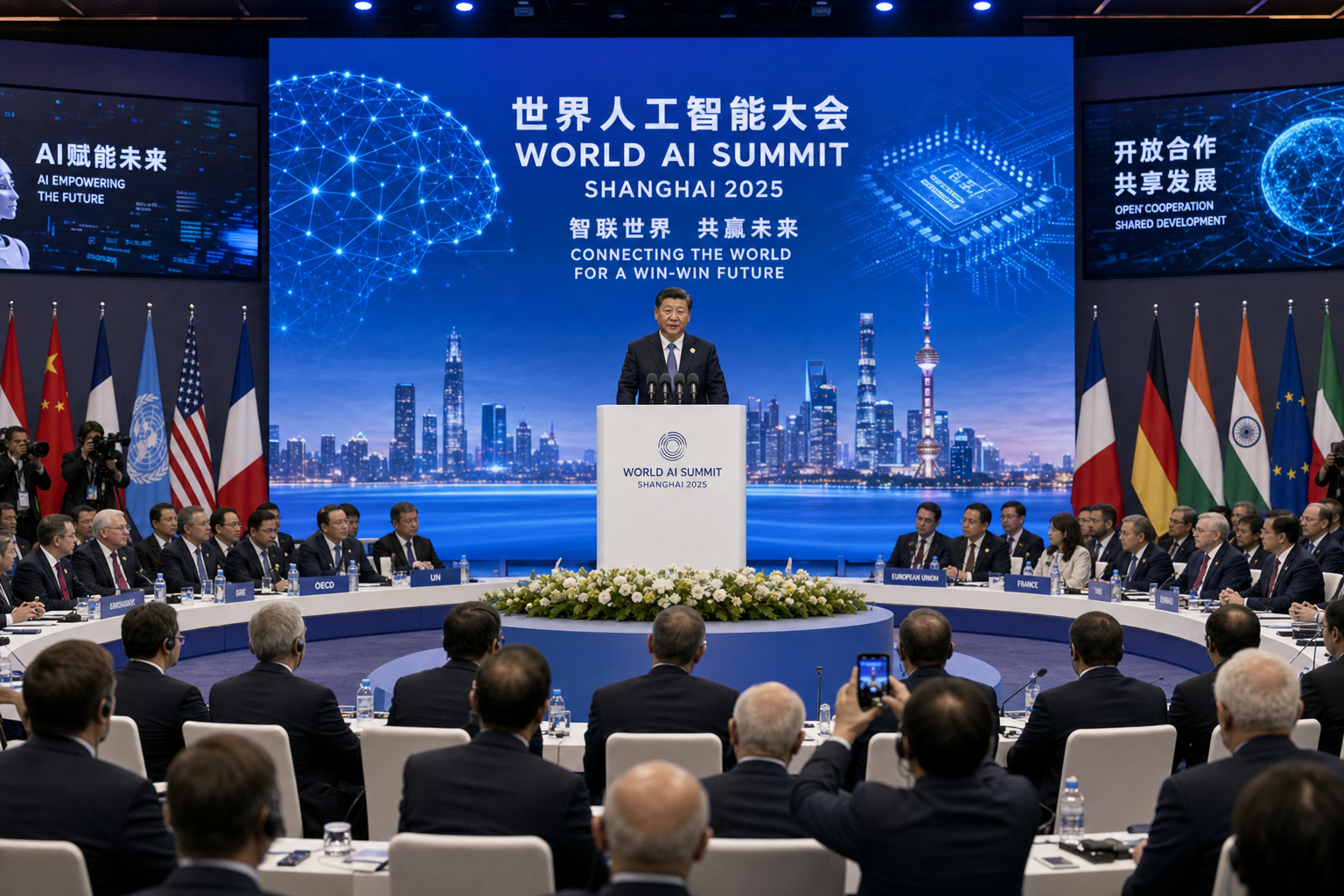
Chinese President Xi Jinping used a speech at the World AI Conference in Shanghai to cast China as a cooperative AI partner for the developing world, especially the Global South. He said China would offer 5,000 AI training and seminar opportunities over the next five years and expand AI cooperation with regional and multilateral blocs such as ASEAN, the Arab League, the African Union and BRICS. Xi framed AI development as something that should be collaborative rather than dominated by any single nation, arguing for a “people-centered” approach to governance and insisting that AI must remain secure, controllable, and under human oversight. He also warned against expanding the idea of national security too far in the AI sector or prioritizing one country’s security over others.
The article places Xi’s remarks in the context of intensifying U.S.-China technology rivalry. It notes that while Xi avoided naming the United States, Washington has tightened export controls on advanced chips and semiconductor technology in recent years, limiting China’s access to key computing components. The piece highlights Nvidia’s claim that it has been effectively shut out of China’s data center computing market, illustrating how geopolitical restrictions have reshaped competition. It also notes that Chinese company Huawei showcased a new supernode, the Atlas 950 SuperPoD, emphasizing domestic efforts to build high-performance AI infrastructure. Overall, the article frames Xi’s speech as both a diplomatic outreach to developing countries and a strategic response to Western tech pressure.
Entities: Xi Jinping, China, Global South, World AI Conference, Shanghai • Tone: analytical • Sentiment: neutral • Intent: inform
17-07-2026
The article contrasts two highly different messages delivered almost simultaneously by US President Donald Trump and Chinese leader Xi Jinping, using that juxtaposition to frame the intensifying US-China competition over artificial intelligence. While Trump accused China of stealing American voter data and interfering in US elections, Xi used the opening of China’s World AI Conference in Shanghai to present Beijing as a responsible steward of AI and a potential global rule-maker. Xi urged that AI development be guided toward humanity’s benefit and called for precise governance to prevent loss of control, while also criticizing what China sees as Washington’s tendency to overuse national security arguments and prioritize its own security over others.
The piece argues that AI has become a central arena in the broader geopolitical rivalry between the two powers. China is trying to position AI as a “global public good” and build international influence through initiatives like the new World Artificial Intelligence Cooperation Organization (WAICO), which includes 29 countries friendly to Beijing. Analysts quoted in the article say Xi views AI not only as a technology race but also as a diplomatic opportunity to bring in allies and shape international norms, much as the United States influenced the internet era.
At the same time, the article notes that American firms still lead in many frontier AI capabilities and hardware, but that China is narrowing the gap through rapid model development, open-source offerings, lower costs, and deployment in robotics and automation. The article also highlights growing mutual suspicion over AI model theft, security risks, and potential cyber vulnerabilities. Overall, it portrays an escalating contest in which both countries are vying not just for technological advantage, but for the right to define the rules governing AI globally.
Entities: Donald Trump, Xi Jinping, China, Beijing, Shanghai • Tone: analytical • Sentiment: neutral • Intent: analyze
17-07-2026
The article examines President Trump’s release of newly declassified documents about China and the 2020 U.S. election, and contrasts his public claims with what the documents actually show. In his remarks, Trump portrayed China as having carried out an unprecedented operation to acquire and exploit American voter data, framing it as a major election-security scandal. The article says that characterization is exaggerated: voter data is often publicly available or purchasable, and the documents do not show evidence that such data could be used to manipulate votes on a large scale.
The newly released documents provide additional detail on a previously known intelligence disagreement. Most U.S. intelligence agencies in 2020 assessed that China was not trying to influence the outcome of the presidential race, though one intelligence official, later identified as Chris Porter, argued that Beijing had taken limited, exploratory steps that could have been aimed at undermining Trump’s reelection prospects. The records show that this dissent existed but was based on low-to-medium confidence and heavily redacted evidence. The documents suggest that Chinese officials discussed ways to respond to U.S. pressure, considered collecting damaging information about Trump, and experimented with deepfakes, though there is no evidence these ideas were carried out in a meaningful way.
The article also notes that the declassified material indicates Chinese actors obtained public voter registration data in several U.S. states in 2022, but the motives remain unknown. Overall, the piece portrays the Trump administration’s presentation of the documents as overstated, emphasizing that while foreign cyber and influence threats are real, the evidence released does not support Trump’s broadest claims about a historic Chinese election-data compromise.
Entities: Donald Trump, China, U.S. intelligence agencies, 2020 U.S. presidential election, voter data • Tone: analytical • Sentiment: neutral • Intent: inform