16-09-2026
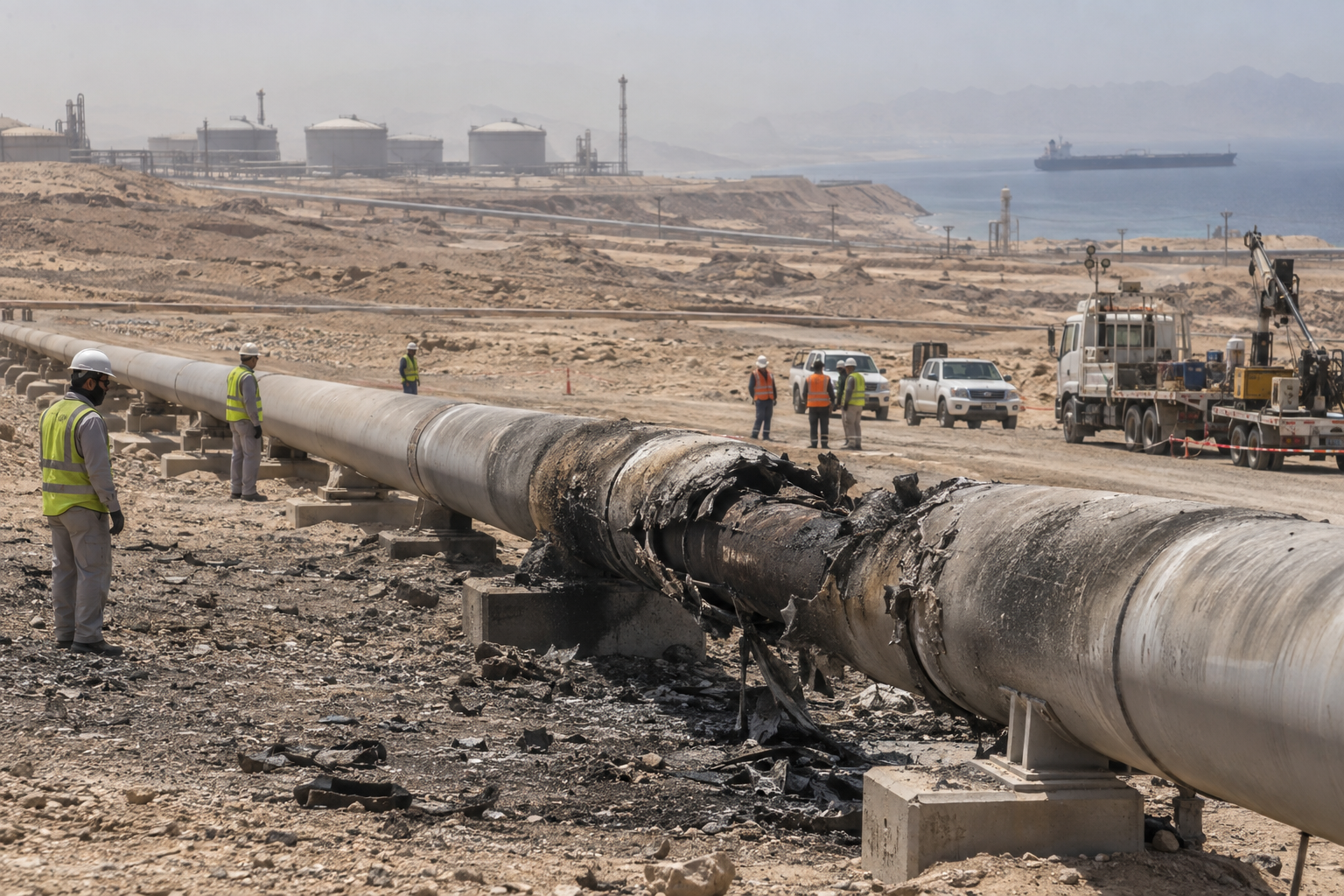
A drone attack on Saudi Arabia’s East-West oil pipeline, launched from Iraqi territory, has intensified pressure on Iraqi Prime Minister Ali al-Zaidi to demonstrate that armed factions operate under state authority. The strike threatened a major share of global oil supplies and pushed Brent crude above $108 per barrel, while also raising the prospect of renewed US and Saudi military action against Iraqi groups.
No organization has claimed responsibility. The Islamic Resistance in Iraq, an umbrella of pro-Iranian factions, denied involvement, while Iraqi authorities said they found launch traces in Maysan province and seized a drone-launch platform. Iraqi officials suspect a splinter faction, but analysts believe the attack may have been carried out by an established faction or a cell linked directly to Iran’s Islamic Revolutionary Guard Corps, using a front group to obscure responsibility.
Al-Zaidi responded by dismissing a regional commander, creating an investigative committee, closing border crossings with Iran and deploying troops. However, critics view these measures as largely symbolic, noting that similar attacks have occurred before and that enforcement against powerful factions has repeatedly failed. Attempts to search or arrest members of Harakat al-Nujaba were blocked or reversed, although a Kataib Hezbollah member was sentenced for kidnapping a US journalist.
The attacks also threaten Iraq’s improving relationship with Saudi Arabia, including potential investment, energy and transport projects. Some Iran-aligned factions oppose Baghdad’s outreach to Riyadh and efforts to diversify Iraq’s economy and reduce reliance on Iran.
The article argues that al-Zaidi’s central problem is not a lack of military capability but a lack of political confidence and reliable support from Washington and Gulf partners. Although Iraq’s Counter Terrorism Service may be capable of confronting faction leaders, officials fear that the US would not back the government in a major internal confrontation. As the US-led coalition prepares to withdraw, armed groups appear increasingly confident that they can resist state control without facing decisive consequences.
Entities: Ali al-Zaidi, Iraq, Saudi Arabia’s East-West oil pipeline, Maysan province and the Duwayrij River, Islamic Resistance in Iraq • Tone: analytical • Sentiment: negative • Intent: analyze
16-09-2026
The article reports that Saudi Arabia has cancelled some oil deliveries to Europe following drone attacks that shut down the East-West pipeline, a major export route carrying oil toward the Red Sea. The disruption represents a rare interruption to Saudi oil shipments and has reportedly triggered concern in global energy markets. According to the report, buyers are rushing to find alternative supplies after the pipeline blast affected the flow of Saudi crude.
The article presents the incident as a significant energy and geopolitical development because Saudi Arabia is a major oil producer and Europe relies on international markets to maintain fuel and industrial supplies. However, the brief report does not provide details about who carried out the drone attacks, the exact location of the blast, the extent of the pipeline damage, or how long the shutdown is expected to last. It also does not specify how much oil was cancelled, which European customers were affected, or what alternative producers buyers are approaching.
The report emphasizes the immediate market reaction, describing global panic and a rush for replacement supplies. Its focus is therefore on the disruption to oil deliveries and the potential implications for energy security rather than on a detailed account of the attack itself. The publication date is listed as 16 September 2026, and the report is presented by Al Jazeera under its conflict and news coverage.
Entities: Saudi Arabia, Europe, East-West pipeline, Red Sea, Drone attacks • Tone: urgent • Sentiment: negative • Intent: inform
16-09-2026
Saudi Arabia has not commented on reports that it cancelled or postponed crude-oil shipments to European refiners after a precautionary shutdown of its East-West pipeline following drone strikes last week. Energy-pricing agency Argus reported that at least three European refiners had cargoes scheduled for late September cancelled or delayed, in some cases until November, citing unnamed market sources. Saudi Aramco declined to comment when contacted by Euronews.
The Saudi energy ministry said technical teams were inspecting the pipeline, which transports crude from the kingdom’s eastern oilfields to the Red Sea port of Yanbu. The route allows Saudi exports to Europe to bypass the Strait of Hormuz, with tankers continuing north toward the Suez Canal. Existing inventories at export terminals may temporarily sustain deliveries, but the duration of that cushion depends on stock levels and how quickly pumping resumes. US Energy Secretary Chris Wright said the interruption would likely last only “days.”
The article also describes broader threats to regional shipping. Yemen’s Iran-backed Houthis reportedly seized control of the Bab el-Mandeb strait after taking the port of Mokha and nearby islands from Yemen’s Saudi-supported government. Although Europe-bound tankers from Yanbu do not directly use the strait, Bab el-Mandeb is a major Europe-Asia trade route. Qatar warned that losing access would intensify disruptions already affecting shipping through the Strait of Hormuz and called the consequences potentially “catastrophic for the entire world.”
A Saudi-led coalition also said it intercepted a Houthi drone south of Mecca, while the Houthis denied targeting the city. Saudi Crown Prince Mohammed bin Salman and Egyptian President Abdel Fattah el-Sisi discussed regional maritime security, with Egypt expressing support for Saudi measures and advocating a political settlement in Yemen. Overall, the article presents an uncertain but increasingly serious picture of oil-supply and shipping risks across the region.
Entities: Saudi Arabia and Riyadh, Saudi Aramco, East-West pipeline, European refiners and delayed crude deliveries, Drone strikes in the Riyadh and Medina regions • Tone: analytical • Sentiment: negative • Intent: inform
16-09-2026
Crude oil prices declined Wednesday after the Trump administration sought to reassure markets that Saudi Arabia’s damaged East-West oil pipeline would resume operations within days. U.S. West Texas Intermediate futures fell 1.6% to $104.09 per barrel, while Brent crude dropped 1.1% to $107.57. Despite the daily decline, oil prices have risen roughly 20% this month as fighting in the Persian Gulf has intensified.
U.S. Energy Secretary Chris Wright described the Saudi pipeline outage as a “brief and temporary interruption” and said the disruption would be measured in days. However, independent analysts disputed that optimistic assessment, citing satellite imagery that reportedly showed significant damage to a pumping station and suggesting that repairs could take weeks. Saudi Arabia has not released a formal damage assessment or a timeline for restoring the pipeline.
While the pipeline is offline, Saudi Arabia is increasing oil exports through the Strait of Hormuz with assistance from the U.S. military. Four supertankers capable of carrying approximately 8 million barrels were seen loading at the Saudi Persian Gulf ports of Ras Tanura and Juaymah. Matt Smith of Kpler said the vessels were likely preparing to shuttle oil through the Omani route and the Strait of Hormuz.
The pipeline was shut late the previous week after drone attacks launched from Iraq damaged it. It normally allows Saudi Arabia to redirect exports to the Red Sea, reducing reliance on Hormuz, which had been the Gulf states’ primary export corridor before the war. Although the U.S. military has established a protected route along Oman’s coast, exports remain well below pre-war levels, and the passage is still dangerous. Iran continues to attack tankers, with at least two vessels reportedly targeted in the Strait of Hormuz since Saturday.
Entities: Chris Wright, Saudi Arabia, Saudi East-West oil pipeline, Trump administration, U.S. Department of Energy • Tone: analytical • Sentiment: negative • Intent: inform