16-07-2026
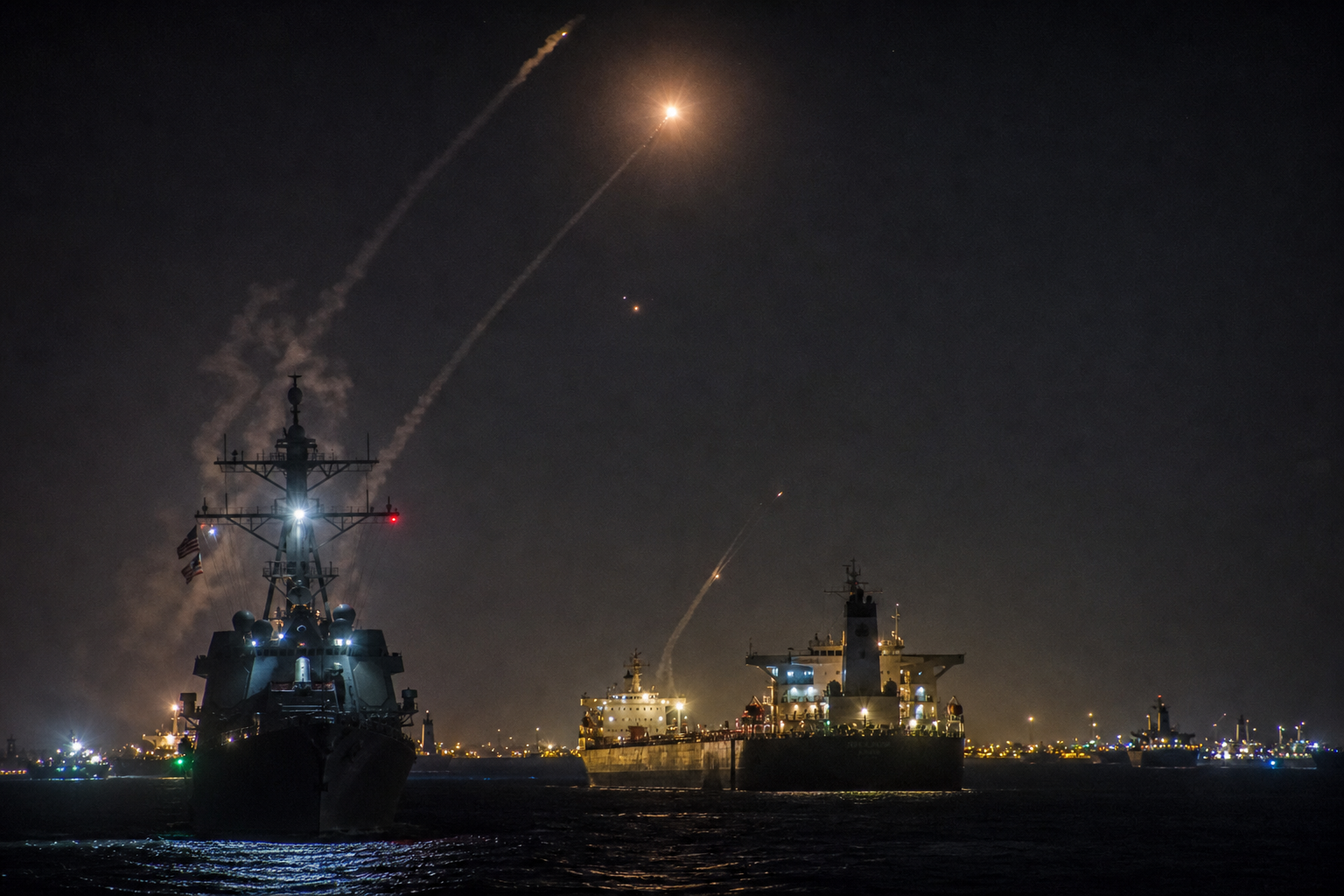
The article reports a sharp escalation in US-Iran tensions, with the United States launching fresh strikes against Iran on Wednesday while President Donald Trump warned Tehran it “better behave.” According to US Central Command, the latest attacks targeted Iranian military capabilities linked to threats against shipping in the Strait of Hormuz, as well as command centers, air defenses, missile and drone capabilities, and coastal surveillance facilities. Iran said it retaliated by striking US military targets in the region, including in Bahrain and Kuwait, and by targeting US army communication and storage facilities in Jordan with drones, though Jordanian officials said the drones were intercepted without casualties or damage. The violence marked a fifth day of renewed hostilities and threatened to derail a preliminary deal intended to end the war.
The dispute centers on the Strait of Hormuz, a vital global shipping route through which oil and commercial vessels pass. The US had renewed a blockade on Iranian ports, prompting warnings from Iran’s Revolutionary Guard Corps that other oil and gas export routes serving US and allied interests could be targeted. The article also notes that Trump threatened further attacks on Iranian infrastructure if Tehran did not return to talks, while Iran’s top negotiator said there was “no reason” to abide by the deal if it did not benefit Iran. Amid the conflict, Trump highlighted what he framed as a goodwill gesture: Iran’s release of an American detainee, Dena Karari, who had allegedly been wrongfully detained and was reportedly on her way back to the United States. The article places the confrontation in the context of rising oil prices, stalled tanker traffic, and broader strategic concerns over the Strait of Hormuz’s role in the global economy.
Entities: Donald Trump, Iran, United States, Strait of Hormuz, US Central Command (Centcom) • Tone: urgent • Sentiment: negative • Intent: inform
16-07-2026
The article explains why the United States has found it extremely difficult to gain full control over the Strait of Hormuz amid escalating tensions with Iran. President Trump has attempted a range of measures — airstrikes, naval blockades, threats, and negotiations — to force Iran to reopen the key shipping lane, which carries roughly 20% of the world’s oil. But military and regional-security experts say that fully securing the strait would likely require far more U.S. warships than are currently available, and possibly tens of thousands of troops on Iranian territory to eliminate hidden missile, drone, and mine threats.
The piece argues that Iran’s long-standing preparation for asymmetric warfare makes it especially hard to defeat from the air alone. Its forces are dispersed, its weapons components are spread across many facilities, and its commanders can act without waiting for centralized approval, making them difficult to target. Experts say the U.S. Navy could escort civilian shipping, as it did in the 1980s, but that approach would be expensive, open-ended, and risky because Iran now has more advanced drones, missiles, and coastal defenses.
Even without launching attacks, Iran can disrupt commerce simply by threatening ships over marine radio or by forcing vessels onto alternative routes. The article frames the situation as a “test of wills” that affects not only military strategy but also oil prices, global shipping, and domestic U.S. politics, especially as rising fuel costs could create political fallout for Trump and Republicans heading into the midterms.
Entities: Strait of Hormuz, Iran, United States, President Trump, U.S. Navy • Tone: analytical • Sentiment: negative • Intent: analyze
16-07-2026
The article reports on President Trump’s proposal to impose a 20% fee on cargo ships transiting the Strait of Hormuz, a major global oil and gas shipping route, and the swift backlash from shipping experts, logistics companies, and international legal bodies. Industry analysts said the fee could have cost large vessels tens of millions of dollars per voyage and argued there is no legal basis for charging vessels for transit through an international strait. Experts warned that such a move would set a dangerous precedent, potentially encouraging other states to levy similar tolls on maritime chokepoints and undermining international maritime law.
Trump initially said the fee would reimburse the United States for security costs in the waterway, which he described as being under American protection, and linked it to blockade measures against Iranian ports and vessels. Oil markets reacted sharply, with Brent crude rising on fears of higher shipping costs and disruptions to supply chains. However, later the same day, Trump abruptly reversed course and said he would replace the fee with trade and investment deals from Gulf states, without providing details.
The article contrasts Trump’s stance with statements from U.S. and international officials who said international waterways cannot be subject to tolls or politically conditioned payments. It also notes the ongoing conflict involving Iran, attacks on ships in the region, and efforts by Gulf producers to reroute oil and gas shipments away from the strait. Despite the uncertainty, the article frames the fee idea as legally dubious, economically disruptive, and geopolitically risky.
Entities: Donald Trump, Marco Rubio, Abbas Araghchi, Amena Bakr, Petras Katinas • Tone: analytical • Sentiment: negative • Intent: inform
16-07-2026
The article is a CNN live updates piece tracking the escalating US-Iran conflict on July 16, 2026. It reports that the US military carried out another day of strikes against Iranian targets, including a 90-minute attack on Greater Tunb Island and an action disabling an empty oil tanker bound for Kharg Island, an important Iranian oil hub. The stated goal of the US operations is to degrade Iran’s ability to threaten shipping in the Strait of Hormuz, while President Donald Trump is reportedly considering expanding the military campaign. In response, Iran launched retaliatory strikes and claimed to have targeted US military assets in Jordan, Bahrain, and Kuwait, though CNN notes those claims could not be independently verified. Jordan said its defenses intercepted eight Iranian missiles, and regional air defenses were activated amid drone and missile threats. The article also describes the broader humanitarian and political fallout inside Iran, including reports of patients being evacuated from a cancer hospital in Ahvaz after a projectile landed nearby and concerns that the Iranian government is intensifying repression and executions under wartime cover. It further notes satellite imagery showing damage in Kuwait and highlights the impact on commercial traffic and oil markets as the naval blockade of Iranian ports continues to reduce ship traffic through the Strait of Hormuz.
Entities: United States, Iran, Donald Trump, CNN, US Central Command (CENTCOM) • Tone: urgent • Sentiment: negative • Intent: inform
16-07-2026
The article argues that President Trump risks drawing the United States into another open-ended conflict with Iran, one that could resemble America’s post-9/11 “forever wars.” Although Trump campaigned on ending wars and avoiding Middle East entanglements, the article says the Iran conflict has already become a cycle of military strikes, failed diplomacy, and widening strategic complications. The war has not produced Trump’s stated goals of regime change or the elimination of Iran’s nuclear program, and instead has created a more dangerous situation centered on the Strait of Hormuz, which Iran can use to inflict economic pain and sustain leverage.
The article places the current conflict in a broader historical context, comparing Trump’s approach to the U.S. experiences in Vietnam, Iraq, and Afghanistan, where quick military victories gave way to prolonged struggles with no clear political settlement. It quotes experts who warn that powerful leaders often fall into the “short-war fallacy,” believing military force can achieve fast results without long-term consequences. The piece emphasizes that Trump is especially constrained because he appears unwilling to commit ground troops, relying instead on air and sea power against a state adversary with significant regional leverage.
The article also presents the view that the U.S.-Iran conflict may be part of a much longer historical struggle dating back to 1979, while also overlapping with the broader Israel-Iran confrontation. It concludes that there is no clear diplomatic exit, and that without a sustainable settlement, the current pattern of sporadic escalation could harden into a new “forever war.”
Entities: Donald Trump, Iran, Israel, Strait of Hormuz, International Crisis Group • Tone: analytical • Sentiment: negative • Intent: analyze