15-10-2026
The article describes an escalation in Yemen’s war and its spillover into Saudi Arabia. Yemeni government forces said they intercepted a drone headed for Medina and a missile aimed at Riyadh, while the Houthis claimed attacks on Aramco facilities in Dhahran, Riyadh airport, and a refinery. Saudi officials confirmed a limited fire at an Aramco building but reported no casualties there. The Saudi-led coalition has responded with strikes on Sanaa, the Houthi-controlled capital, as a ceasefire agreed in 2022 has collapsed in recent months. The article characterizes the exchanges as tit-for-tat attacks, with the Houthis seeking to impose costs on Saudi Arabia through disruption to airports, energy infrastructure, and shipping.
Recent attacks have reportedly killed 14 people and injured more than 300 at Riyadh’s King Khalid International Airport, while strikes at Abha airport killed two. Riyadh airport is expected to remain closed at least through Saturday, disrupting flights and threatening major events, including an investment conference and a tennis tournament. The article also notes Saudi Arabia’s reliance on Red Sea shipping after Iran closed the Strait of Hormuz, and its preparations to host the 2034 FIFA World Cup.
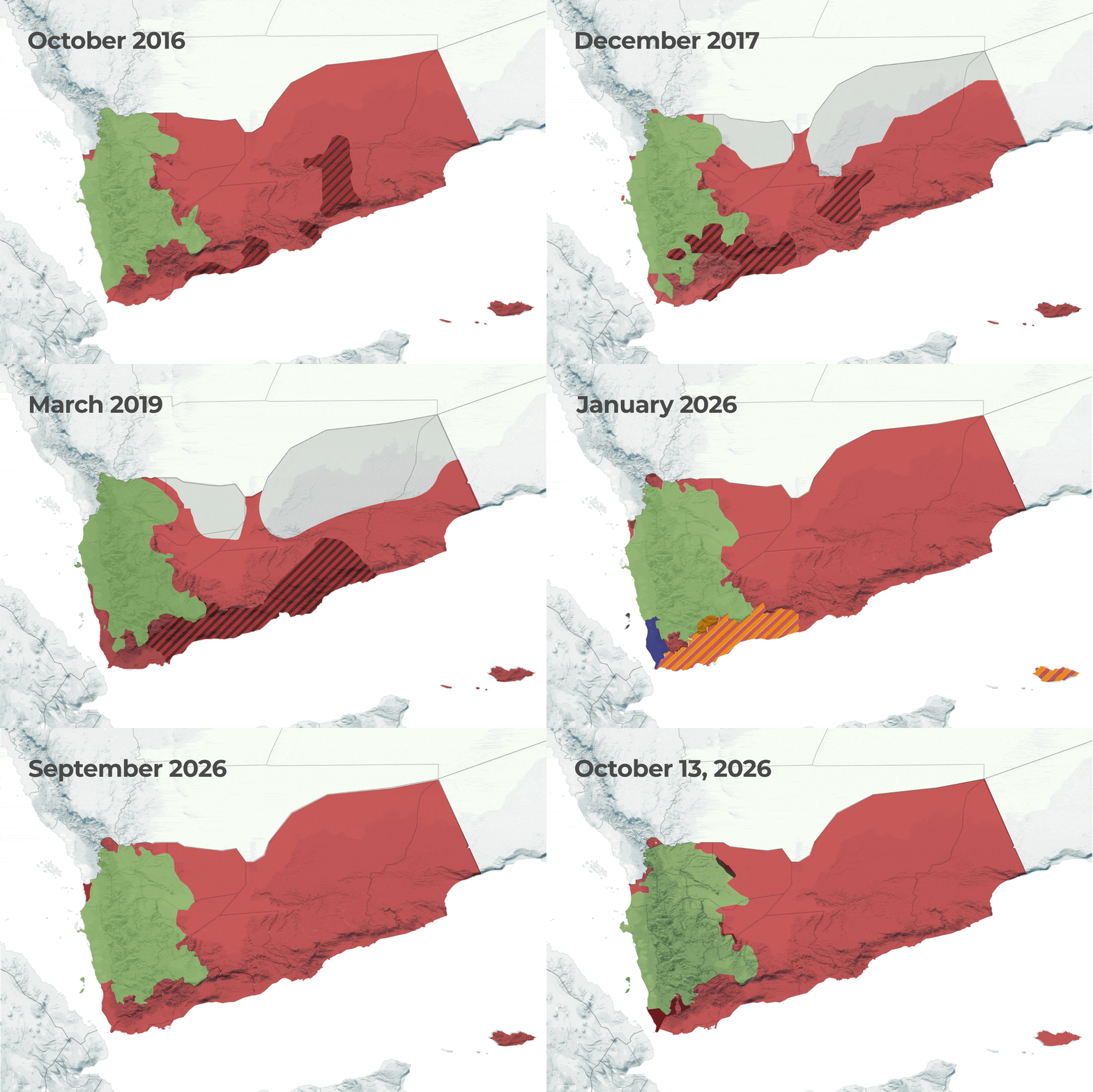
On the ground, Yemeni government forces are conducting “Dawn of Yemen,” a counteroffensive to retake coastal areas near the strategically important Bab al-Mandeb strait. Government forces report thousands of operations and say they have regained some locations in Taiz governorate, though control of contested positions remains fluid. The mountainous terrain gives the conflict strategic significance for access to Taiz city and the Red Sea coast. The fighting and Houthi siege have caused civilian casualties and severe shortages in Taiz; the World Food Programme says wheat flour stocks are nearly exhausted, while the Red Cross reports exceptionally high numbers of weapon-wounded patients at frontline hospitals.
Entities: Yemen, Saudi Arabia, Houthi movement (Ansar Allah), Saudi-led coalition, Yemeni government forces • Tone: analytical • Sentiment: negative • Intent: inform
15-10-2026
A Houthi missile and drone attack struck the area around Maashiq presidential palace in Aden, Yemen’s interim capital, killing five people and wounding 16, according to the country’s health minister. The palace is used by Yemen’s internationally recognised government and by forces of the Saudi-led coalition supporting it. Witnesses reported at least six explosions, while officials said some blasts occurred near the palace hill and its security gate. The government said the Houthis carried out the attack; the Iran-backed rebels claimed responsibility and said they had targeted a military operations headquarters where Saudi forces were present. Government leaders living in Aden were reported safe.
The attack comes amid renewed escalation between the Houthis and Saudi Arabia, adding strain to efforts to end the wider Iran war. Saudi Arabia has reported intercepting missiles and drones, including a cruise missile over Medina and drones in other parts of the kingdom. The Houthis’ military spokesperson denied involvement in the Medina incident, and the Saudi-led coalition did not identify who was responsible. The broader conflict has disrupted regional aviation, with flights cancelled or delayed at Jeddah airport and airlines warned about the risk of using Saudi airspace. The article says the escalation has also unsettled global markets because Saudi Arabia is a major oil exporter.
The report also describes the worsening humanitarian situation inside Yemen. Fighting has revived the country’s devastating civil war after four years of relative calm, with Taiz among the areas of greatest concern. The Houthi-besieged city faces shortages of basic goods, soaring prices, and empty or unusable gas stations. The World Food Programme says it can no longer reach more than 600,000 people in Taiz who rely on aid. A resident described being unable to find flour, cooking gas, or fuel, while the International Committee of the Red Cross said Taiz has experienced some of Yemen’s highest casualty burdens.
Entities: Aden, Maashiq presidential palace, Yemen, Houthi rebels, Saudi Arabia • Tone: neutral • Sentiment: negative • Intent: inform
15-10-2026
France 24 reports that several major sporting events in Saudi Arabia have been cancelled or postponed following repeated deadly attacks attributed to Iran-backed Houthi rebels. The attacks have targeted the Kingdom’s airports and other infrastructure, prompting disruption to the country’s sports calendar. The report is presented as a video interview: France 24’s Mark Owen speaks with Guy Barton, a Visiting Fellow at Lancaster University and co-creator and co-host of The FootPol Podcast. The supplied article text does not identify the specific sporting events affected, give details about the timing or scale of the cancellations, or include Barton’s comments or analysis. It also does not provide further information about the attacks beyond their repeated and deadly nature and the targets named. Consequently, the article’s available text establishes a connection between the security situation and changes to major sporting events, but offers little detail on the decisions, the events involved, or the broader consequences. The page includes related headlines about regional security, aviation disruptions, and Yemen, but those are separate stories rather than additional reporting in this article. This summary is therefore limited to the information visible in the provided article text.
Entities: Saudi Arabia, Houthi rebels, Iran, Yemen, Mark Owen • Tone: neutral • Sentiment: negative • Intent: inform
15-10-2026
The article says Houthi attacks on Saudi Arabia are intended not only to advance the movement’s demands in Yemen but also to help Iran pressure the United States to ease its blockade on Iran. By striking Saudi infrastructure and disrupting prominent investment and oil events, the Houthis are exploiting the kingdom’s dependence on stability, investor confidence and economic transformation. Analysts describe Saudi Arabia as a vulnerable pressure point in a wider confrontation spanning the Strait of Hormuz and the Red Sea’s Bab el-Mandeb chokepoint.
The Houthis have their own goals, including an end to Saudi military operations and restrictions on Yemeni ports and airports, restored salary payments, compensation for war damage, and an end to Riyadh’s support for Yemen’s recognised government. Meeting these terms could consolidate Houthi control over much of Yemen. Saudi Arabia, meanwhile, faces a dilemma: escalation could derail Crown Prince Mohammed bin Salman’s economic agenda, while concessions could strengthen the Houthis. The attacks have reportedly struck Riyadh’s airport and Saudi Aramco, and disrupted a major oil conference and the Future Investment Initiative.
The article traces the conflict to Saudi Arabia’s 2015 intervention in Yemen and notes the 2022 ceasefire, as well as the failure of a 2023 Saudi-backed peace roadmap. Riyadh is described as increasingly inclined toward military action, while Washington has shown little appetite for another sustained campaign against the Houthis. Analysts warn that drones and missiles could turn the conflict into a war of attrition: Saudi Arabia has more valuable infrastructure at risk, whereas the Houthis may believe time and geography favor them. One analyst warns that a renewed war could be bloodier than the conflict that began in 2015 and could threaten the wider Gulf, particularly without unity between Saudi Arabia and the United Arab Emirates.
Entities: Houthis, Iran, Saudi Arabia, Mohammed bin Salman, Donald Trump • Tone: analytical • Sentiment: negative • Intent: analyze
15-10-2026
Yemen’s Houthi movement has advanced its ability to produce sophisticated ballistic missiles locally, using specialist components imported from China, according to a report by Conflict Armament Research (CAR). The report examined parts seized from a shipment bound for the Houthi-held port of Hodeida. The components included custom-machined parts associated with the Iranian Kheibar Shekan missile series, such as airframe elements and equipment for a solid-propellant rocket motor and hypersonic flight.
The Houthis’ Palestine-2 variant is reported to have a range of about 1,800 kilometres and to manoeuvre at up to 6,000 kilometres per hour during its terminal stage. That capability could make it harder to intercept and place much of the Middle East within range. The article says the missile was allegedly used in a recent attack on King Khalid Airport in Riyadh that killed 13 people. Houthi attacks have increased over the past month, with the group seeking to pressure Saudi Arabia to end its blockade of the rebels.
CAR’s findings suggest the Houthis are moving beyond simply reassembling Iranian systems and broadening supply chains beyond Iran-linked networks. UN reporting cited in the article identifies Chinese companies as the largest source of seized goods destined for the Houthis, and says missile components have been imported from China for at least two years. The shipments described in the report arrived in Yemen in four containers in June and October 2025. China says it adheres to the UN arms ban on the Houthis.
Experts caution that the group has not mastered the Kheibar Shekan technology and cannot yet manufacture missiles at scale. Dr Nawaf Obaid of King’s College London says Iranian expertise is accelerating Houthi progress, but that production volume remains a constraint. He also says Saudi Arabia intercepts 85 to 90 per cent of missiles and that the airport strike likely exploited a gap between air-defence layers rather than demonstrating a new technological breakthrough. The article also reports that Saudi Arabia’s ambassador in London welcomed British support and discussed regional security and cooperation.
Entities: Yemen, Houthis, Saudi Arabia, China, Iran • Tone: analytical • Sentiment: negative • Intent: analyze
15-10-2026
Saudi Arabia’s Saudi-led coalition said it intercepted and destroyed a cruise missile in the Medina region on Thursday. Coalition spokesperson Major General Turki al-Maliki announced the interception on X, but provided no further details about who launched the missile or what its intended target was. The Houthis, a Yemen-based group fighting the coalition, denied carrying out an attack on Saudi territory. Spokesperson Yahya Saree said the group had conducted no operation aimed at Saudi Arabia that day and called the Saudi account of a missile targeting Medina a “great and immense falsehood.”
The report places the claim and denial amid an escalating exchange of airstrikes between Houthi forces and coalition forces, with both sides targeting airport infrastructure. Citing Turkey’s Anadolu news agency, it adds that the coalition said it had intercepted and destroyed a drone over Saudi Arabia’s Eastern Province earlier on Thursday. The article also recalls previous Saudi accusations that the Houthis had targeted Mecca and Medina, Islam’s sacred cities, while noting that the Houthis had said those regions were exempt from their strikes and that other air infrastructure remained targets.
On Wednesday, the coalition said it destroyed a Houthi ballistic missile launched toward Riyadh, Saudi Arabia’s capital. The article concludes with background on the conflict: Saudi Arabia has led a military coalition supporting Yemen’s government against the Houthis since 2015, while the Houthis have controlled the capital, Sanaa, and several provinces since 2014. The report presents the rival claims without independently establishing responsibility for the missile incident.
Entities: Saudi Arabia, Medina, Yemen, Houthis, Saudi-led coalition • Tone: analytical • Sentiment: neutral • Intent: inform
15-10-2026
The supplied page identifies a live Middle East news update published by The National on October 15, 2026. Its headline reports that Saudi Arabia intercepted a Houthi drone in the kingdom’s eastern region. The provided material does not include the article’s full report: it gives no further details about when or where the drone was intercepted, whether it caused damage or injuries, or which Saudi authority reported the incident. As a result, those details cannot be confirmed from the text supplied.
The page also displays headlines for other coverage, including a report that a container ship sank after a strike in the Strait of Hormuz, footage of the destruction of an Iran-affiliated dhow, and an earlier Houthi ballistic missile interception in Riyadh that reportedly injured one person with shrapnel. Other teasers refer to economic risks raised by the International Monetary Fund, regional de-escalation, attacks in Riyadh, and developments involving Iran and the United States. These are separate headlines and videos on the page, not details substantiating the eastern-region drone interception.
Most of the remaining supplied text consists of website navigation, sharing and printing controls, video labels, and subscription or notification prompts. The available report is therefore too brief to establish the circumstances or broader implications of the interception. This analysis is limited to the headline and page text provided; it does not infer missing facts or treat the surrounding teaser headlines as part of the article’s account.
Entities: Saudi Arabia, Houthi movement, eastern region of Saudi Arabia, Houthi drone interception, Riyadh • Tone: neutral • Sentiment: neutral • Intent: inform
15-10-2026
UAE leaders have sent condolences to Saudi Arabia’s King Salman bin Abdulaziz after Houthi attacks on airports in the kingdom caused deaths and injuries. President Sheikh Mohamed bin Zayed Al Nahyan expressed sympathy for those killed and wished the injured a speedy recovery. Similar messages were sent by Sheikh Mohammed bin Rashid Al Maktoum, Vice President and Ruler of Dubai; Sheikh Mansour bin Zayed Al Nahyan, Vice President, Deputy Prime Minister and Chairman of the Presidential Court; and Sheikh Dr Sultan bin Muhammad Al Qasimi, Ruler of Sharjah.
The article reports that King Khalid International Airport in Riyadh has been closed since a Saturday attack killed 13 people and injured more than 300, described as the deadliest attack on Saudi Arabia in more than a decade. A further strike on Sunday killed one person and injured nearly a dozen others. Houthi forces have also targeted airports in Abha, Jazan and Najran, and a projectile damaged the airport serving Dammam.
The attacks have disrupted air travel across the region, including services from the UAE. Emirates, flydubai and Air Arabia cancelled some flights to Saudi destinations. Etihad Airways suspended flights between Abu Dhabi and Riyadh until October 18. The article thus covers both the UAE leadership’s expressions of sympathy and the human and transport consequences of the airport strikes.
Entities: Sheikh Mohamed bin Zayed Al Nahyan, King Salman bin Abdulaziz, Sheikh Mohammed bin Rashid Al Maktoum, Sheikh Mansour bin Zayed Al Nahyan, Sheikh Dr Sultan bin Muhammad Al Qasimi • Tone: neutral • Sentiment: negative • Intent: inform
15-10-2026
The 2027 Asian Cup in Saudi Arabia may be postponed until 2028 because of escalating attacks by Yemen’s Houthi movement, although the Asian Football Confederation (AFC) says the tournament remains on schedule for now. AFC President Sheikh Salman bin Ebrahim Al Khalifa said organisers could wait until the end of November before deciding, explaining that conditions in the region could change quickly. If necessary, the tournament can be moved back a year, but officials are not rushing to make that decision.
The competition is scheduled to begin on January 7, 2027, with matches in Jeddah, Riyadh and al-Khobar. Saudi Arabia has recently faced sustained attacks, including a missile fired toward Riyadh that the country’s Civil Defence said it intercepted. An Asian Champions League match involving Cristiano Ronaldo’s Al-Nassr was delayed by an hour after the incident, and three Saudi domestic football matches were postponed during the week.
Security concerns have affected other sporting events and prompted statements from participating countries and player representatives. The Six Kings Slam tennis exhibition, which was expected to feature Novak Djokovic, Carlos Alcaraz and Alexander Zverev, was postponed until late December. Australia, one of the 24 nations due to compete in the Asian Cup, said it was closely monitoring the situation. South Korea’s professional footballers’ association expressed serious concern about the safety of players, and its president, Lee Keun-ho, stressed that the lives and safety of players and fans must take precedence over a tournament.
Entities: Asian Cup, Asian Football Confederation (AFC), Sheikh Salman bin Ebrahim Al Khalifa, Saudi Arabia, Yemen’s Houthis • Tone: analytical • Sentiment: negative • Intent: inform