13-04-2026
Oil prices have surged back above $100 per barrel following the collapse of peace talks between the United States and Iran. Global benchmark Brent crude rose by 7.3% to $102.30, while West Texas Intermediate climbed 8.7% to $104.94. The price spike is a direct reaction to President Donald Trump's announcement that the U.S. will implement a blockade of Iranian ports starting Monday, following the failure of negotiations held in Pakistan.
The conflict centers on the Strait of Hormuz, a critical maritime chokepoint through which approximately one-fifth of the world's energy shipments pass. While a brief conditional ceasefire had previously lowered prices by reopening the waterway, the current escalation threatens to deepen the global energy crisis. U.S. Central Command (Centcom) clarified that the blockade targets vessels entering or leaving Iranian ports specifically, rather than all traffic in the Strait. However, Iran's Islamic Revolutionary Guard Corps (IRGC) has responded with threats, stating that any military vessels approaching the strait will be dealt with severely.
Financial markets have reacted negatively to the news, with major Asian stock indexes, including Japan's Nikkei 225 and South Korea's Kospi, slipping due to their heavy reliance on Middle Eastern oil. Analysts suggest that oil prices may rise even further if the conflict escalates, noting that current prices may actually be suppressed by lingering trader hopes for a diplomatic resolution. The situation remains volatile as the world watches to see if the blockade is fully implemented and if diplomacy can be resumed.
Entities: Donald Trump, Mohammad Bagher Ghalibaf, USA, Iran, Strait of Hormuz • Tone: urgent • Sentiment: negative • Intent: inform
13-04-2026
Following the failure of a diplomatic mission led by Vice-President JD Vance in Islamabad, President Donald Trump has announced a naval blockade of Iran. The decision, communicated via Truth Social, aims to prevent ships from paying 'illegal tolls' and to pressure Iran into abandoning its nuclear ambitions and relinquishing control of the Strait of Hormuz. While the US military Central Command clarified that the blockade targets all ships traveling to and from Iranian ports, the move has sparked significant debate and concern regarding its efficacy and potential risks.
Critics, including Senator Mark Warner, question how a blockade will compel Iran to open the strait, while supporters like Congressman Mike Turner argue it forces allies and adversaries to the negotiating table. The strategy carries substantial risks, including the potential for increased oil prices, the risk of naval clashes, and the diplomatic challenge of dealing with nations like China that rely on Iranian oil.
Domestically, Trump faces a precarious situation. A CBS poll indicates that 59% of Americans believe the war is going poorly, and the upcoming midterm elections make the economic stakes of this 'gamble' particularly high. The article contrasts the high-stakes geopolitical tension with the 'bizarre spectacle' of Trump attending UFC matches in Miami while discussing strategy with Secretary of State Marco Rubio. Ultimately, the conflict has evolved into a test of endurance between Iran's ability to withstand attacks and Trump's tolerance for the resulting political and economic instability.
Entities: Donald Trump, JD Vance, Marco Rubio, Iran, United States • Tone: analytical • Sentiment: negative • Intent: inform
13-04-2026
The United States military has announced the enforcement of a naval blockade targeting all maritime traffic entering or exiting Iranian ports, effective Monday. This move follows the collapse of direct talks in Pakistan between US President Donald Trump and Iranian representatives, with Trump citing Iran's refusal to abandon its nuclear ambitions as the primary cause for the failure. While the blockade specifically targets Iranian ports and coastal areas, the US Central Command (Centcom) stated that vessels transiting to and from non-Iranian ports will not be impeded.
President Trump has framed the operation as a means to stop Iran from charging 'illegal tolls' for passage through the Strait of Hormuz and to force the removal of naval mines. While Trump suggested that NATO and the UK would assist in 'cleaning out' the strait with minesweepers, the UK government has clarified that it will not participate in the blockade itself, though it supports the freedom of navigation.
Legal experts have raised concerns that such a blockade could violate international maritime law and potentially breach existing ceasefire agreements. Strategically, the US aims to strip Iran of its leverage over global oil prices and revenue. However, shipping experts like Lars Jensen suggest the immediate impact may be minimal, as traffic through the strait has already plummeted from an average of 138 ships per day to fewer than 20 since the conflict began on February 28. The move is widely viewed by analysts as a pressure tactic to force Iran into a diplomatic agreement on American terms.
Entities: Donald Trump, Keir Starmer, Iran, United States, Strait of Hormuz • Tone: urgent • Sentiment: negative • Intent: inform
13-04-2026
In this interview from 'Face the Nation,' Margaret Brennan challenges Republican Representative Mike Turner regarding the U.S. government's handling of a conflict with Iran. The discussion centers on the tension between the strategic goal of preventing Iran from acquiring nuclear weapons and the domestic fallout resulting from rising gas prices and a perceived lack of a clear presidential strategy. Brennan cites polling indicating that a majority of Americans disapprove of the war and believe the President lacks a coherent plan, specifically pointing to contradictory statements made by the President regarding the Strait of Hormuz—ranging from promising to ensure the free flow of energy to threatening power plants and eventually announcing a naval blockade.
Rep. Turner defends the administration, arguing that no conflict polls well and that the existential threat of a nuclear-armed Iran outweighs short-term economic concerns like inflation. He emphasizes that the breakdown of recent negotiations occurred because Iran refused to renounce its nuclear ambitions. Turner asserts that the threat is immediate, citing reports from the IAEA that Iran was weeks away from having enough material for a bomb. When questioned about the lack of congressional oversight and public hearings since the start of the war, Turner maintains that classified briefings have occurred and that the core issue of nuclear proliferation has been debated for decades. The interview highlights a sharp divide between the administration's stated security imperatives and the public's frustration with the execution and transparency of the military strategy.
Entities: Mike Turner, Margaret Brennan, Iran, United States, Europe • Tone: positive • Sentiment: negative • Intent: critique
13-04-2026
President Trump has announced that the United States Navy will immediately begin blockading the Strait of Hormuz and intercepting any vessels that have paid tolls to Iran. This decision follows the collapse of face-to-face peace talks in Islamabad, Pakistan, led by Vice President JD Vance. While Trump claimed that most points of the negotiation were agreed upon, he stated that the critical issue of Iran's nuclear program remained unresolved, leading to the breakdown of the discussions.
Trump's directive includes the destruction of Iranian mines in the strait and a warning that any Iranian forces firing upon U.S. or peaceful vessels will be met with severe force. The move is a response to what Trump describes as an 'illegal act of extortion,' referring to the Islamic Revolutionary Guard Corps' (IRGC) de facto toll system, where ships are required to pay fees (some in Chinese yuan) and follow escorted corridors for safe passage.
Despite Trump's claims that the United Kingdom and other nations are assisting with mine sweepers and the blockade, the U.K. government has explicitly denied involvement in a blockade. Instead, a U.K. spokesperson emphasized a commitment to 'freedom of navigation' and revealed that the U.K. is leading a coalition of over 40 nations, including NATO members, to ensure the strait remains open to support the global economy. The situation marks a significant escalation in tensions following a brief two-week ceasefire.
Entities: Donald Trump, JD Vance, Iran, United States Navy, United Kingdom • Tone: urgent • Sentiment: negative • Intent: inform
13-04-2026
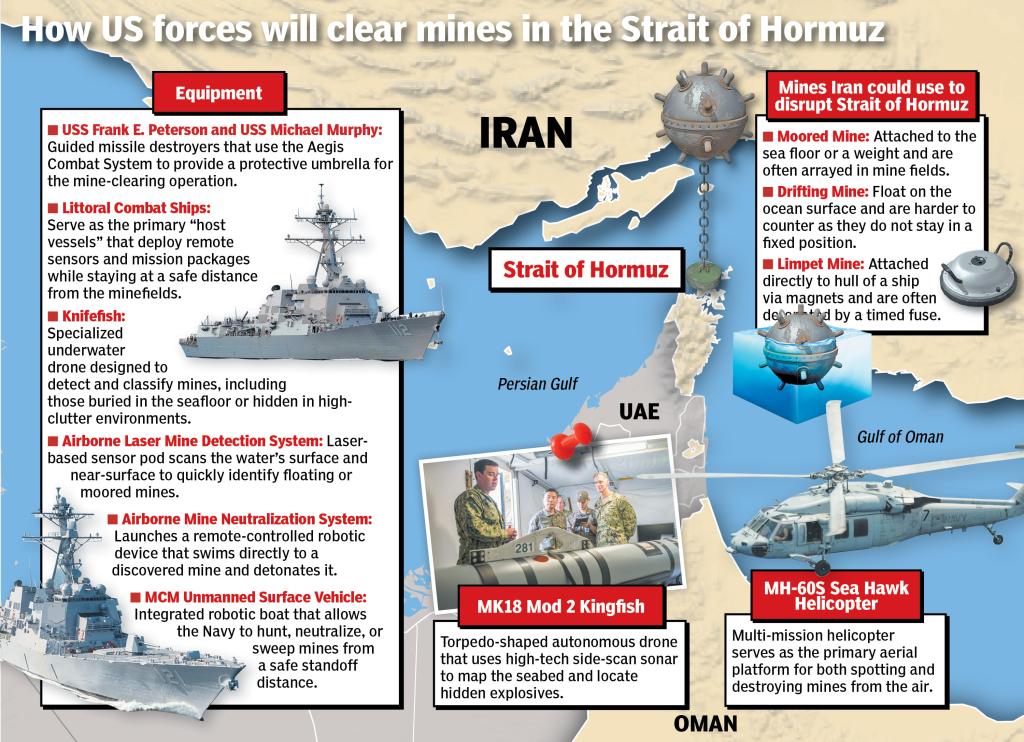
Two U.S. Navy destroyers have entered the Strait of Hormuz to begin mine-clearing operations in a critical waterway that handles approximately 20% of the world's oil supply. U.S. Central Command (CENTCOM) indicated that additional forces, including underwater drones, will support the effort. President Trump claimed that the U.S. is performing a global service by clearing the mines and asserted that Iran's mine-laying ships have been destroyed, though he acknowledged some mines remain in the water.
In response, Iran's Revolutionary Guards (IRGC) issued a stern warning, stating they would deal 'severely' with any military vessels attempting to transit the strait, asserting that passage would only be granted to civilian vessels under specific conditions. This military tension coincides with a significant diplomatic effort; Vice President JD Vance traveled to Islamabad for the first face-to-face talks between the U.S. and Iran since 1979. Despite a 21-hour marathon negotiation session involving Pakistan, Vance announced that no deal was reached as Iran rejected U.S. terms.
Intelligence assessments suggest that Iran deployed at least a dozen mines, including the Maham 3 and Maham 7 models, alongside drones and missiles to block the strait. While a two-week ceasefire established last Tuesday has allowed some maritime traffic to resume, analysts from the Eurasia Group warn that global oil supplies will remain disrupted for months. The recovery process will be hindered by the need to repair damaged energy infrastructure and the time required for shipping companies to resume operations.
Entities: U.S. Navy, Strait of Hormuz, CENTCOM, Donald Trump, Iran • Tone: urgent • Sentiment: negative • Intent: inform
13-04-2026
Asia-Pacific markets experienced a widespread decline on Monday as geopolitical tensions escalated between the United States and Iran. The downturn was triggered by the collapse of diplomatic negotiations in Islamabad, which failed to reach an agreement to end the ongoing conflict in the Middle East. This diplomatic failure has reignited fears of a prolonged war, leading investors to brace for increased economic strain globally.
A primary driver of the market volatility is the surge in energy costs. Following the failed talks, crude oil prices spiked, with West Texas Intermediate rising 7.5% to $103.78 per barrel and Brent crude gaining nearly 7% to exceed $101 per barrel. This price jump is attributed to reports that Washington is preparing a naval blockade of Iranian port traffic. Furthermore, reports indicate that President Donald Trump is considering the resumption of airstrikes on Iran, despite a brief two-week ceasefire previously established to ensure maritime passage through the strait.
The impact was felt across major Asian indices: Japan's Nikkei 225 and Topix both declined, South Korea's Kospi fell 0.86%, and Hong Kong's Hang Seng index dropped 1.22%. India's Nifty 50 and BSE Sensex also saw significant losses. The instability extended to U.S. markets, with Dow Jones, S&P 500, and Nasdaq 100 futures all trading lower overnight. The overall market sentiment reflects deep concern over the intersection of military escalation and global energy security.
Entities: United States, Iran, Islamabad, Donald Trump, Nikkei 225 • Tone: urgent • Sentiment: negative • Intent: inform
13-04-2026
President Donald Trump has ordered a 'complete blockade' of the Strait of Hormuz, effective Monday at 10 a.m. ET, following the collapse of marathon peace talks between the U.S. and Iran. The negotiations, hosted by Pakistan and involving U.S. representative JD Vance, ended in a stalemate primarily due to Iran's refusal to abandon its pursuit of nuclear weapons. This escalation has triggered immediate global economic volatility: oil prices (Brent and WTI) surged by over 8%, Asian markets declined, and U.S. stock futures tumbled. Domestically, the economic strain of the ongoing conflict is reflected in a record low for American consumer confidence in April.
Beyond the Middle East crisis, the article reports a significant political shift in Europe, where Hungary's long-time nationalist leader Viktor Orban has conceded election defeat to the opposition Tisza party. Additionally, the report highlights the decline of Europe's pharmaceutical industry. The sector is currently being squeezed by a combination of China's biotech growth and President Trump's aggressive trade and drug-pricing policies, specifically the 'most-favored-nation' pricing model. This has led to decreased competitiveness and a trend of pharmaceutical companies shifting investments away from the European continent.
Entities: Donald Trump, JD Vance, Viktor Orban, Strait of Hormuz, Iran • Tone: urgent • Sentiment: negative • Intent: inform
13-04-2026
The CNBC Daily Open report details a volatile start to the trading week driven by geopolitical tensions and significant political shifts. U.S. President Donald Trump has announced a naval blockade of the Strait of Hormuz following the failure of 21-hour peace negotiations with Iran in Pakistan. This move has caused a sharp spike in global oil prices, with U.S. crude and Brent benchmarks both jumping over 8% to exceed $100 per barrel. Consequently, Asian markets have declined, and U.S. and European futures are trending lower.
On the diplomatic front, President Trump has engaged in a public dispute with Pope Leo XIV. Using Truth Social, Trump criticized the Pope for opposing the U.S. war in Iran, claiming the Pope's appointment was a strategic move by the Church to appease the Trump administration.
In Europe, a major political shift has occurred in Hungary, where the opposition Tisza party achieved a landslide victory, ending 16 years of rule by Viktor Orbán and his Fidesz party. This result is seen as a victory for pro-EU sentiment and a setback for Orbán's allies in Russia and the U.S. White House.
Finally, the report notes that Goldman Sachs is preparing to release its first-quarter earnings. While the bank is expected to benefit from increased trading activity related to AI disruption and a general rebound in investment banking, analysts are closely monitoring how the ongoing conflict with Iran, which began in late February, will impact the firm's financial performance.
Entities: Donald Trump, Pope Leo XIV, Viktor Orbán, Peter Magyar, Ursula von der Leyen • Tone: urgent • Sentiment: negative • Intent: inform
13-04-2026
The global financial markets have shown a surprisingly muted reaction to President Donald Trump's announcement of a blockade on the Strait of Hormuz. While the move has triggered the expected surge in crude oil prices, rising bond yields, and a stronger U.S. dollar, equity markets have remained relatively stable. Analysts suggest that investors now view such geopolitical shocks as negotiation tactics rather than long-term catalysts, indicating that the market has reached a state of 'peak uncertainty' and is less reactive to headlines than in previous weeks.
Despite the restrained equity response, the blockade poses significant risks. The Strait of Hormuz is critical to one-fifth of global oil flows; consequently, U.S. crude oil futures have jumped over 55% since the start of the conflict, with May delivery prices exceeding $104 per barrel. This surge has reignited global inflation concerns and complicated expectations for interest rate cuts, pushing 10-year Treasury yields significantly higher.
Market experts remain divided on the immediate future but generally optimistic about a recovery. Some analysts predict oil will eventually retreat to $80 per barrel once a negotiated resolution between the U.S. and Iran is reached. Meanwhile, gold prices have fluctuated unpredictably, partly due to emerging-market central banks selling bullion to stabilize their own currencies. Overall, the prevailing market sentiment is one of cautious waiting, with investors positioned defensively but hopeful for a rally as the administration seeks ways to de-escalate the conflict.
Entities: Donald Trump, Strait of Hormuz, Iran, Global X ETFs, Ten Cap • Tone: analytical • Sentiment: neutral • Intent: inform
13-04-2026
Following the failure of peace talks in Islamabad, Pakistan, President Donald Trump has ordered a US military blockade of the Strait of Hormuz to pressure Iran into capitulating to US demands. The administration's goals include the total cessation of uranium enrichment, the dismantling of nuclear facilities, and the termination of funding for regional proxies such as Hamas, Hezbollah, and the Houthis. Trump aims to strangle Iran's economy and prevent Tehran from generating revenue by charging safe passage fees for oil tankers.
However, the move carries significant global economic risks. Oil prices have already spiked, with Brent crude rising to $104 per barrel, exacerbating inflation and increasing costs for American consumers already struggling with high food and housing prices. While US Central Command specifies that the blockade targets traffic to and from Iranian ports rather than general transit, the strategy remains controversial. Critics, including Senator Mark Warner, question the logic of the blockade, while others warn it could lead to diplomatic clashes with major powers like China or alienate European and Japanese allies dependent on Gulf oil.
The situation represents a strategic deadlock. Despite six weeks of war and significant damage to Iran's military infrastructure, Tehran refuses to cede its leverage over the strait or its nuclear ambitions. Trump now faces a choice between this high-risk economic blockade, a return to intensive bombing campaigns that could harm civilians, or a withdrawal that would leave Iran in control of a vital global choke point.
Entities: Donald Trump, Iran, Strait of Hormuz, United States, JD Vance • Tone: analytical • Sentiment: negative • Intent: inform
13-04-2026
The U.S. military reported the destruction of two boats suspected of smuggling drugs in the eastern Pacific Ocean on Saturday, resulting in five deaths and one survivor. This action is part of a broader campaign by the Trump administration to target 'narcoterrorists' in Latin America, a strategy President Trump justifies as a necessary escalation to combat the drug crisis and fatal overdoses in the United States. Since the start of this campaign in early September, at least 168 people have been killed in similar boat strikes.
However, the operation faces significant criticism. U.S. Southern Command has provided little to no evidence that the targeted vessels were actually transporting drugs. Furthermore, critics argue that these maritime strikes are ineffective because the majority of fentanyl—the primary driver of overdose deaths—is trafficked overland from Mexico using chemicals sourced from China and India.
Simultaneously, the U.S. is escalating tensions in the Middle East. Following the collapse of ceasefire talks with Iran in Pakistan, President Trump announced that the U.S. Navy will implement a blockade of Iranian ports and the Strait of Hormuz. This move is intended to weaken Iran's leverage and ensure the reopening of a waterway critical to 20% of global oil supplies. The article highlights a dual-front military approach by the administration, targeting both Latin American cartels and Iranian interests.
Entities: Donald Trump, U.S. military, U.S. Southern Command, U.S. Coast Guard, U.S. Central Command • Tone: analytical • Sentiment: negative • Intent: inform
13-04-2026
In this opinion piece, Miranda Devine argues that President Trump's aggressive strategy toward Iran, termed 'Operation Economic Epic Fury,' is a masterstroke of psychological and economic warfare. The centerpiece of this strategy is a naval blockade of the Strait of Hormuz, designed to cut off Iran's primary revenue stream—oil exports to China—after Russia and China vetoed a UN resolution to reopen the strait. Devine posits that this 'all in, all out' approach forces Iran into a position of economic desperation, effectively flipping the leverage in favor of the United States.
Beyond the blockade, Devine highlights the strategic use of Vice President JD Vance in failed negotiations in Islamabad. She suggests that sending a perceived 'peacenik' to the talks served to demonstrate the administration's unified resolve and exposed Iran's delusions regarding their bargaining power, specifically their refusal to abandon nuclear ambitions. The author defends Trump's high-risk tolerance and unorthodox communication style, arguing that there is a 'method to his madness' and that he is the first president unafraid to confront the Iranian regime.
Devine dismisses Democratic criticism and concerns over rising gas prices, asserting that national security and the prevention of a nuclear-armed Iran outweigh short-term economic fluctuations. She portrays Trump as a 'protector' who combines gut instinct with the advice of smart Cabinet members to achieve strategic dominance without necessarily firing a shot, though he remains ready to use force if provoked.
Entities: Donald Trump, Iran, Strait of Hormuz, JD Vance, China • Tone: emotional • Sentiment: positive • Intent: persuade
13-04-2026
The New York Post Editorial Board argues that President Donald Trump has strategically outmaneuvered Iran by implementing a counter-blockade of the Strait of Hormuz. This move follows the failure of peace talks in Pakistan, where Iranian negotiators refused to meet American demands, betting that threatening the Strait would force the U.S. to concede. Instead, Trump has mirrored Iran's tactics, blocking Iranian oil exports and planning to escort ships through the waterway to ensure freedom of navigation.
The editorial posits that this 'outside the box' strategy effectively neutralizes Iran's primary leverage. The authors claim that Iran lacks the offensive capabilities to mount a serious counter-attack and that any attempt to mine the Strait would be self-defeating, as it would choke off Iran's own remaining exports. Furthermore, the piece suggests that the U.S. could potentially seize Kharg Island to further dismantle the regime's power base.
According to the board, the economic burden of this blockade will fall primarily on Iran and its allies, specifically China and Russia, who recently vetoed a UN Security Council measure to reopen the Strait. The editorial concludes that by defying conventional diplomatic wisdom and refusing to 'blink,' Trump has placed the Iranian hardliners under immense internal and external pressure, ensuring they pay a higher price for their refusal to reach a peaceful settlement.
Entities: Donald Trump, Iran, Strait of Hormuz, Pakistan, Kharg Island • Tone: emotional • Sentiment: positive • Intent: persuade
13-04-2026
President Trump has announced a planned US blockade of the Strait of Hormuz, scheduled to take effect at 10 a.m. EDT on Monday. Speaking at Joint Base Andrews, Trump asserted that Iran is in 'very bad shape,' claiming their navy has been effectively destroyed with 150 ships lost. He expressed indifference toward whether the Iranian regime returns to the negotiating table, vowing that the blockade will be highly effective in preventing Iran from selling oil. US Central Command (CENTCOM) clarified that the blockade will target all maritime traffic entering and exiting Iranian ports impartially, while maintaining freedom of navigation for vessels traveling to and from non-Iranian ports.
International reactions are mixed. While the UK is providing minesweepers to help clear the waterway, the British government has explicitly stated it is not participating in the blockade, emphasizing the need to protect the global economy and freedom of navigation. The UK is reportedly working with France to build a coalition to ensure the Strait remains open and free of tolling.
Iran has responded with strong condemnation. The Islamic Revolutionary Guard Corps (IRGC) Navy warned that US military vessels approaching the Strait would violate the current fragile cease-fire and face a 'strong and forceful response.' Senior adviser Mohsen Rezaee and navy commander Shahram Irani dismissed the blockade as 'ridiculous' and 'doomed to failure,' labeling the US as the aggressor. Additionally, reports suggest the Trump administration is considering restarting limited military strikes if peace talks continue to fail, although a full-scale bombing campaign is currently deemed less likely.
Entities: Donald Trump, Iran, Strait of Hormuz, US Central Command (CENTCOM), United Kingdom • Tone: positive • Sentiment: neutral • Intent: inform
13-04-2026
The United States military has announced a blockade of all Iranian ports effective April 13, 2026, following the collapse of high-level peace negotiations in Islamabad. The breakdown in talks, led by US Vice-President J.D. Vance and an Iranian delegation, was primarily driven by Iran's refusal to abandon its nuclear ambitions and the US's demand for the full reopening of the strategic Strait of Hormuz. While President Donald Trump initially suggested a total blockade of the strait, the US Central Command clarified that the operation will specifically target vessels entering or departing Iranian ports, allowing non-Iranian transit to continue.
This escalation follows a fragile two-week ceasefire and a regional war that began in late February after US and Israeli strikes on Iran. The blockade has immediate global economic implications, with oil prices jumping approximately 8% to over $100 a barrel. Iran has reacted with defiance, with officials calling the threat 'ridiculous' and warning that the Revolutionary Guards maintain control over the waterway.
Beyond the maritime blockade, the situation remains volatile due to ongoing conflicts in Lebanon involving Hezbollah and Israel. President Trump has further intensified the pressure by threatening Iran's energy infrastructure and warning of 50% tariffs on Chinese imports should Beijing provide military aid to Tehran. Experts warn that this move is not merely a coercive signal but could represent an effective resumption of full-scale war.
Entities: Donald Trump, J.D. Vance, Mohammad Bagher Ghalibaf, Strait of Hormuz, Iran • Tone: urgent • Sentiment: negative • Intent: inform