12-04-2026
U.S. Central Command (CENTCOM) has deployed two naval destroyers to the Strait of Hormuz to begin mine-clearing operations in the critical waterway. This effort, which will soon include underwater drones, follows claims by President Trump that the U.S. is performing a global service by removing Iranian-manufactured mines, such as the Maham 3 and Maham 7. Trump asserted that Iran's mine-laying ships have been destroyed, though he acknowledged some mines remain in the water.
In response, Iran's Revolutionary Guards (IRGC) issued a stern warning, stating they would deal 'severely' with any military vessels attempting to transit the strait, asserting that passage would only be granted to civilian vessels under specific conditions. This military tension coincides with a historic diplomatic effort; Vice President JD Vance traveled to Islamabad for the first face-to-face talks between the U.S. and Iran since 1979. However, after a 21-hour negotiation session, Vance announced that no deal was reached as Iran rejected U.S. terms.
The conflict has had a severe impact on global energy markets, as approximately 20% of the world's oil supply passes through the strait. While a two-week ceasefire established last Tuesday has allowed some maritime traffic to resume, analysts from the Eurasia Group warn that global oil supplies will remain disrupted for several months. The recovery process will be hindered by the need to repair damaged energy infrastructure and the time required for shipping companies to resume operations.
Entities: U.S. Central Command (CENTCOM), Strait of Hormuz, Donald Trump, Iran Revolutionary Guards (IRGC), JD Vance • Tone: urgent • Sentiment: negative • Intent: inform
12-04-2026
The provided text is a fragment of a lead editorial from The Economist dated April 9th, 2026. The article posits that Donald Trump has emerged as the 'biggest loser' in the context of a conflict involving Iran, suggesting that his strategic goals or political standing have been severely damaged by the war. The piece highlights a critical failure in diplomacy, noting that Vice-President J.D. Vance announced the collapse of 21 hours of negotiations between the United States and Iran on April 12th. The broader context provided by the surrounding headlines suggests a systemic crisis: the war has heightened the risk of NATO fracturing, caused lasting economic damage to global energy markets (specifically regarding the Strait of Hormuz), and created a geopolitical vacuum that China is attempting to exploit. The editorial argues that the conflict has not only failed to achieve American objectives but has left the U.S. in a precarious position, necessitating a shift in how Europe views its own defense and how the world views the stability of the current U.S. administration's foreign policy.
Entities: Donald Trump, J.D. Vance, Iran, United States, NATO • Tone: analytical • Sentiment: negative • Intent: critique
12-04-2026
This news compilation from CNN focuses primarily on the escalating geopolitical tensions involving the United States, Iran, and China. The central report details the failure of 21 hours of peace talks held in Islamabad between the US and Iran, which were unable to broker a deal. This diplomatic failure is set against a backdrop of broader conflict, including a US-Israel war in Iran and a recent ceasefire that has allowed limited shipping traffic to resume through the critical Strait of Hormuz.
Adding to the volatility, President Donald Trump has issued warnings to China regarding reports that Beijing may be preparing to deliver new air defense systems to Iran. Simultaneously, North Korean leader Kim Jong Un has reaffirmed his support for China's territorial integrity regarding Taiwan, strategically timing this message ahead of a planned meeting between President Trump and Chinese leader Xi Jinping.
Beyond the Middle East and East Asia, the report touches on religious and international events: Pope Leo XIV has condemned the use of religious justification for the US-Israel war in Iran, and Orthodox Christians in Jerusalem have celebrated the traditional Holy Fire. Additionally, the report covers the final stages of Hungary's parliamentary elections between Viktor Orbán and Péter Magyar, and a criminal investigation in the Bahamas regarding the disappearance of Lynette Hooker.
Entities: United States, Iran, China, Islamabad, Donald Trump • Tone: urgent • Sentiment: negative • Intent: inform
12-04-2026
High-level diplomatic talks between the United States and Iran in Islamabad have ended without a deal, dealing a significant blow to hopes of resolving the ongoing crisis in the Middle East. These discussions, led by US Vice President JD Vance, represented the highest level of engagement between the two nations since the 1979 Islamic Revolution. Despite the exchange of technical papers and marathon sessions, the delegations remained deadlocked due to fundamental differences in negotiation styles and core demands.
The primary point of contention remains Iran's nuclear program. While Tehran maintains that its uranium enrichment is for peaceful power generation, the US demands a 'cast-iron commitment' that Iran will not develop nuclear weapons. This tension was exacerbated by a previous 12-day conflict between Iran and Israel. The US approach, characterized by a desire for a quick resolution following a two-week ceasefire, clashed with Iran's traditionally slow, long-term negotiating strategy. Vice President Vance indicated that the US has presented its 'best and final' offer, placing the burden of future progress on Tehran.
The failure of these talks leaves the region in a precarious state. The ceasefire was originally established under the shadow of extreme threats from President Donald Trump, who had previously threatened to destroy Iranian infrastructure. With diplomacy stalled, the international community now faces uncertainty regarding Iran's next move and the continued instability of the global economy.
Entities: JD Vance, Donald Trump, United States, Iran, Israel • Tone: analytical • Sentiment: positive • Intent: inform
12-04-2026
High-level peace talks between the United States and Iran, mediated by Pakistan in Islamabad, have concluded without an agreement. US Vice President JD Vance and an Iranian delegation led by Parliament Speaker Mohammad Bagher Ghalibaf engaged in marathon negotiations lasting over 21 hours. The primary sticking point was Iran's refusal to commit to forgoing the development of a nuclear weapon. While the US presented what it termed its 'best and final' offer, Iranian officials cited a 'gap in viewpoints' on two or three key issues.
The failure of these talks—the highest-level diplomatic engagement between the two nations since 1979—casts significant doubt on the stability of the current ceasefire and raises concerns regarding the reopening of the Strait of Hormuz. Simultaneously, the regional conflict continues to escalate; Israeli airstrikes in southern Lebanon have resulted in casualties, including a strike on a family home in Maaroub. The IDF also reported destroying a rocket launcher in Joya to prevent attacks on Israel.
Despite the lack of a deal, Pakistan's Foreign Minister Ishaq Dar affirmed that Islamabad will continue its role as a mediator. While Iranian state media suggests there are no immediate plans for further talks, the Iranian foreign ministry maintained that 'diplomacy never comes to an end.' The situation remains tense, with the US indicating that the burden of changing positions now rests with Tehran.
Entities: JD Vance, Mohammad Bagher Ghalibaf, Ishaq Dar, Asim Munir, Shehbaz Sharif • Tone: urgent • Sentiment: negative • Intent: inform
12-04-2026
Vice President JD Vance announced that marathon negotiations between the United States and Iran in Islamabad, Pakistan, have failed to produce a peace agreement to end a six-week conflict in the Middle East. After 21 hours of grueling talks, the primary obstacle remained Iran's refusal to provide an 'affirmative commitment' to abandon its nuclear weapons ambitions and enrichment programs. The U.S. administration, led by President Trump, focused on two main priorities: crushing Iran's nuclear capabilities and reopening the Strait of Hormuz to ensure the free flow of global oil.
Conversely, the Iranian delegation, led by Parliamentary Speaker Mohammad Baqer Qalibaf and Foreign Minister Abbas Araqchi, demanded total sovereignty over the Strait of Hormuz, the right to enrich uranium, no limits on ballistic missiles, and reparations for war damages. In a statement posted to X, Iran accused the U.S. and Israel of 'heinous crimes' and 'breaches of promise,' asserting that they would continue to pursue their national interests through all available tools, including diplomacy.
The failure of these talks—the first direct meeting between the two nations in over a decade—leaves the future of the current two-week ceasefire in jeopardy. Experts, including Andrea Stricker from the Foundation for Defending Democracy, suggest that the ceasefire is likely to collapse because the Iranian regime's ideology is intrinsically tied to its nuclear pathway. While the U.S. team has left a 'final and best offer' on the table, it remains unclear if fighting will resume immediately.
Entities: JD Vance, Donald Trump, Marco Rubio, Mohammad Baqer Qalibaf, Abbas Araqchi • Tone: urgent • Sentiment: negative • Intent: inform
12-04-2026
After 21 hours of intensive negotiations in Islamabad, Pakistan, the United States and Iran have failed to reach a diplomatic agreement. US Vice-President J.D. Vance announced the outcome during a press conference, noting that while substantive discussions took place, a final deal remained elusive. The primary point of contention is the US's demand for a 'fundamental commitment of will' from Tehran regarding the cessation of its nuclear weapons development. Vance characterized the US position as their 'last and best offer,' suggesting that the burden of acceptance now lies with the Iranian government. While the US views the failure as a setback for both nations, Iranian representatives have pushed back, citing 'excessive' demands from Washington and stating that they are in 'no hurry' to sign an agreement. The talks occurred against a backdrop of high geopolitical tension, though Vance declined to comment on whether the failure of these negotiations would lead to a resumption of military conflict between the two powers.
Entities: J.D. Vance, United States, Iran, Islamabad, Pakistan • Tone: urgent • Sentiment: negative • Intent: inform
12-04-2026
US President Donald Trump has expressed indifference toward the potential outcome of ongoing diplomatic negotiations between the United States and Iran taking place in Islamabad, Pakistan. Speaking to reporters on April 11, Trump asserted that the US has already achieved a military victory over Iran, rendering the success or failure of a formal deal irrelevant to him. While Vice-President J.D. Vance leads the US delegation in Pakistan, the talks are reportedly centered on contentious issues such as Iran's uranium stockpiles and control over the Strait of Hormuz.
Simultaneously, President Trump confirmed that US Navy warships have entered the Strait of Hormuz to conduct minesweeping operations to clear Iranian mines. This action follows a February 28 attack launched by the US and Israel, which prompted Iran to exert control over the waterway to disrupt global oil supplies. Iran has denied the US claims regarding the presence of mines. Furthermore, Trump used the occasion to criticize NATO allies, claiming they provided no assistance during the conflict and were not consulted prior to the February military action. He framed the US effort to clear the strait as a service to other nations that he characterized as 'afraid or weak or cheap,' emphasizing a position of American strength and unilateralism.
Entities: Donald Trump, J.D. Vance, Iran, United States, Pakistan • Tone: positive • Sentiment: neutral • Intent: inform
12-04-2026
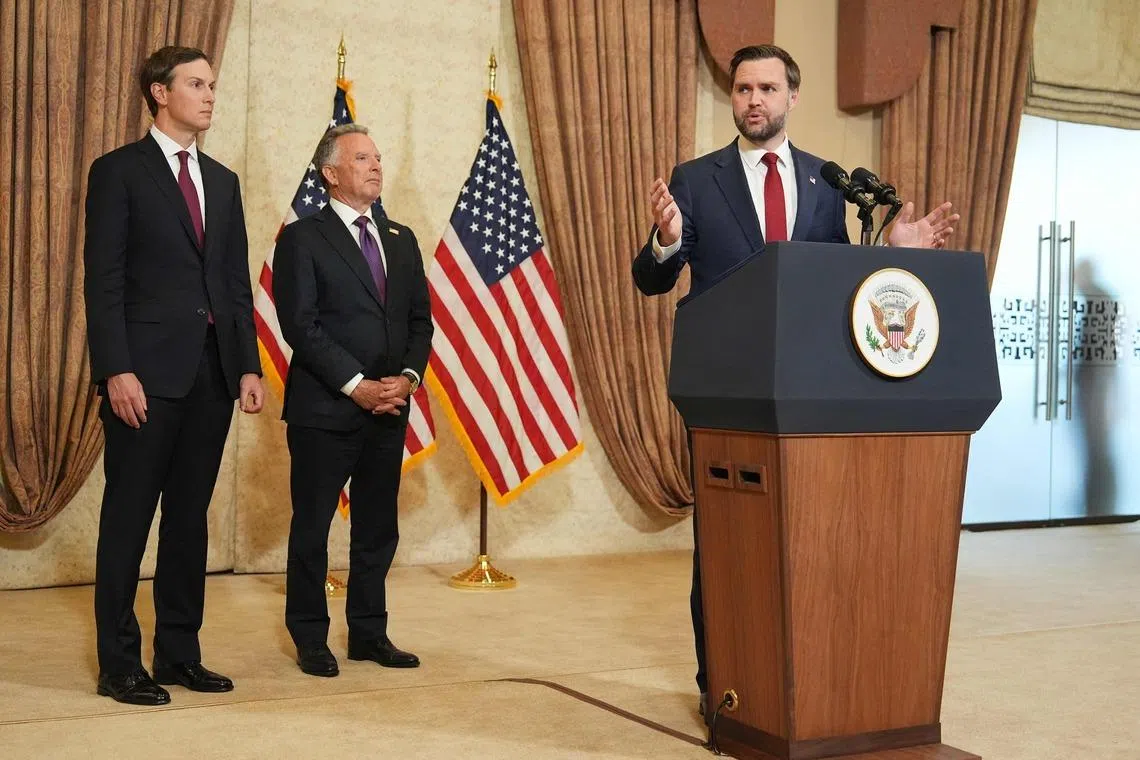
High-level peace talks between the United States and Iran, held in Islamabad, Pakistan, concluded on April 12, 2026, without reaching an agreement to end a six-week war. The negotiations, led by US Vice-President J.D. Vance and featuring key figures like Jared Kushner and Steve Witkoff, represented the first direct meeting between the two nations in over a decade. Despite a fragile two-week ceasefire established on April 7, the 21-hour session ended in a stalemate, with both sides blaming the other for the failure.
The primary sticking points centered on Iran's nuclear program and the control of the Strait of Hormuz, a critical global energy chokepoint. The US demanded an affirmative commitment from Iran to abandon the pursuit of nuclear weapons and the tools required to build them. Conversely, Iran sought the release of frozen assets in foreign banks, war reparations, and a comprehensive regional ceasefire that includes the cessation of Israeli bombing of Hezbollah in Lebanon. Iran also demanded the right to collect transit fees in the Strait of Hormuz.
While US President Donald Trump indicated that a deal was not strictly necessary because he believes the US has already 'won,' the lack of agreement jeopardizes the current ceasefire. Despite the diplomatic failure, some shipping activity has resumed, with three supertankers successfully exiting the Gulf. The talks were characterized by an atmosphere of mistrust and significant security lockdowns in Islamabad, highlighting the volatility of the conflict which has already caused thousands of deaths and spiked global oil prices.
Entities: J.D. Vance, Donald Trump, Jared Kushner, Steve Witkoff, Mohammad Baqer Qalibaf • Tone: neutral • Sentiment: negative • Intent: inform