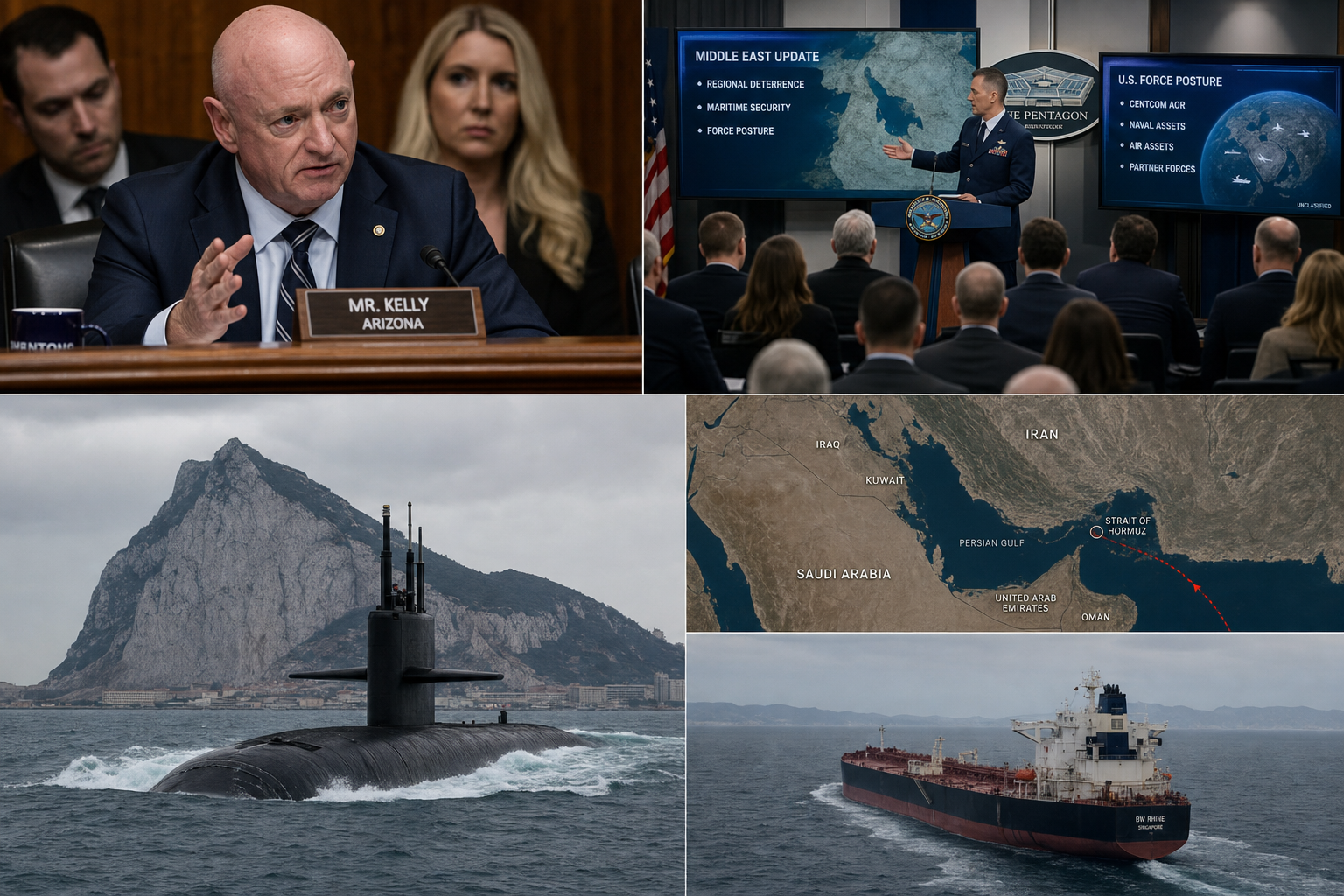
Sen. Mark Kelly in a U.S. Senate hearing room alongside Pentagon briefing visuals and a strategic map of the Middle East, a Navy Ohio-class submarine emerging in Gibraltar under a gray sea sky, and an insured tanker moving through the Strait of Hormuz, documentary photojournalism, realistic newsroom reportage, shot on 35mm and 85mm lenses with crisp natural light and subdued monitor glow, conveying tension, deterrence, and high-stakes strategic decision-making
Summary
Across these articles, the central theme is how escalating tensions with Iran are reshaping U.S. national security policy, military posture, and foreign-policy tools. Sen. Mark Kelly warns that the Iran conflict has drained critical American munitions, weakened readiness for future wars, and exposed the lack of a coherent strategy, while also criticizing oversized defense spending proposals and urging stronger, more targeted pressure on adversaries such as Russia. In parallel, the Pentagon’s unusual public disclosure of a Navy nuclear ballistic missile submarine in Gibraltar is presented as a deliberate signal of U.S. deterrence and readiness amid Trump’s hardline rejection of Iran’s peace offer and the threat of renewed military action. A third development shows the Trump administration broadening its approach beyond military force by using the U.S. International Development Finance Corporation as a geopolitical instrument to insure tankers, reduce risk in conflict zones, and extend American influence through state-backed finance. Together, the stories portray a U.S. foreign policy environment defined by brinkmanship with Iran, concern over depleted defense resources, and an expanding mix of military and financial tools to project power abroad.
Key Points
- Sen. Mark Kelly says the Iran war has depleted U.S. missile and interceptor stocks, leaving America less prepared for a conflict with China or other adversaries.
- Kelly criticizes the administration’s lack of strategic clarity, opposes a $1.5 trillion defense budget and the Golden Dome concept, and pushes stronger sanctions on Russia and China-linked actors.
- The Pentagon’s rare disclosure of a nuclear-capable Ohio-class submarine in Gibraltar is framed as a signal of U.S. deterrence and NATO commitment during rising U.S.-Iran tensions.
- Trump’s rejection of Iran’s peace offer and warnings of possible renewed military action underscore the continuing brinkmanship.
- The Trump administration is also using the DFC as a financial foreign-policy tool, including insurance for tankers in the Strait of Hormuz and a larger push to project U.S. influence through capital rather than force alone.