09-06-2026
This CNN Politics video item focuses on House Speaker Mike Johnson being questioned by CNN’s Manu Raju about President Donald Trump’s unsubstantiated claims that the Los Angeles mayoral primary was “rigged” in Democrats’ favor. The article frames the exchange around the lack of evidence supporting Trump’s allegation and highlights the political tension surrounding the race. At the center of the story is the outcome of the LA mayoral primary itself: CNN’s Decision Desk projected that Nithya Raman would advance to the November election after overtaking Republican Spencer Pratt for second place, setting up a runoff against incumbent Karen Bass. The piece underscores the mismatch between Trump’s claim of election manipulation and the reported vote results. It also reflects how national Republican figures are being pressed to respond to or defend Trump’s broader narrative about election integrity, even in a local municipal race. The content is presented largely as a short video news item, with the key focus on the question of evidence and the projected election outcome, rather than on an extended explanation or analysis of the race.
Entities: Mike Johnson, Manu Raju, Donald Trump, Los Angeles, LA mayoral primary • Tone: analytical • Sentiment: neutral • Intent: inform
09-06-2026
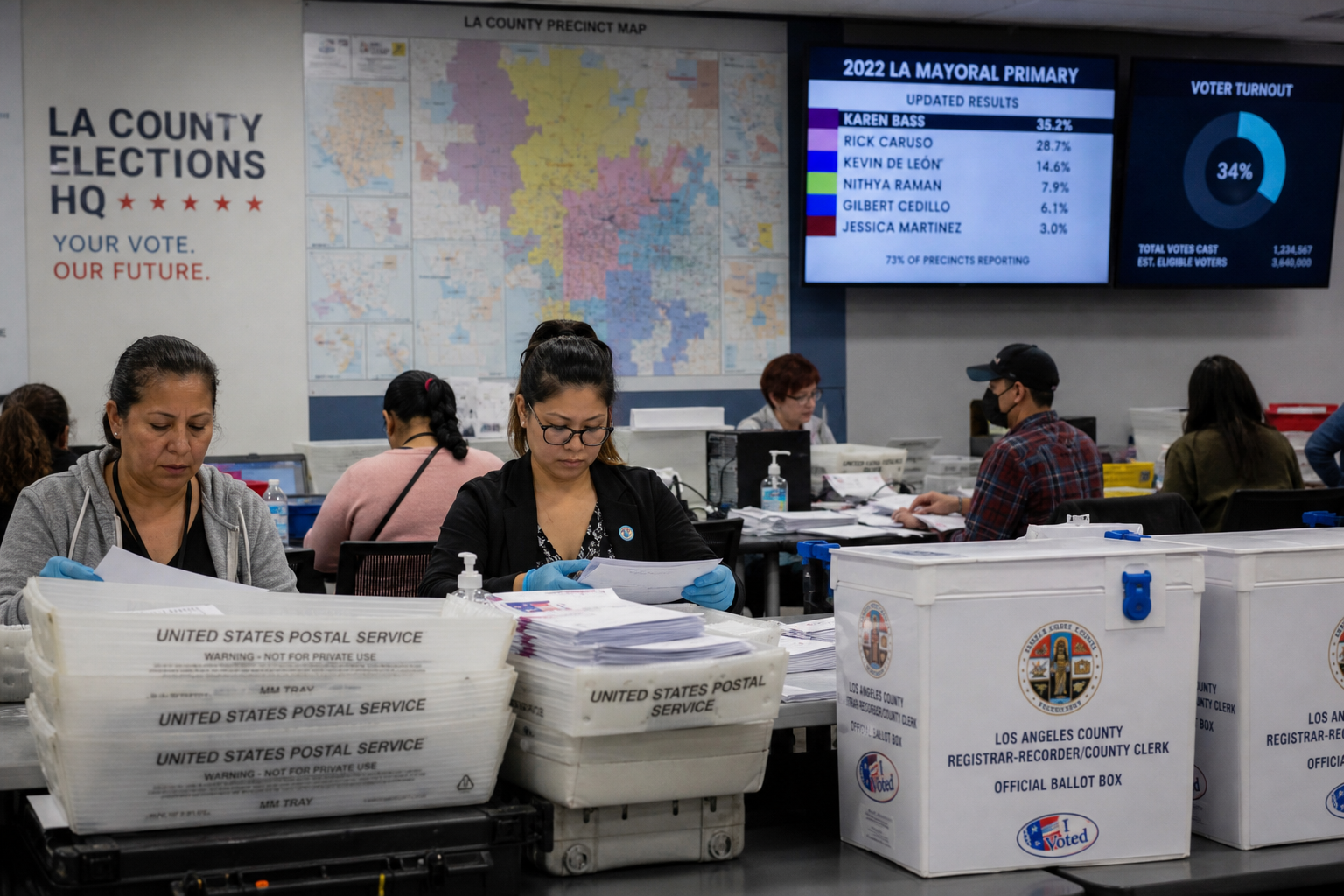
Los Angeles City Councilmember Nithya Raman is projected by CNN’s Decision Desk to advance to the November mayoral election, overtaking former reality TV star Spencer Pratt for second place in the June 2 primary. Raman will now face incumbent Mayor Karen Bass, who had already been projected to advance on election night. The result creates a more ideologically charged matchup between two left-leaning candidates in a city where Democrats far outnumber Republicans, likely making Raman a stronger challenger to Bass than Pratt would have been. The article explains that California’s slow vote-counting process, especially its heavy reliance on mail-in ballots, allowed Raman to gain ground in the days after the primary. Election-night tallies initially showed Pratt in second, but later-counted ballots increasingly favored Raman, a pattern consistent with California’s typical post-election shifts toward Democrats.
The piece also highlights the unusual national attention Pratt attracted during the race, including praise from Republicans and figures in Donald Trump’s orbit, as well as criticism about ballot counting and allegations of fraud amplified by conservatives. Trump himself accused officials of cheating, while First Assistant U.S. Attorney Bill Essayli later rejected a social media claim that Pratt had received zero votes in an election-night update. The article closes by contrasting Bass’s argument that her governing experience is essential with Raman’s outsider-style campaign focused on accountability, urgency, and homelessness reduction. Overall, the report frames the outcome as a significant political development in Los Angeles, setting up a November contest centered on city management, homelessness, and progressive leadership.
Entities: Nithya Raman, Spencer Pratt, Karen Bass, Los Angeles, Los Angeles City Council • Tone: analytical • Sentiment: neutral • Intent: inform
09-06-2026
The article reports that Nithya Raman surged ahead of Spencer Pratt in the Los Angeles mayoral race after another large batch of ballots was counted, effectively ending Pratt’s unusual and high-profile bid for office. Raman, a progressive Los Angeles councilwoman, advanced to a runoff against incumbent Mayor Karen Bass, who remained well ahead in first place. The latest ballot update added significantly more votes for Raman than Pratt, widening the gap and confirming Pratt’s elimination.
The piece frames Pratt’s candidacy as a dramatic, reality-TV-inflected effort that gained attention after his home was destroyed in the Palisades Fire and he attracted sympathetic support online. Pratt had continued to insist he was still mathematically alive in the race earlier on Monday, posting on X that hundreds of thousands of votes remained and that the count could still change. But by the evening update, the numbers had moved decisively against him. Raman responded by saying she was honored and argued that City Hall has long favored powerful interests over working people.
The article also highlights Bass’s campaign response, which attacked Raman over homelessness, encampments near schools, and policing. Beyond the mayoral race, the piece uses the slow ballot count in California to discuss broader criticism of the state’s election system, including claims of fraud and frustration over delayed results. It notes that California law allows ballots postmarked by Election Day to be counted later, making final tallies take days or weeks. The article briefly extends this theme to the governor’s race, where other ballot updates shifted margins and left other candidates waiting for all votes to be counted.
Entities: Spencer Pratt, Nithya Raman, Karen Bass, Los Angeles mayoral election, Los Angeles • Tone: analytical • Sentiment: neutral • Intent: inform
09-06-2026
Nithya Raman, a progressive Los Angeles City Council member, advanced to a November runoff against incumbent Mayor Karen Bass after overtaking Republican reality TV star Spencer Pratt in updated vote totals from the city’s crowded primary. The result sets up a notable intraparty and generational contest between Bass, a veteran establishment Democrat, and Raman, who argues that Los Angeles needs a more effective response to housing shortages, basic city services, and a stalled recovery after recent crises. Pratt, who drew national attention and early Republican consolidation, briefly led the race before late-counted ballots from more Democratic voters shifted the outcome. Bass, who led the primary overall but fell short of an outright majority, now faces a difficult reelection fight marked by criticism over her handling of the Pacific Palisades wildfire aftermath, homelessness, city services, and broader public frustrations. The article places the race in the context of Los Angeles politics, where turnout, mail-in ballot counting, and the city’s shifting priorities will shape the runoff, and it highlights the broader question of how progressive the city’s electorate really is.
Entities: Nithya Raman, Karen Bass, Spencer Pratt, Zohran Mamdani, Los Angeles • Tone: analytical • Sentiment: neutral • Intent: inform
09-06-2026
The article reports that President Trump is using California election results to revive his longstanding and baseless claims that mail voting and slow ballot counts are evidence of fraud. His remarks followed a Los Angeles runoff in which Democrat Nithya Raman overtook Trump-endorsed Republican Spencer Pratt after late-counted mail ballots were added, a sequence Trump cast as suspicious despite election officials’ explanation of the normal “red mirage” effect. The piece argues that this rhetoric is part of a broader strategy: Trump continues to undermine public confidence in elections, particularly ahead of the November midterms, when control of the House is at stake. The article notes that Trump has been pressing Republicans to impose stricter voting rules, including voter ID requirements and limits on mail ballots, and that some of his proposals have stalled or been challenged in court. It also places his current claims in the context of his false 2020 fraud allegations, his continued revision of January 6, and his willingness to pardon rioters. California is especially important because Democrats could potentially flip several congressional seats there, and many of those races may take days or weeks to count—exactly the kind of counting process Trump habitually labels fraudulent. The article concludes that even if Trump cannot materially change the rules, his claims may still create confusion and distrust around legitimate election outcomes.
Entities: Donald Trump, Spencer Pratt, Nithya Raman, Karen Bass, Los Angeles • Tone: analytical • Sentiment: negative • Intent: analyze