08-06-2026
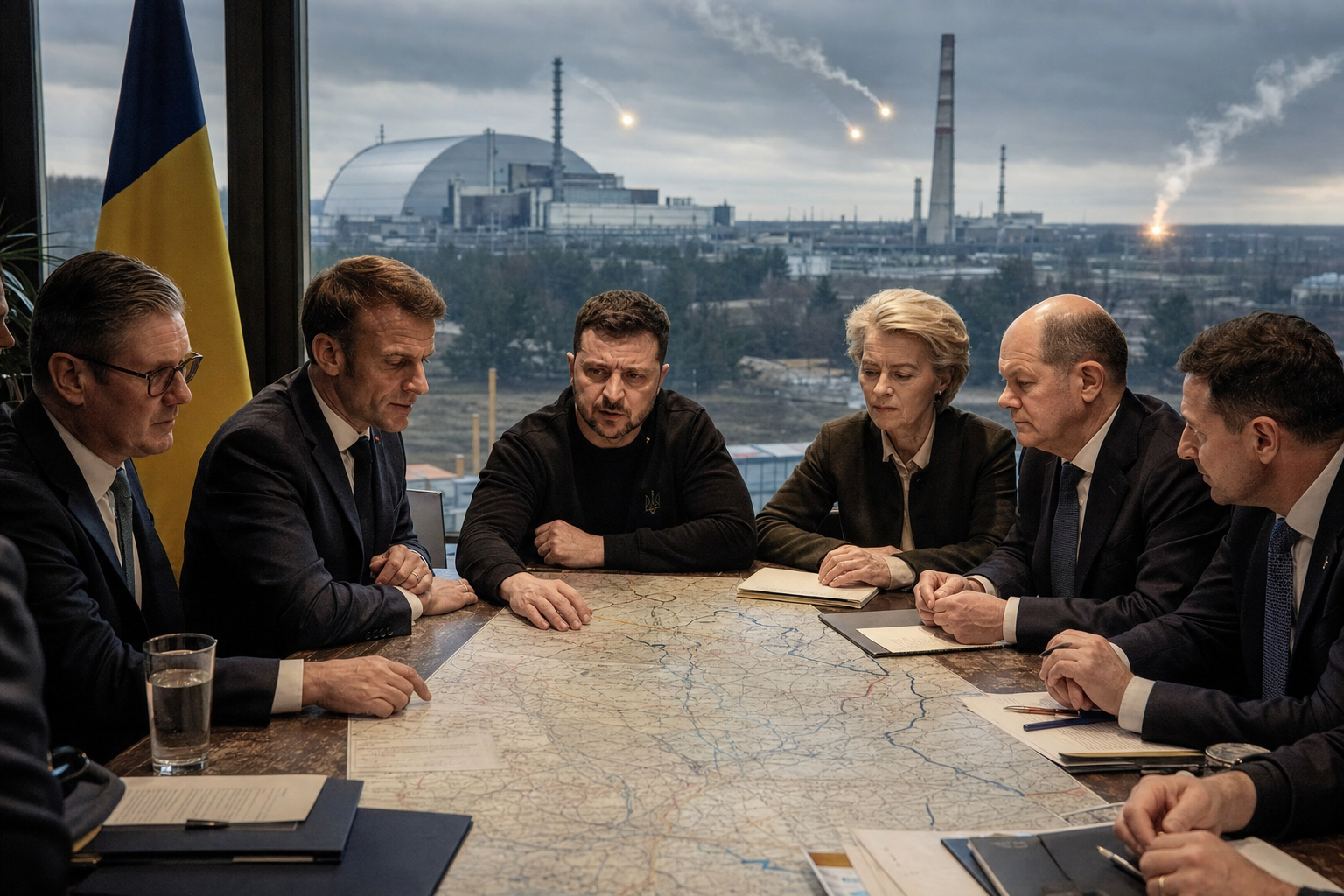
Ukraine’s President Volodymyr Zelensky and his closest European allies — the UK, France and Germany — used a meeting in London to set out five conditions they say are necessary for a “just and lasting” peace deal with Russia. In a joint statement, Zelensky, UK Prime Minister Sir Keir Starmer, French President Emmanuel Macron and German Chancellor Friedrich Merz said they would stand firmly with Ukraine and insisted that any talks must begin from the current front line, include an immediate stop to the fighting, and be backed by “robust” security guarantees for Ukraine. They also stressed the importance of continued US involvement, even as President Donald Trump’s attention has shifted toward the conflict between Israel and Iran.
The article places this diplomatic push against the backdrop of intensified fighting. Russia has recently increased missile and drone attacks on Ukrainian cities, while Ukraine has stepped up its own long-range strikes inside Russia, including a drone attack on St Petersburg during a major economic forum. Zelensky has publicly urged direct negotiations with Vladimir Putin, but the Russian president has repeatedly rejected such talks unless Russia’s war aims are met. The E3 group — Britain, France and Germany — said Ukraine’s right to choose its own alliances, including NATO, must be respected.
The piece also reports a separate Russian drone strike near the Chornobyl nuclear plant, which Ukraine said damaged a spent nuclear fuel storage facility but caused no injuries and no radiation leak. Zelensky condemned the strike as a deliberate threat to nuclear safety. Additional Russian strikes in the Zaporizhzhia region killed at least three people, underscoring the continuing violence and the urgency behind the European leaders’ call for a structured peace process with strong security guarantees.
Entities: Volodymyr Zelensky, Keir Starmer, Emmanuel Macron, Friedrich Merz, Vladimir Putin • Tone: analytical • Sentiment: negative • Intent: inform
08-06-2026
In this Face the Nation transcript, Rep. Don Bacon, a Nebraska Republican, offers unusually blunt criticism of several Trump-era foreign policy and political decisions while defending his own more hawkish, pro-Ukraine stance. Bacon says Texas Republicans made a mistake by nominating Ken Paxton for Senate over John Cornyn, arguing that Trump’s endorsement often outweighs character in primaries but can backfire in general elections. He says he tries to “call balls and strikes” by backing Ukraine, opposing tariffs, supporting border security, and acknowledging the need to confront Iran.
The interview then turns to international security and the Trump administration’s posture toward Europe and NATO. Bacon sharply criticizes Defense Secretary Pete Hegseth’s Normandy remarks tying immigration to D-Day, saying Normandy should be a solemn commemoration of Allied sacrifice rather than a political message. He argues that the administration is too quick to criticize Europe and NATO while failing to criticize Russia, which he says undermines U.S. alliances and national security. Bacon also says Trump’s threats toward Greenland and Canada have damaged allied trust.
On Ukraine, Bacon says the president’s attempt to broker a negotiated settlement is not working because Russia is the aggressor and is bombing Ukrainian cities every night. He frames the conflict in moral terms, saying America should clearly side with Ukraine and democracy against Russia. Bacon also complains that House leadership has not advanced Ukraine policy and says Speaker Mike Johnson whipped against a recent aid vote, helping reduce Republican support. Finally, Bacon supports expanding Patriot missile production, including allowing allied countries in Europe and potentially Ukraine to manufacture them, arguing the U.S. cannot produce enough air defenses to meet global needs in Ukraine, the Middle East, Asia, and against threats from North Korea and China.
Entities: Rep. Don Bacon, Margaret Brennan, Ken Paxton, John Cornyn, Donald Trump • Tone: analytical • Sentiment: negative • Intent: inform
08-06-2026
In this Face the Nation transcript, Rep. Jim Himes, the top Democrat on the House Intelligence Committee, sharply criticizes President Trump’s appointment of Bill Pulte as acting Director of National Intelligence. Himes argues that Pulte lacks national security experience, appears motivated by loyalty to the president rather than the public interest, and could abuse intelligence authorities. He says the nomination has created bipartisan outrage and has jeopardized the reauthorization of FISA Section 702, a major foreign intelligence collection authority set to expire soon. Himes contends that the appointment has effectively derailed Senate progress on renewing the surveillance tool and warns that the failure to reauthorize it could have serious national security consequences. He says the only realistic way to resolve the impasse would be for Trump to withdraw the nomination and choose a more credible alternative.
The interview then shifts to Ukraine, where Himes says Russia is not winning the war. He says Ukraine is now winning on the battlefield, pointing to recent deep strikes into Russian territory as evidence of Ukraine’s improving position. The transcript presents Himes as forcefully critical of Trump’s intelligence-related decision-making while also expressing confidence in Ukraine’s military performance.
Entities: Jim Himes, Margaret Brennan, Donald Trump, Bill Pulte, Federal Housing Finance Agency • Tone: analytical • Sentiment: negative • Intent: analyze
08-06-2026
Russian strikes in Ukraine killed three people and damaged a spent nuclear fuel storage facility near Chernobyl, renewing fears about the risks posed by fighting around nuclear infrastructure. According to Ukrainian officials, a Russian drone struck people waiting at a bus stop in Balabyne in southeastern Ukraine’s Zaporizhzhia region, killing three and wounding another. Separately, a strike in the Kyiv region damaged a storage site for spent nuclear fuel about nine miles from the Chernobyl nuclear power plant. Ukrainian nuclear operator Energoatom said the empty facility was partially destroyed and a fire broke out, but it was extinguished within an hour and radiation levels remained safe. International Atomic Energy Agency chief Rafael Grossi called the incident deeply concerning and said the agency would visit the site soon. The article also notes a Ukrainian strike in Russia’s Kursk region that killed one man and injured a woman, illustrating the continued cross-border attacks in the war.
The report places these attacks in the context of broader diplomatic efforts by European leaders to maintain support for Ukraine. British Prime Minister Keir Starmer hosted Ukrainian President Volodymyr Zelenskyy, French President Emmanuel Macron, and German Chancellor Friedrich Merz for talks on continued backing and security guarantees. The story also references Ukraine’s recent drone strike on St. Petersburg, which showed Kyiv’s growing reach into Russia and embarrassed President Vladimir Putin. Overall, the article underscores the intensifying drone war, the ongoing dangers around nuclear sites, and the lack of progress toward ending the conflict more than four years after Russia’s full-scale invasion.
Entities: Russia, Ukraine, Chernobyl nuclear power plant, Kyiv region, Zaporizhzhia region • Tone: urgent • Sentiment: negative • Intent: inform