08-06-2026
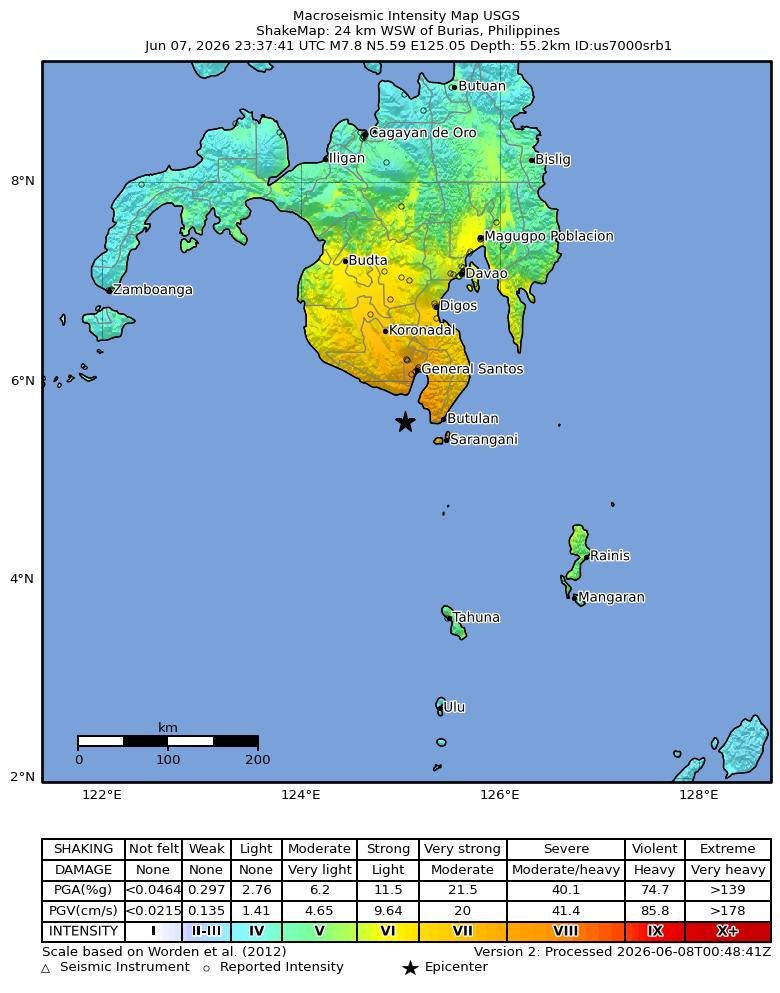
A powerful magnitude 7.8 earthquake struck the southern Philippines early Monday, rattling General Santos and surrounding areas, knocking out power, damaging structures, and triggering tsunami warnings across parts of the region. Authorities urged coastal residents to move to higher ground as the Pacific Tsunami Warning Center warned that waves as high as 10 feet could hit some Philippine coasts, with smaller waves possible in Indonesia, Malaysia, and other western Pacific locations. A small commercial building in General Santos partially collapsed, but there were no immediate reports of casualties, and it remained unclear whether anyone was trapped or injured. The quake’s epicenter was reported just southwest of General Santos at a shallow depth, though agencies initially differed on exact measurements—a common occurrence in the immediate aftermath of major earthquakes. The article also notes that residents in Indonesia felt tremors and that modest tsunami activity was recorded in parts of North Sulawesi and North Maluku. It places the event in broader context by highlighting the Philippines’ extreme exposure to natural disasters because it sits on the Pacific Ring of Fire and is frequently hit by earthquakes, volcanic eruptions, and typhoons.
Entities: Philippines, Southern Philippines, General Santos, Mindanao, Indonesia • Tone: urgent • Sentiment: negative • Intent: inform
08-06-2026
A powerful 7.8 magnitude earthquake struck the southern Philippines on Monday morning, causing panic, structural damage, and confirmed deaths in parts of Mindanao. According to the U.S. Geological Survey, the quake occurred around 7:37 a.m. local time at a depth of about 35 kilometers, near General Santos City in Sarangani province. The Philippine Institute of Volcanology and Seismology said the epicenter was offshore near the southern tip of Mindanao. The quake damaged buildings and infrastructure, with photos and videos showing collapsed storefronts, a partially collapsed restaurant, and school buildings affected while classes had just resumed for the new semester. Although no injuries were reported in some school incidents, officials confirmed fatalities and said additional casualty reports were still being verified. President Ferdinand Marcos Jr. ordered government agencies to respond immediately, begin evacuations, and conduct rescue operations, urging residents to move to higher ground because of a tsunami warning. The quake triggered tsunami alerts in the Philippines, Indonesia, and Japan, though the Pacific Tsunami Warning Center said the main threat had largely passed several hours later. Authorities continued to warn residents to remain vigilant due to possible sea-level fluctuations. The article also notes that the affected region lies within the Pacific Ring of Fire, a seismically active area prone to earthquakes and volcanic eruptions, and that no tsunami threat was detected in Hawaii.
Entities: Mindanao, Philippines, General Santos City, Sarangani province, Davao Occidental • Tone: urgent • Sentiment: negative • Intent: inform
08-06-2026
A powerful magnitude 7.8 earthquake struck the southern Philippines early Monday, prompting tsunami warnings for parts of the Philippines and smaller wave advisories for nearby countries around the western Pacific. The quake’s epicenter was located southwest of General Santos City on Mindanao, with initial reports indicating a shallow depth and the potential for dangerous tsunami waves of up to 3 meters on some Philippine coasts. Authorities urged coastal residents to evacuate to higher ground or move farther inland, while power outages were reported in the affected area. At the time of reporting, no confirmed information on casualties or damage was available.
The Pacific Tsunami Warning Center expanded the scope of concern beyond the Philippines, saying waves up to 1 meter were possible on parts of Indonesia and Malaysia, while smaller waves could affect Taiwan, Japan, Guam, Papua New Guinea, and other island territories in the western Pacific. There was no threat to Hawaii or the U.S. mainland. Residents in Indonesia’s North Sulawesi and North Maluku provinces reportedly felt the shaking, and the U.S. Geological Survey later noted aftershocks as strong as magnitude 6.1. The article also places the quake in the broader context of the Philippines’ vulnerability to natural disasters because of its location on the Pacific Ring of Fire and exposure to frequent typhoons and tropical storms.
Entities: Philippines, Mindanao, General Santos City, Philippine Institute of Volcanology and Seismology, Pacific Tsunami Warning Center • Tone: urgent • Sentiment: negative • Intent: inform
08-06-2026
A powerful 7.8-magnitude earthquake struck offshore near Mindanao in the southern Philippines on Monday morning, damaging buildings, causing panic, and prompting tsunami warnings across multiple countries in the Pacific region. The quake hit around 7:37 a.m. local time near Burias, Philippines, according to the U.S. Geological Survey, and social media footage showed significant structural damage, including a shopping plaza collapsing in General Santos City. While there were no immediate reports of casualties, officials warned that fatalities were possible because of the quake’s strength and the vulnerability of local construction.
The earthquake caused widespread fear and disruption in affected areas. Residents described intense shaking, reported seeing collapsed buildings and emergency vehicles, and witnessed students screaming outside schools on the first day of classes after a two-month break. Some areas also experienced power outages. President Ferdinand R. Marcos Jr. ordered schools suspended in the affected parts of Mindanao and said the government was coordinating disaster response efforts.
Because the quake occurred in the Pacific Ring of Fire, tsunami alerts were issued by authorities in the Philippines, Japan, Indonesia, Malaysia, and Guam. The Pacific Tsunami Warning Center warned of possible waves up to 3 meters in the Philippines, while Japan and Malaysia were also placed under advisories. U.S. officials said there was no threat to the Pacific coasts of the United States and Canada. The article frames the event as an unfolding disaster, noting that it was still developing and that more information could emerge as response efforts continued.
Entities: Philippines, Mindanao, General Santos City, Burias, U.S. Geological Survey (USGS) • Tone: urgent • Sentiment: negative • Intent: inform
08-06-2026
An offshore magnitude 7.8 earthquake struck the southern Philippines, triggering a brief tsunami warning and causing widespread casualties and damage, especially in and around General Santos. According to officials, at least 12 people were killed and more than 200 were injured across affected areas. The Pacific Tsunami Warning Centre said the tsunami threat had largely passed about five hours after the quake, and Philippine authorities reported no confirmed tsunami-related deaths or damage.
The quake struck south of General Santos in the Mindanao region, prompting officials to urge coastal residents to move to higher ground. In General Santos, local authorities reported at least seven deaths and around 130 injuries, with some small buildings partially collapsing and several structures, including a key access bridge, developing dangerous cracks. Officials also said they were investigating reports that students may have been trapped in a collapsed two-storey school. The national police said at least seven people were missing in General Santos. The article emphasizes the scale of the quake, the immediate emergency response, and the ongoing uncertainty as authorities assessed damage and searched for possible survivors.
Entities: Philippines, Mindanao, General Santos, Pacific Tsunami Warning Centre, Philippine Institute of Volcanology and Seismology • Tone: urgent • Sentiment: negative • Intent: inform
08-06-2026
A powerful magnitude 7.8 earthquake struck the southern Philippines on Monday morning, hitting Mindanao near General Santos City and triggering tsunami warnings across parts of the region. The quake caused building collapses, power outages, and at least three deaths and four injuries, according to police and civil defense officials. Video and images verified by the Guardian showed severe damage, including the collapse of part of a Jollibee restaurant, damage to a commercial complex, and the collapse of part of a high school in Davao del Sur as students were outside. Authorities urged residents in coastal areas to move to higher ground or farther inland because tsunami waves of up to 3 meters were possible on some Philippine coasts, with smaller waves also possible in Indonesia, Malaysia, Taiwan, Japan, Guam, Papua New Guinea, and other Pacific islands. Indonesia later lifted its tsunami warning after recording small waves. Philippine President Ferdinand Marcos Jr. urged people not to delay evacuation, stressed that safety comes first, and ordered school suspensions in affected areas while rescue and damage-assessment operations continued. The article also places the disaster in context by noting that the Philippines sits on the Pacific Ring of Fire and is frequently affected by earthquakes, volcanic eruptions, and typhoons.
Entities: Philippines, Mindanao, General Santos City, Davao del Sur, Indonesia • Tone: urgent • Sentiment: negative • Intent: inform