06-07-2026
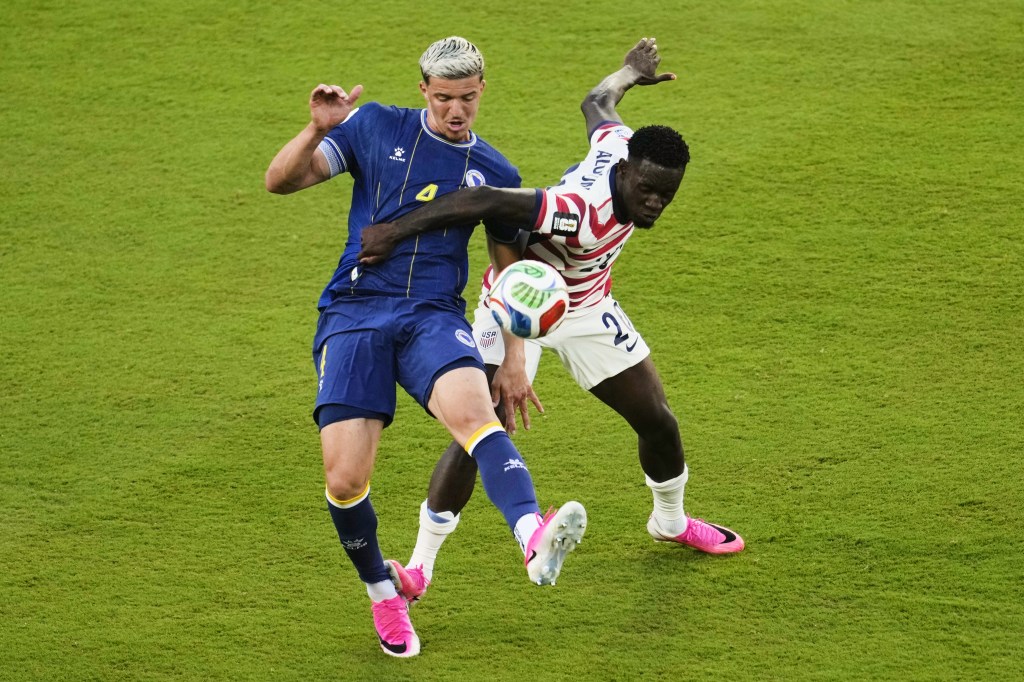
U.S. men’s national team forward Folarin Balogun will be available for the World Cup match against Belgium after FIFA’s disciplinary committee lifted the red-card suspension he received in the previous round. The reversal came after President Trump spoke directly with FIFA President Gianni Infantino, according to sources familiar with the call, and after additional contact from White House World Cup task force executive director Andrew Giuliani and Commerce Secretary Howard Lutnick. CBS News reports that FIFA did not fully erase the red card, instead placing Balogun on one-year probation: if he commits a similar offense during that period, the suspension can be reimposed. The original red card followed a VAR review of a collision with a Bosnia and Herzegovina defender that referees deemed a serious foul. The decision sparked controversy because players and observers believed the play appeared accidental and that red-card suspensions are usually not appealable. U.S. Soccer said it was pleased and engaged in the process, while Belgium’s football association condemned the move as inconsistent with fair play and said it was exploring options. The article also notes the precedent of Cristiano Ronaldo receiving a similar reprieve. Balogun’s return is important for the U.S. team as it seeks to reach the quarterfinals for the first time since 2002, and teammates, including Christian Pulisic, said the forward was happy and remains a key source of physicality, hold-up play, and attacking power.
Entities: Folarin Balogun, Donald Trump, Gianni Infantino, FIFA, U.S. Men's National Team (USMNT) • Tone: analytical • Sentiment: neutral • Intent: inform
06-07-2026
This CNBC Daily Open newsletter frames a day when football drama, geopolitical diplomacy, and market activity all overlap. The lead story centers on U.S. President Donald Trump’s unusual intervention to get FIFA to overturn a red card and suspension for U.S. striker Folarin Balogun, clearing him to play Belgium. The article notes that UEFA may still challenge the decision, underscoring tensions between football governing bodies and national interests. Beyond that, the newsletter highlights the World Cup’s on-field results, including Norway’s win over Brazil and England’s victory over Mexico, which sent both teams into the quarter-finals.
The piece then shifts to the financial side of the tournament, emphasizing how prediction markets have benefited from intense World Cup betting. It cites major volume growth at Kalshi and Polymarket, suggesting that sports-related contracts are driving record participation and trading activity. The article also pivots to NATO diplomacy in Turkey, where leaders are gathering in Ankara and Trump is expected to meet Ukrainian President Volodymyr Zelenskyy to discuss Russia’s war. Trump’s stance toward NATO, and potential deals with Turkish President Recep Tayyip Erdogan, add another layer of diplomatic intrigue.
Finally, the newsletter turns to Wall Street, where futures point toward a fresh record high for the Dow after the July 4th break. It also flags a cluster of large merger-and-acquisition deals involving Lockheed Martin, easyJet, and Novartis. The closing item notes the extraordinary cost borne by some World Cup fans, who spent thousands or even tens of thousands of dollars to attend matches, reinforcing the tournament’s mix of excitement, prestige, and financial excess.
Entities: Donald Trump, FIFA, Gianni Infantino, Folarin Balogun, UEFA • Tone: analytical • Sentiment: neutral • Intent: inform
06-07-2026
CNBC’s Daily Open reviews a market session shaped by political drama, sports controversy, and easing geopolitical tensions. The piece opens with the U.S. celebrating its 250th anniversary and notes that investor attention is being pulled in several directions, from a World Cup suspension controversy involving U.S. striker Folarin Balogun to surging activity in prediction markets tied to the tournament. It reports that Kalshi and Polymarket both posted record or near-record June volumes as football-related trading accelerated. In financial markets, U.S. stock futures were positive, extending gains ahead of the Independence Day holiday, while Asia-Pacific markets were mixed. The article also highlights a cooling of Middle East risk, saying the Iran conflict appears to be deescalating as the U.K. and France agree to coordinate with Oman to secure maritime navigation near the Strait of Hormuz. Combined with OPEC+’s decision to raise oil output, that news pushed oil prices lower. The piece concludes with a Reuters item about President Donald Trump’s July 4 speech on the National Mall, which mixed patriotic themes with campaign-style rhetoric, criticism of ideological threats, and renewed calls for voting restrictions. Overall, the article frames a day in which sports, politics, prediction markets, and energy markets are all influencing investor sentiment.
Entities: Donald Trump, Gianni Infantino, Folarin Balogun, FIFA, Kalshi • Tone: analytical • Sentiment: neutral • Intent: inform
06-07-2026
CNN’s analysis argues that Donald Trump’s intervention in a World Cup disciplinary decision has transformed what should have been a routine soccer controversy into a political and diplomatic flashpoint. The article focuses on the reversal of a one-game suspension for U.S. striker Folarin Balogun after a red card against Bosnia and Herzegovina, allowing him to play in the knockout match against Belgium. Trump publicly praised FIFA for reversing what he called a “great injustice,” and CNN reports that he had spoken with FIFA president Gianni Infantino and asked him to review the call. The piece says the episode has fueled suspicion that political influence, rather than pure sporting fairness, shaped the outcome.
The article explains the red card itself was controversial: Balogun’s challenge looked minor at full speed but more severe in slow-motion replay, and some fans believed he was unfairly punished by VAR. Still, CNN notes that the referee’s decision was consistent with FIFA standards, making the reversal harder to justify without transparency. The lack of a clear explanation from FIFA deepened concerns among rival teams and observers, especially the Belgian federation, which accused the move of undermining fair play and football’s integrity.
Beyond the immediate sporting dispute, the article uses the incident to explore Trump’s habit of inserting himself into major sports moments and his unusually close relationship with Infantino. It portrays Infantino as politically vulnerable and eager to maintain cordial ties with powerful leaders, while also noting the broader concerns that arise when a global tournament appears subject to presidential pressure. The article concludes that even if Trump’s intervention was not decisive, the appearance of interference alone risks damaging perceptions of the World Cup’s legitimacy.
Entities: Donald Trump, Folarin Balogun, FIFA, Gianni Infantino, Raphael Claus • Tone: analytical • Sentiment: negative • Intent: analyze
06-07-2026
This CNN video segment focuses on the controversy surrounding FIFA’s decision to reverse a suspension involving striker Folarin Balogun, making him eligible to play against Belgium on Monday. CNN’s Don Riddell speaks with World Cup fans about the ruling and captures their reactions to what is described as a “stunning decision.” The piece centers on fan skepticism and the broader perception that FIFA’s late change may have affected competitive fairness and transparency. Rather than detailing the full disciplinary background, the segment emphasizes public reaction and the immediate sporting implications for the upcoming match. The article/video positions the ruling as a notable and potentially contentious moment in the tournament, reflecting how administrative decisions by governing bodies can draw strong scrutiny during major international events.
Entities: FIFA, Folarin Balogun, Belgium, World Cup, Don Riddell • Tone: analytical • Sentiment: neutral • Intent: inform
06-07-2026
The article reports that FIFA reversed the one-game suspension of U.S. striker Folarin Balogun, allowing him to play in the United States’ Round of 16 World Cup match against Belgium. Balogun had been sent off after a collision with Bosnia-Herzegovina defender Tarik Muharemovic, but The Post says U.S. Soccer argued the red card was wrongly issued because VAR was used improperly to assess intent and severity rather than simply identify the point of contact. According to sources cited by the article, U.S. Soccer quickly escalated the matter after the Bosnia match, involving attorneys, White House lawyers, and even President Donald Trump, who contacted FIFA president Gianni Infantino. The piece says U.S. Soccer also raised the possibility of taking the matter to the Court of Arbitration for Sport, which helped push FIFA to act before any formal appeal process was needed. U.S. manager Mauricio Pochettino said he was not directly involved but praised the federation’s efforts and called the original punishment unfair. Players such as Chris Richards and Christian Pulisic reacted positively to Balogun’s reinstatement, saying it boosted the team’s morale ahead of the Belgium match. The article frames the decision as a victory for U.S. Soccer, a correction of an injustice, and a timely lift for the team before an important knockout game.
Entities: Folarin Balogun, United States men’s national team, Belgium, FIFA, U.S. Soccer • Tone: analytical • Sentiment: positive • Intent: inform
06-07-2026
FIFA’s decision to suspend, then effectively lift, U.S. striker Folarin Balogun’s one-game World Cup ban sparked immediate celebration from the United States camp and sharp criticism abroad. Balogun had been sent off with a straight red card in the USMNT’s round-of-32 win over Bosnia and Herzegovina, leading to what many expected would be an automatic suspension for the round of 16 against Belgium. The Athletic reported that FIFA’s disciplinary committee instead suspended the punishment for a probationary period, making Balogun available for the match in Seattle.
The reaction from U.S. figures was enthusiastic. President Donald Trump publicly thanked FIFA for “reversing a great injustice,” while U.S. players and staff said the news boosted morale and confidence. Christian Pulisic defended Balogun and described the original decision as overly harsh, while Chris Richards and others said the team initially thought the news was fake or generated by AI because it seemed so improbable.
Outside the U.S. camp, the decision provoked concern about fairness and the integrity of tournament rules. The Belgian federation said it was “astonished” and was exploring options, arguing the decision contradicted competition regulations and fair play principles. Belgium coach Rudi Garcia mocked the timing and suggested FIFA had turned July 5 into “April Fools.” Norway coach Stale Solbakken called the ruling a major mistake that could undermine confidence in disciplinary consistency.
The article also frames the controversy as part of a broader debate over FIFA’s authority and the consistency of disciplinary decisions. A former Premier League referee, Graham Scott, argued FIFA was acting inconsistently with precedent, and that players should be judged on their actions rather than the outcome of the challenge. Overall, the piece captures a highly charged World Cup moment in which a single disciplinary reversal became a global talking point about justice, precedent, and FIFA’s power.
Entities: Folarin Balogun, Donald Trump, FIFA, U.S. Soccer, Belgium • Tone: analytical • Sentiment: neutral • Intent: inform