04-09-2026
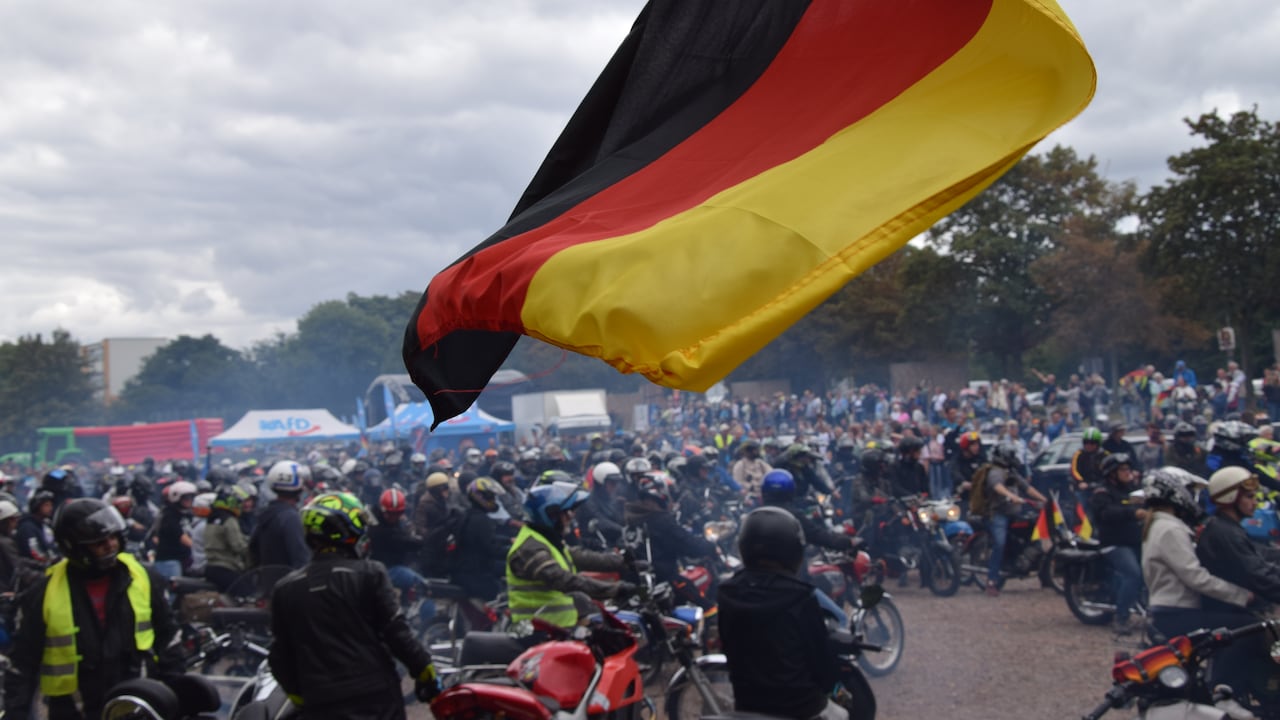
Germany’s far-right Alternative for Germany (AfD) is leading polls ahead of the Saxony-Anhalt state election and could become the first far-right party to head a German state government since World War II. The party is polling above 40 percent, well ahead of the conservative Christian Democratic Union (CDU), which is slightly above 20 percent. The AfD’s leading candidate, Ulrich Siegmund, is a former CDU member who has been described by Der Spiegel as “Germany’s most dangerous man.” Germany’s domestic intelligence service classifies the AfD as far-right extremist in Saxony-Anhalt.
The article profiles former CDU voter Mario Jung, who says economic concerns and support for the AfD’s hardline immigration policies have driven his decision to switch parties. The AfD’s platform calls for abolishing the right to asylum, confiscating asylum seekers’ assets, carrying out mass deportations, banning Antifa, ending public broadcasting and reversing the transition to renewable energy. It also proposes criminal penalties for people who insult German identity.
The party was founded in 2013 as a Eurosceptic movement but shifted sharply to the right after Angela Merkel’s 2015 decision to admit approximately one million refugees. Analysts attribute its strength in eastern Germany to economic stagnation, inadequate public services, depopulation and resentment toward liberal elites in Berlin. Other research suggests that concerns about immigration explain AfD support far more strongly than economic disadvantage alone.
The AfD’s possible entry into state government would challenge Germany’s political establishment and potentially damage the country’s international image. Chancellor Friedrich Merz has ruled out cooperation with both the AfD and the Left Party, although the CDU’s local-level “firewall” against cooperation with the AfD has already weakened. Further elections in Mecklenburg-Western Pomerania and Berlin will provide additional tests of the party’s momentum.
Entities: Alternative for Germany (AfD), Saxony-Anhalt, Ulrich Siegmund, Mario Jung, Christian Democratic Union (CDU) • Tone: analytical • Sentiment: negative • Intent: analyze
04-09-2026
Germany’s far-right Alternative for Germany (AfD) party is leading opinion polls ahead of a regional election in Saxony-Anhalt, raising the possibility that it could become the first far-right party to control a German state government since the Second World War. The AfD is polling at 42 per cent in the state, well ahead of the national figure of 28 per cent, and its success could allow it to form a government if other parties cannot maintain their longstanding “firewall” against cooperation with extremist parties.
Experts say state power would give the AfD control over significant resources and policy areas, including education, policing, cultural policy and environmental policy. The party’s regional platform calls for restrictions on immigration, detention centres for deportees, separate classrooms for refugee children, and a policy of “remigration,” a term associated with mass deportations of people from migrant backgrounds. It also proposes banning Pride flags in schools, revising history curricula to emphasize positive aspects of Germany’s past, and promoting a traditional family model while reducing emphasis on the Nazi era.
The AfD’s regional branch is classified as right-wing extremist by Saxony-Anhalt’s Office for the Protection of the Constitution. Critics and experts point to members’ use of Nazi-associated language, connections to ethnonationalist movements and reported ties to Russia. Control of state-level domestic intelligence services is a particular concern.
The article portrays strong support for the AfD among younger and rural voters, including enthusiastic supporters of candidate Ulrich Siegmund, while also documenting fears among immigrants and LGBTQ+ residents. Nigerian immigrant Akinola Sanyaolu describes experiencing racism, and lesbian couple Anki Wolf and Miriam Siemon question whether they can safely raise a family amid rising homophobia. Historians warn that an AfD victory could have consequences beyond Saxony-Anhalt, affecting Germany, the European Union and the country’s postwar democratic order.
Entities: Alternative for Germany (AfD), Saxony-Anhalt, Germany, Ulrich Siegmund, Marcus Böick • Tone: analytical • Sentiment: negative • Intent: analyze
04-09-2026
Germany’s eastern state of Saxony-Anhalt is approaching a state election in which the far-right Alternative for Germany (AfD) is expected to perform strongly, potentially becoming the clear winner. The AfD, whose state organization has been classified as right-wing extremist by Germany’s domestic intelligence agency, argues that the state has been left behind socially and economically. Its message has gained particular traction among younger voters and amid declining support for the traditionally dominant Christian Democrats (CDU) and Social Democrats (SPD).
Saxony-Anhalt does face significant economic challenges. Unemployment is above the national average, full-time median earnings are lower, and economic output per person is only about three-quarters of the German average. The state’s economy has also grown more slowly than Germany’s overall economy in recent years. Its relatively high proportion of pensioners contributes to the lower per-capita output, while many eastern German retirees depend primarily on state pensions rather than supplementary company or private pensions.
However, the article challenges the AfD’s broader portrayal of Saxony-Anhalt as being abandoned or overwhelmed by foreigners. The state has important industrial sectors, including chemicals, machinery and plant engineering, as well as retail, transport, hospitality and tourism. Its population has also grown in recent years through positive migration. Since 2016, more non-Germans have moved into the state than have left, and migration among German citizens has also produced a positive balance for six consecutive years.
Foreign nationals represented around 9% of the population at the end of 2025, well below the proportion in North Rhine-Westphalia. The claim that foreigners disproportionately live on welfare is also described as misleading, since Saxony-Anhalt has a relatively low share of foreign nationals among potential recipients of basic income support. The article concludes that although the state’s economic weaknesses are real, they do not fully support the bleak narrative promoted by extremist parties. Nevertheless, radical-party support is becoming increasingly entrenched, threatening the CDU’s mainstream position and bringing the SPD closer to the 5% threshold for parliamentary representation.
Entities: Saxony-Anhalt, Alternative for Germany (AfD), Christian Democratic Union (CDU), Social Democratic Party (SPD), Free Democratic Party (FDP) • Tone: analytical • Sentiment: neutral • Intent: analyze
04-09-2026
A representative ARD Deutschlandtrend poll found that 56% of German voters now view Russia as a threat to Germany’s security, amid a series of suspected acts of sabotage and other hybrid attacks. Recent incidents include a drone attack at Leipzig Airport, an arson attack near defense contractors in Bavaria, and the discovery of explosive devices and pyrotechnics at substations in Brandenburg and North Rhine-Westphalia. Chancellor Friedrich Merz and Interior Minister Alexander Dobrindt have described Germany as being in a state between peace and war, with Russia publicly blamed for the Leipzig incident.
The survey reveals significant regional and political divisions. Nearly half of eastern Germans feel little or no threat from Russia, while two-thirds of Alternative for Germany (AfD) supporters assess the threat as low. Similar divisions exist over military assistance to Ukraine: slightly more than half of respondents support the current level of aid or favor expanding it, while more than four in ten believe it has gone too far. Opposition is strongest in eastern Germany and among AfD supporters.
The poll also indicates continued strength for the AfD. It would receive 27% of the vote in a hypothetical federal election, ahead of the CDU/CSU at 21%, the Greens at 15%, the SPD at 13%, and the Left Party at 12%. The governing CDU/CSU-SPD coalition would lose its majority under these figures. Public dissatisfaction extends to the government and chancellor, with only 15% approving of the coalition’s performance and 13% approving of Merz’s work.
Economic anxiety remains the country’s most pressing concern, with 79% describing Germany’s economic situation as poor or very poor. Pessimism is especially strong among AfD supporters, while SPD and Green voters are more optimistic. The results suggest that concerns over security, economic decline, and dissatisfaction with the government are reinforcing political polarization and benefiting the AfD.
Entities: Germany, Russia, Friedrich Merz, Alexander Dobrindt, Christian Democratic Union (CDU) • Tone: analytical • Sentiment: negative • Intent: inform
04-09-2026
Germany’s far-right Alternative for Germany (AfD) is leading polls ahead of a state election in Saxony-Anhalt, raising the prospect that it could lead a German state government for the first time since World War II. The party’s candidate, 35-year-old Ulrich Siegmund, has built a highly polished, social-media-driven campaign. A former marketing professional and popular TikTok personality, Siegmund presents himself as youthful, optimistic and approachable, in contrast to the more confrontational image associated with many AfD politicians. His campaign emphasizes short, energetic messages, while the party maintains hard-line positions on immigration, including mass deportations and criticism of foreign-trained medical workers.
The article examines how the AfD’s carefully managed image is attracting voters who may not support all of its policies. Former AfD voter Hannes Kreschel attends rallies to challenge supporters about the party’s economic and nationalist positions. He argues that the AfD’s program primarily benefits the wealthy and says he abandoned the party after concluding that its vision was incompatible with an open, tolerant Germany. However, voter Alexander Winsek is considering voting for the AfD because of its promise to restrict migration. Although he rejects some of the party’s positions on NATO, the euro and Russia, he views Siegmund as a positive alternative to the party’s more pessimistic figures.
Political researcher Marcel Lewandowsky says many AfD voters still identify as pro-democracy, even while believing German democracy is failing. He argues that the party successfully presents itself as the defender of “real” democracy against an establishment that ignores ordinary citizens. The AfD’s appeal is increasingly national rather than confined to eastern Germany, where it is also polling strongly at the federal level. A victory in Saxony-Anhalt would mark a major breakthrough for a party classified as right-wing extremist by domestic intelligence authorities in several German states. The article also highlights the contradiction between the AfD’s claim to represent ordinary people and its intolerance of critics.
Entities: Alternative for Germany (AfD), Ulrich Siegmund, Saxony-Anhalt, Halle, Germany, Hannes Kreschel • Tone: analytical • Sentiment: negative • Intent: analyze