04-07-2026
Extreme heat disrupted Fourth of July celebrations across the eastern and central United States, forcing the cancellation or delay of major events in Washington, DC, Philadelphia, and other states. In Philadelphia, organizers canceled the Salute to Independence Semiquincentennial Parade, saying it was unsafe to proceed under dangerous heat conditions. In Washington, a morning Independence Day event was canceled, and the Great American State Fair on the National Mall was temporarily shut down after several attendees suffered heat-related illnesses. At least 11 people were transported by ambulance from the fair, according to DC Fire and EMS. The article also notes that US Capitol Police delayed entry to the outdoor A Capitol Fourth concert and that President Donald Trump planned to speak outdoors despite the predicted heat.
The broader weather situation was severe: more than 165 million Americans were under record temperatures, with Philadelphia and Washington expected to approach or tie record highs, and humidity pushing heat index values well above 110F. New York City also experienced its hottest day since 2012. The article explains that the heatwave was expected to continue through the weekend, with additional risks from severe thunderstorms, hail, wind, flooding, and possible tornadoes in other regions. It closes by linking the increasing frequency and intensity of heatwaves to human-induced climate change and rising global temperatures.
Entities: Fourth of July, Washington DC, Philadelphia, Great American State Fair, US National Weather Service • Tone: urgent • Sentiment: negative • Intent: inform
04-07-2026
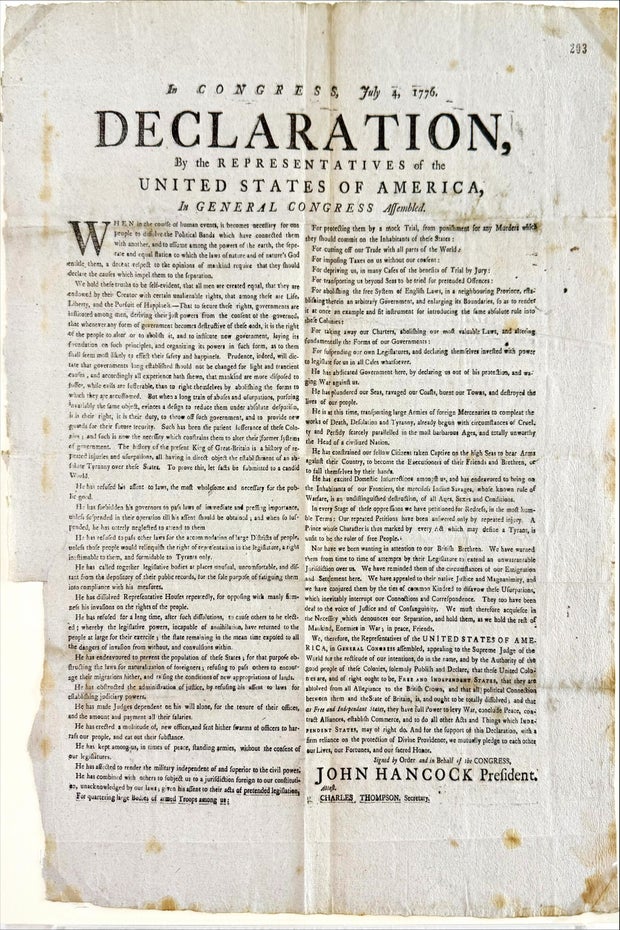
A rare 1776 printed copy of the Declaration of Independence, known as an Exeter Declaration, has been discovered in the U.K.’s National Archives by volunteer Michael Scurry while cataloguing a box of correspondence. The document is believed to be one of only 11 surviving copies of its kind and, according to the National Archives, the only one known to be outside the United States. The article explains that these copies were printed in Exeter, New Hampshire, shortly after the Declaration was signed, with the purpose of spreading news of American independence. The copy’s provenance was traced to the American ship Dalton, which was seized by the British Royal Navy vessel HMS Raisonable on Christmas Eve in 1776 after a pursuit off the coast of Portugal. Along with other seized papers, the Declaration was archived and mislabeled as “another paper.” After identifying the document, archivists performed careful conservation work to repair a tear and stabilize the paper. Curators said the find is historically significant because it sheds light on how quickly the Declaration was distributed and the importance it held even among those at sea during the Revolutionary era. The discovery is being described by National Archives officials as extraordinary and vanishingly rare.
Entities: Declaration of Independence, Exeter Declaration, U.K. National Archives, National Archives, Saul Nassé • Tone: analytical • Sentiment: neutral • Intent: inform
04-07-2026
This CNN video article features Anderson Cooper reflecting on the story of America in the lead-up to the United States’ 250th birthday, and uses that reflection to explain why he feels optimistic about the country. The piece is framed as a Fourth of July commentary connected to CNN’s “Fourth in America” coverage, with Cooper positioned as the central voice. Although the page is mainly a video landing page rather than a long written article, its core message is patriotic and reflective: it looks back at the American story, acknowledges its complexities, and emphasizes reasons for hope in the nation’s future.
The headline and accompanying description suggest that Cooper’s optimism comes from viewing America as a country shaped by struggle, reinvention, and continued progress. The article does not provide a full transcript, but it clearly presents Cooper’s monologue as a thoughtful meditation on national identity, history, and the significance of the upcoming semiquincentennial. The context is Independence Day, making the commentary timely and celebratory while still reflective rather than purely jubilant. Overall, the piece serves as a concise introduction to a video segment that blends historical perspective with civic optimism.
Entities: Anderson Cooper, Sam An, CNN, United States, America 250 • Tone: analytical • Sentiment: positive • Intent: inform