03-10-2026
The eviction of 87-year-old Maricarmen Abascal from the Madrid apartment where she had lived for more than 70 years has become a rallying point in Spain’s worsening housing crisis. After an investment firm, Urbagestión, took over her lease in 2018, her rent rose from €500 to €1,650 a month—more than her €1,350 monthly benefits. Courts rejected several eviction attempts, and the UN Committee on Economic, Social and Cultural Rights called for the eviction to be halted. But a court eventually ruled in the company’s favour, and police removed Abascal from her home as demonstrators gathered outside. Images of the wheelchair user being taken away on a stretcher helped galvanize public anger. Protests and a tent encampment in Madrid’s Puerta del Sol connected her case to broader problems: rental prices have nearly doubled over a decade, Spain is estimated to lack 700,000 homes, and social housing accounts for less than 2 per cent of the country’s housing stock. Following five days of protests, Urbagestión offered Abascal an eight-year contract with rent capped at 30 per cent of her net income. Prime Minister Pedro Sánchez proposed measures including restrictions on bulk property purchases by investment funds, an eviction ban for vulnerable tenants through 2030, and a tax on seasonal rentals. Congress rejected the measures, raising the possibility of an early election. Protests are continuing in Madrid and other Spanish cities. From hospital, Abascal said she had fought so others could learn to defend what is theirs.
Entities: Maricarmen Abascal, Urbagestión, Madrid, Spain’s housing crisis, Eviction of vulnerable tenants • Tone: analytical • Sentiment: negative • Intent: inform
03-10-2026
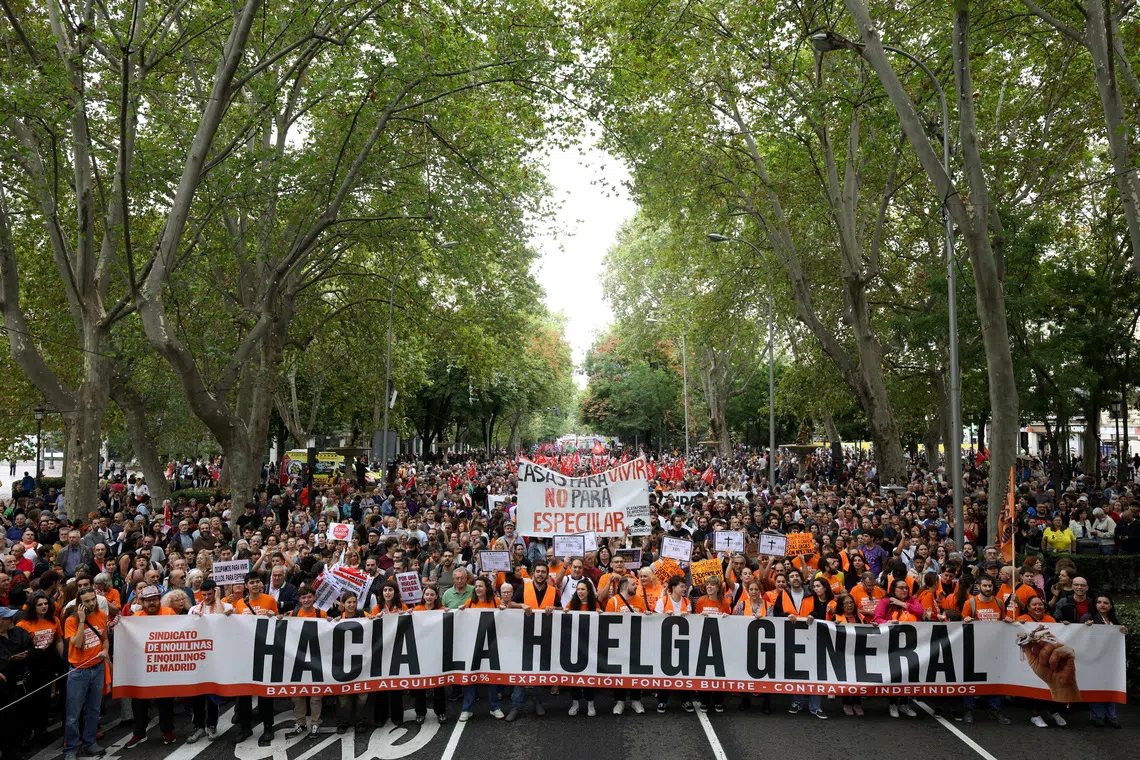
Thousands of people marched in cities across Spain on Saturday to demand stronger tenant protections and action on the housing crisis, after parliament rejected emergency measures proposed by Prime Minister Pedro Sánchez’s minority coalition. Around 50 demonstrations were planned, including in Madrid, Valencia and Barcelona. In Valencia, some protesters clashed with police near a real estate summit; Spanish media reported that officers responded to objects thrown by demonstrators with rubber bullets. Estimates for the Madrid march varied sharply, from 70,000 according to government officials to 500,000 according to the city’s Tenants’ Union. Protesters have also camped in Puerta del Sol, and the union has called for a general strike.
The legislation followed public anger over the September eviction of 87-year-old Maricarmen Abascal, who could not afford a steep rent increase. The backlash led the company owning her flat, Urbagestión, to negotiate her return at a lower rent, but demonstrations continued. Protesters have called for lower rents, an end to evictions and restrictions on investment funds purchasing homes.
The proposed package was split into two decrees. One included suspending evictions of vulnerable tenants until 2030, extending certain rental leases by two years, raising taxes on tourist apartments and restricting purchases by so-called “vulture funds.” The other would have automatically renewed rental contracts. MPs rejected the decrees by 178–172 and 184–166. The conservative People’s Party, far-right Vox and centre-right, pro-independence Together for Catalonia opposed the measures, while Sánchez’s coalition lacked a parliamentary majority. The defeat has intensified speculation about an early general election, although one was not due until next summer.
The demonstrations reflect wider affordability pressures. The Bank of Spain estimates a housing shortfall of 700,000 homes. House prices rose 12.2% in the year to the second quarter of 2026, while rental costs increased 8.5% in 2025. Madrid and Barcelona were the country’s most expensive cities to rent, according to Idealista.
Entities: Pedro Sánchez, Maricarmen Abascal, Spain, Madrid, Valencia • Tone: analytical • Sentiment: negative • Intent: inform
03-10-2026
Protests are planned in more than 50 Spanish cities after parliament rejected two government decrees intended to strengthen tenant protections. The vote has intensified public anger over housing costs and put further pressure on Prime Minister Pedro Sánchez’s minority government. The Tenants’ Union, which is coordinating the demonstrations, said there is a disconnect between public demands and parliamentary decisions. In Madrid, marchers are expected to converge on Plaza de Cibeles, while activists have been camped at Puerta del Sol.
The immediate trigger for the protests was the eviction of 87-year-old Maricarmen Abascal from the Madrid flat where she had lived for about 70 years. Campaigners said an investment company that bought the property tried to raise her rent by 275 percent. Following public backlash, the new owners agreed to let Abascal return at a low rent.
The rejected package would have automatically renewed rental contracts when they expired, restricted evictions of vulnerable tenants, and addressed so-called vulture funds—investment firms that acquire properties cheaply in pursuit of higher returns. The decrees failed after Junts, a Catalan separatist party whose support was required, opposed them, saying they lacked rigour.
The defeat has renewed questions about whether Sánchez’s government can remain in office until the next scheduled election in 2027. Popular Party leader Alberto Núñez Feijóo urged the prime minister to call an early election, arguing that he no longer had support in either parliament or the streets. Opinion polls have generally put the opposition PP ahead of the Socialists.
Housing has long been a major concern in Spain. The article attributes the pressure to housing supply falling short of demand and rising costs. Data from property website Idealista indicate that average rents have nearly doubled in a decade, while asking prices for homes have risen by about 90 percent.
Entities: Pedro Sánchez, Maricarmen Abascal, Alberto Núñez Feijóo, Tenants’ Union, Junts • Tone: analytical • Sentiment: negative • Intent: inform
03-10-2026
Tens of thousands of people protested in Madrid and more than 50 other Spanish cities on Saturday, demanding affordable housing and stronger protections for tenants. The demonstrations followed parliament’s narrow rejection on Friday of two government decrees intended to provide relief to renters, adding to protests that began after 87-year-old Maricarmen Abascal was evicted from her Madrid home on September 23. She had lived in the apartment for about seven decades and was removed on a stretcher.
The rejected measures would have automatically renewed rental contracts when they expired and restricted the eviction of vulnerable tenants. They also targeted so-called “vulture funds,” investment firms that buy properties at low prices in pursuit of higher returns. The Catalan separatist party Junts, whose votes were needed for the decrees to pass, opposed them, saying they lacked rigour.
The defeat is another setback for Socialist Prime Minister Pedro Sanchez and has raised questions about the ability of his minority government to remain in power until the next scheduled election in 2027. Popular Party leader Alberto Nunez Feijoo called on Sanchez to hold an election, arguing that he had the support of neither parliament nor the public. Recent polls have generally put the opposition Popular Party ahead of the Socialists.
The Tenants’ Union, which coordinated the demonstrations, said there was an “irreparable disconnect” between public demands and parliamentary votes. In Madrid, protesters had camped for about a week in Puerta del Sol before marching from several parts of the city and converging on Plaza de Cibeles.
Housing costs have been a major concern in Spain for years as supply has failed to meet demand. Idealista data cited in the article show average rents have nearly doubled in the past decade and asking prices for homes have risen by about 90 percent. Abascal’s eviction intensified anger over rising costs: campaigners said the new owner, an investment company, sought to raise her rent by 275 percent. After public backlash, the owners agreed to let her return at a low rent.
Entities: Spain, Madrid, Pedro Sanchez, Maricarmen Abascal, Alberto Nunez Feijoo • Tone: analytical • Sentiment: negative • Intent: inform
03-10-2026
Tens of thousands of people protested in Madrid and other Spanish cities on October 3, demanding government action on the country’s worsening housing crisis. The demonstrations followed the Spanish parliament’s rejection on October 2 of proposed measures intended to address housing problems, including evictions. The proposals came amid public anger over the eviction of an 87-year-old woman in Madrid and wider concerns about housing access and affordability.
Some protesters in Madrid carried signs calling for a general strike. Demonstrator Nando de Anguulo, 26, said the parliamentary rejection showed that people were being expected to adapt to political parties rather than politicians responding to public demands. The Spanish government estimated that about 70,000 people joined the Madrid demonstration. Protests were also held in 50 other Spanish cities, most of them peacefully.
In Valencia, in southeastern Spain, some demonstrators clashed with police. Officers used rubber bullets and tear gas to disperse the protest. Around 30 protesters entered the City of Arts and Sciences, a prominent cultural landmark, before police removed them.
Spanish media reported that Prime Minister Pedro Sanchez might call a snap election in November after the legislation failed. Those reports said Sanchez would assess the size and strength of the October 3 protests before deciding. His office declined to comment. The demonstrations put renewed public pressure on the government over housing policy and the failure of its proposed response to pass parliament.
Entities: Spain, Madrid, Valencia, Spanish Prime Minister Pedro Sanchez, Nando de Anguulo • Tone: neutral • Sentiment: neutral • Intent: inform