02-07-2026
The article reports on the emotional reunion between Andreína Sarmiento and her two-year-old nephew, Kleiber Moran, who was rescued alive from the rubble of his home in Venezuela’s La Guaira state after spending six days trapped following two major earthquakes. Sarmiento told the BBC that she broke down in tears when she heard he had been found and described her determination to care for him “with a mother’s warmth” while still hoping that his parents—her sister Ana Luz and brother-in-law Carlos—may also be found alive. The piece highlights both the personal grief and hope surrounding the rescue: Kleiber was taken to hospital in Caracas with only minor scratches and no fractures, and Sarmiento said he was gradually stabilizing, speaking to her, and even giving her kisses. At the same time, the wider disaster remains catastrophic, with official deaths already in the thousands, tens of thousands missing, and rescue operations still continuing. The article uses this family story to illustrate the human impact of the earthquakes and the desperate persistence of search and rescue efforts amid mounting casualties.
Entities: Kleiber Moran, Andreína Sarmiento, Ana Luz, Carlos, Delcy Rodríguez • Tone: emotional • Sentiment: negative • Intent: inform
02-07-2026
The BBC article tells the story of several Venezuelan men who were deported from the United States and returned to Venezuela only hours before twin earthquakes devastated the country. The central case is Abelardo Rincón, a 23-year-old who had built a life in Georgia, was detained during the Trump administration’s immigration crackdown, and was flown back to Venezuela on Flight 164. After landing, he and other deportees were housed near the coast while their families awaited confirmation of their safety. Within hours, the earthquakes struck, causing massive deaths, injuries, destruction, and confusion, and leaving many of the deportees missing.
The report follows multiple families as they search hospitals, morgues, and the ruins of the hotel where the deportees were staying. Some relatives fear their loved ones were killed, while others have found survivors with catastrophic injuries. The article highlights the emotional toll on families already separated by migration and detention, and then suddenly forced to confront a natural disaster immediately after repatriation. It also notes the limited information provided by both U.S. and Venezuelan authorities, and the difficulty families face in learning whether their relatives are alive, dead, or injured. The piece combines human-interest reporting with broader themes of immigration enforcement, deportation, disaster response, and government accountability.
Entities: Abelardo Rincón, Donald Trump, Department of Homeland Security, Immigration and Customs Enforcement (ICE), Venezuela • Tone: urgent • Sentiment: negative • Intent: inform
02-07-2026
About 2,000 U.S. service members are supporting humanitarian relief operations in Venezuela after devastating earthquakes that struck the country the previous week. According to Gen. Francis Donovan of U.S. Southern Command, American personnel are deployed on land, in the air, and at sea to assist with search-and-rescue, recovery, and delivery of critical supplies. The mission remains focused on finding survivors during the narrow window when people may still be trapped but alive, with officials noting that Wednesday marked the seventh day after the quakes.
Venezuela’s government said more than 2,000 people have died and over 10,000 were injured. U.S. officials said roughly 310 urban search-and-rescue specialists were flown in soon after the 7.2- and 7.5-magnitude earthquakes, and those teams have already rescued five survivors, including a mother and her toddler. U.S. Embassy chargé d'affaires John Barrett said the United States has provided more than $300 million in humanitarian assistance and continues to coordinate logistics, medical support, water purification, and other needs.
The article also places the disaster response in the broader context of U.S. policy toward Venezuela, referencing the Trump administration’s earlier three-phase plan for stabilization, economic recovery, and political transition. Officials said that although reconstruction efforts will eventually return to economic recovery and long-term rebuilding, the immediate priority is saving lives, clearing debris, and sustaining relief operations for as long as needed.
Entities: Venezuela, U.S. Southern Command, Gen. Francis Donovan, John Barrett, U.S. Embassy in Caracas • Tone: analytical • Sentiment: neutral • Intent: inform
02-07-2026
A small dog named Giselle was rescued from the rubble in Caraballeda, Venezuela, five days after powerful twin earthquakes devastated the country. Video shared by Salvadoran President Nayib Bukele showed a search-and-rescue team from El Salvador locating the dog in a dark crevice, pulling her free, and feeding her after the rescue. The moment drew applause and highlighted a rare hopeful development amid a disaster that has killed more than 1,900 people and left tens of thousands missing. The article places the rescue in the broader context of ongoing international search-and-rescue efforts, including teams from the U.S. and El Salvador, who were still working to save survivors trapped in collapsed buildings. It also notes other recent rescues, including an 18-day-old baby and a mother with her 9-month-old child, underscoring both the scale of the devastation and the persistence of rescue crews. Officials described the conditions as extremely difficult because of aftershocks and unstable structures, while continuing to express hope for additional successful rescues.
Entities: Venezuela, Caraballeda, La Guaira, Giselle, Nayib Bukele • Tone: urgent • Sentiment: negative • Intent: inform
02-07-2026
Six days after twin earthquakes devastated northern Venezuela, rescuers from Venezuela and around the world were still searching collapsed buildings for survivors, though hopes were fading as time passed. The confirmed death toll had climbed to more than 1,900, and thousands remained missing. In La Guaira, near the epicenter, CBS News observed American rescuers working alongside local teams as desperate families pleaded for news of loved ones trapped under rubble. One father searched for his 22-year-old daughter, while another woman mourned the loss of her 13-year-old son and her mother. Rescuers said they were continuing every search effort, but acknowledged that the chances of finding survivors diminished with each passing day.
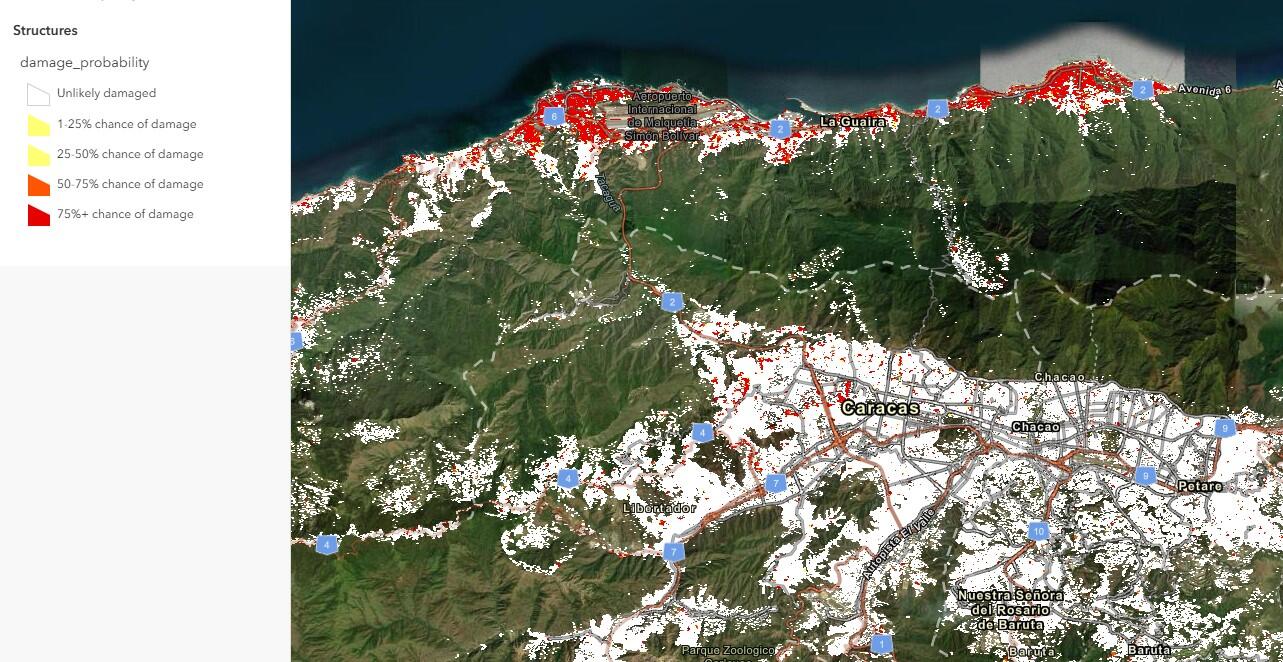
The article also highlights the scale of destruction through a NASA satellite assessment, which estimated that approximately 58,870 buildings were likely damaged or destroyed across the affected region. NASA described the estimate as preliminary and not yet verified by ground assessments. Overall, the article portrays an ongoing humanitarian disaster marked by urgency, grief, and a race against time to save anyone still alive.
Entities: Venezuela, Caracas, La Guaira, Northern Venezuela, Caribbean coastline • Tone: urgent • Sentiment: negative • Intent: inform
02-07-2026
Nearly a week after two powerful earthquakes struck northern Venezuela, rescue crews from Venezuela and abroad, including a team from Los Angeles County Fire Department, are continuing difficult round-the-clock efforts to find survivors in the rubble. The article centers on Hernan Gil Flores, a 44-year-old security guard who has been trapped for six days in a partially collapsed 10-story building in La Guaira. Rescuers believe he remains inside a security booth in an underground parking garage and have been able to communicate with him and provide water, though the operation is extremely dangerous because nearby buildings are leaning toward the structure and could collapse further.
The earthquakes, measuring 7.5 and 7.2, struck within a minute of each other on June 24 and left widespread devastation. The confirmed death toll had risen to more than 1,900, with tens of thousands still missing, according to the United Nations. Rescue workers have also reported several successful rescues amid the destruction, including an 18-day-old baby and mother pulled from a collapsed high-rise, as well as another mother and her 9-month-old baby rescued with only minor injuries. Venezuelan officials say about 6,400 people have been saved so far.
The broader humanitarian crisis remains severe. NASA satellite data suggests nearly 59,000 buildings were damaged or destroyed, and the U.N. says 1.8 million people need aid, including nearly 700,000 children. The worst damage is concentrated in La Guaira, pushing many residents inland to Caracas. One displaced resident tells CBS News that she and her family are living in tents after losing their home, underscoring the scale of displacement and hardship after the disaster.
Entities: Venezuela, La Guaira, Caracas, Hernan Gil Flores, Gusbimar Gonzalez • Tone: urgent • Sentiment: negative • Intent: inform
02-07-2026
A week after deadly twin earthquakes struck Venezuela, the official death toll has risen to 2,295, but widespread skepticism remains about whether that figure reflects the true scale of the disaster. A forensic pathologist working in a makeshift morgue in La Guaira told CNN that the number is likely far higher, describing a crisis in which morgues are overwhelmed, refrigerated storage is full, and bodies are being left outside in the sun. Families are also reportedly recovering bodies themselves because emergency crews cannot keep up. The article describes a growing gap between official government accounting and outside estimates, with the U.S. Geological Survey suggesting the quakes may have killed tens of thousands, while the Venezuelan government has not offered its own final estimate or a clear figure for the missing.
The story also explores the political and informational battle surrounding the death count. Opposition figures, human rights groups, and Venezuelans abroad accuse the government of downplaying the destruction and restricting communications, while some analysts caution that the government may simply be unable to accurately assess casualties amid widespread destruction and institutional inefficiency. A crowdsourced missing-persons database called Venezuela Reporta has emerged as an unofficial source of information, though its numbers cannot be independently verified. Overall, the article portrays a national tragedy compounded by uncertainty, political mistrust, and a lack of reliable data about how many people were killed or remain missing.
Entities: Venezuela, La Guaira, Caracas, deadly twin earthquakes, US Geological Survey • Tone: analytical • Sentiment: negative • Intent: inform
02-07-2026
Rescuers in Venezuela have made contact with a man who was found alive under the rubble of a shopping mall in La Guaira, a week after a major earthquake. According to the report, Portuguese rescuers and the Chilean Fire Department’s USAR team have been working to keep the survivor alive while trapped beneath the debris. The rescue team said the man is stable, indicating that emergency crews are still focused on life support and recovery operations despite the long time elapsed since the quake.
The article is presented as a CNN video segment within broader coverage of the devastating Venezuela earthquakes and their aftermath. It sits among related clips describing other rescue efforts, the humanitarian toll, and challenges facing recovery, including homelessness, displacement, and shortages of fuel that are slowing cleanup work. Another related item highlights a three-year-old boy rescued after six days under rubble, underscoring the ongoing rescue efforts and the possibility of finding survivors even after many days. Overall, the piece emphasizes the persistence of search-and-rescue teams and the fragile hope of survival amid widespread destruction.
Entities: Yoyo Chow, CNN, La Guaira, Venezuela, Portuguese rescuers • Tone: urgent • Sentiment: negative • Intent: inform
02-07-2026
CNN’s article/video describes the harrowing survival of a Venezuelan woman who had been deported from the United States only hours before deadly earthquakes struck her country. The woman was staying in a hotel that was housing more than 100 deported Venezuelans when the building collapsed in the quake. According to CNN reporter Stefano Pozzebon, she was trapped when debris pinned her legs, leaving her unable to feel them. Despite the severity of the collapse, she managed to escape by crawling through a hole that opened in the ceiling. The piece presents her as one of the earthquake survivors and connects her individual ordeal to the larger humanitarian and political crisis involving deported Venezuelans and the disaster response in Venezuela. The article’s emphasis is on the immediacy and human cost of the quake, as well as the shocking timing of her deportation and near-immediate entrapment in the collapse. The video format and associated text also situate her story among other coverage of the Venezuela earthquakes, rescue efforts, and the conditions facing deported migrants.
Entities: Venezuela, United States, CNN, Kate Augustine, Stefano Pozzebon • Tone: urgent • Sentiment: negative • Intent: inform
02-07-2026
Emergency workers in Venezuela rescued a 2-year-old boy, identified as Klieber Moran, from the rubble of a collapsed building six days after devastating twin earthquakes struck the country’s northern coast. The rescue, carried out by a Jordanian emergency team in the hard-hit La Guaira area, was the only reported survivor found on the sixth day of search operations and offered a rare moment of relief amid a mounting disaster. Venezuelan officials said the child was taken to a hospital and was receiving care in Caracas. National Assembly President Jorge Rodríguez said authorities still hoped to find more survivors beneath the debris.
The earthquakes, measured at magnitudes 7.2 and 7.5, have caused widespread destruction and a growing humanitarian crisis. Venezuelan officials said the death toll had risen to 1,943 by Tuesday, with more than 10,500 injured. Rescue efforts have been bolstered by international assistance, including U.S. search-and-rescue teams and Jordanian responders. The State Department previously shared footage of American rescuers pulling a 9-month-old infant and her mother alive from rubble, both with only minor injuries. Meanwhile, UNICEF delivered 47 metric tons of humanitarian supplies, including emergency health kits and materials for safe births, newborn care, and disease prevention. The article emphasizes both the scale of the catastrophe and the small but powerful signs of hope emerging from the rescue operations.
Entities: Venezuela, La Guaira, Caracas, Delcy Rodríguez, Jorge Rodríguez • Tone: urgent • Sentiment: neutral • Intent: inform
02-07-2026
A week after twin powerful earthquakes devastated Venezuela, hopes of finding more survivors were fading as the death toll climbed to nearly 2,300 and thousands more remained missing. In the hardest-hit areas, especially La Guaira near Caracas, rescue crews marked collapsed buildings with the letter ‘D’ for ‘deceased’ after exhaustive searches found no signs of life. Although a few miraculous rescues still occurred, experts warned that trapped victims were unlikely to survive beyond 72 hours, making the search increasingly a recovery operation rather than a rescue mission.
At the same time, the disaster was rapidly turning into a broader humanitarian emergency. Survivors were struggling to secure food, clean water, and shelter, with reports of fights at aid distribution points, theft, and looting. Local residents expressed anger over what they saw as the state’s absence, even as international rescue teams and the US assisted in the response. Official figures put the number of injured above 11,000 and the homeless at nearly 13,000, while the UN estimated 50,000 people missing.
Health authorities and aid agencies warned that Venezuela’s already fragile medical system was under extreme pressure, raising fears of disease outbreaks, especially vaccine-preventable illnesses such as measles and diphtheria. The World Food Programme appealed for emergency funding to feed half a million people, while satellite assessments suggested tens of thousands of buildings had been damaged or destroyed. The article portrays a disaster moving from urgent search-and-rescue into a prolonged crisis of survival, public health, and humanitarian need.
Entities: Venezuela, La Guaira, Caracas, Delcy Rodriguez, Jorge Rodriguez • Tone: urgent • Sentiment: negative • Intent: inform