01-09-2026
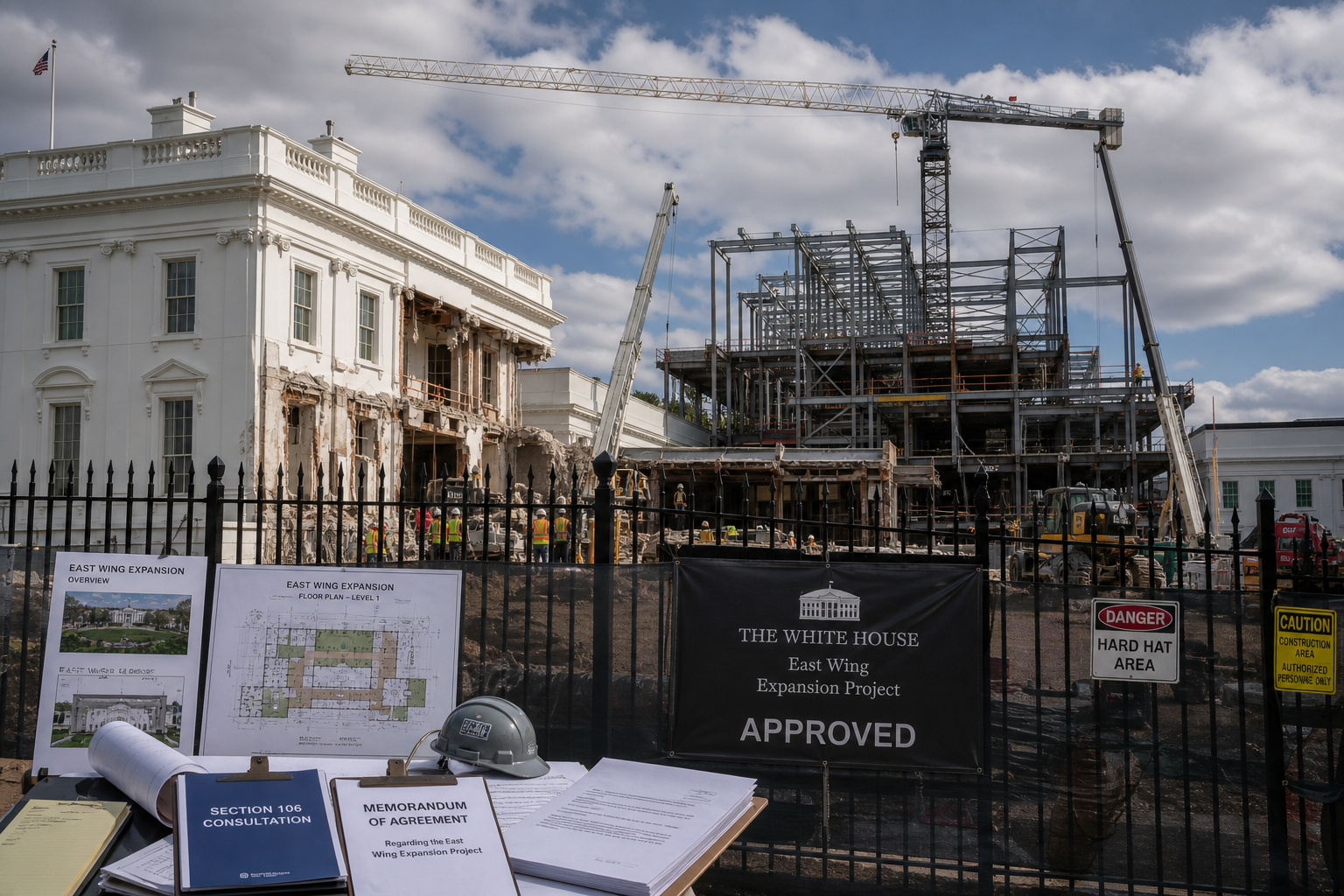
The United States Supreme Court has allowed construction to continue on President Donald Trump’s proposed $400 million ballroom at the White House while legal challenges proceed. The divided court’s apparent 5-4 decision replaces an earlier temporary order permitting construction and represents a victory for Trump, whose administration has pursued an expansive view of presidential authority.
The justices did not rule on whether the project itself is lawful. Instead, the unsigned majority opinion concluded that the National Trust for Historic Preservation likely lacks the legal standing to challenge the construction. The majority also referred to national security concerns cited by the administration. Chief Justice John Roberts and the court’s three liberal-leaning justices dissented. Roberts described the project as “likely unlawful” because Congress had not approved it and warned that the decision undermined the separation of powers.
The lawsuit will return to lower courts, but the construction schedule could make the dispute difficult to resolve before major work is completed. Court documents state that crews are working 20 hours a day on the planned 8,400-square-metre ballroom. The framework is expected to be completed in November, much of the facade by April, and the entire project by August 2028.
The National Trust argues that Trump lacks unilateral authority to demolish the East Wing and build the ballroom. Lower courts previously ordered aboveground construction to stop, although underground work on bunkers and military installations could continue. The administration has argued that the president has broad authority to renovate the White House and that a secure ballroom is required for national security, despite initially describing the project as privately funded.
The demolished East Wing contained the first lady’s offices and the White House movie theatre. It was built in 1902 during Theodore Roosevelt’s presidency and substantially expanded in 1942 under Franklin Roosevelt. The Supreme Court’s ruling is part of a broader pattern in which the administration has won several emergency-docket cases, although it has also lost some major policy disputes after full review.
Entities: United States Supreme Court, White House, Donald Trump, John Roberts, National Trust for Historic Preservation • Tone: analytical • Sentiment: negative • Intent: inform
01-09-2026
The US Supreme Court has allowed the Trump administration to continue construction of a $400m ballroom at the White House, temporarily blocking lower-court decisions that would have halted the above-ground portion of the project. The 5-4 emergency ruling is a victory for President Donald Trump, although the justices did not definitively rule on whether the project itself is legal.
The majority said the lower courts had likely exceeded their authority by stopping construction and concluded that the National Trust for Historic Preservation probably lacked standing to bring the case. The administration had also shown that it could suffer irreparable harm if construction were delayed. Chief Justice John Roberts joined the court’s three liberal justices in dissent, arguing that construction was likely unlawful because Congress had not approved the project. He wrote that the ruling was “no victory for the separation of powers.”
The National Trust challenged Trump’s decision to demolish the historic East Wing and proceed with construction without congressional authorization. The organization argued that the work was causing irreversible damage to a landmark. Its case relied partly on the declaration of Alison Hoagland, a Washington DC resident and preservationist who said the proposed ballroom would harm her professional, personal, aesthetic, cultural and historical interests. Roberts said those alleged injuries were sufficient for the lawsuit to proceed.
Trump welcomed the decision, calling the lawsuit baseless and describing the ballroom as a major addition to Washington. He has said the White House needs a larger events space and that the project would improve security, particularly after an alleged assassination attempt at a White House Correspondents’ Association dinner in April.
The 90,000 sq ft ballroom is expected to be substantially completed by November and fully finished by August 2028. It forms part of Trump’s broader plans to reshape Washington, including a South Lawn helipad, renovations to the Lincoln Memorial Reflecting Pool and a proposed “Arc de Trump.”
Entities: US Supreme Court, Donald Trump, White House ballroom project, National Trust for Historic Preservation, Chief Justice John Roberts • Tone: analytical • Sentiment: neutral • Intent: inform
01-09-2026
The US Supreme Court has allowed Donald Trump to continue construction of a ballroom at the White House, overturning a lower-court order that had required most work on the project to stop. The 5-4 decision represents a significant legal and political victory for Trump as he pursues projects intended to leave a lasting mark on Washington during his second term.
The court’s conservative majority concluded that the National Trust for Historic Preservation, which brought the lawsuit, likely lacked the legal standing necessary to challenge the construction. Because of that procedural finding, the justices lifted the stay blocking the work while the broader lawsuit continues in lower courts. The ruling does not definitively resolve whether the ballroom project is lawful.
Chief Justice John Roberts joined the Supreme Court’s three liberal members in dissent. In his opinion, Roberts argued that the White House renovation was “likely unlawful” because Congress had not authorised the project. His warning highlights the central legal dispute: whether the executive branch can undertake such a major alteration to the White House complex without congressional approval.
Trump welcomed the ruling, saying construction could proceed “without any further contingency, doubt, or threat.” The ballroom is part of a wider programme to reshape the US capital. Other proposed or ongoing initiatives include renovations to Washington’s Reflecting Pool and the construction of a large triumphal arch. The decision permits work on the ballroom to continue for now, but the legal challenge remains unresolved and could lead to further proceedings in the lower courts.
Entities: Donald Trump, US Supreme Court, Chief Justice John Roberts, National Trust for Historic Preservation, White House ballroom • Tone: analytical • Sentiment: neutral • Intent: inform
01-09-2026
The US Supreme Court has allowed the Trump administration to continue construction of a $400 million ballroom complex at the White House while litigation over the project proceeds. The court’s unsigned 5-4 order overturned a lower-court decision that had halted above-ground construction. The majority did not determine whether the ballroom is legally authorized; instead, it concluded that the National Trust for Historic Preservation, which is challenging the project, likely lacked standing and that stopping construction could cause the government irreparable harm.
Five of the court’s six conservative justices supported the order. Chief Justice John Roberts joined the three liberal justices in dissent, arguing that the decision failed to address the central legal issue. Roberts said the project was likely unlawful because Congress had not expressly approved it and maintained that federal law gives Congress authority over construction on federal property in Washington.
The National Trust argues that President Trump lacked unilateral authority to demolish the White House’s East Wing and replace it with a 90,000-square-foot ballroom. The East Wing has already been demolished. The administration initially described the project as a privately funded ballroom but has increasingly emphasized national security, saying the wider complex will be connected to an underground military facility containing bomb shelters, medical facilities and defenses against drones and missiles.
Trump celebrated the ruling on Truth Social and said the ballroom and military complex could proceed without further legal uncertainty. The administration says construction is progressing rapidly and that the ballroom is expected to be completed in 2028. The National Trust has accused officials of trying to accelerate construction and “outrun the courts.” Although the Supreme Court’s order permits work to continue for now, the fundamental dispute over whether Trump needed congressional approval remains unresolved.
Entities: Donald Trump, US Supreme Court, Chief Justice John Roberts, National Trust for Historic Preservation, White House • Tone: analytical • Sentiment: neutral • Intent: inform