12-09-2026
The article examines Iran’s enthusiastic reaction to the Houthi capture of Yemen’s Red Sea coastline, including the port city of Mocha and several islands. The advances reportedly give the Iran-aligned group control or significant influence over the Bab al-Mandeb strait, a vital maritime chokepoint connecting the Red Sea with the Gulf of Aden. Iranian officials and state-linked media have portrayed the developments as a victory for the broader “resistance” camp and as a potential source of additional leverage against the United States.
Senior Iranian figures, including Islamic Revolutionary Guard Corps spokesman Hossein Mohebbi, parliament speaker Mohammad Bagher Ghalibaf, and First Vice President Mohammad Reza Aref, publicly praised the Houthis’ battlefield gains. Iranian media described the outcome as a “miracle of resistance” and suggested that Iran and the Houthis had become the “lord of the straits.” The article notes that the Yemeni government, already weakened by years of conflict, now lacks direct access to the Red Sea after losing Mocha.
The Houthi gains could benefit Tehran by giving its ally closer-range capabilities against shipping in the Bab al-Mandeb. The group has previously attacked vessels it said were linked to Israel during the Gaza war, prompting military campaigns by the United States, United Kingdom, and Israel. Although the Houthis have not formally closed the strait, their commanders have suggested that coastal artillery could threaten ships without relying solely on missiles and drones. The group says navigation remains safe except for Saudi vessels.
The development also parallels Iran’s use of the Strait of Hormuz as leverage in its confrontation with Washington. At the same time, Iran’s Foreign Ministry has avoided openly presenting the Houthi victories as a direct Iranian strategy. It insists that the Houthis act independently, emphasizes Yemen’s grievances and Saudi blockade, and rejects the characterization of the group as merely an Iranian proxy. The article therefore presents the advances as both a major strategic opportunity for Tehran and a complicated development that Iran continues to frame through regional sovereignty and Yemeni agency.
Entities: Iran, Yemeni Houthis / Ansar Allah, Yemen’s Red Sea coast, Bab al-Mandeb strait, Mocha port • Tone: analytical • Sentiment: neutral • Intent: analyze
12-09-2026
The article reports that Yemen’s Iran-aligned Houthi movement is celebrating after claiming to have seized control of Yemen’s Red Sea coast. The takeover reportedly followed a rapid offensive against Yemen’s internationally recognised government, representing a significant development in the country’s continuing conflict and a potential shift in control of a strategically important coastal area.
The report also describes an immediate military response from government forces. They have launched strikes against Houthi positions as fighting intensifies, indicating that the reported territorial gains have not ended the confrontation and may instead be contributing to a broader escalation. The article does not provide details about the locations of the strikes, the scale of the Houthi advance, casualties, damage, or the identities of specific commanders involved.
The report’s framing focuses on the contrast between Houthi celebrations and the government’s military retaliation. It says the Houthis have been celebrating the reported seizure on social media, while government forces are responding with attacks on their positions. This juxtaposition highlights the continuing volatility of Yemen’s civil war and the competing claims of authority between the Houthis and the internationally recognised government.
Published on 12 September 2026, the brief report functions primarily as a breaking-news update. It presents the reported territorial change and subsequent strikes without offering broader political background, independent verification, or detailed analysis of the consequences for Yemen, regional security, or shipping along the Red Sea. The central development is the reported Houthi control of the coast and the resulting escalation in fighting.
Entities: Houthis, Yemen, Red Sea coast, Iran alignment, Internationally recognised government • Tone: urgent • Sentiment: negative • Intent: inform
12-09-2026
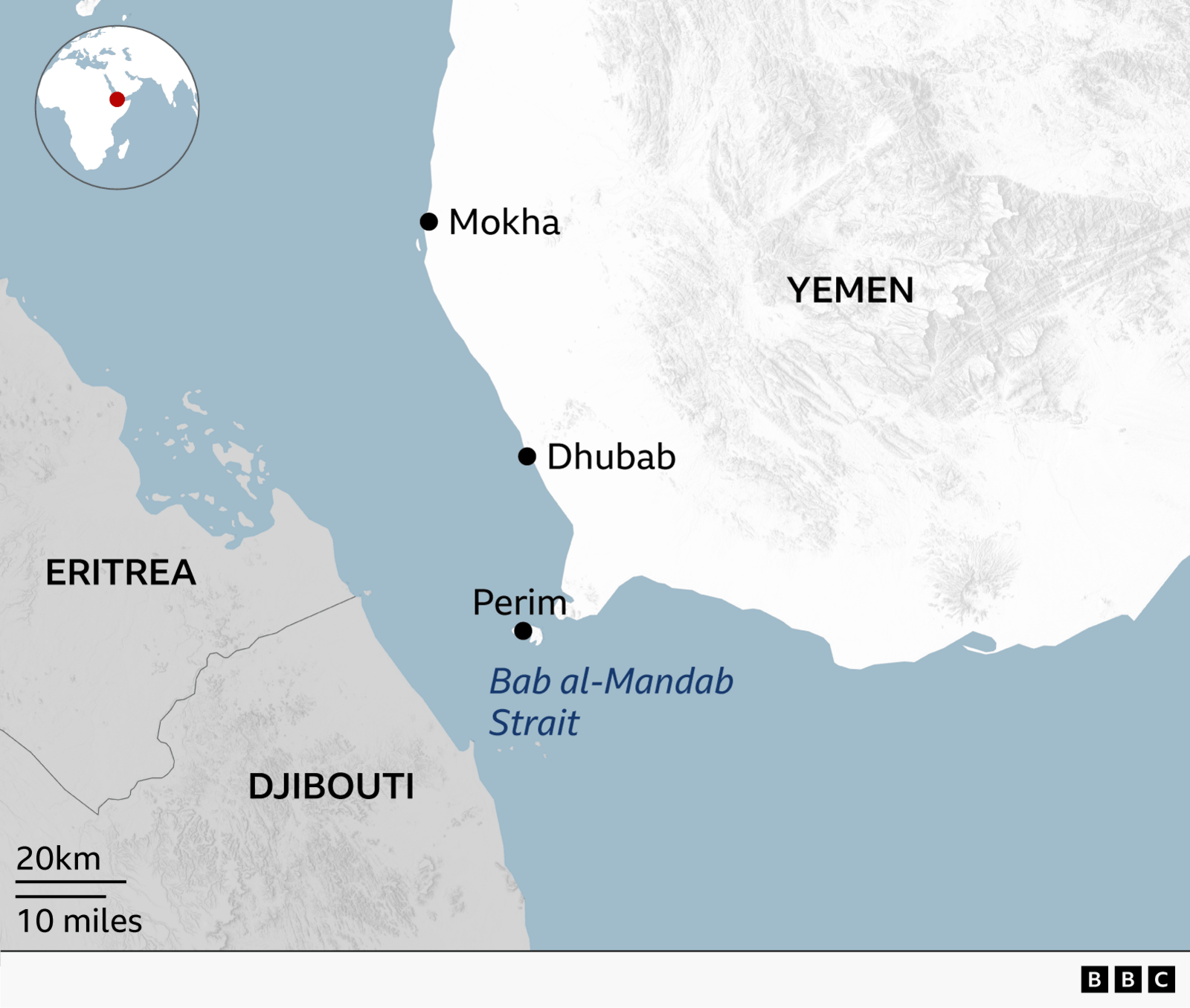
Houthi forces have seized Mayun Island, also known as Perim, a 13-square-kilometre volcanic island located in the Bab al-Mandeb Strait at the southern entrance to the Red Sea. The takeover was confirmed by officials from both Yemen’s internationally recognised government and the Houthis. The move gives the Iran-backed group a physical foothold in one of the world’s most important maritime chokepoints and consolidates its control over Yemen’s Red Sea coastline, including nearby Hanish Island and the port city of Mocha.
Analysts say control of Mayun could significantly strengthen the Houthis’ position in their conflict with Saudi-backed Yemeni government forces and provide Iran with additional leverage in its broader confrontation with the United States. Because Mayun divides the Bab al-Mandeb into two channels, the Houthis could potentially threaten or restrict maritime traffic through the strait. Their stated policy is to allow general shipping to pass while targeting vessels linked to Saudi Arabia, but their previous campaign included attacks on more than 100 commercial ships between November 2023 and mid-2025, including some vessels with no clear connection to Israel or its allies.
The island’s position could make attacks easier because the Houthis would be able to use shorter-range missiles against passing vessels. Analysts warn that renewed disruption could increase war-risk insurance, shipping costs and prices across energy, container and bulk-commodity markets.
Whether the Houthis can retain Mayun depends largely on whether Saudi-backed forces attempt to recapture it. The Houthis are well placed to defend it in the short term because they control surrounding territory, but the island could be vulnerable to a long-term amphibious assault. Analysts identify the consolidation of coastal and mainland areas as the decisive factor. The rapid Houthi advance is attributed to weak coordination and armament among government forces, alongside the Houthis’ years-long military build-up. US President Donald Trump said the Houthis had asked Washington not to intervene and suggested that arrangements concerning shipping and Saudi Arabia could be resolved.
Entities: Houthi forces, Mayun Island (Perim Island), Bab al-Mandeb Strait, Red Sea, Yemen’s internationally recognised government • Tone: analytical • Sentiment: neutral • Intent: analyze
12-09-2026
The supplied material does not contain the substantive body of the Al Jazeera liveblog. It includes only the headline, the source publication and URL, and fragments of website interface text such as “Advertisement,” “16 Updates,” and a prompt inviting readers to receive instant alerts. Consequently, there is not enough verified article content to provide a comprehensive account of the reported developments, chronology, statements by officials, or reactions from the parties involved.
The headline indicates that the live coverage concerns the Iran war and presents two reported developments: an assertion that the Houthis control the Red Sea coast and a claim that a Saudi pipeline has been shut down. It also labels the coverage as related to Donald Trump, suggesting that the liveblog may include political or military developments involving him. However, the supplied text does not explain who made these claims, when the events occurred, what areas of the Red Sea coast are involved, which Saudi pipeline is affected, or what consequences may follow. It also provides no corroborating details, casualty figures, official responses, or independent assessments.
The available material is therefore best classified as incomplete source data rather than a full news article. The extracted entities and features below are limited to information explicitly present in the headline and publication metadata. No additional facts have been inferred from the headline, and the apparent claims about territorial control or infrastructure disruption should not be treated as independently verified based solely on this excerpt.
Entities: Iran war, Houthis, Red Sea coast, Saudi Arabia, Saudi pipeline • Tone: neutral • Sentiment: neutral • Intent: inform
12-09-2026
The article reports that U.S. President Donald Trump believes Iran was “probably” responsible for an attack on Saudi Arabia’s East-West oil pipeline. The reported attack occurred on Friday and forced Saudi authorities to shut down the pipeline. The East-West pipeline is a major piece of Saudi oil infrastructure, so its closure represents a potential disruption to the country’s oil transportation system and raises broader concerns about regional security and energy supplies.
The article presents Trump’s statement as an assessment rather than a confirmed finding, using the qualification “probably” to indicate uncertainty. No additional evidence, independent investigation, or response from Iran is included in the provided text. The report therefore focuses primarily on the U.S. president’s attribution of blame rather than establishing who carried out the attack.
Trump also said that the Houthis had asked his administration not to intervene in Yemen. This remark introduces a second regional development involving the Houthi movement and the U.S. government, although the article does not provide details about the nature of the request, the circumstances surrounding it, or Washington’s response.
The report is presented in a concise, factual news format. It highlights two statements by Trump: his view that Iran was likely behind the Saudi pipeline attack and his claim that the Houthis did not want the United States to intervene in Yemen. The available text does not describe casualties, the extent of damage, the duration of the pipeline shutdown, or any official Iranian or Saudi response.
Entities: Donald Trump, Iran, Saudi Arabia, East-West oil pipeline, Houthis • Tone: neutral • Sentiment: negative • Intent: inform
12-09-2026
Yemeni government forces say they launched air strikes against Houthi fighters and their vehicles along the Red Sea coast after the Houthis seized Mocha and the island of Mayun, giving the group control of the Bab al-Mandeb strait. Government forces described the fighting as a major escalation and a “battle for survival.” Yemen’s state news agency, Saba, reported that military operations near Mocha destroyed Houthi vehicles and weapons and killed fighters. Government spokesperson Majed Abdullah al-Nazili also said Houthi vehicles and members were targeted on the Mocha-Dhubab road, about 11km from the city.
The Houthi capture of Mocha on Thursday and Mayun on Friday has intensified concerns about regional security and international shipping. The Bab al-Mandeb is a strategically important waterway connecting the Red Sea with the Gulf of Aden and is vital to global oil transportation.
The escalation has also worsened Yemen’s humanitarian crisis. The United Nations said nearly 46,000 people had been displaced since the fighting intensified earlier in the week, although the actual number may be higher. Abdusattor Esoev, the International Organization for Migration’s chief in Yemen, said the fall of Mocha had made it more difficult for aid agencies to reach vulnerable communities because the UN had maintained a significant presence there.
The wider regional fallout includes the temporary closure of Saudi Arabia’s 1,200km East-West oil pipeline after a drone attack. The drones were reportedly launched from Iraq, but no group has claimed responsibility. Iraq’s parliament speaker, Haybat al-Halbousi, condemned the use of Iraqi territory.
The article also reports that Saudi Crown Prince Mohammed bin Salman asked US President Donald Trump twice for American air strikes against the Houthis, but the requests were rejected. Trump said the Houthis had contacted Washington and did not want the United States to intervene. The head of US Central Command is meanwhile in Saudi Arabia for discussions about the Houthi advances.
Entities: Yemen government forces, Houthi movement, Mocha, Mayun island, Bab al-Mandeb Strait • Tone: urgent • Sentiment: negative • Intent: inform
12-09-2026
Yemen’s Houthi movement has reportedly expanded its control over the country’s western Red Sea coast, seizing or moving into strategically important locations near the Bab al-Mandab Strait. A source from Yemen’s internationally recognised government told the BBC that the Iran-backed group had taken Perim Island, while military sources said it had captured the port city of Mokha from Saudi-backed pro-government forces. A Yemeni official claimed the Houthis now controlled the entire coastline, although the group’s own statement did not mention Perim Island.
The Houthis said their recent offensive was launched in response to what they called Saudi aggression. They claimed to have expelled Saudi-backed forces from six districts in the Taiz and Hodeidah regions, while warning that maritime navigation was safe for all vessels except those from Saudi Arabia. The developments have increased concerns about international shipping through the Bab al-Mandab, one of the world’s most important maritime chokepoints, particularly after disruption to the Strait of Hormuz during the wider US-Iran conflict.
Saudi Crown Prince Mohammed bin Salman has reportedly urged US President Donald Trump to take military action against the Houthis. Trump has so far declined direct military involvement but has offered intelligence and targeting assistance. Saudi Arabia has not publicly commented on the reported territorial gains.
The escalation has also affected energy markets and regional infrastructure. Oil prices have risen, while Saudi Arabia has faced Houthi missile and drone attacks on cities and energy facilities. Saudi Arabia also reported drone strikes from Iraq against its East-West oil pipeline. Meanwhile, a Saudi-led coalition has conducted air strikes in Houthi-controlled areas of Yemen.
The fighting has caused substantial humanitarian consequences. At least 46,000 people have been displaced since the latest escalation, according to the International Organization for Migration, which warned that displacement was increasing rapidly. The conflict follows the collapse of a largely observed truce and a civil war that began with the Houthis’ 2015 takeover of the capital, Sanaa.
Entities: Houthis, Yemen’s internationally recognised government, Saudi Arabia, Perim Island (Mayyun), Bab al-Mandab Strait • Tone: analytical • Sentiment: negative • Intent: inform
12-09-2026
Saudi Arabia has temporarily closed its 1,200km East-West oil pipeline after drones launched from Iraq struck the facility, injuring people and causing damage that remains under assessment. The pipeline is strategically important because it allows Saudi Arabia, the world’s largest crude oil exporter, to transport oil to the Red Sea while bypassing the Strait of Hormuz. It reportedly carries between 4% and 5% of global oil supply.
Iraq acknowledged that the attack originated in Maysan governorate, which borders Iran, and removed the province’s operations commander while launching an investigation. Saudi Arabia said it would not retaliate for now, following a call from Iraq’s prime minister, but warned that it reserved the right to take further measures to protect its sovereignty, infrastructure, and population. The Gulf Co-operation Council condemned the incident as a dangerous escalation and a violation of international law.
The attack occurred as Iran-backed Houthi rebels made rapid gains in Yemen. The Houthis claimed control of much of Yemen’s Red Sea coastline, including the strategic port city of Mokha and the Bab al-Mandab Strait, a key gateway linking the Red Sea with the Suez Canal. They said navigation remained safe for all shipping except Saudi vessels. Saudi-backed Yemeni government forces responded with attacks on Houthi positions around Mokha and in Taiz and Ibb governorates.
The simultaneous threats to Saudi Arabia’s oil infrastructure and major maritime routes have intensified concerns about global energy supplies. Crude oil prices rose above $100 per barrel for the first time since July, while fears of renewed inflation and higher government borrowing costs increased. The developments also add pressure to the wider Middle East conflict, which the article says has continued into its seventh month.
Entities: Saudi Arabia, East-West oil pipeline, Iraq, Maysan governorate, Iran-backed militias • Tone: urgent • Sentiment: negative • Intent: inform
12-09-2026
The live report describes the economic and geopolitical effects of the escalating Iran war and related Houthi advances in Yemen. U.S. diesel prices reached a record national average of $6.05 per gallon, more than 60% higher than a year earlier, raising concerns that transportation companies will pass increased fuel costs on to consumers. Brent crude prices also rose sharply before easing below $105 per barrel, while U.S. inflation remained elevated at 3.4% year over year.
According to multiple reports, Iran-backed Houthi forces seized Yemen’s Red Sea port of Mokha, the island of Perim, and the remaining islands under government control in the Bab el-Mandeb Strait. These positions could enable the Houthis to threaten commercial shipping and Saudi oil exports more easily. Saudi Crown Prince Mohammed bin Salman reportedly urged President Donald Trump to take military action against the Houthis as they advanced along Yemen’s western coast.
Saudi Arabia also shut sections of its East-West oil pipeline after drone attacks caused injuries and damage. The pipeline is a major alternative to the Strait of Hormuz, transporting an estimated 5 million to 7 million barrels of oil per day from eastern Saudi Arabia to the Red Sea.
The report further covers delayed Israel-Lebanon peace talks, increased violence involving Hezbollah, a war of words between Iranian Foreign Minister Abbas Araghchi and U.S. Treasury Secretary Scott Bessent, and a rebound in U.S. stocks after oil prices declined. Indian Prime Minister Narendra Modi also held separate meetings with Russian President Vladimir Putin and Iranian President Masoud Pezeshkian ahead of a BRICS summit. The supplied article ends mid-sentence during that final update.
Entities: United States diesel prices, Iran war, Yemeni Houthis, Mokha port, Perim island • Tone: urgent • Sentiment: negative • Intent: inform
12-09-2026
The Iran war is intensifying across the Middle East, with Iran-backed Houthi forces reportedly expanding their control over Yemen’s Red Sea coast and key maritime positions. The Houthis have seized the port of Mokha, the strategic island of Perim, and the remaining islands in the Bab el-Mandeb Strait, according to reports and a Yemeni military official. Control of these locations could make it easier for the group to attack commercial vessels and disrupt a crucial route for Saudi oil exports.
Saudi Arabia said it shut down a major oil pipeline after attacks the previous day. The pipeline had become increasingly important after the Strait of Hormuz was disrupted, with its throughput reportedly more than doubling since the war began, according to the International Energy Agency. Saudi Crown Prince Mohammed bin Salman has urged President Donald Trump to take military action against the Houthis, as the group advances along Yemen’s Red Sea coast. Trump and the crown prince have reportedly spoken several times in recent days.
The conflict is also producing diplomatic and regional repercussions. Bahrain rejected a proposed Oman meeting involving Iran and Gulf states, arguing that regional security cannot be achieved through appeasement and demanding unrestricted access to the Strait of Hormuz. Iraq closed three crossings with Iran after a drone attack on the Saudi pipeline was reportedly launched from Iraqi territory, while authorities investigated the perpetrators and dismissed a provincial military commander.
At a BRICS summit in New Delhi, the leaders of China, Russia, Iran, India and other member states called for restraint and condemned attacks on civilian infrastructure and safeguarded nuclear facilities. Iranian President Masoud Pezeshkian also met the UAE crown prince. Meanwhile, Trump predicted that the war with Iran would end “very soon,” while saying Iran was probably responsible for the attacks on Saudi Arabia.
Entities: Iran-backed Houthis, Mokha, Yemen, Perim Island, Bab el-Mandeb Strait, Saudi Arabia • Tone: urgent • Sentiment: negative • Intent: inform
12-09-2026
President Donald Trump said the war involving Iran will likely end shortly after the November midterm elections and predicted that oil prices would fall sharply once the conflict ends. His comments came as crude prices retreated on Friday but recorded significant weekly gains after rising above $100 per barrel for the first time in months. Brent crude settled at $104.61 per barrel, down 2.8%, while U.S. West Texas Intermediate fell 2.4% to $100.05. Prices had reached approximately $108 for Brent and more than $104 for WTI earlier in the week.
The pullback followed reports that Iran would meet Gulf states in Oman to discuss the Strait of Hormuz. MS NOW reported that Iranian and Gulf officials could sign an agreement establishing an Iran-Oman shipping route through the strategically important waterway. However, Iranian President Masoud Pezeshkian rejected the idea that Iran would surrender, saying his country had resisted U.S. and Israeli aggression.
The article also describes escalating regional threats to energy infrastructure and shipping. Trump said Iran was probably responsible for drone attacks on Saudi Arabia’s East-West crude pipeline, which Saudi authorities temporarily shut down as a precaution. The pipeline can transport up to 7 million barrels of oil per day to Red Sea export terminals, allowing Saudi Arabia to bypass the Persian Gulf.
Trump also claimed that Yemen’s Iran-backed Houthi movement had contacted his administration and did not want to fight the United States. At the same time, reports said the Houthis had seized the port city of Mokha and advanced onto Perim Island, a strategically located island dividing the Bab el-Mandeb Strait. Control of both the Bab el-Mandeb and Strait of Hormuz could give Iran and its allies influence over two critical oil and shipping chokepoints. The developments have raised concerns about disruptions to global trade and prompted Saudi Crown Prince Mohammed bin Salman to seek U.S. military intervention, according to an attributed report.
Entities: Donald Trump, Iran war, Masoud Pezeshkian, Iran, Saudi Arabia • Tone: urgent • Sentiment: negative • Intent: inform
12-09-2026
The article reports that Iran-backed Houthi fighters have captured Mayyun Island, also known as Perim, a strategically important island in the Bab el-Mandeb Strait. The island divides the narrow waterway into two shipping lanes, and its seizure followed the withdrawal of Yemeni government forces. Local officials and eyewitnesses said Houthi fighters were deploying along the strait and moving in military vehicles, effectively giving the group control of Yemen’s Red Sea gateway.
The reported offensive also included the capture of the port city of Mokha, the town of Dhubab, the coastal village of Murad and Zuqar Island. Government forces on the Hanish Islands were reportedly besieged, with more than 2,000 soldiers appealing for rescue, food, water and air support. If confirmed, the offensive would place Yemen’s entire Red Sea coastline under Houthi control.
The article highlights the global economic significance of the development. The Bab el-Mandeb links Asian and European trade through the Red Sea and the Suez Canal, while the Bab el-Mandeb and Strait of Hormuz together handle more than a quarter of global seaborne crude oil and petroleum shipments. Nearly one-third of global container traffic passes through the Red Sea. A Houthi-controlled strait, combined with an Iranian blockade of Hormuz, could force shipping companies to reroute around the Cape of Good Hope, adding weeks, insurance costs and fuel expenses to journeys.
Although Houthi officials claimed international shipping was safe, they later said Saudi vessels were excluded from that assurance. The takeover comes amid renewed fighting with Saudi-backed Yemeni forces, Houthi attacks on Saudi targets and rising oil prices. The article also examines the uncertain likelihood of intervention by the United States, Turkey or Pakistan, noting that Washington was reportedly reluctant to launch strikes while involved in its own conflict with Iran.
Entities: Houthis / Ansar Allah, Yemen, Bab el-Mandeb Strait, Mayyun (Perim) Island, Red Sea shipping routes • Tone: urgent • Sentiment: negative • Intent: inform
12-09-2026
The France 24 report describes two developments that could affect regional security and energy shipments. Saudi Arabia has suspended the transfer of oil through a major pipeline after the infrastructure was attacked by drones. The report presents this as a disruption threatening Saudi oil exports, although it does not specify the pipeline, the extent of the damage, the duration of the suspension, or whether the attacks caused casualties.
At the same time, Houthi forces have reportedly taken control of a strategic port and an island near Bab el-Mandeb from forces aligned with Yemen’s government. Bab el-Mandeb is a vital maritime passage connecting the Red Sea with the Gulf of Aden, so the reported Houthi advances could affect shipping and regional military calculations. The headline emphasizes that the Houthis have seized key positions around the strait, while the body identifies a port and island as the captured sites.
The report also notes that Iran, which supports the Houthi rebels, denies involvement in the attacks. It does not provide further evidence regarding Iran’s role, identify those responsible for the drone strikes, or offer responses from Saudi Arabia, Yemen’s government, or other international actors. Overall, the brief video report links an attack on Saudi oil infrastructure with Houthi territorial gains around a strategically important shipping route. Its focus is on the immediate security and economic implications of the developments rather than on detailed background, verification, or broader diplomatic consequences.
Entities: Houthi forces, Saudi Arabia, Iran, Yemen’s government forces, Bab el-Mandeb • Tone: urgent • Sentiment: negative • Intent: inform
12-09-2026
The France 24 liveblog reports that Saudi Arabia temporarily shut down its East-West pipeline, also known as Petroline, as a precaution after the critical oil route was targeted in multiple attacks earlier in the week. The pipeline carries Saudi crude from the country’s eastern oil-producing region to the Red Sea, providing an alternative export route that reduces reliance on the Strait of Hormuz. The reported damage included a fire at infrastructure southeast of Medina, while Saudi authorities also closed sections of the pipeline in the Riyadh and Medina areas.
Saudi Arabia and Iraq both stated that the attacks originated in Iraqi territory, where Iranian-backed militias operate. The report does not identify the specific group responsible for the attacks, but it places the incident within a broader regional escalation involving Iran-aligned forces and the conflict in Yemen. The developments raise concerns about the security of Saudi energy infrastructure and the potential impact on regional oil supplies.
The liveblog also highlights several related events. Iran-aligned Houthi rebels in Yemen reportedly seized control of the country’s entire Red Sea coast. Iran’s president said pressure on Iran had reached a critical and dangerous stage, while US President Donald Trump reportedly declined a request from Saudi Arabia’s crown prince for US strikes against the Houthis.
The supplied article excerpt is dated September 12, 2026, and was updated later the same day. It presents a developing situation rather than a completed analysis, attributing information to France 24, Reuters, The Associated Press and Agence France-Presse. The source page currently displays a “Page not found” notice, so the available material may represent only a partial version of the original live coverage.
Entities: Saudi Arabia, East-West pipeline (Petroline), Riyadh, Medina, Iraq • Tone: urgent • Sentiment: negative • Intent: inform
12-09-2026
An Associated Press report describes a sharp escalation in regional security threats centered on Yemen, the Red Sea and the Persian Gulf. Iran-backed Houthi rebels captured Mayun, a strategically located island at the entrance to the Red Sea and near the Bab el-Mandeb Strait. The waterway carries roughly 12% of global goods and is an important alternative route for Saudi oil exports after disruptions in the Strait of Hormuz. Houthi spokesman Yahya Saree said shipping would remain safe except for Saudi vessels, but markets and experts remain concerned about the group’s unpredictability. The United Nations also said Houthi forces seized a compound in Mokha that had housed U.N. personnel, although all staff escaped safely.
Saudi Arabia separately shut down its East-West oil pipeline as a precaution after attacks. Iraq said an investigation determined that the attacks were launched from Maysan province and dismissed the local operations commander. The International Energy Agency said Saudi oil exports through the Red Sea have more than doubled since U.S. and Israeli attacks on Iran disrupted Hormuz shipping.
The article also reports that Anthropic blocked users in Houthi-controlled northern Yemen after finding that its AI models were being used in programs aimed at developing advanced missiles and autonomous targeting software. The company said there was no evidence a weapon had been successfully deployed.
Additional developments include planned Iranian talks with Gulf states over Hormuz shipping, Israeli claims that Hezbollah tunnels in southern Lebanon were destroyed, continued Israeli demolitions and military activity there, and an Israeli strike in Gaza that killed one man and wounded others, including children. Lebanese and Israeli ambassadors are also scheduled to meet at the U.S. State Department to discuss a trilateral framework intended to address Lebanon’s sovereignty and Israel’s security.
Entities: Yemen's Houthi rebels, Mayun island, Bab el-Mandeb Strait, Red Sea maritime shipping and Saudi oil exports, Saudi Arabia's East-West oil pipeline • Tone: analytical • Sentiment: negative • Intent: inform
12-09-2026
The article describes a worsening threat to oil exports from the Persian Gulf as regional tensions disrupt both major maritime routes used to transport crude. Houthi militants backed by Iran have expanded their control of Yemen’s Red Sea port of Mokha, placing additional pressure on a strategically important corridor for Gulf energy shipments. This development threatens to further restrict access to the Red Sea and complicate the movement of Persian Gulf oil to global markets.
The Strait of Hormuz, another critical export route, is also described as increasingly dangerous. The article reports numerous attacks on vessels and says that at least 22 sailors have been killed since February. With shipping companies facing heightened security risks, Gulf producers are running out of safe and practical alternatives for exporting oil.
Saudi Arabia has been particularly affected, with its oil exports falling to their lowest level in 13 years. The disruption could have broader consequences for global energy supplies and oil prices, although the article does not provide a specific price forecast. It emphasizes that the problem is not limited to one isolated attack or one shipping lane: control of ports, threats to vessels and instability around the Strait of Hormuz are combining to squeeze the region’s energy corridors.
The United States is attempting to secure maritime routes, but the article portrays Washington’s options as limited. Efforts to protect shipping may not be sufficient to end the wider conflict or quickly reduce energy costs. Overall, the report presents a stark picture of strategically important waterways becoming less accessible, placing pressure on Gulf oil exporters, shipping crews and international energy markets.
Entities: Houthi militants, Abdul-Malik al-Houthi, Iran, Yemen, Mokha port • Tone: urgent • Sentiment: negative • Intent: inform
12-09-2026
A rapid Houthi offensive in Yemen has created a new strategic and political dilemma for U.S. President Donald Trump. The Iran-aligned group has advanced south along Yemen’s coast and seized Perim, an island located in the Bab el-Mandeb Strait, a vital waterway linking the Red Sea with the Gulf of Aden. Control of the strait could allow the Houthis, and potentially Iran, to disrupt shipping through one of the world’s most important energy and trade corridors.
The development is particularly damaging for Saudi Arabia, which has relied more heavily on Red Sea ports after the war effectively closed the Strait of Hormuz. The Bab el-Mandeb carries roughly 7% of global petroleum supplies and about 12% of global trade. If both straits remain vulnerable, Iran would gain significant leverage over international energy markets and global commerce.
Trump is already under pressure from high U.S. gasoline prices, low approval ratings and the political risks of the continuing war with Iran. His strategy of applying economic pressure to Tehran while avoiding a major expansion of the conflict has been undermined by the Houthi advance. Analysts say Washington must choose between using additional military resources to contain the Houthis or leaving Saudi Arabia and Yemen’s internationally recognized government to confront them.
Saudi Crown Prince Mohammed bin Salman reportedly asked Trump for direct U.S. military assistance. Washington declined to intervene directly for now but offered intelligence support. A renewed U.S. campaign against the Houthis could require substantial naval, air and intelligence assets, expose American forces to missile and drone attacks, and deplete air-defense interceptors. It would also end a previous arrangement under which the U.S. stopped bombing the Houthis in exchange for a halt to attacks on Red Sea shipping. U.S. officials insist that the military has sufficient resources, while former officials urge greater intelligence-sharing, diplomacy and material support for regional partners.
Entities: Houthi movement, Donald Trump, Iran, Yemen, Bab el-Mandeb Strait • Tone: analytical • Sentiment: negative • Intent: analyze
12-09-2026
A meeting between Iran and Gulf states scheduled for Monday in Oman is expected to focus on regional issues, including the Strait of Hormuz, but is unlikely to produce a formal agreement governing the strategically important waterway, according to a senior Iranian official. The official, who spoke anonymously, said Oman initiated the meeting and that it would provide a forum for broader discussions. Iran announced on Friday that it planned to attend, although Oman had not publicly confirmed the meeting and several other Gulf states had not commented. Bahrain said it would not participate in talks with Iran.
Iran has been negotiating with Oman for months over arrangements for transport through the Strait of Hormuz. Tehran wants an agreement that would allow it to collect fees from ships using the passage, but Oman opposes that demand. Oman controls the strait’s opposite bank and has said its negotiations with Iran have the backing of other Arab Gulf countries.
The talks are taking place amid heightened regional tensions and growing concern over energy security. Before the reported war launched by United States and Israeli attacks on Iran in February, roughly one-fifth of global oil supplies passed through the Strait of Hormuz. Oil prices have risen sharply over the past week after the United States and Iran exchanged fire involving tankers in the strait. At the same time, Iran’s Houthi allies in Yemen advanced near the Bab el-Mandeb Strait, another major oil-trading route on the opposite side of the Arabian Peninsula. The meeting could therefore provide an opportunity to discuss maritime security and regional stability, even if it does not immediately resolve the dispute over control and fees in Hormuz.
Entities: Iran, Oman, Gulf states, Strait of Hormuz, Bahrain • Tone: analytical • Sentiment: negative • Intent: inform
12-09-2026
Saudi Arabia has temporarily shut its 1,200-kilometre East-West oil pipeline after it was struck by a drone, adding to mounting disruptions affecting energy shipments across the region. Baghdad and Riyadh said the attack originated in Iraq, where Iranian-backed Shi’ite militias operate, although responsibility had not been definitively established. Iraq dismissed a military commander linked to operations in Maysan province and began investigating the attack, while also closing the Shalamcheh border crossing with Iran as a precaution.
The pipeline, which transports an estimated 4 million to 5 million barrels of crude per day—roughly 4% to 5% of global supply—allows Saudi Arabia to bypass the Strait of Hormuz. Tanker traffic through the strait has slowed sharply because of the war between the United States and Iran. The Saudi energy ministry said the pipeline closure was precautionary, while officials reported injuries and damage that was still being assessed. Saudi crude supplies have already fallen to their lowest level in more than three decades, according to the International Energy Agency, partly because of attacks on vessels transiting the Bab el-Mandeb Strait.
The pipeline strike coincided with reports that Iran-aligned Houthi forces had seized Perim island at the entrance to the Red Sea. Control of the island and the Bab el-Mandeb could give Iran and the Houthis greater influence over a major global shipping route. The developments pushed oil prices above US$100 a barrel and raised concerns about a broader escalation as diplomatic efforts stalled.
Saudi Arabia has so far refrained from retaliating, but Crown Prince Mohammed bin Salman reportedly asked US President Donald Trump for military assistance. Washington declined direct military action for now, offering intelligence-sharing and targeting support instead. Yemeni government forces said they planned to counterattack Houthi positions, while the Houthis maintained that shipping remained safe except for Saudi vessels under an existing ban.
Entities: Saudi Arabia, East-West oil pipeline, Houthis, Yemen, Red Sea shipping • Tone: urgent • Sentiment: negative • Intent: inform
12-09-2026
U.S. President Donald Trump said Iran was probably responsible for an aerial attack on Saudi Arabia that disrupted the kingdom’s East-West pipeline, a major crude-export route designed to bypass the strategically important Strait of Hormuz. Trump made the comments on Saturday in Dublin while responding to reporters’ questions about whether Tehran was behind the attack. His statement amounted to an attribution of responsibility, although the article does not describe the evidence supporting the claim or report an official Iranian response.
The East-West pipeline is significant to Saudi Arabia because it provides an alternative route for transporting oil to export terminals on the Red Sea, reducing the kingdom’s reliance on shipping crude through the Strait of Hormuz. The reported shutdown therefore has implications for Saudi oil exports and regional energy security.
Trump also said he had spoken with Saudi Crown Prince Mohammed bin Salman, whom he characterized as a “good friend.” In addition, he claimed that Yemen’s Iran-aligned Houthi movement had contacted his administration and said it did not want the United States to become directly involved in the conflict. According to Trump, the Houthis were allowing most ships to pass through, while objecting to one particular country’s vessels or involvement. He said the United States would resolve that issue.
The report presents the attack and Trump’s comments against the backdrop of wider tensions involving Iran, Saudi Arabia, Yemen’s Houthis, maritime shipping, and possible U.S. intervention. It relies on Reuters reporting and does not provide further details about casualties, the precise nature of the aerial attack, the duration of the pipeline disruption, or responses from Iran, Saudi Arabia, or the Houthis.
Entities: Donald Trump, Iran, Saudi Arabia, East-West pipeline, Strait of Hormuz • Tone: neutral • Sentiment: negative • Intent: inform
12-09-2026
Yemen’s Riyadh-backed government forces said on Sept 12 that they had attacked Iran-aligned Houthi fighters in and around Mokha, a strategically important port city on Yemen’s Red Sea coast. The reported strikes followed a week-long Houthi offensive during which the group captured Mokha and other parts of Yemen’s Red Sea coastline, strengthening its control over the Bab al-Mandab Strait.
The strait is a major maritime route and a vital artery for Saudi Arabian oil exports. Its importance has increased as the Strait of Hormuz remains closed amid the reported US-Iran war. Yemeni government military spokesman Majed Abdullah al-Nazili said government forces destroyed Houthi vehicles and weapons and killed members of the group near Mokha’s port and along the Mokha-Dhubab road, about 11km from the city. The government also warned civilians not to use the Taiz-Mokha and Mokha-Dhubab roads after beginning shelling in the area.
The Houthis took control of Mokha on Sept 10, prompting many residents to flee to Aden, the base of Yemen’s internationally recognised government. Houthi media reported that Saudi strikes hit Mokha airport on Sept 11, while a local official said six missiles of unknown origin struck the city’s seaport.
According to sources on both sides, the offensive has killed more than 500 people. The United Nations migration agency said approximately 46,000 people had been displaced as of Sept 11. The fighting represents a renewed phase of Yemen’s civil war, which began after the Houthis seized the capital, Sanaa, in 2014. The article attributes battlefield claims to the opposing sides and does not independently verify them.
Entities: Yemen government forces, Houthi movement, Mokha, Red Sea coast, Bab al-Mandab Strait • Tone: neutral • Sentiment: negative • Intent: inform
12-09-2026
Around 80,000 people—more than 11,442 households—were displaced in Yemen between September 3 and 9 as fighting intensified, according to United Nations figures. The UN warned that the total is probably an undercount because access to people who fled the violence remains difficult. The escalation followed the Houthi seizure of Mokha port on Yemen’s western coast and the reported fall of the entire west coast the following day.
The renewed fighting has further reduced prospects for diplomacy. A source close to peace negotiations said both the Yemeni government and the Houthis rejected calls to halt hostilities, reflecting what the source described as a widespread “war mood.” Doctors Without Borders, also known as Médecins Sans Frontières, said its hospital in Aden was preparing for mass casualties from the front lines. Medical referrals from Mokha General Hospital have become increasingly difficult, although about 30 healthcare workers remain there to provide essential services.
MSF said medical needs extend beyond treating combat injuries, with staff continuing maternity, paediatric, cholera and other health services. Since the hostilities began, the organisation has treated more than 30 to 40 wounded people arriving from the Bab Al Mandeb area, including civilians, soldiers and Yemeni government troops.
The article links the escalation to the wider conflict between Iran and the United States. Yemeni, Iranian and regional sources said the Houthi advance was guided by Iran’s Islamic Revolutionary Guard Corps, while Iranian sources claimed Tehran urged the Houthis to intensify attacks on Saudi Arabia and offered additional support. A former British ambassador said the capture of Mokha showed that the US had failed to treat Yemen as an integral front in the wider war.
Yemen’s civil war began in 2014 and had been paused by a ceasefire since 2022, but the truce collapsed the previous month. The UN estimates that more than 22 million people in Yemen need humanitarian assistance, 5.2 million are internally displaced and 18.3 million face acute food insecurity. The latest violence is expected to worsen the country’s already severe humanitarian crisis.
Entities: Yemen, Houthi movement, Mokha port and Mokha General Hospital, Aden, Bab Al Mandeb • Tone: urgent • Sentiment: negative • Intent: inform
12-09-2026
Ship traffic through Yemen’s Bab Al Mandeb Strait fell by half on Friday, dropping from 30 crossings the previous day to 15, according to preliminary Kpler data. The vessels carried crude oil, grains and steel; six exited the Red Sea, nine entered, and three were sailing in ballast. The decline followed the Houthi rebels’ seizure of several strategically important locations on Yemen’s western coast, including the port city of Mokha, Dhubab and Perim Island, also known as Mayyun.
Perim lies at the centre of the Bab Al Mandeb and provides a valuable position for monitoring vessels moving between the Red Sea, the Suez Canal, Asia, the Gulf and Europe. Arsenio Longo, founder of tanker-movement analytics company Huax, said Mokha improves the Houthis’ position on the approaches to the strait, while Dhubab and Perim give them greater ability to track and pressure shipping. The group already had missile and drone range over the waterway.
The Houthis have also announced a maritime embargo on vessels linked to Saudi Arabia and have attacked ships passing through the strait. As a result, Saudi Arabia has been forced to divert crude cargoes toward the Suez Canal and take the longer route around Africa to reach Asian markets.
The disruption is occurring alongside a wider crisis in the Strait of Hormuz amid conflict involving Iran and the United States. Hormuz traffic has fallen from more than 20 million barrels per day and over 100 daily ship crossings before the conflict began in February to an estimated 10 million barrels per day. Although crossings rose from seven to 14 on Friday, tanker attacks and broader tensions continue to suppress traffic. Oil prices approached $110 per barrel, with Brent crude ending the week at $104.60 and West Texas Intermediate near $100.
Entities: Bab Al Mandeb Strait, Houthi rebels, Perim Island (Mayyun), Mokha, Dhubab • Tone: analytical • Sentiment: negative • Intent: inform
12-09-2026
Iran-backed militias in Iraq and Houthi forces in Yemen launched near-simultaneous drone attacks against Saudi Arabia, raising concerns that Tehran-aligned proxy groups are coordinating more closely across the region. The Iraqi drones targeted Saudi Arabia’s East-West oil pipeline, prompting Riyadh to shut the infrastructure and warning of further pressure on global energy markets, which were already affected by disruptions in the Red Sea and Strait of Hormuz. Oil prices subsequently rose above $100 per barrel.
The attacks also triggered an immediate security response in Iraq. Prime Minister Ali Al Zaidi dismissed the military and police chiefs in Maysan province, where the drones were reportedly launched, ordered an investigation, and directed authorities to close several border crossings with Iran. Baghdad said the measures were intended to identify breaches, track down those responsible, and prevent their escape. Iraq also agreed to an Iranian request for a joint investigation into drone-launch platforms found near the Iraqi-Iranian border. No Iran-backed militia formally claimed responsibility.
The attacks occurred as the Houthis expanded their control around the Red Sea, including the seizure of Perim Island in the Bab Al Mandeb strait. The simultaneous strikes from Yemen and Iraq are portrayed as a potentially dangerous escalation, particularly as diplomatic efforts to end the wider conflict have stalled. They also intensify pressure on Baghdad to control armed groups operating outside state authority.
The latest incidents follow Saudi-US strikes in July against Popular Mobilisation Forces facilities in Iraq, which killed at least 20 fighters and prompted threats against Saudi and US interests. The developments come shortly before the planned September 30 withdrawal of the US-led coalition from Iraq, while Baghdad says it is developing new air-defence capabilities.
Entities: Iran-backed militias, Houthi movement, Saudi Arabia, Iraq, Yemen • Tone: analytical • Sentiment: negative • Intent: analyze
12-09-2026
US President Donald Trump said Iran was “probably responsible” for multiple drone attacks on Saudi Arabia’s East-West oil pipeline, which Saudi officials said were launched from Iraqi territory. The strikes hit infrastructure in the Riyadh and Madinah regions, caused injuries, and prompted Saudi Arabia to shut down the pipeline as a precaution while technical teams assessed its condition. The extent of the damage remained unclear.
The East-West pipeline can transport approximately seven million barrels of oil per day and connects production facilities in Saudi Arabia’s Eastern Province with the Red Sea port of Yanbu. Its closure reduces the kingdom’s ability to export oil from both its eastern and western coasts, although the article does not report a significant disruption to production.
Trump, speaking in Dublin, expressed confidence that the crisis would be resolved and cited his friendship with Saudi Crown Prince Mohammed bin Salman. He also said Yemen’s Houthi rebels, who are backed by Iran, did not want a confrontation with the United States. Saudi Arabia has recently exchanged strikes with the Houthis, who the article says have expanded their control over Yemen’s western coastline and strategic islands near the Bab Al Mandeb strait.
The attacks triggered strong condemnation from the Gulf Co-operation Council, Qatar, Jordan, Bahrain, and the Muslim World League. They described the strikes as a threat to Saudi sovereignty, regional security, and critical civilian and economic infrastructure. Saudi Arabia said it reserved the right to take necessary measures to defend the kingdom but would not retaliate immediately after a request from Iraqi Prime Minister Ali Al Zaidi. Al Zaidi ordered an investigation, dismissed a military commander, and rejected aggression launched from Iraqi territory. The incident was presented as part of a broader escalation involving Iran, its regional proxies, and energy infrastructure across the Middle East.
Entities: Donald Trump, Mohammed bin Salman, Ali Al Zaidi, Saudi Arabia, Iraq • Tone: urgent • Sentiment: negative • Intent: inform
12-09-2026
The article reports that Saudi Crown Prince Mohammed bin Salman asked US President Donald Trump for American assistance in responding to the growing threat posed by Yemen’s Iran-aligned Houthi movement. According to two sources familiar with the matter, Trump and Mohammed bin Salman held at least two telephone conversations on Thursday as Houthi activity increased pressure on the Red Sea and heightened security concerns for Saudi Arabia.
The sources said Washington declined to undertake direct military action against the Houthis for the time being. However, the United States reportedly offered to support Riyadh through intelligence sharing and assistance with targeting. The account indicates that the US is willing to provide military-related support without immediately entering the conflict itself.
The White House did not confirm or comment on whether Trump and the Saudi crown prince had spoken. A senior US official, speaking anonymously, said Washington remained in continuous communication with Saudi Arabia and the Yemeni government. The official did not provide further details about the nature or scope of that dialogue.
The report also says that Admiral Brad Cooper, commander of US Central Command, traveled to Saudi Arabia on Thursday. His visit suggests that military and security consultations between the two countries were taking place as the Houthi threat intensified. The article does not provide details about specific Houthi attacks, Saudi military operations, casualties, or the precise intelligence and targeting assistance under discussion. Its account is based primarily on anonymous sources and official comments that stop short of confirming direct US intervention.
Entities: Saudi Arabia, Mohammed bin Salman, Donald Trump, United States, Houthis • Tone: neutral • Sentiment: negative • Intent: inform
12-09-2026
The article reports that Saudi Arabia shut down its major East-West oil pipeline after drone attacks struck pumping stations in the Riyadh and Madinah regions. The attacks injured several people and damaged infrastructure, though the extent of the damage and the timeline for repairs remained unclear. The pipeline was closed as a precautionary measure.
US President Donald Trump said Iran was “probably” responsible for the attack, telling reporters in Dublin that he had discussed the situation with Saudi Crown Prince Mohammed bin Salman. Saudi officials said the drones entered from Iraq, where Iran-backed militias operate. Iraq condemned the attack, pledged not to allow its territory or airspace to be used against Saudi Arabia or neighboring countries, and dismissed a military commander after an investigation concluded that the attack originated from Iraq.
Riyadh has not retaliated, partly in response to a request from Iraq’s prime minister to allow Baghdad time to act. Saudi Arabia nevertheless reserved the right to take measures to defend its sovereignty, security, infrastructure, and population.
Built in the 1980s, the approximately 1,200-kilometer pipeline connects Saudi Arabia’s eastern oil-producing region with Yanbu on the Red Sea. It has become increasingly important during the Iran war because it enables Saudi Arabia to bypass the Strait of Hormuz, where tanker traffic has been severely disrupted. Analysts and ship-tracking companies estimate that it has transported 4 million to 5 million barrels of crude per day in recent months, equivalent to roughly 4% to 5% of global oil supply.
Trump also said that Iran-aligned Houthi rebels had contacted his administration and appeared opposed to direct US involvement. Separately, during his visit to Ireland, he said he would like to see Ireland reunified with Northern Ireland and predicted that this would eventually happen.
Entities: Donald Trump, Iran, Saudi Arabia, East-West oil pipeline, Saudi Energy Ministry • Tone: urgent • Sentiment: negative • Intent: inform
12-09-2026
The article reports two developments that could increase pressure on major energy and security routes in the Middle East. First, Saudi Arabia’s Foreign Ministry said that a key Saudi pipeline running toward the Red Sea was shut down after being struck by “several drones.” The statement attributed the drone launch to Iraq, though the supplied excerpt does not provide further details about the attackers, the extent of the damage, casualties, or how long the shutdown was expected to last.
At the same time, Iranian-backed Houthi fighters in Yemen reportedly claimed major battlefield gains. According to the article, the Houthis said they had expelled Saudi forces from Yemen’s Red Sea coast, a strategically important area because of its proximity to maritime shipping routes and energy infrastructure. The combination of an attack on Saudi oil infrastructure and Houthi advances presents a potential threat to the movement of oil through key regional corridors.
The events highlight the interconnected nature of conflicts involving Saudi Arabia, Iran, Iraq, and Yemen. Drone attacks can disrupt energy infrastructure even when they occur away from major battlefronts, while control of Yemen’s Red Sea coast could affect regional security and shipping. The excerpt does not establish whether the pipeline attack and Houthi military gains were coordinated, nor does it include responses from Iraq, the Houthis, Saudi military officials, or other governments. Because the provided material consists only of the headline, byline, and opening paragraph, broader details about the conflict, the pipeline’s capacity, and the international reaction are unavailable.
Entities: Saudi Arabia, Yemen, Red Sea, Iraq, Saudi Foreign Ministry • Tone: urgent • Sentiment: negative • Intent: inform