22-09-2026
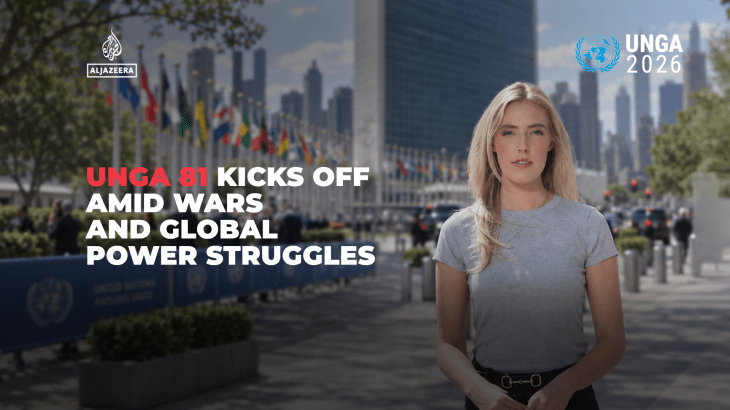
The article is a brief Al Jazeera video explainer previewing the major issue expected to shape the 81st United Nations General Assembly (UNGA) in New York. It notes that world leaders are gathering at a time when armed conflicts are increasing and confidence in international institutions is weakening. Against this backdrop, the report focuses less on the formal agenda of the gathering and more on the credibility and practical relevance of the international system.
According to Al Jazeera’s Emma Withrow, the central question is whether global rules continue to matter when powerful countries can disregard them without facing meaningful consequences. This framing points to concerns about the erosion of international norms, the unequal application of those norms, and the difficulty of preserving cooperation when influential states act outside established rules.
The preview presents UNGA 81 as an important test of the United Nations’ authority and of the broader rules-based international order. While the short article does not identify specific conflicts, countries, or diplomatic initiatives, it establishes a wider context of multiplying wars and declining trust. The report therefore directs attention to the gap between the principles expressed at the United Nations and the actions of states with the greatest political or military influence.
Published on 22 September 2026, the item is designed as an analytical video introduction to the themes viewers should follow during the UNGA. Its emphasis is ultimately on accountability, international legitimacy, and whether global institutions can still constrain powerful actors.
Entities: United Nations General Assembly (UNGA), UNGA 81, New York, Al Jazeera, Emma Withrow • Tone: analytical • Sentiment: negative • Intent: analyze
22-09-2026
The article reports on a meeting between U.S. President Donald Trump and New York Mayor Zohran Mamdani at Trump’s official residence. The meeting took place one day before Trump was scheduled to address the United Nations General Assembly. According to the report, the two leaders discussed issues affecting New York City and recognized that they hold differing views on several matters.
The central point of disagreement was Trump’s approach to the press. The headline characterizes the encounter as Mamdani challenging Trump over a White House press ban, while the article describes the issue more broadly as Trump’s restrictions on the press. This suggests that press access and the relationship between the administration and media were directly or prominently raised during the meeting.
The report presents the encounter as notable because it brought together two political figures who acknowledge their differences while discussing concerns affecting the same city. However, the brief account does not provide direct quotations, explain the precise nature of the press restrictions, or identify the other city issues discussed. It also does not indicate whether the meeting produced any agreements or changes in policy.
Overall, the article provides a concise news update about the meeting, its timing ahead of Trump’s UN appearance, the city-focused agenda, and the political disagreement over press access. Its primary purpose is to inform readers about the encounter and highlight the tension between cooperation on local concerns and disagreement over media restrictions.
Entities: Donald Trump, Zohran Mamdani, New York City, White House, United Nations General Assembly • Tone: neutral • Sentiment: neutral • Intent: inform
22-09-2026
The article previews Donald Trump’s return to the United Nations in New York and asks what message the US president will deliver. His appearance comes one year after he told the UN General Assembly that he was the “world’s greatest peacemaker,” a claim that provides a contrast with the circumstances surrounding his latest visit.
According to the article, Trump is returning amid a war with Iran that it says he started, ongoing Israeli violations of a ceasefire in Gaza, and growing scrutiny over the United States’ objectives at the United Nations. These developments create a politically difficult context for Trump, particularly as his previous self-presentation as a peacemaker is juxtaposed with continuing conflict and allegations of ceasefire violations.
The report also raises questions about the broader relationship between the Trump administration and the UN. It suggests that observers will be watching not only what Trump says about Iran and Gaza, but also how he explains the US role in international diplomacy and what Washington wants from the global organization. The article does not provide the president’s remarks or outline specific policy announcements; instead, it frames his appearance as an event requiring close scrutiny.
Overall, the piece is a concise news preview focused on the gap between Trump’s past rhetoric and the conflicts and diplomatic controversies confronting his administration. Its framing is skeptical and critical, emphasizing the tension between his claim to be a peacemaker and the wars, ceasefire disputes, and international questions surrounding his return to the UN.
Entities: Donald Trump, United Nations, UN General Assembly, New York, United States presidency • Tone: analytical • Sentiment: negative • Intent: analyze
22-09-2026
World leaders are gathering in New York for the 81st United Nations General Assembly amid wars, geopolitical polarization, economic disruption, climate pressures and growing anxiety about artificial intelligence. The meeting will examine whether the 193-member organization can still coordinate international action on crises that cross national borders, including conflicts in the Middle East, Gaza, Ukraine, Sudan, Congo and Myanmar.
The future of the United Nations itself is also central to the discussions. Member states have agreed to a broad reform package, including changes to the Security Council, whose five permanent members—the United States, Russia, China, Britain and France—retain disproportionate influence through their veto powers. The selection of a successor to Secretary-General Antonio Guterres, whose second term ends on December 31, is another issue likely to be discussed.
Approximately 130 heads of state and government are expected to address the General Assembly. Speakers include U.S. President Donald Trump, French President Emmanuel Macron, Ukrainian President Volodymyr Zelenskyy, Iranian President Masoud Pezeshkian and Israeli Prime Minister Benjamin Netanyahu. Palestinian President Mahmoud Abbas will participate by video after the United States refused to grant him a visa. The absence of Chinese President Xi Jinping, Russian President Vladimir Putin and Indian Prime Minister Narendra Modi is also notable.
The United Nations is experiencing severe financial and political strain. U.S. arrears have damaged its finances, forcing cuts to peacekeeping and humanitarian programs, although a recent payment of $725 million preserved Washington’s voting rights. Analysts describe the organization as no longer in freefall but still trapped in a prolonged crisis.
Artificial intelligence has moved toward the center of the agenda. AI executives have warned that the technology could escape human control, while President Trump has dismissed such concerns and advocated continued U.S. development. The Security Council will hold a high-level meeting on AI, alongside discussions on Ukraine. Despite the gravity of the challenges, diplomats and experts argue that personal meetings and multilateral cooperation can still produce practical agreements and offer grounds for cautious hope.
Entities: United Nations, 81st United Nations General Assembly, New York City, Antonio Guterres, Donald Trump • Tone: analytical • Sentiment: negative • Intent: inform
22-09-2026
US President Donald Trump visited Gracie Mansion in New York on September 21 during the UN General Assembly, holding private talks with New York City Mayor Zohran Mamdani. The meeting was notable because the two politicians have sharply different political views and have publicly criticised each other’s policies, although their previous encounters at the White House were described as cordial.
Housing was the central issue. Mamdani said they discussed plans to develop Sunnyside Yard in Queens, a project that could create 12,000 homes and 30,000 jobs and potentially form an entirely new neighbourhood. The leaders agreed to establish formal discussions between housing and operations officials at City Hall and the White House. Mamdani has previously described the proposal as potentially New York’s largest housing development since the early 1970s, at a time when housing costs are the city’s biggest expense.
Trump adopted a warm tone during the visit, describing Gracie Mansion as a highly representative New York location and calling the encounter “a little bit of old home week”. He also used the appearance to defend restrictions placed on some news organisations at the White House. CNN, MS NOW and Politico filed a lawsuit challenging those restrictions, while Trump said he believed his administration had an obligation to exclude outlets he considered “fake news”.
Earlier the same day, Mamdani met Brazilian President Luiz Inácio Lula da Silva at Brazil’s UN mission in Manhattan. Their discussion focused on challenges facing both countries, including the rising cost of living. Lula urged Mamdani to prepare for a long-term struggle against poverty and the marginalisation of poor people.
Entities: Donald Trump, Zohran Mamdani, Luiz Inácio Lula da Silva, Gracie Mansion, New York City • Tone: neutral • Sentiment: neutral • Intent: inform
22-09-2026
The United Nations General Assembly’s high-level debate is underway in New York, where intense security measures, motorcades and thousands of diplomats have transformed the area around UN headquarters. More than 1,000 bilateral meetings have been requested between member states, making the gathering a major venue for discreet, face-to-face diplomacy.
Brazilian President Luiz Inácio Lula da Silva opened the high-level debate on Tuesday, followed by US President Donald Trump. While the formal speeches attract global attention, much of the week’s diplomacy is taking place in half-hour meetings between delegations. Middle Eastern countries are using the event for intensive discussions on regional conflicts, especially the Iran war, which has affected the global economy.
UN Secretary-General António Guterres is seeking renewed commitment to the organization’s principles while urging member states to address what his spokesman Stéphane Dujarric calls “runaway risks,” including artificial intelligence, climate change and inequality. Dujarric compares the hectic week to surfing a giant wave and says participants are running on adrenaline.
The article captures the atmosphere around the UN: officials and journalists move through heavily guarded streets, nearly everyone carrying coffee, while delegates try to find rare breaks between meetings. One journalist describes the week as exhausting but exciting. Dujarric, attending his 26th General Assembly, says he still feels a sense of awe when entering the chamber.
The report also recalls the drama surrounding Trump’s visit the previous year, when an escalator stopped and his teleprompter reportedly malfunctioned. A UN staff member jokingly expressed hope that the escalator would work this time, as delegates gathered in the cafeteria for expensive snacks during brief pauses in the proceedings.
Entities: United Nations General Assembly (UNGA), United Nations headquarters, New York City, Luiz Inácio Lula da Silva, Donald Trump • Tone: analytical • Sentiment: neutral • Intent: inform
22-09-2026
The National published an editorial cartoon by Shadi on September 22, 2026, under its Opinion and Cartoon sections. The cartoon is titled “Shadi’s take on the Iran war at the UN General Assembly” and is tagged “Iran war” and “UNGA 2026.” Based on the supplied page text, the work addresses the Iran war in the setting of the United Nations General Assembly, using visual commentary rather than a conventional written news report. The source provided does not include the cartoon image, a caption, or a transcript of any text appearing within the artwork. Consequently, the specific argument, targets, symbolism, and political claims made by the cartoon cannot be determined reliably from the available material alone.
The title establishes the central subject and institutional context: the conflict involving Iran and its presentation or discussion at the UN General Assembly. The classification as an opinion cartoon indicates that the piece is intended as editorial commentary, likely condensing a political viewpoint into a satirical or symbolic image, but the supplied text does not allow its precise tone or message to be described in detail. The publication date places it within the 2026 UNGA news cycle.
The page also lists other recent cartoons by Shadi concerning Israeli settlements, UN peacekeeping in Lebanon, Mahmoud Abbas’s visa for the UN General Assembly, the cost of the Iran war to the United States, Sudan’s food crisis, rising oil prices, and other subjects. These links provide broader context about the cartoonist’s coverage but are separate from the featured item. No additional reporting, quotations, factual claims, or explanatory text accompanies the cartoon in the supplied content.
Entities: Shadi, The National, Iran war, United Nations General Assembly, UNGA 2026 • Tone: analytical • Sentiment: negative • Intent: critique
22-09-2026
In this opinion article, Damien McElroy argues that the United Nations’ future depends less on expanding or defending its bureaucracy and more on strengthening its political and diplomatic capabilities. Written during the annual “UN week” in New York, the piece acknowledges the organization’s credibility problems and the worsening conflicts confronting the international system. However, it rejects the idea that the UN should simply be dismissed, emphasizing that no other institution possesses comparable global infrastructure for addressing conflict, disease, climate change, hunger and other major crises.
McElroy uses the recent memorial for Nicholas Haysom, a respected UN envoy and political operator, as an example of the type of diplomatic expertise the organization needs. Haysom worked with Nelson Mandela, played significant roles in post-Saddam Hussein Iraq and post-Omar Al Bashir Sudan, and operated within the senior leadership around the Secretary General. His career illustrates the value of experienced intermediaries who can navigate political tensions and quietly pursue settlements.
The article contrasts this approach with administrative or grassroots programs that may be less effective in an era characterized by concentrated national power, internal political divisions and conflicts that spill across borders. Citing observations from David Miliband and Robert Pape, McElroy contends that traditional supranational programs and technical management cannot adequately address today’s political crises.
The author therefore calls on the next Secretary General, who is due to take office in 2027, to reinforce the UN’s political team and give diplomacy a more prominent role. An internal reshuffle should consolidate the organization’s most effective tools rather than signal retreat. With military and technical power failing to prevent escalation in the Middle East, and with climate change, fragile global supply systems and artificial intelligence creating additional long-term pressures, McElroy concludes that the UN’s diplomatic engagements remain vital and consequential.
Entities: United Nations (UN), UN General Assembly, Antonio Guterres, Nicholas Haysom, Nelson Mandela • Tone: analytical • Sentiment: neutral • Intent: analyze
22-09-2026
The African Union is expected to use the United Nations General Assembly’s annual high-level meeting to seek a stronger role in global decision-making. A central objective is securing permanent African representation on the UN Security Council, reflecting long-standing concerns that the continent is underrepresented in the body responsible for addressing international peace and security.
The gathering begins amid heightened security at UN headquarters in New York, where flags were raised and police officers, canine teams, and law-enforcement drones were deployed ahead of the arrival of world leaders. The security measures are presented as preparations for the high-level event rather than as a response to a specific incident.
On Monday, the leaders of the African Union and the United Nations met to discuss issues affecting Africa’s position in the international system. Their agenda included reforms to international financial institutions, debt sustainability, and ways to ensure that African countries gain greater economic value from their mineral resources. These priorities link political representation with broader demands for fairer financial arrangements and more beneficial resource management.
Kenyan President William Ruto is also expected to promote several issues during his visit, including climate finance, reform of global governance, peace and security, and digital cooperation. In addition, the UN Development Programme will present an Africa-focused package addressing artificial intelligence, natural resources, data, talent, and access to capital.
Overall, the article highlights a coordinated African effort to influence debates at the UN, expand the continent’s formal representation, and secure stronger economic, technological, and financial support. It also places those diplomatic priorities within the context of the security preparations surrounding the General Assembly.
Entities: African Union (AU), United Nations (UN), UN General Assembly, UN Security Council, New York • Tone: analytical • Sentiment: neutral • Intent: inform