15-10-2026
Ukraine’s reliance on SpaceX’s Starlink and Starshield satellite communications has become a source of urgent concern after Ukrainian officials reported an unexpected restriction on terminals operating in motion. The change disrupted some military missions, including drone strikes and interceptions of Russian drones; Ukraine’s 7th Corps of the Air Assault Forces said some operations had to be cancelled. Officials said they had received no warning. Connectivity was later restored at speeds of up to 160 kilometres per hour, but former defence minister Mykhailo Fedorov called for the speed limits to be removed entirely.
The cause of the restriction remains unclear. Elon Musk denied that SpaceX set the limits, saying they would have been imposed by the US military and President Donald Trump. The White House and Pentagon did not respond to ABC’s requests for comment. Ukrainian officials linked the disruption to the political climate, while President Volodymyr Zelenskyy warned that losing access could cost lives. Analysts say Starlink supports battlefield communications and strategic strikes that hamper Russian supply lines; reduced access could help Russia move more resources to the front.
The incident comes amid worsening relations between Zelenskyy and Trump. US support has slowed since Trump took office, and the two countries have clashed over aid and a recent US energy deal with Russia. Zelenskyy said Trump was choosing to side with Russia, while US senators from both parties criticised the deal as a gift to an adversary and a betrayal of allies.
Britain reaffirmed its support for Ukraine and announced £45 million in drone-defence missiles, with some deliveries to be accelerated. European allies have also offered support, but the article notes that Europe has no equivalent to Starlink and remains dependent on American space capabilities. The episode therefore highlights both Ukraine’s operational reliance on the systems and the broader strategic vulnerability created by that dependence.
Entities: Volodymyr Zelenskyy, Elon Musk, Donald Trump, SpaceX, Starlink • Tone: analytical • Sentiment: negative • Intent: inform
15-10-2026
The article explains Starshield, SpaceX’s military-oriented satellite communications service, and the dispute over a reported interruption to Ukraine’s access. Ukraine’s military uses the service, along with Starlink-related connectivity, for communications and to support drones, reconnaissance, logistics, and signal relaying. Ukrainian officials said access was disrupted for a period between Tuesday and Wednesday, affecting military missions. An adviser to President Volodymyr Zelenskyy also said Starlink terminals had been subject to a speed limit that disconnected drones and missiles traveling faster than 100mph. Ukraine said it had received no warning of the restrictions and no advance warning of Russian ballistic missile strikes during the same period.
SpaceX chief executive Elon Musk denied that his company made the decision, saying Starshield is owned and controlled by the US government and that usage limits are decided by the US military and ultimately the president. He described Starlink as intended for civilian or defensive use, distinguishing it from Starshield. Ukraine’s defence ministry later said the connection had been restored, while Kyiv sought an explanation from SpaceX. Zelenskyy rejected the idea that the incident was a technical glitch and said it reflected a deliberate choice. He also said US officials had previously warned that intelligence sharing could be restricted if Ukraine continued attacks on Russian energy infrastructure.
The article places the dispute within worsening tensions between the Trump administration and Kyiv. Washington has pressed Ukraine to halt attacks on Russian oil facilities, while Trump has linked Ukrainian strikes to global fuel prices and announced an energy ceasefire without, according to Zelenskyy, consulting Ukraine. Russia did not confirm the ceasefire, and Russian attacks on Ukraine continued. Zelenskyy said strikes on Ukrainian energy infrastructure caused blackouts for 600,000 people, and confirmed that Ukraine had resumed attacks on Russian oil infrastructure. The article also reviews Musk’s past statements and disagreements with Zelenskyy over the war.
Entities: Starshield, Starlink, SpaceX, Elon Musk, Volodymyr Zelenskyy • Tone: analytical • Sentiment: negative • Intent: inform
15-10-2026
Elon Musk has suggested that the US government, rather than SpaceX alone, may be responsible for limits that disrupted the speed and connectivity of some Ukrainian weapons using Starlink. Ukraine reported that a new 100mph (160km/h) speed restriction introduced Tuesday night caused faster-moving weapons to lose their connection. Connectivity was partly restored by Wednesday evening, but former defence minister Mykhailo Fedorov said removing the limit entirely remained critical to Ukraine’s defence. Musk said Starshield, Starlink’s military-grade sister service, is controlled by the US government, and that the US military and ultimately the president decide restrictions on its speed or use. He also said Starlink is intended for civilian or defensive activity, not offensive military action. The US government had not commented. Ukrainian officials suspected the disruption was linked to worsening political tensions with Washington. The restrictions coincided with major Russian attacks that killed people, damaged military communications and energy facilities, and left at least 600,000 people without electricity. Residents said they received no warning of incoming drones. The article places the dispute amid broader strains between US President Donald Trump and Ukrainian President Volodymyr Zelensky, including disagreements over attacks on Russian energy infrastructure, an energy ceasefire and US dealings with Russia. Musk later called for Zelensky to leave office, echoing comments by Trump. Elections in Ukraine have been suspended under martial law since Russia’s 2022 invasion. During a visit to London, Zelensky said he had felt betrayed by a US deal to import Russian diesel, while acknowledging the issue was complicated. He also met King Charles and received a pledge from UK Prime Minister Andy Burnham to accelerate delivery of lightweight missiles used to intercept Russian drones.
Entities: Elon Musk, Volodymyr Zelensky, Donald Trump, Starlink, Starshield • Tone: analytical • Sentiment: negative • Intent: inform
15-10-2026
Starlink, SpaceX’s satellite internet network, has become central to Ukraine’s battlefield communications and drone operations because it is quick to deploy, works across much of the country, and enables operators to control drones and view targets in real time. The article reports that Starlink unexpectedly imposed a speed limit of 100 mph (160 km/h) on Tuesday night, disconnecting faster-moving drones. A Ukrainian official said the restriction disrupted missions and weakened the country’s ability to defend against Russian attacks. Connectivity was restored by Wednesday evening, but the incident highlighted Ukraine’s reliance on a service for which it has no ready substitute. The limit was especially consequential for intercepting Shahed drones, which can travel faster than 198 mph (319 km/h). The article explains the difference between civilian Starlink and the military-grade Starshield service, and describes how both are used by Ukrainian forces. It also notes that Russia is not authorised to use Starlink, although Ukrainian officials have previously alleged that Russian forces obtained terminals in occupied territory. The reason for the restriction remains disputed. President Volodymyr Zelensky suggested it was deliberate, while Elon Musk said Starshield is controlled by the US government and that restrictions on it are determined by the US military and the president. The episode occurred amid worsening US-Ukraine relations, disagreements over Ukrainian strikes on Russian oil facilities, and tensions over US support. The article presents the incident as both an operational setback and a reminder of how a commercial satellite network—and decisions about its access—can affect the course of the war.
Entities: Starlink, Starshield, SpaceX, Elon Musk, Volodymyr Zelensky • Tone: analytical • Sentiment: negative • Intent: inform
15-10-2026
CBS News reports that the United States may have failed to provide Ukraine with advance warning of Russian missile strikes, despite an early-warning system that normally detects launches. Ukrainian President Volodymyr Zelenskyy said Ukraine received no warning from its partners before Tuesday’s attacks. Sources familiar with the matter said U.S. officials blamed the lapse on bad weather, but Ukrainian officials privately rejected that explanation and suspected the system had been deliberately manipulated. The sources said the warning system appeared to be functioning again when Russia launched another missile wave early Wednesday. They described this as a specific incident, not a halt to overall U.S. intelligence sharing, and noted that the U.S. had previously withheld launch intelligence while reallocating resources to the Middle East.
Zelenskyy said the overnight assault involved more than 39 ballistic missiles and over 120 drones and loitering munitions. The attacks, aimed mainly at energy and critical infrastructure in Kyiv and Kharkiv, killed six people and left about 600,000 without electricity. President Donald Trump denied that the United States had stopped sharing intelligence, saying Washington was assisting Ukraine while seeking an end to the war. The strikes followed his announcement that Russia and Ukraine had agreed to an “energy ceasefire.”
The report also says the Trump administration had threatened to restrict intelligence sharing and the European purchase of U.S.-made weapons for Ukraine through the PURL system unless Ukraine stopped deep strikes on Russian energy infrastructure. Separately, Ukrainian officials and soldiers reported problems with Starlink. Ukraine’s Defense Ministry sources said SpaceX had restricted Starshield terminals used by military forces while they were moving, affecting drone missions, logistics, reconnaissance, and communications. The ministry said it was coordinating with the United States, SpaceX, and NATO and testing backup channels. Zelenskyy, visiting the United Kingdom, called the Russian attacks deliberate and urged the United States and others to respond forcefully.
Entities: Volodymyr Zelenskyy, Donald Trump, Mykhailo Fedorov, Kyiv, Kharkiv • Tone: analytical • Sentiment: negative • Intent: inform
15-10-2026
Elon Musk said restrictions on Ukraine’s military-grade Starshield network are determined by the U.S. government and, ultimately, President Donald Trump. In a post on X, Musk said the U.S. government owns and controls Starshield, and that the U.S. military decides any limits on its speed or use. His comments followed Ukrainian complaints that SpaceX had imposed speed restrictions on satellite internet terminals used by its forces, without prior notice, disrupting some military operations. Serhii Beskrestnov, an adviser to President Volodymyr Zelenskyy on defense technology, said the restrictions affected terminals in motion and applied to Starshield as well as Starlink. He described Starlink as important to operating Ukrainian interceptor drones used against Russian Shahed drones. Musk distinguished the services, saying Starshield is military-grade while Starlink is intended for civilian or defensive activities. By early Thursday, some limits appeared to have been eased. Former defense minister Mykhailo Fedorov thanked Musk after Starlink connectivity at speeds of up to 160 kilometers per hour was restored, while saying that removing Starshield’s speed limit entirely remained critical to Ukraine’s defense. The dispute comes amid tensions between Kyiv and Washington over a proposed energy ceasefire between Ukraine and Russia. Ukraine welcomed the deal subject to Moscow honoring it, but Russian authorities said talks were ongoing without confirming an agreement. Zelenskyy accused Russia of violating the ceasefire. Trump, meanwhile, criticized Ukraine’s attacks on Russian energy facilities and attributed rising diesel prices to those attacks rather than the U.S. war with Iran. The article also reports that Washington had threatened to cut intelligence sharing with Kyiv, and that Ukrainian officials said they had gone two days without receiving warnings of Russian attacks.
Entities: Elon Musk, Donald Trump, Volodymyr Zelenskyy, Serhii Beskrestnov, Mykhailo Fedorov • Tone: analytical • Sentiment: negative • Intent: inform
15-10-2026
Ukrainian President Volodymyr Zelenskyy said Ukraine will resume strikes on Russian energy infrastructure after Russia failed to honor a proposed energy ceasefire. Ukraine had paused attacks on energy targets for three days at Washington’s request, following President Donald Trump’s announcement of an arrangement intended to stop both sides from attacking power facilities and to help reduce oil and diesel prices ahead of U.S. midterm elections. Zelenskyy told the Financial Times, “The block [on attacking refineries] is out. We're done.”
Zelenskyy also criticized what he described as recent U.S. actions and dealings with Russia. In an interview with Piers Morgan, he said he felt “betrayed” by Trump’s dealings with Vladimir Putin, Russian attacks on Ukrainian energy facilities, and apparent limits on SpaceX’s military communications network. Zelenskyy said Ukraine refrained from attacks and retaliation during its three-day pause, but Russia then launched a major assault on Ukrainian energy infrastructure, including about 40 ballistic missiles. He said he had warned U.S. officials that Russia would break the ceasefire.
Separately, Ukrainian officials reported that Starlink restrictions had disrupted military operations and removed advance warnings of incoming ballistic missiles. Serhii Beskrestnov, an adviser to Zelenskyy on defense technology, said SpaceX had imposed speed limits on Starlink terminals in motion without informing Ukrainian defense forces, and suggested the timing was linked to the political situation. Elon Musk said Starshield systems are owned and controlled by the U.S. government. The White House and SpaceX did not respond to CNBC’s request for comment. Zelenskyy criticized the reported Starlink restrictions as inconsistent with the conduct expected between partners, while emphasizing that Ukraine’s survival and its strategic relationship with the United States outweighed his personal feelings.
Entities: Volodymyr Zelenskyy, Donald Trump, Vladimir Putin, Ukraine, Russia • Tone: analytical • Sentiment: negative • Intent: inform
15-10-2026
The article explains Starshield, SpaceX’s government-focused satellite network, and the renewed scrutiny it faces after Ukrainian officials reported restrictions affecting satellite connectivity used in the war against Russia. Built on Starlink technology and SpaceX’s launch capabilities, Starshield is intended for government and national-security missions. SpaceX describes its work as including Earth observation, secure communications, and hosted payloads—specialized equipment carried aboard satellites. Compared with Starlink’s commercial service, Starshield offers stronger security features, including high-assurance encryption for classified information and specialized user equipment, while relying on Starlink’s broader satellite network and laser links.
Ukraine said terminals moving faster than 100 miles per hour (about 160 kilometers per hour) had lost connectivity, disrupting systems used to track and intercept Russian attacks. President Volodymyr Zelenskyy said the interruption affected drones used for defense and that some Russian drones were not intercepted, contributing to civilian deaths. He criticized the lack of advance warning. Former Ukrainian defense minister Mykhailo Fedorov later said connectivity at those speeds was being restored and called removal of the speed limit critical to Ukraine’s defense.
The article highlights uncertainty over which Ukrainian terminals use commercial Starlink and which operate under Starshield, as well as who controls restrictions. Elon Musk said Starshield systems are owned and controlled by the U.S. government, with the military and ultimately the president determining limits. The White House and Pentagon did not immediately comment. Musk separately characterized commercial Starlink as restricted to civilian and defensive purposes, not offensive military operations. SpaceX has reported more than $6 billion in multiyear U.S. government contracts for Starshield, largely tied to Space Force communications and sensing systems. The dispute underscores Ukraine’s reliance on satellite connectivity and the distinction—and operational overlap—between SpaceX’s commercial and government services.
Entities: Starshield, Starlink, SpaceX, Elon Musk, Volodymyr Zelenskyy • Tone: analytical • Sentiment: negative • Intent: inform
15-10-2026
Elon Musk said that any limits on Ukraine’s use of the Starshield satellite communications system are set by the US government and military, not SpaceX. He distinguished Starshield, a government-controlled system used by Ukraine for battlefield communications, from civilian Starlink, which Ukraine is not permitted to use for offensive operations. Musk was responding to former Ukrainian defence minister Mykhailo Fedorov, who said some Starlink connectivity speeds were being restored but argued that removing Starshield’s speed limit was essential to Ukraine’s defence. Ukrainian officials have suggested Washington is responsible for slower connections affecting military terminals used in operations against Russian-occupied territory and in interceptor-drone missions.
The article places the dispute amid wider tensions between Kyiv and Washington. Ukraine has accused the United States of failing to provide timely warnings about incoming Russian missile attacks, while a senior Ukrainian official said the US recently threatened to stop sharing missile-launch intelligence. President Donald Trump denied that allegation. US Democrats condemned the administration over the reported interruptions. The article also links Trump’s position to political pressure ahead of midterm elections, noting that he has blamed Ukrainian attacks on Russian oil refineries for contributing to fuel supply and price problems.
Meanwhile, Russia accused Ukraine of violating an “energy ceasefire” by attacking two oil refineries; Kyiv rejected the claim as false. The accusations followed a deadly Russian overnight attack on Kyiv that killed at least one person and injured more than 20. The strikes caused a fire in a residential building and targeted the Darnytska CHP-4 power and heating plant, according to Volodymyr Zelenskyy. Russia said it had shot down 900 Ukrainian drones overnight.
The article concludes with Italian Prime Minister Giorgia Meloni’s criticism of a US-Russia agreement to purchase Russian diesel. She called the deal risky and said it could legitimise Moscow and weaken sanctions intended to pressure Vladimir Putin into negotiations.
Entities: Elon Musk, Donald Trump, Mykhailo Fedorov, Giorgia Meloni, Volodymyr Zelenskyy • Tone: analytical • Sentiment: negative • Intent: inform
15-10-2026
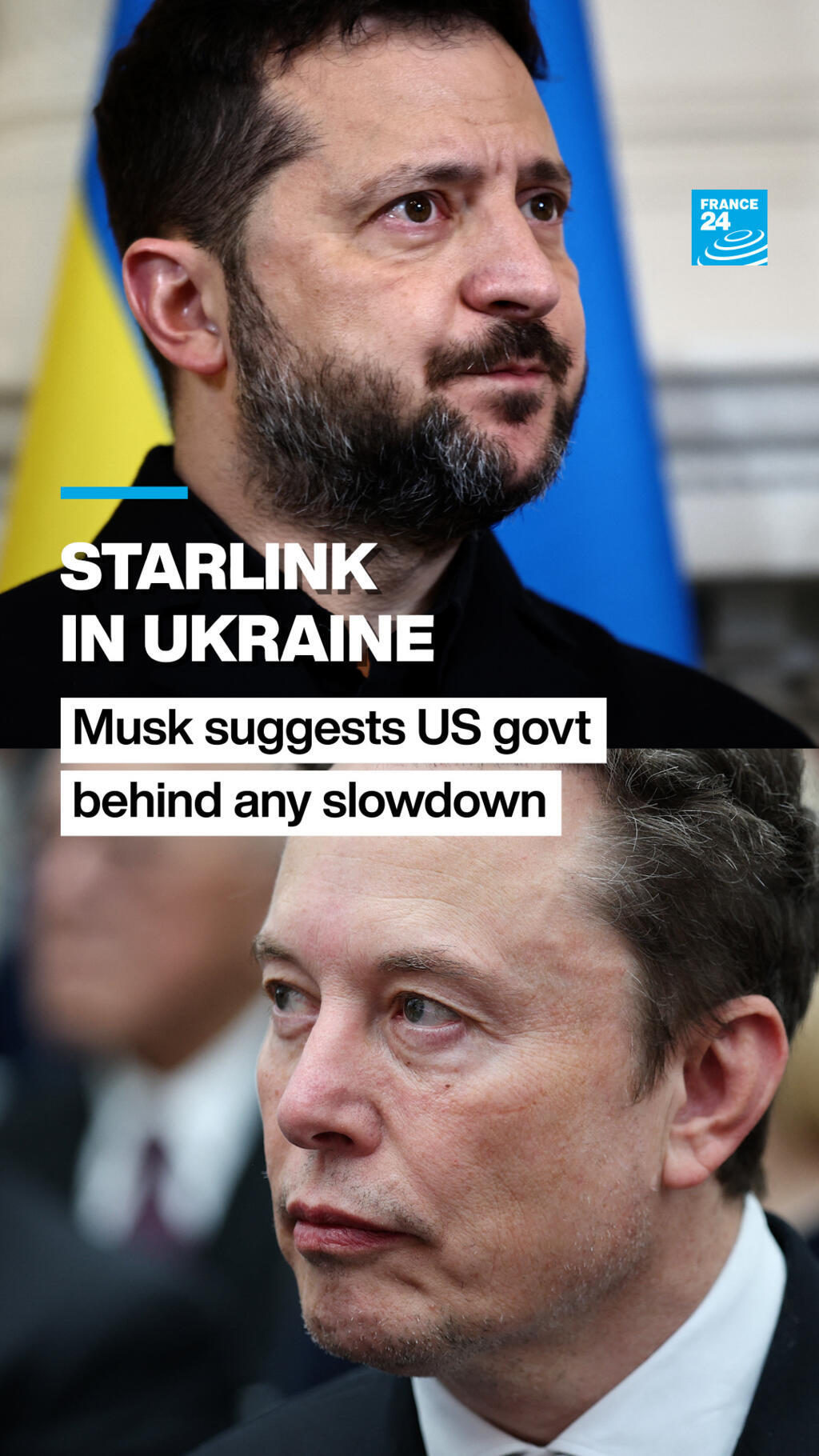
France 24’s press review surveys international coverage of reported disruptions to Starlink services in Ukraine and the broader implications for the country’s security. The Kyiv Post quotes President Volodymyr Zelensky saying he feels betrayed by the United States, while The Times warns that restrictions could have devastating consequences. France’s Libération describes the situation as “American abandonment,” reporting that US intelligence services are no longer warning Kyiv about Russian strikes and may thereby be putting civilians at risk. La Repubblica, by contrast, highlights Italian Prime Minister Giorgia Meloni’s support for Ukraine.
US outlets offer competing details about the reported disruptions and the changing US-Ukraine relationship. Axios cites a US official who says the Trump administration was not involved and attributes any outage to a technical incident. The Wall Street Journal traces worsening relations between Donald Trump and Zelensky to a September meeting in New York. The Financial Times reports that US envoy Steve Witkoff and Jared Kushner proposed transferring some unfrozen Russian assets into a Washington-supervised financial vehicle in an effort to restart peace talks.
The review also covers a political alliance in Germany’s Saxony-Anhalt between the far-right Alternative for Germany (AfD) and the far-left populist BSW. The two parties backed a motion to end German financial and military aid to Ukraine, though the Berliner Morgenpost says it is unlikely to pass the Bundesrat. Süddeutsche Zeitung criticizes the AfD’s anti-immigration politics and its targeting of Ukrainians and other refugee groups.
The roundup concludes with lighter stories: the Wildlife Photographer of the Year awards, including Federico Veronesi’s winning image of an elephant grieving her dead calf and 14-year-old Oscar Whitfield’s young photographer award, and a Finnish archipelago’s effort to establish itself as the world’s best-smelling place by recruiting a professional nose.
Entities: Ukraine, Russia, Starlink disruptions, Volodymyr Zelensky, Donald Trump • Tone: analytical • Sentiment: negative • Intent: inform
15-10-2026
France 24’s short video report, published on October 15, 2026, examines what Elon Musk’s increasingly close relationship with Donald Trump could mean for Ukraine. The report’s description links the issue to a recent disruption of SpaceX’s Starlink satellite internet service in Ukraine. Starlink is described as playing a key role in Ukraine’s long-range drone operations, making any interruption potentially significant for the country’s military capabilities.
The disruption is occurring as Washington increases pressure on Kyiv to stop striking Russian oil refineries. The timing raises questions about whether changes to satellite connectivity could affect Ukraine’s ability to carry out those operations, and about the influence Musk may have as his ties with Trump grow. The description frames these developments as connected concerns but does not establish that Musk or Trump caused the disruption, or provide details about its duration, extent, or operational consequences.
The supplied page contains only a brief description for a 1-minute, 32-second video, rather than a transcript or full article. It therefore does not include the report’s detailed analysis, interviews, evidence, or conclusions. The page also displays an unrelated notice that the requested content is unavailable; that notice does not clarify the status of the video itself. Based on the available text, the report’s central purpose is to prompt scrutiny of the strategic importance of Starlink in Ukraine, the pressure Washington is applying to Kyiv, and the possible implications of Musk’s political ties. Its framing is analytical and cautious: it highlights questions and potential consequences without resolving them.
Entities: Elon Musk, Donald Trump, Ukraine, Kyiv, Washington • Tone: analytical • Sentiment: neutral • Intent: analyze
15-10-2026
The France 24 item, issued on October 15, 2026, reports on Ukrainian claims that the Starlink system has experienced slowdowns. Starlink is used in Ukraine for battlefield communications and logistics near the front line. In response, Elon Musk said that any restrictions on speed or usage are decided by the US military and, ultimately, the US president (“POTUS”). His statement suggests that responsibility for any such limits would lie with US authorities rather than being a decision made independently by him or his company. The article does not provide further details about the reported slowdowns, including their timing, extent, causes, or effects on Ukrainian operations. Nor does the supplied text include a response from the US military, the US president, or Ukrainian officials beyond the report that Ukraine has reported slowdowns. The item is a short video report, listed as 1 minute and 22 seconds, and credits Mandi Heshmati. Because the video itself is not transcribed in the supplied page text, the available account is limited to its caption and brief description. The central issue is the control of Starlink service limits in a war zone and the role of the US government in decisions that could affect Ukraine’s communications and frontline logistics. The page also includes related-news links, but they are not part of this report.
Entities: Starlink, Ukraine, Elon Musk, US military, US government • Tone: neutral • Sentiment: neutral • Intent: inform
15-10-2026
The NPR item is a brief report and interview listing about Democratic Rep. Mike Quigley of Illinois and reports that SpaceX temporarily restricted Ukraine’s access to Starshield. NPR host Michel Martin speaks with Quigley about the reported restriction and its possible effect on Ukraine’s war efforts. The supplied article text does not include the interview transcript or Quigley’s answers, so it does not establish why access was restricted, how long the restriction lasted, what operational effects occurred, or what Quigley’s specific views were. It also provides no additional details about the circumstances or consequences of the reported action.
The page identifies the segment as part of NPR’s “Morning Edition,” dated October 15, 2026, and lists its duration as 4 minutes and 35 seconds. The description frames the subject as a question of communications technology and military support in wartime: Starshield access in Ukraine is reported to have been temporarily limited, with potential implications for the country’s war effort. However, the supplied text supports only that this was the topic of Martin’s conversation with Quigley; it does not provide enough information to assess the scale or outcome of any effects.
Overall, this is an informational interview notice rather than a full article transcript. The summary is therefore limited to the facts explicitly included in the provided page text, without attributing statements or conclusions to Quigley that are not present there.
Entities: Mike Quigley, Michel Martin, SpaceX, NPR, Ukraine • Tone: neutral • Sentiment: neutral • Intent: inform
15-10-2026
Elon Musk said the US government, rather than SpaceX, controls operational limits on Starshield, the military version of Starlink used in Ukraine, after connectivity restrictions disrupted Ukrainian operations. Musk stated that Starshield is owned and controlled by the US government and that limits on speed or use are set by the US military and ultimately the president. He distinguished it from commercial Starlink, which SpaceX controls and which he said should be used only for civilian or defensive purposes, not offensive military action.
Ukraine had relied on Starshield for drone operations and logistics. Ukrainian officials reported that connectivity was being throttled for drones traveling at 160 kilometers per hour or faster. Defense Minister Mykhailo Fedorov later said connectivity at speeds up to 160 km/h was being restored, while arguing that removing the limit entirely was critical to Ukraine’s defense. President Volodymyr Zelensky called the slowdown a serious mistake and warned that people would die. Ukrainian officials said it had undermined several active operations against Russian forces.
The disruption occurred amid tension between the Trump administration and Ukraine over Ukrainian strikes on Russian oil refineries, which the article says the administration blamed for contributing to high diesel prices and political problems ahead of the US midterm elections. The article also reports that Russia had launched another barrage of attacks, including a ballistic missile attack, and that Ukraine said it had not received advance US warning, unlike in the past. A Ukrainian source told the Post that the Pentagon contracts with SpaceX for Starshield through the Space Force, but said the contract alone does not clarify who had authority to impose the specific speed restriction. The White House and Pentagon were contacted for comment.
Entities: Elon Musk, Volodymyr Zelensky, Donald Trump, Mykhailo Fedorov, Ukraine • Tone: urgent • Sentiment: negative • Intent: inform
15-10-2026
Elon Musk said that any reported disruption to Ukraine’s use of the Starshield satellite communications system is the responsibility of the US government, not SpaceX. In a post on X, he said Starshield is owned and controlled by the US government, and that decisions about speed or usage limits are made by the US military and ultimately the president. Musk distinguished Starshield, which Ukraine uses for battlefield communications, from Starlink, a civilian satellite service that Ukraine also uses but is not permitted to deploy for offensive operations. Both systems were designed by SpaceX.
The comments followed a post by former Ukrainian defence minister Mykhailo Fedorov, who said Starlink connectivity at speeds of up to 160kmh was being restored, while urging the removal of Starshield’s speed limit. Ukrainian defence officials have suggested that Washington is responsible for slower speeds on some terminals used by the military to strike Russian-occupied territory and operate interceptor drones. Kyiv has also accused the US of helping Russia by failing to provide warnings about incoming missile attacks. The article reports that ballistic missiles hit Kyiv on two consecutive nights before air raid sirens sounded.
US lawmakers from both parties raised concerns about restrictions or possible interruptions. Democrats on the House Foreign Affairs Committee said restrictions aided Russian President Vladimir Putin, while Senator Jeanne Shaheen called for them to end and said lives were at stake. Shaheen also urged Pentagon chief Pete Hegseth to notify Congress if intelligence sharing with Ukraine had been paused or downgraded, as required. Republican Senator Tom Tillis said support for Ukrainian sovereignty should not be a grey area.
A senior Kyiv official said the US had recently threatened to stop sharing intelligence about Russian missile launches, which Ukraine uses to thwart attacks; President Donald Trump denied doing so on Oct 13. The article also notes that Trump has blamed Ukrainian strikes on Russian oil refineries for supply pressures and rising fuel prices, an issue ahead of November’s midterm elections.
Entities: Elon Musk, Donald Trump, Mykhailo Fedorov, Jeanne Shaheen, Pete Hegseth • Tone: analytical • Sentiment: negative • Intent: inform
15-10-2026
Ukraine’s drone operations slowed after SpaceX imposed a speed limit on Starlink terminals mounted on Ukrainian drones, according to an adviser to President Volodymyr Zelenskyy. The restriction made slower attack drones more vulnerable to Russian air defences. Connections later improved to speeds of up to 161 kph, but a Ukrainian official said they still were not fast enough to intercept jet-powered Russian drones and called for all limits to be lifted. Elon Musk said military Starlink is controlled by the US military and President Donald Trump; US authorities had not immediately commented on whether they imposed restrictions.
The disruption has heightened Ukrainian concerns that US support could be weakening, alongside uncertainty about intelligence sharing. Zelenskyy said Kyiv received no advance warning before an initial Russian ballistic missile attack, though Ukraine’s air force said warnings preceded later waves. A parliamentary defence committee member said intelligence sharing with partners had not stopped. Trump has said the US continues to share intelligence, but his criticism of Zelenskyy and a reported diesel deal with Russian President Vladimir Putin have further strained concerns about Washington’s position. Trump’s efforts to end the fighting have made no progress.
Russia continued attacks on Ukrainian energy infrastructure despite Trump’s call for a ceasefire. Zelenskyy reported strikes on power, oil and gas facilities, saying 600,000 people lost electricity; he also said Russia launched 39 ballistic missiles and more than 120 drones. Ukraine says it has halted its campaign against Russian oil refineries, while Moscow and Kyiv disputed claims of further Ukrainian attacks. Russia’s energy ceasefire arrangements remained under discussion.
During a visit to London, Zelenskyy met British Prime Minister Andy Burnham and King Charles III. Burnham announced accelerated delivery of British air-defence systems and reaffirmed Britain’s support. Ukrainian officials also claimed their forces had recaptured 277 square kilometres in eastern Ukraine, a figure that could not be independently verified. The supplied article ends mid-sentence while reporting Russia’s claim that it shot down Ukrainian drones.
Entities: Volodymyr Zelenskyy, Donald Trump, Vladimir Putin, Elon Musk, Ukraine • Tone: analytical • Sentiment: negative • Intent: inform
15-10-2026
The Straits Times roundup presents five stories published on Oct 15, 2026. First, Ukraine accused the United States of helping Russia after Kyiv said Washington failed to warn it about incoming missile strikes and changes to the Starlink system hindered Ukrainian military operations. President Volodymyr Zelensky asked Elon Musk to restore the service, while former defence minister Mykhailo Fedorov said Starlink speeds were being restored for strike and interceptor drones.
Second, attacks on vessels in and near the Strait of Hormuz reached their highest level since the war involving the United States, Israel and Iran began. At least ten vessels were attacked from Oct 11 onward, including six on Oct 11 and four on Oct 13. Two seafarers were reported missing, and a container ship reportedly sank.
Third, new White House press secretary Katie Zacharia faced questions about whether she was licensed to practise law. A watchdog group asked the State Bar of California to investigate claims that she had presented herself as a lawyer and served as general counsel of a California-based nonprofit.
Fourth, unexpectedly high inflation data drove the Nasdaq sharply lower as investors worried the Federal Reserve might raise interest rates further. AI-related companies and server makers suffered notable losses, including Oracle, CoreWeave, Nebius, Dell and Hewlett Packard Enterprise.
Finally, Paris Saint-Germain defeated Manchester City 4-2 in a Champions League match at the Etihad Stadium. PSG scored three times in the first 35 minutes; City fought back after halftime, with Erling Haaland scoring twice, but PSG secured the win. The report notes the defeat came during City’s first home game since a guilty verdict concerning widespread breaches of Premier League financial rules.
Entities: Volodymyr Zelensky, Elon Musk, Mykhailo Fedorov, United States, Ukraine • Tone: analytical • Sentiment: negative • Intent: inform
15-10-2026
NPR reports that Ukraine says its access to SpaceX’s Starshield system has been restored. The article’s brief description identifies Starshield as a system Ukraine uses for offensive drone attacks on Russia. It does not explain when or why access was interrupted, how long the interruption lasted, what led to its restoration, or whether the change has affected military operations. No statements from SpaceX or additional details from Ukrainian officials appear in the supplied text. The report is dated October 15, 2026, and is credited to Greg Myre and Steve Inskeep; it was heard on NPR’s Morning Edition. Because the provided article content is only a headline and a short summary, it supports a limited account of the development rather than a fuller explanation of its background or consequences. The central news is the reported restoration of Ukrainian access to Starshield, alongside the stated role of the system in Ukraine’s drone attacks against Russia.
Entities: Ukraine, SpaceX, Starshield, Russia, NPR • Tone: neutral • Sentiment: neutral • Intent: inform