15-10-2026
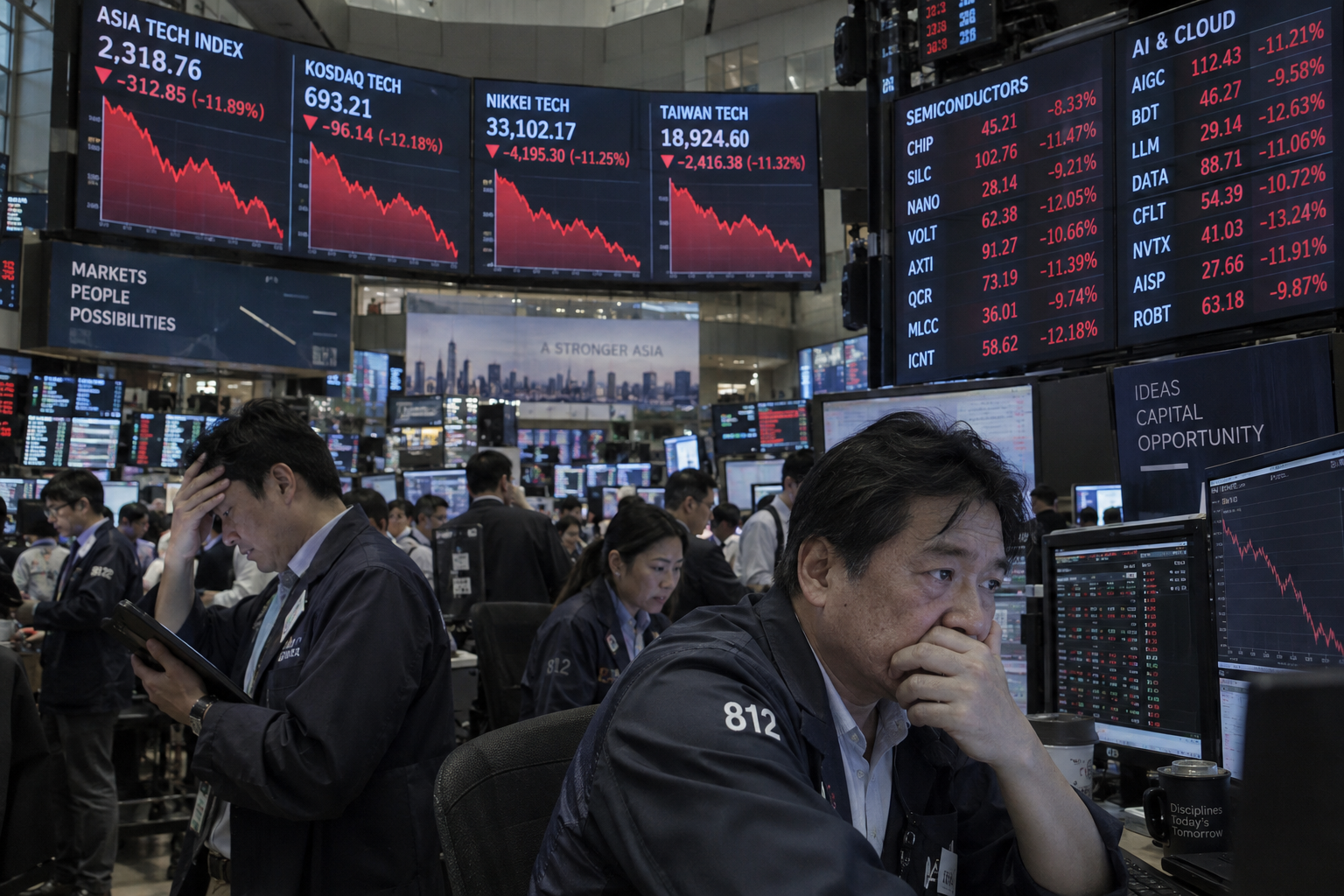
Asian technology stocks fell sharply on Thursday, extending losses from Wall Street as investors worried about the effect of higher interest rates on the cost of financing artificial-intelligence infrastructure. South Korean chipmaker SK Hynix dropped more than 10%, while Samsung Electronics fell 7.1%. Other South Korean technology-related companies also declined, including LG Innotek, Seoul Semiconductor and Samsung SDI. In Japan, SoftBank Group lost 7.9%, and semiconductor equipment and chip companies such as Advantest, Tokyo Electron and Renesas Electronics also recorded significant losses.
The article links the sell-off to hotter-than-expected U.S. inflation data, which fueled expectations that the Federal Reserve might raise interest rates further. Higher borrowing costs could make the large capital investments needed to build AI infrastructure more expensive. Broadcom CEO Hock Tan and Intel’s chief executive had warned that financing could become a major constraint on AI expansion—potentially a bigger challenge than shortages of chips or electricity.
The declines followed a weak session for U.S. markets, where technology shares led losses. The Nasdaq Composite fell 1.88%, the S&P 500 declined 1.11%, and the Dow Jones Industrial Average slipped 0.09%.
Dan Ives, a technology analyst at Yorkville Ives, said rising Treasury yields—above 5%—were intensifying concerns about funding infrastructure projects. He noted that higher yields increase financing costs and make balance sheets and contract structures important to investors, while arguing that this is a financing concern rather than evidence of weaker AI demand. Ives described the pullback as a potential buying opportunity and said the AI infrastructure boom remained in its early stages. He identified reduced spending plans by hyperscalers, canceled contracts and falling GPU rental prices as possible signs that would change his view.
Entities: SK Hynix, Samsung Electronics, SoftBank Group, Broadcom, Intel • Tone: analytical • Sentiment: negative • Intent: analyze
15-10-2026
Asian stock markets fell sharply on Thursday ahead of Europe’s opening, extending a technology-led sell-off that followed losses on Wall Street. The downturn came after US inflation data showed consumer prices rising faster than expected, increasing concern among investors. US equity futures were also lower.
South Korea’s Kospi dropped 7.7% to 5,548.78, far below the record high above 9,000 it reached in June amid enthusiasm for artificial intelligence. Samsung Electronics fell 9.5%, while SK Hynix plunged 11.4%. Japan’s Nikkei 225 declined 4.8% to 64,489.06. SoftBank Group lost 9.4%, Tokyo Electron fell 7.3%, and Kioxia Holdings dropped 11.2%. Taiwan’s Taiex slid 3%, while Taiwan Semiconductor Manufacturing Co. fell 2.2% ahead of its earnings report. Hong Kong’s Hang Seng lost 1% and Shanghai’s Composite fell 1.4%; Australia’s S&P/ASX 200 edged down 0.1%.
The declines followed Wednesday’s losses in the United States. The S&P 500 fell 1.1%, the Dow Jones Industrial Average dipped 0.1%, and the technology-heavy Nasdaq Composite dropped 1.9%. Major AI-related companies also retreated: Nvidia lost 3.2%, Broadcom 3.1%, and AMD 5.7%.
The US consumer price index rose 3.7% year over year in September, compared with 3.4% in August and above economists’ expectations. The article links the hotter inflation reading and the falling technology shares to the broad weakness in Asian markets, particularly among companies associated with the artificial-intelligence boom.
Entities: Angela Barnes, South Korea, Japan, United States, Kospi • Tone: neutral • Sentiment: negative • Intent: inform
15-10-2026
Global stock markets fell as investors reacted to unexpectedly high US inflation and growing concern about the debt and valuations associated with artificial-intelligence companies. The sell-off was particularly severe in Asia, where South Korea’s technology-heavy Kospi 200 dropped 8.1% to a six-month closing low. Trading was halted at points by circuit breakers. Chipmakers SK Hynix and Samsung Electronics fell nearly 11% and 9.5%, respectively. Japan’s Nikkei 225 declined 4.9%, with memory-chip maker Kioxia down 11% and SoftBank, a major investor in OpenAI, down 10%.
The falls followed losses on Wall Street, where the Nasdaq Composite slid 1.9% and the S&P 500 fell 1.1%, their worst session since July. US inflation reached 3.7% in September, higher than expected and the fastest increase since May. Investors worried that the figures could prompt the Federal Reserve to raise interest rates again, with some anticipating a possible increase by the end of the month. Deutsche Bank analysts said markets had faced a tumultuous 24 hours, combining the inflation data with rising concerns about AI investments. They noted that price increases were broad-based rather than driven only by energy costs.
The International Monetary Fund warned that a sharp correction in AI share prices could threaten global financial stability. It said Asian markets were especially exposed, while the UK and eurozone might be more insulated, though investors holding US assets could still suffer losses. Markets across China and Taiwan also weakened: the CSI 300 fell as much as 2.4%, while TSMC declined 2% despite reporting a sixth consecutive quarter of profits. European indexes were modestly lower, and US Nasdaq 100 futures pointed to further technology-stock losses.
Entities: South Korea, Kospi 200, SK Hynix, Samsung Electronics, Japan • Tone: analytical • Sentiment: negative • Intent: inform
15-10-2026
Asian stock markets fell sharply on Thursday, October 15, 2026, as a sell-off in artificial intelligence-related and semiconductor stocks followed Wall Street’s decline. South Korea’s Kospi dropped more than 7 per cent, Tokyo’s Nikkei 225 fell 5.12 per cent by midday, Hong Kong’s Hang Seng lost 1 per cent, and China’s Shanghai Composite declined 1.75 per cent.
The market downturn reflected several connected concerns: increasing competition and the possibility that chip-sector profit growth has peaked, alongside higher US inflation and tighter financial conditions. US consumer price inflation reached 3.7 per cent year-on-year in September, above the 3.6 per cent forecast and August’s 3.4 per cent. Core inflation was also higher than expected, at 2.6 per cent. The figures revived expectations of higher US interest rates, including a possible Federal Reserve rate hike, and weighed on Wall Street. The S&P 500 had its weakest session since late July, while the Nasdaq was hit particularly hard by pressure on chip stocks.
Analysts said Asian markets faced both the technology-stock sell-off and the effects of higher yields and a stronger US dollar. The International Monetary Fund warned that Asia’s reliance on the AI boom creates exposure if AI investment or asset valuations correct. Strong demand for semiconductors, AI infrastructure and related products has supported exports and investment in economies integrated into technology supply chains, particularly in East and South-East Asia. But the IMF said the long-term effects of AI investment remain uncertain and that a correction could disproportionately affect the region. It also cautioned that uncertainty over US monetary policy could keep Asian financial markets volatile.
Entities: Aarti Nagraj, Kyle Rodda, Daniel Richards, International Monetary Fund (IMF), Capital.com • Tone: analytical • Sentiment: negative • Intent: inform