22-09-2026
ABC News reports that Yemen’s Iran-aligned Houthi rebels have sharply escalated their conflict with Saudi Arabia and the internationally recognised Yemeni government, seizing the port city of Mokha and the island of Perim in September. These gains reportedly give the Houthis extensive control over Yemen’s Red Sea coastline and the ability to threaten vessels passing through the Bab el-Mandeb Strait, a vital maritime chokepoint linking the Red Sea with the Gulf of Aden.
The Houthis have targeted Saudi oil facilities, fuel tanks, energy infrastructure and shipping. The attacks follow their announcement of a blockade on ships carrying Saudi exports and come after an alleged attack on Saudi Arabia’s East-West pipeline, blamed on Iran-backed militias in Iraq. Analysts warn that the escalation could expose Saudi Arabia to a new front in the broader Iran-US conflict and could raise global oil and gas prices by disrupting one of the world’s key shipping routes.
Saudi Crown Prince Mohammed bin Salman reportedly asked US President Donald Trump for assistance. Trump reportedly came close to ordering air strikes against Houthi targets, with military forces preparing for an operation, but cancelled the planned action at the last moment. The decision has left Washington in a difficult position with Riyadh and could affect the wider conflict with Iran.
The article explains the strategic importance of the Bab el-Mandeb Strait, particularly after Iran’s activity around the Strait of Hormuz forced Saudi Arabia to redirect more oil exports through its East-West pipeline to the Red Sea port of Yanbu. Previous Houthi attacks during the Gaza war killed sailors, sank ships and significantly reduced oil flows through the waterway. Analysts say the group’s objective includes forcing Saudi Arabia to end its intervention in Yemen, while its relatively inexpensive weapons and control of strategic territory allow it to disrupt global shipping without fully closing the strait.
Entities: Donald Trump, Houthis, Saudi Arabia, Yemen, Iran • Tone: analytical • Sentiment: negative • Intent: analyze
22-09-2026
Iranian President Masoud Pezeshkian is traveling to New York with Foreign Minister Abbas Araghchi and other officials to attend the United Nations General Assembly. Pezeshkian is expected to present Iran’s account of the conflict with the United States and Israel, including what Tehran describes as crimes against the Iranian people, while also exploring diplomatic options to end the war. Araghchi said Iran would defend its rights and interests during meetings on the sidelines of the assembly and criticized the United Nations for failing to maintain international peace and security.
The article says the conflict, which began on February 28, has disrupted shipping through the Strait of Hormuz and contributed to global energy-price pressures. Iran plans to raise issues including a reported bombing at a school in Minab and the assassination of Supreme Leader Ayatollah Ali Khamenei. Tehran also objects to US sanctions, a naval blockade of Iranian ports, and restrictions placed on the Iranian delegation’s media team.
The wider regional crisis includes possible further US military action, fighting in Yemen involving the Iran-aligned Houthis, and increased Houthi control near the Bab al-Mandeb strait. Pakistan, Qatar, Oman and Turkiye are attempting to mediate. Iran has communicated seven conditions for reopening the Strait of Hormuz, including an end to attacks, the release of frozen assets, the lifting of the blockade and noninterference in its internal affairs.
Iranian officials remain divided between pursuing negotiations and continuing the war until Tehran’s demands are met. Some officials have threatened further escalation, including abandoning the Nuclear Non-Proliferation Treaty, while still saying diplomacy remains possible. Although Donald Trump has expressed tentative openness to meeting Pezeshkian, Iranian officials have dismissed the prospect as propaganda. Public opinion in Iran is largely skeptical that the UN meetings will produce a breakthrough, particularly as the war worsens economic conditions.
Entities: Masoud Pezeshkian, Abbas Araghchi, Iran, United States, United Nations General Assembly • Tone: analytical • Sentiment: negative • Intent: inform
22-09-2026
The brief Al Jazeera NewsFeed report states that Iranian President Masoud Pezeshkian is traveling to New York to attend the 81st session of the United Nations General Assembly. During the flight, Pezeshkian said he intended to use the UN gathering to address what he described as US “oppression” and to pursue the restoration of trust in the world. His comments frame the upcoming diplomatic engagement around Iran’s criticism of the United States and a broader appeal for renewed confidence in international relations.
The report identifies the United Nations General Assembly as the setting for Pezeshkian’s remarks and places them in the context of his journey to New York. It does not provide details about the specific US policies or actions he considers oppressive, nor does it outline the measures he believes would restore global trust. It also does not include reactions from US officials, other governments, or the United Nations, and it does not describe Pezeshkian’s planned schedule or the subjects he may address beyond these broad themes.
Published on September 22, 2026, the item is a short news update focused on the Iranian president’s stated diplomatic priorities ahead of the UNGA session. Its wording presents Pezeshkian’s assertions as reported remarks rather than independently verified conclusions, while highlighting the potentially contentious nature of Iran-US relations at a major international forum.
Entities: Masoud Pezeshkian, Iran, New York, United Nations General Assembly, 81st session of the UNGA • Tone: neutral • Sentiment: neutral • Intent: inform
22-09-2026
Leaders of the six Gulf Cooperation Council (GCC) states—Bahrain, Kuwait, Oman, Qatar, Saudi Arabia and the United Arab Emirates—are scheduled to meet US President Donald Trump in New York on the sidelines of the United Nations General Assembly. The meeting takes place as the US-Israel war on Iran approaches seven months and has generated severe regional and global economic consequences.
The article says Iran has repeatedly attacked US bases, airports, energy facilities and hotels across the Middle East since the war began on February 28. Gulf countries, whose economies depend heavily on oil and gas exports, have been particularly affected. A June memorandum of understanding that briefly raised hopes of ending the conflict collapsed amid disputes over navigation through the Strait of Hormuz, which remains effectively closed.
GCC governments are expected to urge Trump to avoid another major escalation with Iran and to emphasize their vulnerability to renewed fighting. Their shared priorities include de-escalation, restoring freedom of navigation through the Strait of Hormuz and the Red Sea, and developing an agreement that could revive negotiations. However, the Gulf states have experienced different consequences. The UAE has continued some oil exports through a pipeline to Fujairah, while Qatar’s liquefied natural gas shipments have been severely disrupted because they rely on the Strait of Hormuz. Saudi Arabia is also seeking stronger US action against the Houthis in Yemen, who have been gaining ground against Saudi-backed forces.
Trump’s objectives are less clear. He may seek greater GCC involvement in confronting Iran or support for Saudi Arabia against the Houthis. At the same time, domestic political pressure—including low approval ratings, approaching midterm elections and concerns about rising petrol prices—could make him wary of military escalation that pushes oil prices higher. Experts interviewed by Al Jazeera say the meeting is unlikely to produce a breakthrough; the most plausible outcome may be an agreement to resume negotiations, potentially facilitated by Qatar or Pakistan.
Entities: Donald Trump, Gulf Cooperation Council (GCC), Bahrain, Kuwait, Oman, Qatar, Saudi Arabia and the United Arab Emirates, Iran, United States-Israel war on Iran • Tone: analytical • Sentiment: negative • Intent: inform
22-09-2026
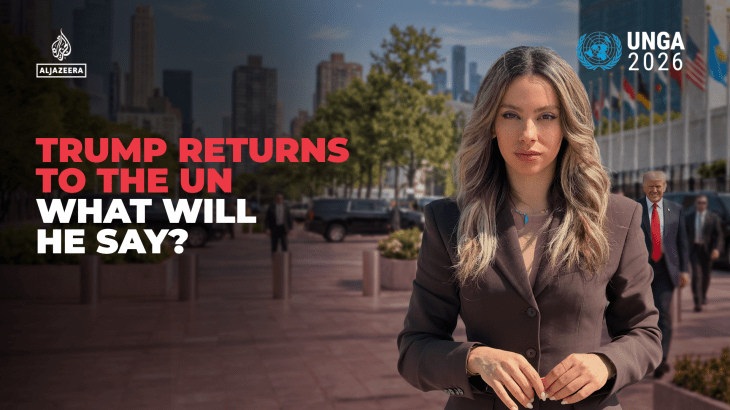
The article previews Donald Trump’s return to the United Nations in New York and asks what message the US president will deliver. His appearance comes one year after he told the UN General Assembly that he was the “world’s greatest peacemaker,” a claim that provides a contrast with the circumstances surrounding his latest visit.
According to the article, Trump is returning amid a war with Iran that it says he started, ongoing Israeli violations of a ceasefire in Gaza, and growing scrutiny over the United States’ objectives at the United Nations. These developments create a politically difficult context for Trump, particularly as his previous self-presentation as a peacemaker is juxtaposed with continuing conflict and allegations of ceasefire violations.
The report also raises questions about the broader relationship between the Trump administration and the UN. It suggests that observers will be watching not only what Trump says about Iran and Gaza, but also how he explains the US role in international diplomacy and what Washington wants from the global organization. The article does not provide the president’s remarks or outline specific policy announcements; instead, it frames his appearance as an event requiring close scrutiny.
Overall, the piece is a concise news preview focused on the gap between Trump’s past rhetoric and the conflicts and diplomatic controversies confronting his administration. Its framing is skeptical and critical, emphasizing the tension between his claim to be a peacemaker and the wars, ceasefire disputes, and international questions surrounding his return to the UN.
Entities: Donald Trump, United Nations, UN General Assembly, New York, United States presidency • Tone: analytical • Sentiment: negative • Intent: analyze
22-09-2026
The supplied material does not contain the substantive text of the Al Jazeera live article. It includes the headline “UN General Assembly live: Trump, Qatar emir to speak as Iran war dominates,” the label “30 Updates,” and multiple advertisement and notification prompts. Based on the headline alone, the article was intended to provide live coverage of a United Nations General Assembly session in which US President Donald Trump and the emir of Qatar were expected to speak. The headline indicates that the war involving Iran was the dominant subject shaping the diplomatic event and the live updates.
Because the individual updates, quotations, statements, background information, and reactions are absent from the supplied content, it is not possible to determine what Trump or the Qatari emir said, how other governments responded, or which specific developments related to the Iran war were discussed. It is also not possible to verify the article’s chronology, factual claims, or broader analysis. The available material supports only a limited description of the article’s apparent focus: high-level diplomacy at the United Nations, speeches by prominent leaders, Qatar’s role, and the effect of the Iran conflict on the General Assembly agenda.
The page also contains prominent advertising and an invitation to enable personalized alerts. Those elements are unrelated to the article and have been excluded from the cleaned text. The analysis below therefore reflects the headline and the small amount of article metadata provided, rather than the missing liveblog updates themselves.
Entities: United Nations General Assembly, United Nations, Donald Trump, Emir of Qatar, Qatar • Tone: neutral • Sentiment: neutral • Intent: inform
22-09-2026
The G7 has called on Iran to end its alleged arming and support of the Houthi movement in Yemen, while demanding that the Houthis halt attacks on civilian shipping and return to peace negotiations. In a joint statement issued ahead of the UN General Assembly, the foreign ministers of the UK, Canada, France, Germany, Italy, Japan and the United States condemned Houthi attacks on Saudi Arabia and warned that the escalation threatened regional and global energy security, international trade and economic stability.
The statement followed a major Houthi advance along Yemen’s Red Sea coast, including the seizure of the Bab al-Mandab Strait, a strategically important maritime chokepoint connecting the Red Sea with the Gulf of Aden and the Indian Ocean. The United Nations estimates that more than 120,000 people have been displaced by the recent fighting. Saudi Arabia has responded with hundreds of air strikes, while the Houthis have launched drones and missiles at Saudi cities, oil facilities, airports and shipping.
The article reports competing allegations of civilian casualties. Houthi authorities blamed Saudi air strikes for deaths in Mokha, Jawf and Taiz, while Saudi government media reported that a Houthi missile struck a crowded market in Lahj province. Neither side immediately accepted responsibility for all reported incidents.
The conflict has also prompted requests for international military assistance. The UK announced defensive air-to-air refuelling support for Saudi Arabia, while France reportedly offered help protecting Saudi energy infrastructure. Saudi Crown Prince Mohammed bin Salman has also sought US support, although President Donald Trump was reported to be undecided.
Iran denies supplying weapons to the Houthis, but Western governments and UN experts say Iranian, Hezbollah and Iraqi assistance has significantly strengthened the group. The fighting is part of Yemen’s civil war, which began in 2014 and escalated after Saudi-led intervention in 2015. A four-year informal ceasefire began breaking down in July after the Houthis declared a maritime embargo against Saudi Arabia.
Entities: G7 foreign ministers, Houthis, Iran, Yemen, Saudi Arabia • Tone: analytical • Sentiment: negative • Intent: inform
22-09-2026
The live update describes escalating military, economic, and diplomatic tensions between Iran and the United States as Iranian President Masoud Pezeshkian travels to New York for the United Nations General Assembly. Pezeshkian says he will firmly defend Iran’s position and use the summit to highlight Iran’s difficulties. President Donald Trump has said he would probably be willing to meet Pezeshkian, although Secretary of State Marco Rubio says no meeting has been scheduled and that any talks would need to support a positive diplomatic outcome.
Iranian officials reportedly want the United States to formally declare its commitment to a diplomatic resolution before negotiations resume. A senior official told Reuters that Iran’s delegation has authorization from Supreme Leader Ayatollah Ali Khamenei to revive diplomacy, but the official ruled out a direct Trump-Pezeshkian meeting. Iran has also reportedly offered to reopen the Strait of Hormuz to commercial shipping within a week if the United States lifts its naval blockade of Iranian ports and vessels. The offer had not been independently confirmed.
Oil prices continued to fall amid reports that Saudi Arabia had restarted its East-West Crude Oil Pipeline, which was damaged in drone attacks blamed on Iran-backed groups. The pipeline could allow exports to resume through the Red Sea port of Yanbu, although operations were reportedly limited. The potential reopening of the Strait of Hormuz also eased concerns about global oil supplies.
The update reports additional regional and international consequences. Iran Air said it had not been notified of any regional flight ban before new U.S. sanctions take effect, while Treasury Secretary Scott Bessent warned that Iranian airlines could be shut out of global aviation services and the dollar system. China condemned the threatened sanctions as illegal. Separately, Iran-backed Houthi officials said a Saudi strike on a prison in Yemen killed nine detainees. Iran’s foreign minister also said Tehran has no trust in the United Nations in its current form.
Entities: Masoud Pezeshkian, Donald Trump, Abbas Araghchi, Marco Rubio, Scott Bessent • Tone: urgent • Sentiment: negative • Intent: inform
22-09-2026
President Donald Trump is set to address the United Nations General Assembly in New York and meet with numerous foreign leaders as his administration manages several major international crises. According to White House officials, Trump will present his use of American power as a means of reshaping global affairs in favor of the United States. He is also expected to criticize international institutions that he says infringe on U.S. sovereignty or promote a “radical left-wing agenda.”
The speech comes as the war with Iran approaches its seven-month mark, negotiations continue over a proposed peace plan for Gaza between Israel and Hamas, and Trump struggles to end Russia’s invasion of Ukraine. Officials said Trump would discuss efforts to prevent Iran from acquiring a nuclear weapon and provide an update on implementing the Gaza plan. Treasury Secretary Scott Bessent and Secretary of State Marco Rubio are expected to warn countries that continuing to do business with Iran could bring consequences.
The regional conflict risks expanding after Iranian-backed Houthi militants attacked targets in Saudi Arabia, including Riyadh’s international airport and oil facilities. Trump considered strikes against the Houthis at the request of Saudi Crown Prince Mohammed bin Salman but ultimately called them off. He has not indicated what action he may take next.
Trump is also expected to meet with leaders from the United Kingdom, Japan and Gulf states, as well as potentially Venezuela’s acting president. His upcoming meeting with Chinese President Xi Jinping will bring trade, artificial intelligence, Chinese support for Iran and purchases of Russian oil into focus. A new U.S. security agreement for Greenland is also expected to be signed, despite Denmark and Greenland’s rejection of Trump’s push for U.S. ownership.
The article also highlights tensions between Trump and European allies over Greenland, trade, defense spending and NATO’s role in the Iran conflict. Coverage of Trump’s meetings may be limited after several news organizations sued the administration over restrictions on White House access.
Entities: Donald Trump, United Nations General Assembly, White House, Iran war, Gaza peace plan • Tone: analytical • Sentiment: neutral • Intent: inform
22-09-2026
CBS News’ live coverage describes the continuing Iran war, which the article says has lasted roughly six and a half months, amid allegations of civilian harm, diplomatic uncertainty, attacks on shipping and rising energy costs. A U.N.-commissioned panel of human rights experts said there were “reasonable grounds” to believe the United States committed war crimes in two strikes in Iran that killed at least 178 civilians. The report is presented as an allegation by the panel, not as a judicial finding.
President Donald Trump again said Iran wants to negotiate an end to the war and expressed hope that the conflict was nearing its conclusion. Secretary of State Marco Rubio said the United States was open to meeting Iranian officials during the U.N. General Assembly, although no meeting had been scheduled. Trump also said he would probably meet Iranian President Masoud Pezeshkian. Both Pezeshkian and Foreign Minister Abbas Araghchi planned to defend Iran’s position at the summit.
The maritime situation remained volatile. A tanker in the Strait of Hormuz was reportedly hit by an unknown projectile, causing a fire that was later extinguished; the crew was safe, while the environmental impact remained unclear. The U.K. Maritime Trade Operations organization also reported another attack on a vessel, while Iran’s Islamic Revolutionary Guard Corps claimed it had struck a ship making an “illegal passage.” It was not clear whether the incidents were connected.
South Korea ruled out deploying troops or military assets to intervene, though it said it would protect its merchant ships and oil routes. Iranian Americans in the United States were described as sharply divided over the war, with disputes damaging friendships and family relationships. The article also reports falling oil prices after assurances about a damaged Saudi pipeline, but continued increases in gasoline and diesel prices. A North Carolina farmer who voted for Trump said high costs had made him feel the country had been misled. Finally, Russia and China vetoed a U.N. resolution that would have extended monitoring of sanctions imposed on Iran, though the supplied text ends before describing the U.S. response.
Entities: Iran war, United States, Iran, Donald Trump, U.N.-commissioned panel of human rights experts • Tone: urgent • Sentiment: negative • Intent: inform
22-09-2026
Iran has reportedly offered to reopen the Strait of Hormuz within seven days if the United States reduces military pressure and lifts its blockade on Iranian ports. The proposal, cited by Reuters and Japan’s Kyodo news agency through an unnamed senior Iranian official, has raised the possibility of renewed U.S.-Iran diplomacy after nearly seven months of war. CNBC said it could not independently verify the reports.
The Strait of Hormuz is a crucial global energy route, typically carrying about 20% of the world’s oil and liquefied natural gas supplies. The conflict has severely disrupted shipping through the waterway, contributing to market volatility and broader concerns about energy security. Following the reports, U.S. stock futures were mixed and oil prices fell, with Brent crude down 2.6% to $97.73 per barrel and West Texas Intermediate down 3.1% to $92.40.
The reported offer emerged as the Trump administration intensifies economic pressure on Tehran. Treasury Secretary Scott Bessent warned that the United States could effectively shut down Iranian airlines by denying them fuel, landing services and access to ticket sales, while Washington continues targeting Iranian financial partners and “enablers.”
Regional tensions are also rising around the Bab el-Mandeb Strait. The G7 condemned attacks by Iran-backed Houthi rebels against civilian shipping and Saudi Arabia. The Houthis reportedly claimed attacks on sites in Riyadh and recently seized Yemen’s Perim Island, strengthening their position near the Red Sea chokepoint. Together, Hormuz and Bab el-Mandeb are vital to global oil transportation.
The United Kingdom reportedly agreed to provide air-to-air refueling for Saudi aircraft, while NATO officials indicated that other European countries could support Riyadh. The developments occurred before President Donald Trump’s address to the United Nations amid domestic criticism of his decision to launch the war against Iran.
Entities: Iran, United States and Trump administration, Donald Trump, Scott Bessent, Strait of Hormuz • Tone: analytical • Sentiment: negative • Intent: inform
22-09-2026
G7 foreign ministers have strongly condemned continued Houthi attacks in Yemen and against Saudi Arabia, calling on the Iran-backed group to immediately halt military operations, threats, and attacks on civilian shipping. Meeting on the sidelines of the United Nations General Assembly, ministers from Britain, Canada, France, Germany, Italy, Japan, and the United States also urged Iran to end its support for the Houthis, including the provision of weapons.
The article reports that British Prime Minister Andy Burnham approved limited defensive military assistance for Saudi Arabia after Riyadh requested support. The Royal Air Force is expected to provide air-to-air refueling for Saudi aircraft, allowing them to conduct defensive operations against Houthi drones and missiles. The arrangement is reportedly time-limited, likely lasting several weeks, and will use an RAF Voyager tanker. It supplements the Sky Sabre air-defense system already deployed in Saudi Arabia. British officials emphasized that the mission is intended to protect Saudi territory rather than support offensive strikes against the Houthis, while also helping preserve oil-supply routes.
Tensions have intensified after the collapse of a 2022 truce between the Houthis and Saudi Arabia. The breakdown followed the landing of an Iranian aircraft in Sanaa, an action that challenged Saudi control of Yemeni airspace. The Houthis recently claimed an attack on Riyadh, reportedly the first strike targeting the Saudi capital in several years. They have also announced a blockade of Saudi-linked shipping in the Bab el-Mandeb Strait and the Red Sea, major international trade routes, and have attacked oil facilities inside Saudi Arabia. The developments increase pressure on regional governments and raise concerns about civilian shipping, energy supplies, and the wider conflict in Yemen.
Entities: G7 foreign ministers, Houthi rebels, Iran, Saudi Arabia, Yemen • Tone: urgent • Sentiment: negative • Intent: inform
22-09-2026
The article examines how the Iran war has expanded beyond the Strait of Hormuz, increasing pressure on the United States, Iran and the Gulf states. Iran-backed Houthi forces in Yemen have seized positions along the Yemeni coast, threatened Red Sea shipping and attacked targets in Saudi Arabia. The developments have compounded a global energy crisis caused by the blockade of the Strait of Hormuz. Saudi officials have also accused Iran-aligned militias in Iraq of attacking the East-West oil pipeline. Saudi Crown Prince Mohammed bin Salman reportedly urged US President Donald Trump to intervene, but Trump rejected or abandoned possible airstrikes against the Houthis after the group allegedly agreed not to target US interests.
Trump is seeking a way to end the conflict while demonstrating political success before the US midterm elections, amid high gasoline and diesel prices. According to Iran expert Fatemeh Aman, his desired outcome would include weakening Iran’s nuclear and military capabilities, restoring freedom of navigation and forcing Tehran back to negotiations. However, Iran has not capitulated, and no durable ceasefire has been reached.
Diplomatic efforts involve China, Iran, the Gulf states, Qatar and Oman. Trump is expected to discuss China’s economic relationship with Iran with President Xi Jinping and may meet Iranian President Masoud Pezeshkian during the United Nations General Assembly. Gulf states favor de-escalation because they recognize the risks of direct confrontation with Iran, but disagreements over control of the Strait of Hormuz and the war in Yemen remain major obstacles.
Iran may pursue a two-track strategy: resisting US-led regional containment while offering its Gulf neighbors a security framework based on dialogue and accommodation. Tehran is demanding an end to fighting on all fronts, the release of frozen assets and the lifting of the naval blockade. Despite ongoing contacts with Qatar and Oman, the parties remain divided over how to end the conflict.
Entities: Iran war, US President Donald Trump, Iranian President Masoud Pezeshkian, Iranian government and Tehran, Houthi militia • Tone: analytical • Sentiment: negative • Intent: analyze
22-09-2026
The article reports that British Prime Minister Andy Burnham has approved limited military support for Saudi Arabia as the kingdom faces renewed attacks by Yemen’s Houthi rebels. The UK’s Royal Air Force is expected to provide defensive air-to-air refuelling for Saudi aircraft, using a Voyager tanker. The mission is reportedly due to begin within days, will be time-limited, and could last several weeks. British officials emphasize that the support is intended to help Saudi Arabia defend against Houthi drones and missiles rather than facilitate Saudi strikes against the Iran-backed movement. The deployment would supplement the UK’s Sky Sabre air-defence system already stationed in Saudi Arabia.
Burnham said Saudi Arabia had formally requested military assistance and argued that the UK was acting to protect British and regional interests, including the security of oil-supply routes. The decision comes amid a deterioration in relations between Saudi Arabia and the Houthis. Saudi Arabia has led a coalition supporting Yemen’s internationally recognized government since 2015, but a truce reached in 2022 broke down after the Houthis permitted an Iranian aircraft to land in Sana’a, challenging Saudi control of Yemeni airspace.
The article says the Houthis recently attacked Riyadh, marking the first strike on the Saudi capital in years. They have also threatened Saudi-linked shipping in the Bab el-Mandeb Strait and the Red Sea, while targeting Saudi oil facilities with drones and missiles. The G7 foreign ministers condemned the attacks, urged the Houthis to halt military operations and threats against civilian shipping, and called on Iran to stop providing support and weapons to the rebels. Overall, the report presents the British deployment as a limited defensive response to escalating regional tensions and risks to global energy and maritime routes.
Entities: Andy Burnham, United Kingdom, Royal Air Force (RAF), Saudi Arabia, Yemen’s Houthi rebels • Tone: analytical • Sentiment: negative • Intent: inform
22-09-2026
Conflicting reports from Tehran have raised uncertainty over whether Iran privately offered to reopen the Strait of Hormuz within seven days in exchange for reduced US military pressure. Reuters and Japan’s Kyodo news agency, citing unnamed Iranian officials, reported that the proposal had been passed to Washington through mediators. Iran’s semi-official Fars news agency quickly rejected the reports as inaccurate and suggested they were intended to push down oil prices. Kyodo said the proposal could involve a permanent end to the war and a possible revival of US-Iran diplomacy if Washington also took steps toward peace.
The article notes that Tehran has previously issued contradictory signals about ceasefires and peace terms. In 2025, President Donald Trump announced a ceasefire involving Iran and Israel before Iran’s foreign minister denied that an agreement had been reached. More recently, Trump said terms for ending the war had been approved in writing, while Iranian state media called competing versions of the terms fabricated.
US Secretary of State Marco Rubio said Washington was open to meeting Iranian officials during the UN General Assembly, although no meeting had been scheduled. He stressed that preventing Iran from obtaining a nuclear weapon remained the central US objective.
Iranian President Masoud Pezeshkian travelled to New York for the UN meeting, promising to defend Iran’s positions and present what he called the country’s plight to the international community. His appearance would make him the highest-ranking Iranian official to visit the United States since the war began.
The Strait of Hormuz remains central to negotiations. The waterway carried about one-fifth of global oil and LNG supplies before the war, but shipping has been severely disrupted by Iranian attacks and passage restrictions. The US has maintained a counterblockade of Iranian ports while increasing economic pressure, and Iranian officials have warned that continued pressure will bring higher fuel prices and prolonged energy problems.
Entities: Iran, United States, Strait of Hormuz, UN General Assembly, Masoud Pezeshkian • Tone: analytical • Sentiment: neutral • Intent: inform
22-09-2026
The article examines the Middle East’s central role at the United Nations General Assembly as regional leaders confront the consequences of war with Iran, renewed Houthi attacks, threats to energy routes, and uncertainty over Gaza’s future. Leaders from Jordan, Türkiye, Qatar and Egypt are expected to address the General Debate beginning September 22, while Israeli Prime Minister Benjamin Netanyahu is also scheduled to attend. President Donald Trump is expected to meet Gulf leaders on the sidelines of the gathering to discuss the Iran conflict and broader regional concerns. U.S. Ambassador to the United Nations Mike Waltz described the meeting as an opportunity for the administration to hear directly from its Gulf partners.
The article highlights arguments that the Iran war could reshape regional alliances and energy infrastructure. Rich Goldberg of the Foundation for Defense of Democracies said the crisis could encourage closer cooperation between Israel and Arab states, including new energy partnerships. He proposed overland pipeline networks linking Gulf producers to the Mediterranean, potentially through Israel, to reduce reliance on vulnerable maritime routes and make the Strait of Hormuz less strategically decisive.
However, the energy threat extends beyond Hormuz. Renewed Houthi activity along Yemen’s Red Sea coast has raised concerns about the Bab el-Mandeb, another major global shipping chokepoint. Analysts cited in the article said the Houthi offensive had disrupted the previous security balance along Yemen’s western coast.
Gaza remains a separate and difficult diplomatic issue. Arab governments are seeking a political settlement but disagree with Israel over Palestinian statehood and Gaza’s future. A joint statement by several Arab and Muslim-majority countries rejected the forced displacement of Palestinians and reaffirmed support for a Palestinian state based on the 1967 lines, with East Jerusalem as its capital. Qatar has condemned Iranian and Houthi attacks while continuing to insist that the Palestinian issue remain a regional priority.
Entities: Donald Trump, United Nations General Assembly, Mike Waltz, Iran war, Gulf states • Tone: analytical • Sentiment: neutral • Intent: analyze
22-09-2026
The France 24 live report, dated September 22, 2026, describes a sharp escalation in fighting in Yemen. Saudi airstrikes on the Red Sea port of Mokha reportedly killed at least six people, while Iran-backed Houthi forces continued an offensive against Saudi-backed forces. The article presents the violence as part of a broader regional crisis involving Iran, Saudi Arabia, Israel, Lebanon, Gaza and the wider Middle East.
The escalation is said to be increasing pressure on the United States and its allies to protect Saudi Arabia and critical regional energy infrastructure. The timing is also linked to US President Donald Trump’s planned address to the United Nations in New York, suggesting that the Yemen conflict could feature prominently in wider diplomatic and security discussions.
The report includes a still image described as showing Houthi fighters attacking Saudi-backed forces on September 15, 2026. The image is credited to Houthi Military Media and Reuters. France 24 says the live blog is being updated with information from Reuters, the Associated Press and Agence France-Presse.
However, the supplied page appears to be unavailable: after the introductory material, it displays a “Page not found” notice stating that the requested content does not exist or is no longer available. As a result, the available text provides only the initial overview and does not include further updates, casualty figures, statements from the parties, or independent verification of the reported events. The report’s central focus is therefore the alleged Saudi airstrike on Mokha, the continuing Houthi offensive, and the mounting international pressure created by the conflict’s potential impact on regional security and energy supplies.
Entities: Yemen, Mokha, Red Sea, Saudi Arabia, Saudi-backed forces • Tone: urgent • Sentiment: negative • Intent: inform
22-09-2026
World leaders are gathering in New York for the 81st United Nations General Assembly amid wars, geopolitical polarization, economic disruption, climate pressures and growing anxiety about artificial intelligence. The meeting will examine whether the 193-member organization can still coordinate international action on crises that cross national borders, including conflicts in the Middle East, Gaza, Ukraine, Sudan, Congo and Myanmar.
The future of the United Nations itself is also central to the discussions. Member states have agreed to a broad reform package, including changes to the Security Council, whose five permanent members—the United States, Russia, China, Britain and France—retain disproportionate influence through their veto powers. The selection of a successor to Secretary-General Antonio Guterres, whose second term ends on December 31, is another issue likely to be discussed.
Approximately 130 heads of state and government are expected to address the General Assembly. Speakers include U.S. President Donald Trump, French President Emmanuel Macron, Ukrainian President Volodymyr Zelenskyy, Iranian President Masoud Pezeshkian and Israeli Prime Minister Benjamin Netanyahu. Palestinian President Mahmoud Abbas will participate by video after the United States refused to grant him a visa. The absence of Chinese President Xi Jinping, Russian President Vladimir Putin and Indian Prime Minister Narendra Modi is also notable.
The United Nations is experiencing severe financial and political strain. U.S. arrears have damaged its finances, forcing cuts to peacekeeping and humanitarian programs, although a recent payment of $725 million preserved Washington’s voting rights. Analysts describe the organization as no longer in freefall but still trapped in a prolonged crisis.
Artificial intelligence has moved toward the center of the agenda. AI executives have warned that the technology could escape human control, while President Trump has dismissed such concerns and advocated continued U.S. development. The Security Council will hold a high-level meeting on AI, alongside discussions on Ukraine. Despite the gravity of the challenges, diplomats and experts argue that personal meetings and multilateral cooperation can still produce practical agreements and offer grounds for cautious hope.
Entities: United Nations, 81st United Nations General Assembly, New York City, Antonio Guterres, Donald Trump • Tone: analytical • Sentiment: negative • Intent: inform
22-09-2026
U.S. President Donald Trump is scheduled to address the 81st session of the United Nations General Assembly as tensions over trade, tariffs and international cooperation continue to intensify. The Assembly’s theme is “Restoring trust, managing transformation: A United Nations that delivers for all,” but Trump’s administration has pursued policies that challenge the organization and broader multilateral institutions.
Trump has demanded major reforms at the UN, withheld funding and withdrawn the United States from several UN organizations, including the World Health Organization and UNESCO. He is also expected to criticize the UN again during his speech, as he did in 2025 when he argued that the body had failed to end wars and claimed he had been the target of a UN conspiracy after an escalator and TelePrompTer malfunctioned at its headquarters.
Canadian Prime Minister Mark Carney is expected to attend the General Assembly opening. The article presents Carney as an increasingly prominent defender of multilateralism and international cooperation on issues such as climate change, financial instability and armed conflict. For nearly a year, he has encouraged middle powers to cooperate around shared interests and values, rather than relying solely on existing institutions.
Carney has also attempted to build stronger links between the European Union and the CPTPP, a Pacific Rim trade bloc, to help countries resist economic pressure from the United States and China. His efforts have drawn attention from Trump’s administration, particularly after Canada-U.S. trade talks ended acrimoniously. Trump recently warned that closer ties between Canada and the European Union could be a “hostile act.”
Carney may face additional pressure while co-hosting an event with France and the United Kingdom on a two-state solution, one year after the three countries recognized an independent Palestinian state. Relations between Canada and the United States remain strained as their trade war escalates and prospects for a new bilateral trade agreement deteriorate.
Entities: Donald Trump, Mark Carney, United Nations General Assembly, United Nations, Canada-U.S. trade war • Tone: analytical • Sentiment: negative • Intent: inform
22-09-2026
President Donald Trump is heading to New York to address the United Nations General Assembly after a difficult stretch marked by legal and political setbacks. His approval rating has fallen below 40%, partly because of growing concerns about the economic consequences of the war with Iran. He is also facing lawsuits from CNN, MS NOW and Politico after barring the organizations from the White House. With the midterm elections less than two months away, Trump is expected to use a high-profile week of diplomacy to demonstrate foreign-policy accomplishments.
In his U.N. speech, Trump is expected to present himself as a peacemaker, emphasize peace agreements his administration has announced and defend the decision to strike Iran. He is also likely to stress the importance of preventing Iran from developing a nuclear weapon. The address follows a history of provocative and attention-grabbing appearances at the U.N., including threats against North Korea, sweeping claims about his administration’s achievements and criticism of the organization itself.
Trump may also highlight a new security agreement with Denmark concerning Greenland. During the week, he is expected to meet with Ukrainian President Volodymyr Zelenskyy, British Prime Minister Andy Burnham, Gulf leaders and Venezuela’s interim President Delcy Rodríguez. Analysts say these private meetings may be more consequential than formal U.N. proceedings, especially as the Security Council continues to struggle to reach agreement on major issues.
Artificial intelligence safeguards are another major topic at the gathering. However, China’s absence from New York may limit the event’s importance, since many global issues involve Beijing. Chinese President Xi Jinping will instead travel to Washington for a state dinner with Trump, shifting much of the world’s attention from the U.N. to the U.S. capital.
Entities: Donald Trump, United Nations General Assembly, New York City, Washington, D.C., Xi Jinping • Tone: analytical • Sentiment: negative • Intent: analyze
22-09-2026
The article examines why Saudi Arabia is being left largely on its own to confront renewed attacks by Yemen’s Iran-backed Houthi movement, despite Riyadh’s longstanding security relationships with the United States and other regional powers. President Trump and Saudi Arabia’s allies are treating the fighting as an internal Yemeni conflict rather than an extension of the broader Iran war. Analysts identify two main reasons for the lack of assistance: regional governments fear Houthi and Iranian retaliation against their own civilians and energy infrastructure, and the Saudi-Houthi conflict predates the current regional crisis.
Turkey and Pakistan, despite signing the August Mecca Agreement promising to defend Saudi Arabia in the event of an attack, have declined to intervene. Pakistan argues that the renewed fighting is part of the pre-existing Yemeni civil war and therefore does not activate the agreement. Saudi Arabia has asked France, Britain, Pakistan and Egypt for air support while reportedly running low on missile interceptors.
Crown Prince Mohammed bin Salman asked Trump to help suppress the Houthi uprising, but Trump reportedly declined to launch US airstrikes. Washington is concerned that intervention could escalate the Iran conflict and expose American troops and assets in the Middle East. The US is preparing to sell Saudi Arabia 48 F-35 fighter jets, but delivery would take years.
Meanwhile, Houthi attacks have intensified. Ballistic missiles have been fired near Riyadh, the group has taken control of the Bab al-Mandeb Strait, and disruptions have affected the Saudi East-West Pipeline, which carries oil away from the Strait of Hormuz. Oil prices briefly rose to about $100 per barrel. The article warns that Iran could use the Houthi conflict as leverage in broader regional negotiations, making a settlement difficult, although it remains uncertain whether the Houthis will fully prioritize Iran’s objectives over their own goals in Yemen.
Entities: Saudi Arabia, Donald Trump, Crown Prince Mohammed bin Salman (MBS), Houthi movement (Ansarallah), Iran • Tone: analytical • Sentiment: negative • Intent: analyze
22-09-2026
France is drafting a new United Nations Security Council resolution, in coordination with the United States, to establish an international mission aimed at restoring commercial movement through the Strait of Hormuz, according to diplomats. The initiative follows a meeting between French President Emmanuel Macron and US President Donald Trump in New York on the sidelines of the UN General Assembly.
Macron said the two sides had discussed several options and would pursue diplomatic solutions that could permit more container ships and oil tankers to transit the strategically important waterway, even without reaching a comprehensive agreement. France hopes to circulate a draft resolution to the Security Council soon, although diplomats did not provide a timetable.
Previous French efforts to secure UN action on Hormuz failed because China and Russia, both permanent members with veto power, feared that such a resolution could be biased against Iran. The latest proposal is being developed amid surging global oil prices and concern that advances by Houthi rebels in Yemen could endanger the Bab el-Mandeb corridor, another major route for international shipping.
According to the diplomats, the proposed resolution would seek to separate maritime security from broader tensions involving Iran. It would emphasize the shared interest of all countries in protecting freedom of navigation and access to energy supplies. UN member states would coordinate measures to safeguard commercial shipping without taking an offensive stance toward Iran, criticizing the United States, or tying the issue to other regional disputes. A French diplomatic source said France wanted to work with Washington and other partners on a resolution guaranteeing freedom of navigation in the Strait of Hormuz.
Entities: France, United States, United Nations Security Council, Strait of Hormuz, Emmanuel Macron • Tone: analytical • Sentiment: neutral • Intent: inform
22-09-2026
Saudi-led airstrikes on Yemen’s Red Sea port city of Mokha reportedly killed at least six civilians and wounded eight others, according to Saba, a news agency affiliated with Yemen’s Iran-backed Houthi movement. The reported fatalities included two children and a woman, while the wounded included a child and a woman. Mokha has become strategically important as the Houthis have launched an offensive aimed at taking control of Yemen’s entire Red Sea coastline, intensifying pressure on the Saudi-backed, internationally recognised Yemeni government.
The article says Yemen’s governing body head, Rashad al-Alimi, asked US President Donald Trump for American support during a Sept 20 call. According to a source in al-Alimi’s office, Trump did not promise military assistance, and the call was intended partly to demonstrate solidarity with Yemen’s embattled government. US media also reported that Saudi Crown Prince Mohammed bin Salman had urged Trump to strike the Houthis. Media reports said British Prime Minister Andy Burnham had agreed to provide military support to Saudi Arabia.
The latest fighting is presented as part of a broader regional conflict involving Iran, the United States, Israel and Iran-backed armed groups. The article says Houthi gains have strengthened Iran and its allies’ influence over key waterways, including the Strait of Hormuz, which is vital to Gulf states and Saudi Arabia for oil exports.
Yemen’s civil war began in 2014 when the Houthis captured the capital, Sanaa. Saudi Arabia began leading a coalition in support of the internationally recognised government in 2015. Although the conflict had largely been frozen since 2022, the article reports that fighting resumed in July. The Saudi intervention helped escalate the war, which has contributed to one of the world’s worst humanitarian crises.
Entities: Houthis, Mokha, Yemen, Saudi Arabia, Yemen’s Red Sea coast, Saba news agency • Tone: urgent • Sentiment: negative • Intent: inform
22-09-2026
Iran and the United States have signalled a possible return to negotiations as Presidents Donald Trump and Masoud Pezeshkian prepare to attend the UN General Assembly in New York. The meeting would be the first major event attended by both leaders since Trump and Israel launched Operation Epic Fury against Iran in February. Although there are no current plans for a direct presidential meeting, an Iranian official said Tehran’s delegation had authority to revive talks and proposed reopening the Strait of Hormuz to Gulf shipping within seven days if Washington eased military pressure and lifted its blockade of Iranian ports. Tehran has reportedly sent its latest proposal through mediators and wants the United States to formally commit to a diplomatic process and establish a timetable.
US Secretary of State Marco Rubio said Washington was open to discussions if they could produce a positive outcome, while stressing that Iran must not acquire nuclear weapons. He also warned that President Pezeshkian operates under Supreme Leader Ayatollah Mojtaba Khamenei. Iran’s Parliament Speaker Mohammed Baqer Qalibaf, meanwhile, reiterated that Iran would not surrender or accept the imposition of US power.
The Gulf states are seeking to restore maritime traffic through the Strait of Hormuz but remain concerned that negotiations could strengthen Iran’s regional influence. Their meeting with Trump will also address the expanding conflict involving Saudi Arabia and Iran-aligned Houthi fighters in Yemen. Houthi advances have weakened Saudi-backed forces, threatened oil exports and targeted Saudi Arabia with missiles and drones. Saudi Arabia has restarted its East-West Pipeline and may resume limited exports from Yanbu, providing an alternative route around Hormuz.
Qatar has proposed a regional security framework involving Iran and the six Gulf states. Its prime minister said lasting stability would require security guarantees for Gulf countries and deeper economic interdependence with Iran, rather than repeated cycles of escalation and retaliation.
Entities: Iran, United States, Donald Trump, Masoud Pezeshkian, Marco Rubio • Tone: analytical • Sentiment: negative • Intent: inform
22-09-2026
French President Emmanuel Macron said his Sept 21 meeting with US President Donald Trump in New York produced positive and “very constructive” discussions about the war between Ukraine and Russia and the security situation in the Red Sea. The meeting took place ahead of the United Nations General Assembly’s high-level week and was considered diplomatically significant, with a French official saying Macron was prepared to speak to Trump with “total candour.”
Macron said he urged Trump to support the faster and stronger delivery of defensive weapons systems to Ukraine, particularly missile interceptors. He characterized Trump as “very amenable” and said the two leaders were able to discuss the conflicts in detail. Macron presented both issues as important to global peace and international security.
The Red Sea discussion was linked to wider concerns about energy and shipping. The article describes the Red Sea as an important oil route following the reported blockage of the Strait of Hormuz, while the takeover of the Strait of Bab al-Mandab by pro-Yemeni rebels has complicated maritime operations.
Before traveling to New York, Macron visited the French territory of Saint Pierre and Miquelon, where he met Canadian Prime Minister Mark Carney. Carney has been involved in an increasingly hostile exchange with Trump following the collapse of a proposed US-Canada trade agreement and the imposition of reciprocal tariffs. Macron was also scheduled to meet Ukrainian President Volodymyr Zelensky on the sidelines of the UN General Assembly. Overall, the article reports a cautiously positive diplomatic encounter while placing it within broader conflicts and international trade tensions.
Entities: Emmanuel Macron, Donald Trump, Ukraine-Russia war, Red Sea conflict and maritime security, United Nations General Assembly • Tone: neutral • Sentiment: positive • Intent: inform
22-09-2026
Oil prices rose on Sept 22 after declining for four consecutive sessions, as investors awaited possible talks between the United States and Iran during the United Nations General Assembly in New York. Brent crude futures for November increased US$1.14, or 1.1 per cent, to US$101.48 a barrel. West Texas Intermediate (WTI) crude for October, which expires on Sept 22, gained 87 cents, or 0.9 per cent, to US$96.65, while the more actively traded November WTI contract rose 85 cents to US$93.22.
The market’s gains appeared to reflect short-covering rather than a fundamental shift in supply and demand. Analysts said prices would probably remain volatile and range-bound until there was clearer evidence of progress or failure in US-Iran diplomatic efforts. Washington and Tehran exchanged threats on Sept 20, although US President Donald Trump said he was open to meeting Iranian President Masoud Pezeshkian. Iran reportedly conveyed conditions for resuming negotiations through mediators.
Supply concerns eased after Saudi Aramco increased crude exports through the Strait of Hormuz. Around 14 million barrels were loaded onto seven supertankers inside the Gulf on Sept 20, following attacks on the East-West Pipeline that had disrupted some shipments through Yanbu. Crude implied volatility declined, although it remained historically high.
Regional risks persisted. Yemen’s Iran-backed Houthis claimed attacks on Riyadh and a Saudi Aramco facility in Yanbu, while China privately urged Tehran to help restrain the group after Saudi Arabia sought Beijing’s assistance. In Libya, an armed group closed a valve on the pipeline linking the Sharara oilfield to the Zawiya port. Production at the field fell by approximately 200,000 barrels per day to between 100,000 and 105,000 barrels per day. These competing developments—easing Gulf supply concerns and continued geopolitical and operational disruptions—left oil markets highly sensitive to diplomatic and security headlines.
Entities: Brent crude futures, West Texas Intermediate (WTI) crude, United States-Iran diplomatic talks, United Nations General Assembly, Donald Trump • Tone: analytical • Sentiment: neutral • Intent: inform
22-09-2026
United Nations Secretary-General Antonio Guterres used what is described as his final address to the General Assembly to urge world leaders to confront several interconnected global challenges: the risks posed by artificial intelligence, ongoing wars, climate change and weaknesses in international institutions. His second five-year term ends on December 31 after a decade leading the UN.
Guterres called for countries at the forefront of AI development to share information about emerging safety risks, cooperate on testing and evaluation, and establish common safeguards. He advocated a multilateral AI risk-management framework backed by credible and independent oversight. His remarks came as the Security Council prepared to host an AI briefing and as the United States and China discussed a possible mechanism for notifying each other about AI incidents with national-security implications.
The secretary-general also highlighted the UN’s efforts to develop international AI governance, including a 39-member advisory body established in 2023. However, he acknowledged the organization’s growing difficulties as major powers increasingly bypass it and the United States cuts funding and withdraws from some UN agencies. He argued that current institutions no longer adequately reflect contemporary global power realities.
On international conflicts, Guterres defended a two-state solution for Israelis and Palestinians and called for de-escalation and dialogue amid tensions in the Middle East, including threats to Red Sea shipping and continued instability around the Strait of Hormuz. He demanded an end to fighting, the unrestricted flow of humanitarian aid and restoration of navigational rights under international law.
Guterres also pressed leaders to act on climate change, insisting that “polluters must pay.” In a farewell message, he said that peace remains possible and pledged to continue defending the UN Charter and refusing to give up, even after leaving office.
Entities: Antonio Guterres, United Nations General Assembly, United Nations Security Council, United Nations, Artificial intelligence governance • Tone: analytical • Sentiment: neutral • Intent: inform
22-09-2026
G7 foreign ministers have urged Iran to end its weapons, funding, training and technical support for Yemen’s Houthi movement, warning that the group’s actions threaten international trade, energy supplies and global stability. The appeal was issued by the foreign ministers of the UK, Canada, France, Germany, Italy, Japan and the US after they met on the sidelines of the UN General Assembly in New York.
The ministers condemned continued Houthi strikes in Yemen and against Saudi Arabia. They also called on the Houthis to immediately stop military operations, threats and attacks on civilian shipping and to return to the political process in good faith. Although Iran denies directly directing Houthi operations, the article describes the group as an important source of Iranian regional leverage.
The Houthis control Sanaa and large parts of northern and western Yemen and have become a major regional force after years of conflict with Saudi-backed forces. Their recent advance along Yemen’s western coast, including the capture of Mokha and strategic islands, has reportedly given them effective control of the Bab Al Mandeb strait, a crucial maritime passage connecting the Red Sea and the Gulf of Aden.
The waterway has gained additional importance after Iran restricted shipping through the Strait of Hormuz. The article says Bab Al Mandeb could provide an alternative route for Gulf oil exports reaching global markets, particularly Saudi energy shipments. Since the US-Iran war began in February, Houthi control of Yemen’s Red Sea coast has also become a potential pressure point against Gulf states and regional energy routes. The G7’s statement reflects growing concern over the wider economic and security consequences of the conflict, especially risks to civilian shipping, energy supplies and international stability.
Entities: G7, Iran, Houthi movement, Yemen, Saudi Arabia • Tone: urgent • Sentiment: negative • Intent: inform
22-09-2026
The National’s live coverage of the 2026 United Nations General Assembly in New York highlights a series of diplomatic, security and humanitarian developments. G7 foreign ministers are demanding that Iran end its support for Houthi rebels in Yemen, underscoring continuing concerns about regional instability and the Houthis’ role in the Middle East conflict. The United Nations is also prepared to investigate alleged chemical-weapons use in Sudan’s civil war, adding an international accountability dimension to the gathering.
Security concerns extend to New York, where the US Secret Service has warned the public against flying drones in the city. The coverage also reports that no network travel pool will accompany President Donald Trump to the UN General Assembly. Alongside these security and geopolitical issues, the page emphasizes diplomacy, with UAE Foreign Minister Sheikh Abdullah bin Zayed leading the country’s delegation and declaring that dialogue is “more important than ever.”
The 2026 assembly’s theme is “restoring trust, managing transformation.” The High-Level General Debate is scheduled to begin on Tuesday and continue through Monday. The live page also features short videos and related updates, including a report on the congestion surrounding the General Assembly, comments from UAE Ambassador Lana Nusseibeh advocating diplomacy and optimism, an explainer on speaking order at the UN General Assembly, and remarks by New York City Mayor-elect Zohran Mamdani that he will not join anti-Benjamin Netanyahu protests during the event. The supplied material consists primarily of headlines, brief descriptions and media links rather than full reports on each development.
Entities: 2026 United Nations General Assembly (UNGA), G7 foreign ministers, Iran, Houthi rebels, Yemen • Tone: urgent • Sentiment: negative • Intent: inform
22-09-2026
The United Nations General Assembly’s high-level debate is underway in New York, where intense security measures, motorcades and thousands of diplomats have transformed the area around UN headquarters. More than 1,000 bilateral meetings have been requested between member states, making the gathering a major venue for discreet, face-to-face diplomacy.
Brazilian President Luiz Inácio Lula da Silva opened the high-level debate on Tuesday, followed by US President Donald Trump. While the formal speeches attract global attention, much of the week’s diplomacy is taking place in half-hour meetings between delegations. Middle Eastern countries are using the event for intensive discussions on regional conflicts, especially the Iran war, which has affected the global economy.
UN Secretary-General António Guterres is seeking renewed commitment to the organization’s principles while urging member states to address what his spokesman Stéphane Dujarric calls “runaway risks,” including artificial intelligence, climate change and inequality. Dujarric compares the hectic week to surfing a giant wave and says participants are running on adrenaline.
The article captures the atmosphere around the UN: officials and journalists move through heavily guarded streets, nearly everyone carrying coffee, while delegates try to find rare breaks between meetings. One journalist describes the week as exhausting but exciting. Dujarric, attending his 26th General Assembly, says he still feels a sense of awe when entering the chamber.
The report also recalls the drama surrounding Trump’s visit the previous year, when an escalator stopped and his teleprompter reportedly malfunctioned. A UN staff member jokingly expressed hope that the escalator would work this time, as delegates gathered in the cafeteria for expensive snacks during brief pauses in the proceedings.
Entities: United Nations General Assembly (UNGA), United Nations headquarters, New York City, Luiz Inácio Lula da Silva, Donald Trump • Tone: analytical • Sentiment: neutral • Intent: inform
22-09-2026
At the 81st United Nations General Assembly, the UAE is presenting optimism, resilience, diplomacy and multilateralism as essential responses to the Middle East’s deepening crises, Minister of State Lana Nusseibeh told The National in New York. Despite the UAE’s direct experience of regional tensions, including an Iranian attack this year, Nusseibeh said Abu Dhabi remains committed to de-escalation, dialogue and behind-the-scenes diplomacy.
She described the Gaza peace process as being at a “critical turning point” and urged all parties to prevent spoilers from undermining progress. The UAE also condemned Houthi attacks on Saudi Arabia and international shipping, calling for a stronger UN role in managing non-state actors. On Sudan, Nusseibeh stressed that the country is “too big to fail” and called for an immediate humanitarian ceasefire, accountability and a return to civilian rule.
The UAE wants the UN to help develop a long-term regional security architecture based on international law, freedom of navigation and the protection of all states’ interests. Nusseibeh acknowledged that the organisation has played a more limited role in mediation than in previous decades because of a crisis of confidence and the complexity of dealing with great powers and non-state actors. Nevertheless, she argued that the UAE’s recent challenges have reinforced its belief in the UN’s underused potential.
Alongside conflict diplomacy, the Emirati delegation is pursuing economic partnerships, investment in artificial intelligence and new Comprehensive Economic Partnership Agreements. Nusseibeh highlighted the UAE’s economic diversification, with nearly 80 per cent of GDP now coming from non-oil sectors, as well as its investments in ports, rail, alternative trade routes, renewable energy, clean nuclear power and AI. Although the Strait of Hormuz remains strategically vital, she said diversification is central to the UAE’s long-term resilience.
Entities: Lana Nusseibeh, United Arab Emirates, United Nations General Assembly, Gaza peace process, Sudan humanitarian ceasefire • Tone: analytical • Sentiment: positive • Intent: inform
22-09-2026
Iran has reportedly offered to reopen the Strait of Hormuz within seven days if the United States takes initial steps to ease its military pressure and blockade of Iranian ports. A senior Iranian official told Kyodo news agency that Tehran sees a possible path toward an agreement but needs Washington to demonstrate “seriousness and commitment” to diplomacy. If the US makes those moves, Iran would reopen the strategic waterway and enter negotiations on terms for ending the conflict.
The standoff has disrupted shipping through the Strait of Hormuz and placed additional pressure on Iran’s crude oil exports, a major source of national revenue. The official said the initiative was approved by Supreme Leader Mojtaba Khamenei and the Supreme National Security Council. Tehran also plans to use the United Nations General Assembly in New York to consult with countries acting as mediators.
Iran has ruled out a meeting between President Masoud Pezeshkian and US President Donald Trump during the UN gathering, although it believes progress toward an agreement remains possible. US Secretary of State Marco Rubio said Washington was open to meeting Iranian officials if discussions could lead to a positive outcome.
The conflict began on February 28, when the United States and Israel launched attacks on Iran, prompting Iranian strikes against Israel and other regional countries hosting US assets. A Pakistan-brokered ceasefire in April led to the June Islamabad Memorandum of Understanding, which gave both sides 60 days to negotiate a long-term settlement. However, retaliatory strikes resumed, leading Washington to reinforce its blockade of Iranian ports and Tehran to close the Strait of Hormuz. Iran’s latest proposal has reportedly been conveyed to Washington through intermediaries.
Entities: Iran, United States, Strait of Hormuz, Mojtaba Khamenei, Masoud Pezeshkian • Tone: analytical • Sentiment: neutral • Intent: inform
22-09-2026
Russian President Vladimir Putin and Saudi Crown Prince Mohammed bin Salman discussed the need to restore safe, uninterrupted shipping through the Strait of Hormuz and Bab el-Mandeb during a phone call on Tuesday, according to the Kremlin. The discussion took place as disruptions involving Iran and Iran-aligned Houthi forces continued to affect oil shipments, regional security, and global trade.
The leaders reviewed the broader Middle East situation and agreed that a political and diplomatic settlement was the only viable way forward. They also called for a rapid end to hostilities in Yemen. The Kremlin emphasized that the two waterways are vital international routes for energy transportation. Because of the disruption, Saudi Arabia has increasingly relied on Egypt’s Suez Canal to move oil exports. The article also reports that the United States has so far declined Saudi requests to resume military action against the Houthis, while The New York Times said President Donald Trump canceled planned strikes at the last moment.
Saudi crude exports rose 3.3% in July to 4.125 million barrels per day, while production increased to 8.135 million barrels per day. UBS analyst Giovanni Staunovo attributed the rise partly to moderating regional tensions but warned that August exports, particularly from Red Sea terminals, could weaken if Houthi-related tensions intensify. Saudi Arabia also resumed its East-West Pipeline after drone attacks forced its closure on September 13.
Separately, an Iranian official said Tehran could reopen the Strait of Hormuz within seven days if Washington eased military pressure and lifted a blockade on Iranian ports. At the same time, Houthi fighters reportedly sought strategic high ground in Yemen to sever the Red Sea coast from territory controlled by Saudi-backed forces. The developments underscore the close relationship between regional conflict, shipping access, oil supplies, and refinery operations.
Entities: Vladimir Putin, Mohammed bin Salman, Kremlin, Iran, Houthi militants • Tone: analytical • Sentiment: neutral • Intent: inform
22-09-2026
The article preview reports that global leaders are gathering in New York for the opening of the 81st United Nations General Assembly. The session is taking place amid heightened international instability, particularly in the Middle East and Europe. The preview identifies two major conflicts shaping the diplomatic environment: the United States’ war with Iran and Russia’s continuing war in Ukraine. The headline indicates that President Donald Trump is expected to address the United Nations, making his speech a central event of the opening session. However, the supplied content ends after the introductory paragraph and does not provide details about Trump’s planned remarks, the positions of other national leaders, the agenda of the General Assembly, or developments in either conflict. The excerpt frames the U.N. gathering as occurring at a moment when instability is affecting many countries, suggesting that war and geopolitical tension will be important themes during the annual diplomatic meeting. It also places the event in New York, the customary location of the General Assembly’s opening. Overall, the available material functions as a brief news introduction rather than a complete account of the session. It informs readers about the timing and setting of the U.N. meeting, identifies the international crises surrounding it, and highlights Trump’s forthcoming address. Because only a short preview was provided, no further conclusions about policy announcements, diplomatic disputes, or reactions to the speech can be drawn from the text.
Entities: Donald Trump, United Nations, 81st United Nations General Assembly, New York, Middle East • Tone: analytical • Sentiment: negative • Intent: inform
22-09-2026
The National published an editorial cartoon by Shadi on September 22, 2026, under its Opinion and Cartoon sections. The cartoon is titled “Shadi’s take on the Iran war at the UN General Assembly” and is tagged “Iran war” and “UNGA 2026.” Based on the supplied page text, the work addresses the Iran war in the setting of the United Nations General Assembly, using visual commentary rather than a conventional written news report. The source provided does not include the cartoon image, a caption, or a transcript of any text appearing within the artwork. Consequently, the specific argument, targets, symbolism, and political claims made by the cartoon cannot be determined reliably from the available material alone.
The title establishes the central subject and institutional context: the conflict involving Iran and its presentation or discussion at the UN General Assembly. The classification as an opinion cartoon indicates that the piece is intended as editorial commentary, likely condensing a political viewpoint into a satirical or symbolic image, but the supplied text does not allow its precise tone or message to be described in detail. The publication date places it within the 2026 UNGA news cycle.
The page also lists other recent cartoons by Shadi concerning Israeli settlements, UN peacekeeping in Lebanon, Mahmoud Abbas’s visa for the UN General Assembly, the cost of the Iran war to the United States, Sudan’s food crisis, rising oil prices, and other subjects. These links provide broader context about the cartoonist’s coverage but are separate from the featured item. No additional reporting, quotations, factual claims, or explanatory text accompanies the cartoon in the supplied content.
Entities: Shadi, The National, Iran war, United Nations General Assembly, UNGA 2026 • Tone: analytical • Sentiment: negative • Intent: critique
22-09-2026
Oil prices fell below $100 a barrel as markets responded to signs that supply disruptions in the Middle East could ease. Brent crude declined 2.64% to $97.69 a barrel, its lowest level since September 9, while West Texas Intermediate fell 3.20% to $89.41. Gasoline and heating-oil futures also dropped, and the S&P GSCI commodity index declined.
The main catalyst was Iran’s indication that it could reopen the Strait of Hormuz within a week if the US reduces military pressure and lifts its blockade of Iranian ports. Iran has reportedly sent Washington a proposal through mediators, raising the prospect of a diplomatic solution after almost seven months of disruption to the strategically vital waterway. However, shipping traffic remains far below normal, and attacks on two tankers continue to highlight security risks.
Saudi Aramco also restarted its East-West pipeline at a reduced rate after drone attacks damaged pumping infrastructure on September 13. The pipeline carries crude across Saudi Arabia to the Red Sea port of Yanbu, providing an alternative to exports through Hormuz. Yanbu shipments were expected to resume the same day. In the meantime, Saudi Arabia sharply increased crude movements through Hormuz, averaging 2.9 million barrels per day over six days, compared with approximately 700,000 barrels per day in August. Some cargoes have also been transferred between ships off Oman to reduce the need for large tankers to enter the Gulf.
The article also places the oil-price decline in a wider economic context. The Federal Reserve raised its benchmark interest rate to 3.75%–4%, joining the European Central Bank and Bank of Japan in tightening policy as energy prices fuel inflation. US retail diesel reached $6.50 per gallon, raising concerns that the energy shock could weaken consumer demand and contribute to an economic slowdown. Traders were also monitoring a planned meeting between US President Donald Trump and Chinese President Xi Jinping for indications on sanctions and Chinese demand for Iranian crude.
Entities: Strait of Hormuz, Iran, Saudi Aramco, East-West pipeline, Yanbu, Saudi Arabia • Tone: analytical • Sentiment: neutral • Intent: inform
22-09-2026
Saudi Arabia has restarted its 1,200-kilometre East-West Pipeline after drone attacks forced it to shut down on September 13, temporarily halting crude loadings at the Red Sea port of Yanbu. The pipeline was initially operating at a low rate, and crude exports from Yanbu could resume later on September 22.
The restart comes as Saudi Arabia shifts more of its exports back through Gulf terminals and the Strait of Hormuz. Seven supertankers, with combined capacity for about 14 million barrels, were loaded over the weekend. Satellite data from the EU’s Sentinel system identified the activity as the clearest indication yet of a move away from Yanbu and towards the strategically important waterway.
Saudi Arabia, Opec’s biggest producer, had expanded exports through the Strait of Hormuz after the pipeline shutdown. The route is critical to global energy markets, but its use exposes shipments to the security and geopolitical risks associated with the region.
The increased Gulf loadings contributed to a decline in oil prices. Brent crude, the benchmark for roughly two-thirds of the world’s oil, fell below $100 a barrel for the first time in several weeks, trading at $97.81 at 2.19pm UAE time. West Texas Intermediate, which tracks US crude, declined 3.11 per cent to $89.50 a barrel.
Noureldeen Al Hammoury, chief market strategist at Equiti Group, said the surge in Gulf shipments helped push Brent lower. The developments indicate that Saudi Arabia is gradually restoring its export capacity, although the low initial pipeline flow and continuing regional tensions suggest that supply and transport conditions remain subject to change.
Entities: Saudi Arabia, East-West Pipeline, Yanbu, Strait of Hormuz, Red Sea • Tone: analytical • Sentiment: neutral • Intent: inform
22-09-2026
The supplied material is not the full Al Jazeera live-blog article. It consists primarily of website clutter—repeated “Advertisement” labels and a prompt asking readers to enable instant alerts—along with the indicator “24 Updates.” The headline states that Iran’s Islamic Revolutionary Guard Corps (IRGC) says the United States and Israel must accept withdrawal from the region, placing the article within the context of the US-Israel war on Iran. However, none of the 24 reported updates, quotations, official statements, timelines, locations, casualty figures, military developments, or reactions are included in the provided content. As a result, it is not possible to produce a substantive account of the events, verify the IRGC’s statement, or determine how the situation developed during the live coverage. The headline suggests a confrontational regional military and political dispute, with Iran demanding that the United States and Israel leave the region. The wording also conveys an ultimatum and indicates that the IRGC is presenting withdrawal as an obligation rather than a negotiated possibility. The available text supports only a limited analysis: the article’s apparent purpose is to provide breaking-news coverage of the conflict, while its framing is urgent and conflict-focused. Any further claims about military operations, diplomatic responses, civilian impact, or the positions of other governments would require the missing article updates. The advertisements, notification prompt, and navigation-like elements have therefore been excluded from the cleaned version.
Entities: Iran, Islamic Revolutionary Guard Corps (IRGC), United States, Israel, Middle East region • Tone: urgent • Sentiment: negative • Intent: inform