24-09-2026
The article is a short Al Jazeera NewsFeed video report about Chinese President Xi Jinping’s visit to the United States and his meetings with US President Donald Trump. According to the description, Trump welcomes Xi for talks and a state dinner as he seeks to stabilise global relations. The leaders’ agenda is expected to include several consequential and potentially contentious issues: trade, Taiwan, artificial intelligence, and the war on Iran. Al Jazeera correspondent Kimberly Halkett reports from Joint Base Andrews, where the visit is being covered.
The description presents the meeting as a high-level diplomatic effort taking place amid rising tensions, but it does not provide details of what the leaders said, whether any agreements were reached, or how they addressed the listed issues. It also offers no reactions from officials, analysts, or members of the public. As a result, the report’s available text establishes the purpose and setting of the visit and identifies the topics under discussion, without explaining their outcomes or assessing the prospects for improved relations. The article is dated September 24, 2026. This summary reflects only the headline and brief video description supplied, rather than a full transcript of the report.
Entities: Xi Jinping, Donald Trump, Kimberly Halkett, United States, China • Tone: analytical • Sentiment: neutral • Intent: inform
24-09-2026
The article examines how the United States and China are competing to shape the future of artificial intelligence, as Donald Trump and Xi Jinping prepare to meet. Both countries view AI as a source of national power, though Trump has stated this rivalry more explicitly. The article contrasts the US lead in frontier models and investment with China’s strengths in widely available open-weight models, energy costs, and large-scale deployment. US firms such as Anthropic, Google, and OpenAI produce leading systems, while Chinese models including DeepSeek and Moonshot AI’s Kimi K3 have narrowed the performance gap. US restrictions on advanced chip exports constrain Chinese developers, but analysts say China has shown resilience and may gain influence by making capable AI cheap and broadly accessible. The article also highlights China’s dominance in industrial and humanoid robot manufacturing.
The two governments differ in their approach to AI safety. Washington has prioritized innovation and reduced regulation, with Trump rejecting calls to slow development. Beijing has issued guidance on data and algorithms and Xi has stressed keeping AI under human control. Their concerns also differ: US officials worry about powerful systems escaping control, while Beijing is more focused on misuse, cyber conflict, and domestic stability. Although both countries have called for cooperation, shared understandings of AI risks remain limited. Officials have discussed a notification mechanism for serious AI incidents, but it is unclear whether the leaders will agree on practical safeguards. The article concludes that “winning” the AI race has no obvious definition or finish line, and that the summit’s discussion could affect global AI governance and the balance of power.
Entities: Donald Trump, Xi Jinping, United States, China, Artificial intelligence (AI) race • Tone: analytical • Sentiment: neutral • Intent: analyze
24-09-2026
CNBC’s Daily Open describes a series of diplomatic, economic and technology developments. President Donald Trump gave Chinese President Xi Jinping a rare airport tarmac welcome near Washington, as Treasury Secretary Scott Bessent announced that the U.S.-China tariff truce would be extended to Jan. 10. The article presents the ceremony as a backdrop to a temporary easing of trade tensions, while noting reports that China seized F-35 parts routed through Hong Kong. It also flags artificial intelligence as a potential topic for Trump and Xi, though chip export controls are reportedly off the table. OpenAI CEO Sam Altman and Anthropic CEO Dario Amodei urged international cooperation on AI safety at the U.N. Security Council, in contrast with Trump’s criticism of international AI oversight. Bessent has also proposed a U.S.-China alert system for AI incidents with national-security implications.
Other U.N.-related developments include Iranian President Masoud Pezeshkian’s defense of his country’s right to peaceful nuclear technology and accusations that the U.S. and Israel have destabilized the region. South Korean President Lee Jae-myung said Seoul is working to create an opening for renewed dialogue between Washington and Pyongyang, while Trump reiterated his interest in talks with North Korea.
Markets were under pressure: the 10-year Treasury yield rose to 5.135%, its highest since July 2007, following stronger inflation data, hawkish Federal Reserve comments and weak demand at a five-year note auction. U.S. stocks fell, and markets priced in a greater likelihood of an October rate hike. The article also reports that oil companies warned a proposed diesel export ban could worsen global fuel shortages, and that Amazon blocked Meta’s Muse AI shopping assistant, citing alleged improper browsing and credential storage—claims Meta disputes. It concludes that rising Treasury yields could increase borrowing costs for households and businesses, while offering savers limited relief and potentially benefiting banks.
Entities: Donald Trump, Xi Jinping, Scott Bessent, Masoud Pezeshkian, Ali Khamenei • Tone: analytical • Sentiment: neutral • Intent: inform
24-09-2026
The U.S. and China have extended their trade truce until Jan. 10, U.S. Treasury Secretary Scott Bessent said, though the extension is shorter than many observers had expected. The truce, agreed to by U.S. President Donald Trump and Chinese President Xi Jinping last October, had been due to expire in November. Bessent said China still needs to meet additional commitments. Chinese state media had not immediately commented on his announcement.
The extension came as Xi arrived in Washington for a state visit through Friday. Analysts offered differing interpretations: Dong Shaopeng of Renmin University of China said the countries should address trade differences through mutual benefit and expected the truce to keep improving, while Scott Kennedy of the Center for Strategic and International Studies said the two-month extension suggested the U.S. was dissatisfied with China’s offers and wanted to maintain pressure. European Chamber of Commerce in China President Jens Eskelund cautioned that extending the truce alone would not resolve business concerns, including the lack of a standardized process for rare-earth export licenses.
Xi said he hoped the visit would produce fruitful results and called for the countries to act as partners rather than rivals, managing competition and differences while building a stable relationship. His arrival statement did not mention tariffs, rare earths, or artificial intelligence. Trump said he planned to discuss the Iran war with Xi, among other subjects.
Bessent had met Chinese Vice Premier He Lifeng in New York before Xi’s arrival. Bessent said they discussed creating an alert system for AI incidents. The leaders may also meet at upcoming APEC and G20 events. U.S. technology executives are expected at a summit dinner, but Chinese counterparts are not. Xi was accompanied by senior Chinese officials Cai Qi and Wang Yi.
Entities: Scott Bessent, Donald Trump, Xi Jinping, Melania Trump, Peng Liyuan • Tone: analytical • Sentiment: neutral • Intent: inform
24-09-2026
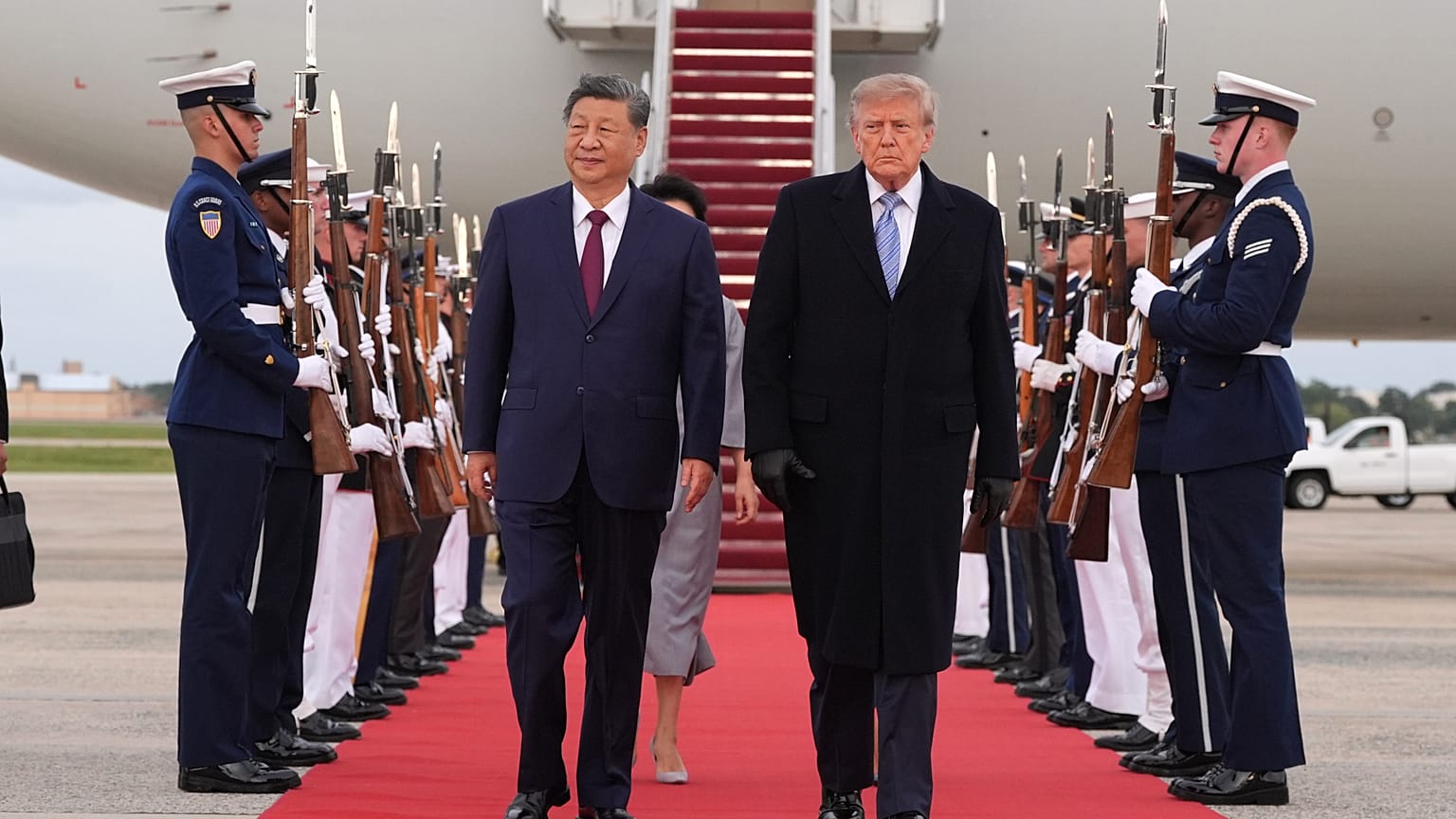
US President Donald Trump welcomed Chinese President Xi Jinping at Joint Base Andrews on Wednesday as Xi began a three-day state visit to the United States, his first in more than a decade. The arrival ceremony, attended by Trump and first lady Melania Trump, took place as officials from both countries agreed to extend a trade truce until January. The arrangement includes scaling back tariffs and refraining from introducing new trade restrictions. Treasury Secretary Scott Bessent said it remained uncertain whether the countries would negotiate a broader agreement or simply continue the current deal. He pointed to upcoming international summits in China in November and Florida in December as possible occasions for further discussions.
Xi said China and the United States should be partners rather than rivals, arguing that the goals of national rejuvenation in China and making America great again could coexist and benefit the wider world. He also said he looked forward to detailed discussions with Trump about bilateral relations and global affairs. Trade, artificial intelligence, the US war with Iran and China’s position on Taiwan are among the major points of friction, although the visit was expected to emphasize ceremony more than substantive negotiations.
The welcome drew criticism from some Republicans. Senator Roger Wicker, chairman of the Senate Armed Services Committee, objected to what he called a “lavish welcome,” arguing that Trump should not have invited Xi given concerns about the Chinese leader and the Chinese Communist Party. Secretary of State Marco Rubio, by contrast, stressed the importance of maintaining high-level relations, citing the countries’ economic and military influence.
The visit’s schedule includes a formal welcome, an Oval Office meeting and a White House state banquet on Thursday. Xi is due to leave on Friday after tea at the White House and a visit to the National Archives.
Entities: Donald Trump, Xi Jinping, Melania Trump, Peng Liyuan, Joint Base Andrews • Tone: analytical • Sentiment: neutral • Intent: inform
24-09-2026
Donald Trump personally welcomed Chinese President Xi Jinping and his wife, Peng Liyuan, at Joint Base Andrews on September 23, opening a lavish state visit intended to manage tensions between the United States and China. The unusual airport reception included a red carpet, a military band and a flyover by B-1 bombers. Trump dismissed the fact that Xi had not offered him a comparable welcome during his May visit to Beijing.
The visit’s agenda includes trade, artificial intelligence and the Iran war, but expectations for major breakthroughs are low. Analysts describe the pageantry as a way to preserve a fragile diplomatic and economic calm between the rival powers. One early development was an extension of the trade truce: US Treasury Secretary Scott Bessent said it would continue from its November 10 deadline to January 10. The absence of Chinese business leaders from Xi’s delegation has tempered expectations for commercial deals, while prominent US technology executives are expected at a White House banquet.
AI is expected to be a central topic as both countries compete for leadership in the field and concerns grow about its risks. Preliminary discussions between Bessent and Chinese official He Lifeng included the possibility of establishing a channel to communicate about AI concerns. Trump also confirmed that Iran would be discussed, against a backdrop of reports that Beijing had supplied Tehran with intelligence—an allegation he had previously played down.
Trump’s reception of Xi drew criticism from China hawks in his party. Republican Senator Roger Wicker called Xi a “brutal, unelected and oppressive dictator.” The article also notes the domestic political context: the Iran war’s effect on fuel prices has coincided with falling approval ratings for Trump ahead of November’s midterm elections. The visit is scheduled to conclude Friday with tea at the White House and a visit to the National Archives.
Entities: Donald Trump, Xi Jinping, Melania Trump, Peng Liyuan, Joint Base Andrews • Tone: analytical • Sentiment: neutral • Intent: inform
24-09-2026
The article reports that Chinese President Xi Jinping’s state visit to the United States has begun with two signs that analysts view positively: the extension of a US-China tariff truce and an elaborate personal welcome from President Donald Trump on the airport tarmac. The truce, which had been due to expire in November, was extended for two months, through January 10. The article presents the extension as evidence that the world’s two largest economies remain willing to negotiate and build momentum toward broader agreements, even as their rivalry grows across multiple issues.
John Gong, an economics professor at Beijing’s University of International Business and Economics, says the extension is shorter than observers had expected but still indicates that both governments can manage their differences. The announcement followed an unscheduled meeting in Washington between Chinese Vice-Premier He Lifeng and US Treasury Secretary Scott Bessent at the World Bank headquarters. According to Bessent, the Chinese side proposed a “bigger deal” on trade during that meeting.
The available article excerpt emphasizes the cautiously encouraging diplomatic and economic context surrounding Xi’s visit. It does not provide further details about the ceremony, the proposed trade deal, or the analysts referenced in the headline beyond Gong. Its central point is that the truce extension and Trump’s high-profile welcome offer positive early signals, though the relatively short duration of the extension suggests that negotiations and underlying tensions remain unresolved.
Entities: Donald Trump, Xi Jinping, John Gong, He Lifeng, Scott Bessent • Tone: analytical • Sentiment: positive • Intent: inform
24-09-2026
Prospects for a major new Boeing aircraft order from China at the Sept 24 summit between US President Donald Trump and Chinese President Xi Jinping have weakened. Rather than securing commitments for hundreds of additional aircraft, Boeing is focused on finalising a provisional deal announced in May for 200 jets. Boeing CEO Kelly Ortberg previously described that order as an initial tranche, and investors and analysts had hoped a larger purchase would follow. He has since played down those expectations. One analyst said even preserving the 200-plane order would be a victory.
Boeing has been largely shut out of China’s market since 2017, while Airbus has gained ground. Airbus’s position has benefited from its final assembly line in Tianjin and comparatively favourable China-Europe relations. The stakes are significant: China is forecast to order about 9,000 new aircraft by 2045, more than any other region.
The summit agenda is focused more on extending the US-China trade truce and addressing issues including AI safeguards, Taiwan-related weapons sales, and trade in soybeans and rare earth minerals. A trade truce due to expire on Nov 10 has been extended by two months to allow more time for work on a broader agreement. A China specialist said new aircraft orders would be welcome but were not essential to the meeting.
Some progress on the May Boeing deal remains possible. US Trade Representative Jamieson Greer said about 140 aircraft orders were in a good state, with 10 more being finalised. A source said details on part of the deal could be announced at the summit if contracts are completed. Earlier, China had concerns about guaranteed access to spare parts after US President Trump made threats affecting supplies. China’s commerce ministry said in May that the US had provided guarantees for aircraft engine parts and components.
Entities: Boeing, Airbus, China, United States, Donald Trump • Tone: analytical • Sentiment: negative • Intent: inform
24-09-2026
China has taken possession of a cockpit canopy and weapons-bay door from an Australian F-35 fighter after the parts were unexpectedly diverted to Hong Kong while being shipped to the United States for inspection and possible repair or disposal. The parts, supplied by Lockheed Martin and coated with radar-absorbing material, were transported by UPS. The aircraft or shipment stopped in South Korea before being routed to Hong Kong; it remains unclear why the route changed or whether the diversion was deliberate. China has not returned the parts.
The incident has prompted concern because the components may reveal information about the F-35’s stealth capabilities, and because it emerged as Chinese President Xi Jinping arrived in the United States for a state visit hosted by President Donald Trump. Senator Elissa Slotkin criticized the contrast between the visit and China’s possession of sensitive military technology, while noting she had not received a briefing on the matter. The article also describes longstanding US concerns about Chinese espionage targeting the F-35 and potential technology exposure through proposed sales to the United Arab Emirates and Saudi Arabia.
The Pentagon says it is working with US authorities and industry partners to retrieve the components, investigate the incident, and establish safeguards against a recurrence. UPS reported the incident to the State Department’s Directorate of Defense Trade Controls. Australia is examining what happened on its end, and Lockheed Martin said the Defense Department selected the transportation parameters and that the company is working with the carrier on preventive measures.
The shipment is under review by multiple congressional bodies, including House committees on Foreign Affairs and Armed Services and a Senate Armed Services subcommittee. Officials had discussed the issue in a closed Senate hearing in June and expressed hope that the parts would be returned. The article places the incident in the wider context of the F-35’s strategic importance, its use by allied countries, and Australia’s role as an Indo-Pacific parts and maintenance hub.
Entities: F-35 stealth fighter, Cockpit canopy and weapons-bay door, China, Hong Kong, South Korea • Tone: analytical • Sentiment: negative • Intent: inform
24-09-2026
Chinese President Xi Jinping’s arrival in the United States for a state visit received unusually little live television coverage on Sept. 23, amid a dispute between the Trump administration and several news organizations. President Donald Trump personally greeted Xi and his wife, Peng Liyuan, at Joint Base Andrews, departing from the usual practice of welcoming foreign leaders at the White House. The ceremony included military music, national anthems and a flyover by two B-1 bombers, but most Americans did not see it broadcast live.
Major television networks had suspended live filming and broadcasts of presidential events since Sept. 21 to protest the administration’s decision to bar CNN, MS NOW and Politico from the White House. Reporters instead provided written accounts, while CNN and Fox briefly discussed the arrival without video. Several newspapers published still photographs, though The Washington Post and The Wall Street Journal had not reported the event within 45 minutes. The White House also did not stream the ceremony on its website, despite promoting the popularity of its official mobile app.
The extent of television coverage for the remainder of Xi’s visit remained uncertain while a legal challenge proceeded in Washington. U.S. District Judge Timothy Kelly said he expected to rule soon on whether to temporarily restore the outlets’ White House access. The news organizations argued that the administration had retaliated against them for unfavorable reporting and had revoked their credentials without notice, explanation or a meaningful opportunity to contest the decision, violating press freedoms and due process.
The Justice Department argued that White House access is a privilege, not a constitutional right, and urged the judge to deny emergency relief. It also defended the ban on national-security grounds, accusing the outlets of publishing false claims and sensitive or classified information. The article presents Xi’s low-key arrival as a consequence of both the media boycott and the unresolved fight over press access.
Entities: Xi Jinping, Peng Liyuan, Donald Trump, Cat Zakrzewski, Timothy Kelly • Tone: analytical • Sentiment: neutral • Intent: inform
24-09-2026
Donald Trump welcomed Chinese president Xi Jinping and his wife, Peng Liyuan, at Joint Base Andrews on Wednesday, an unusual gesture for a US president and the start of Xi’s state visit to Washington. The arrival ceremony featured a 100-foot red carpet, US service members, a military flyover by two B-1 bombers, and the flags and national anthems of both countries. Trump and first lady Melania Trump traveled to the Maryland base to greet the couple in person.
The visit coincided with an agreement to extend the “Busan agreement,” a temporary US-China trade truce. Treasury secretary Scott Bessent said the pause in trade-war hostilities would continue until 10 January, extending it by two months beyond its scheduled expiration. Trade is one of several significant issues facing Trump and Xi during their two-day meetings, alongside artificial intelligence, Taiwan and geopolitical instability.
The article describes the visit’s ceremonial schedule, including a formal welcome at the White House, private tea and a tour of the National Archives. A state dinner was also expected to bring together major technology executives, including leaders from OpenAI, Apple, xAI, Microsoft, Nvidia and Meta.
The US-China competition over AI is a prominent concern, with some technology executives warning about the risks of rapid development. Trump has dismissed those concerns and argued that investment is necessary for the US to outpace China, asserting that AI leadership brings military and economic advantages. The arrival ceremony also produced an awkward moment when Trump visibly winced at the sound of a military jet overhead; the reaction was widely mocked online and was omitted from the edited highlights released by his aides. The article presents the elaborate welcome as a sign of the importance Trump places on honoring Xi, who is receiving ceremonial treatment comparable to that given to Trump during his visit to China earlier in the year.
Entities: Donald Trump, Xi Jinping, Peng Liyuan, Melania Trump, Scott Bessent • Tone: analytical • Sentiment: neutral • Intent: inform
24-09-2026
The article argues that the UAE, and particularly its oil-export route through Fujairah, has become a strategically important third force in the US-China relationship. While coverage of the Trump-Xi summit focuses on tariffs, Taiwan, artificial intelligence and critical minerals, the author says the Gulf’s energy infrastructure is another crucial element. The Strait of Hormuz has been largely closed during the Iran conflict, and attacks have also forced Saudi Arabia to shut its East-West pipeline. As a result, the UAE’s Habshan-to-Fujairah pipeline is one of the few remaining routes for Gulf oil exports that bypasses Hormuz. Abu Dhabi’s plan to build a second pipeline and double capacity by 2027 is presented as a strategic investment whose value has risen sharply.
China’s priority, the article says, is reducing its dependence on the Strait, rather than punishing Iran. It can look to US oil or to supplies shipped from outside Hormuz, making the UAE a potential partner for both Beijing and Washington. The UAE’s departure from OPEC, operational bypass infrastructure and relationships with both powers strengthen that position. The author describes Fujairah as especially valuable because it remains functional during a crisis.
This opportunity carries risks. Both superpowers may eventually demand political or technological loyalty. US restrictions on advanced chips could complicate the UAE’s AI and data-centre ambitions, while China has shown limited willingness to use its influence over Iran to resolve the strait crisis. The author advises the UAE to make bypass capacity a national priority, remain useful to both powers without becoming dependent on either, and monitor the November expiry of the US-China trade truce and China’s rare-earth export-control suspension. The summit, the article concludes, is better understood as a strategic triangle involving American chips, Chinese minerals and Fujairah’s Gulf coastline.
Entities: Donald Trump, Xi Jinping, United Arab Emirates, Fujairah, Strait of Hormuz • Tone: analytical • Sentiment: neutral • Intent: analyze