24-09-2026
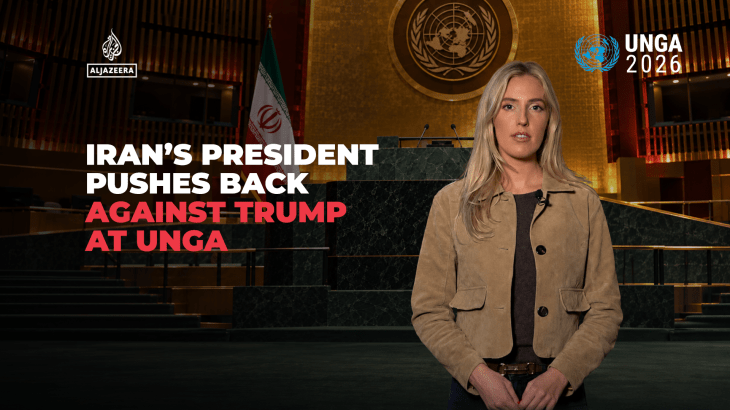
The Al Jazeera video report focuses on Iran’s president addressing the United Nations General Assembly one day after US President Donald Trump threatened to “annihilate” Iran. The headline characterizes the Iranian president as presenting evidence of US strikes on civilians, though the supplied description does not identify the evidence or provide details about the strikes. It says Iran is open to talks but will not negotiate while under threat, setting out Tehran’s stated position amid the war. The report poses the central question of whether the United States and Iran can find a way to end the conflict. Al Jazeera correspondent Emma Withrow is identified as explaining the situation. The item is dated September 24, 2026. Because the supplied article text is only a brief video description, it does not give the president’s name, quote his full UN address, describe the civilian casualties, or report any response from the US. Its focus is therefore the contrast between Trump’s threat and Iran’s conditional openness to negotiations, with the possibility of ending the war left unresolved.
Entities: Iran, Iran’s president, Donald Trump, United States, United Nations General Assembly (UNGA) • Tone: analytical • Sentiment: negative • Intent: analyze
24-09-2026
The live update reports escalating conflict and diplomatic activity surrounding the nearly seven-month Iran war. Iranian President Masoud Pezeshkian told the U.N. General Assembly that Iran was a victim of U.S. and Israeli attacks, while insisting that Iran remained open to diplomacy but would not accept negotiations conducted through force. The White House rejected his account, saying President Trump was acting to prevent Iran from obtaining a nuclear weapon. Trump had threatened to “annihilate” Iran if an agreement to end the war was not reached, even as he said U.S. and Iranian representatives had met at the U.N. and that discussions went well.
The Strait of Hormuz remains a central point of military and economic pressure. A commercial vessel was attacked there, killing one crew member and prompting the evacuation of more than 20 sailors. U.S. Central Command said the American blockade had redirected 115 commercial vessels entering or leaving Iranian ports. Iran’s foreign ministry said no agreement would be signed while the blockade remained in place.
The article also details the human and political consequences of the conflict. A Navy letter disclosed eight suicide attempts among sailors assigned to the USS Abraham Lincoln strike group during its record-long, roughly 10-month deployment. Two attempts occurred during active fighting, and Senator Kirsten Gillibrand criticized the administration’s response to concerns about service members’ conditions. Meanwhile, Canada imposed sanctions on Iranian officials and state entities over repression and restrictions on freedoms. The United Arab Emirates also barred its branches of Bank Melli Iran from conducting financial transactions with Iran, citing regulatory violations related to money laundering, terrorism financing, and proliferation financing.
Entities: Masoud Pezeshkian, Donald Trump, Iran, United States, Israel • Tone: analytical • Sentiment: negative • Intent: inform
24-09-2026
The article examines the public confrontation and tentative diplomatic contacts between President Donald Trump and Iranian President Masoud Pezeshkian during the United Nations General Assembly in New York. Foreign policy expert Behnam Ben Taleblu of the Foundation for Defense of Democracies told Fox News Digital that Pezeshkian’s sharp criticism of Washington would likely have prompted little more than a smirk from Trump, whom Taleblu believes understands that the United States has greater leverage in the standoff.
Pezeshkian accused the United States and Israel of attacking Iran and presented his country as a victim, saying Iran had only defended itself and that its people had suffered “cowardly attacks.” Trump, by contrast, defended the U.S. conflict with Iran and warned Tehran that it must choose between a deal and further destruction. Taleblu described both leaders’ speeches as predictable, given the countries’ current relationship and established foreign-policy positions. He also argued that Pezeshkian’s remarks framed Iran through an anti-American, anti-Israeli, anti-imperialist message, while contending that the Iranian people—not the government—were the enduring victims of the crisis.
Despite the public threats, diplomatic contacts reportedly continued behind the scenes. Trump said U.S. envoy Steve Witkoff and Jared Kushner spoke with Iranian officials for about three hours during the General Assembly and called the discussions productive. Witkoff said mediators carried messages between the delegations; reports identified Iranian Foreign Minister Abbas Araghchi as representing Tehran. Taleblu said both sides were trying to use time to their advantage and shift responsibility for choosing escalation or engagement to the other. The article concludes that the opposing public rhetoric and ongoing contacts underscore unresolved tensions, as officials explore whether negotiations can create a path away from conflict.
Entities: Donald Trump, Masoud Pezeshkian, Behnam Ben Taleblu, Steve Witkoff, Jared Kushner • Tone: analytical • Sentiment: neutral • Intent: analyze
24-09-2026
In this France 24 Spotlight segment, host François Picard speaks with journalist and author Scott Anderson about the US war with Iran and the risks of misunderstanding the country. Anderson draws a parallel between 1979 and 2026, arguing that Washington has repeatedly misread Iran. He points to US intelligence and military exercises that, he says, anticipated Iran would close or seize the Strait of Hormuz in a conflict, and questions why the Trump administration did not adequately account for that possibility when starting the war.
The discussion takes place nearly seven months into the war. Iranian President Masoud Pezeshkian has accused the United States of “terrorism” at the UN General Assembly, following President Donald Trump’s threat to “annihilate” the Islamic Republic if no deal is reached. Pezeshkian has also expressed willingness to negotiate, while rejecting coercion and emphasizing that Iran would not submit to force.
Anderson’s argument extends beyond an alleged intelligence failure. He describes the 1979 revolution as an uncertain struggle among liberal, leftist, nationalist and religious groups, rather than an inevitable path to the Islamic Republic. Ayatollah Khomeini, he says, proved more politically capable than many expected. In contrast, today’s Islamic Republic is an established system supported by institutions and constituencies, not one reliant on a single revolutionary leader.
The segment’s central warning is that history does not simply repeat itself, but misjudging Iran’s internal politics, resilience and capacity for resistance can have far-reaching consequences. The outcome of the current conflict may differ from that of 1979, yet the costs of misunderstanding Iran could be comparable in scale.
Entities: Scott Anderson, François Picard, Donald Trump, Masoud Pezeshkian, Ayatollah Khomeini • Tone: analytical • Sentiment: neutral • Intent: analyze
24-09-2026
On the second day of the U.N. General Assembly, Iran and Ukraine dominated discussions as diplomats considered ways to contain two wars with consequences for global stability. Iranian President Masoud Pezeshkian addressed the assembly a day after President Trump threatened that the U.S. could annihilate Iran if it did not reach a deal. Pezeshkian portrayed Iran as a victim of the U.S.-Israeli war, displayed images of the supreme leader and schoolgirls killed in strikes, and rejected the accusation that Iran is a terrorist state. He warned against a world governed by military might rather than diplomacy.
U.S. Secretary of State Marco Rubio countered that Iran had no standing to lecture others on human rights, citing its crackdown on protesters and support for armed groups. Rubio said Trump wanted a deal to end Iran’s nuclear ambitions. U.S. and Iranian negotiators were reportedly holding talks through mediators on the sidelines, though Rubio offered few details.
The report also focused on the war in Ukraine. After meeting Russian Foreign Minister Sergey Lavrov, Rubio said both sides had shown interest in a limited ceasefire involving grain and energy. Ukraine had offered to pause attacks on Russian oil and gas infrastructure if Russia stopped striking Ukraine’s energy grid ahead of winter. Lavrov, however, said Russia would not pause its military operation. Ukraine’s foreign minister accused Russia of widening the conflict by recruiting mercenaries from 37 African countries; U.S. Ambassador Mike Waltz also cited Cuban mercenaries and raised concerns about Russian violations of NATO airspace.
Waltz warned that the conflict’s spread was dangerous and said global food and energy markets were at stake. The report concludes that, as in the Persian Gulf, the U.S. has yet to outline a clear endgame.
Entities: Masoud Pezeshkian, Donald Trump, Marco Rubio, Sergey Lavrov, Mike Waltz • Tone: analytical • Sentiment: neutral • Intent: inform
24-09-2026
The National’s editorial argues that the UN General Assembly’s value lies not only in formal debate but also in bringing adversaries together. It points to a three-hour meeting in New York between US and Iranian officials, brokered by Qatar and Pakistan amid months of Middle East conflict, as a timely example of the practical work of diplomacy. The editorial cites Norwegian Foreign Minister Espen Barth Eide’s observation about “seeing the limitations of warfare” to make the case that military force rarely resolves modern conflicts on its own. Even when force can destroy targets and disrupt economies, its effects must eventually be translated into a political arrangement both sides can accept. Negotiation, the editorial says, is not capitulation but the mechanism through which conflicts—often lacking a decisive battlefield winner—can end. The piece emphasizes that achieving a settlement is difficult and that post-conflict recovery in the Gulf, including rebuilding institutions, restoring trade routes and rebuilding trust among neighbours, could take a generation. It presents the UAE’s continued commitment to dialogue, despite repeated attacks by Iran, as a clear-eyed response to the costs of continued conflict, citing Minister of State Lana Nusseibeh’s focus on de-escalation. The editorial acknowledges that mediation may stall, spoilers can undermine progress, and leaders’ public rhetoric can damage delicate diplomatic efforts. Nevertheless, it concludes that the alternative to diplomacy is not victory but continued escalation and greater costs for all sides. Even limited signs of talks between Washington and Tehran during UN General Assembly week would therefore be worthwhile, and all parties should recognize that escalation has limits.
Entities: United Nations General Assembly (UNGA), The National, New York, United States, Iran • Tone: analytical • Sentiment: neutral • Intent: analyze
24-09-2026
The National’s September 24, 2026 edition of its “Trending Middle East” podcast presents a concise roundup of five regional developments. First, Iran has reportedly given the United States a proposed road map to end the war. According to sources cited by The National, the proposal includes a region-wide ceasefire lasting up to 60 days, the gradual reopening of the Strait of Hormuz, and an end to the US blockade of Iran. Second, the US-backed Board of Peace has proposed a six-month plan worth $2.45 billion to begin rebuilding Gaza and restoring basic services. Third, the UAE Central Bank has barred Bank Melli Iran from conducting financial transactions between its branches in the Emirates and Iran, following investigations that found the lender had not complied with UAE anti-money-laundering regulations. Fourth, tourism in Syria is recovering: visitor numbers in the first half of the year more than doubled compared with the same period in 2025. Finally, the Emirates Foundation and the Responsible AI Future Foundation have partnered to apply artificial intelligence for social good in the UAE and internationally. The podcast notes that it is AI-assisted, drawing on original reporting published by The National and curated and edited by humans. Overall, the item is a factual, compact news briefing rather than an extended analysis of any one development.
Entities: Iran, United States, Strait of Hormuz, Gaza, Board of Peace • Tone: neutral • Sentiment: neutral • Intent: inform