07-09-2026
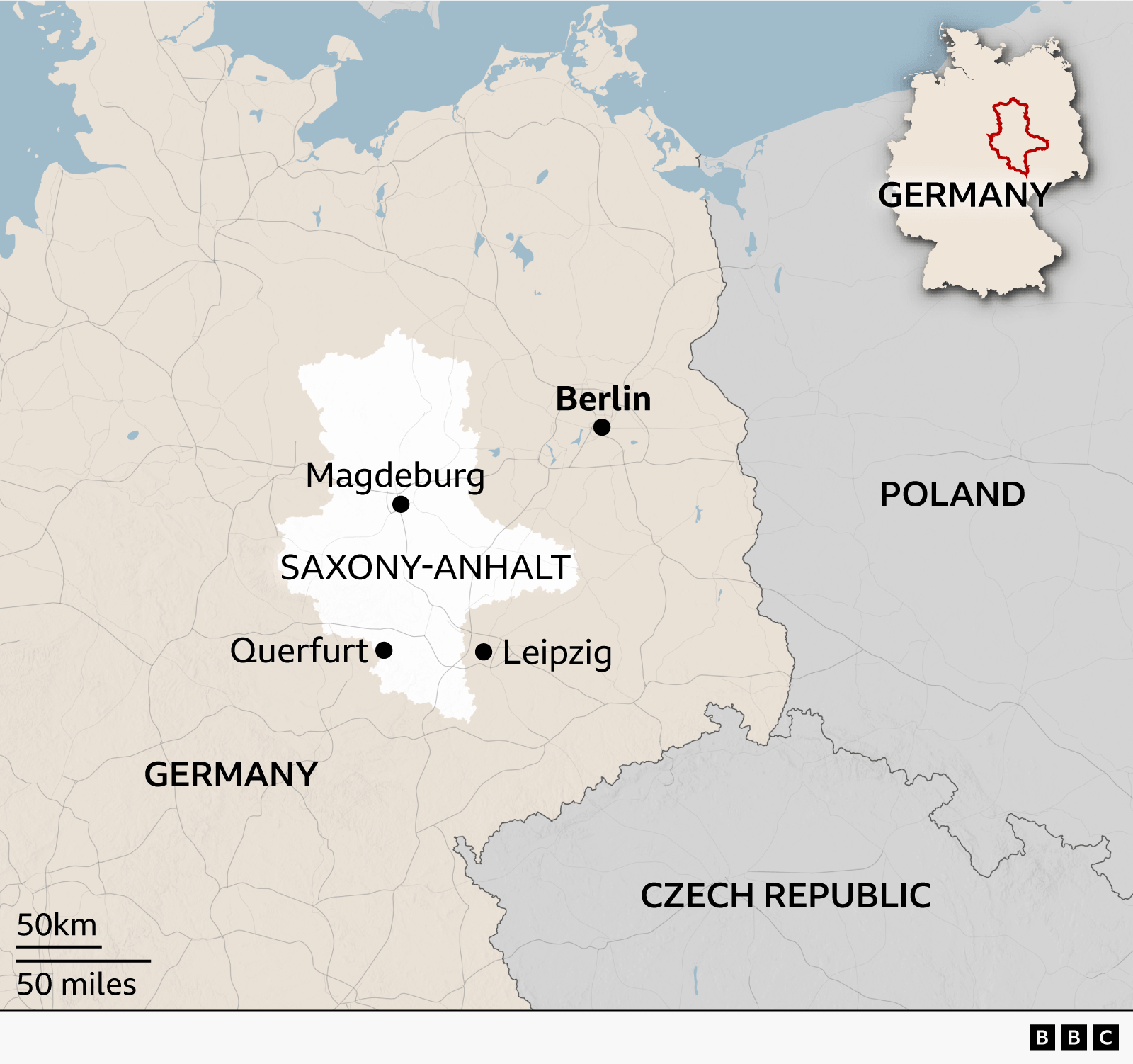
Germany’s far-right Alternative for Germany (AfD) is projected to win a historic victory in Saxony-Anhalt, securing about 44% of the vote—more than twice its 2021 result and far ahead of the conservative Christian Democratic Union (CDU), which is on about 17%. The result would make the AfD the strongest party in the 83-seat state parliament, with approximately 39 seats, but it would still fall short of the 42 needed for an outright majority.
State AfD leader Ulrich Siegmund called the result “sensational” and said the party had received a mandate to govern. However, he has rejected leading a minority administration, suggesting that fresh elections could produce an even larger AfD majority. The party’s success is particularly significant because no far-right party has governed a German state since the Second World War. State governments control areas including policing, education and culture.
The AfD is classified as “right-wing extremist” by domestic intelligence authorities in Saxony-Anhalt, a designation Siegmund rejects. Its anti-migration agenda includes “remigration,” a term widely associated with mass deportations, although the party says it primarily means deporting criminals and people living in Germany illegally. Other mainstream parties maintain a political “firewall,” or Brandmauer, refusing to form coalitions with the AfD. The BSW may cooperate with it on selected issues if it enters parliament.
The result prompted sharply contrasting reactions. AfD supporters celebrated, while CDU and SPD figures described the outcome as dramatic and a warning to national politicians. US President Donald Trump and Russian official Kirill Dmitriev welcomed the result, whereas Polish Prime Minister Donald Tusk condemned those celebrating it. Critics also pointed to the AfD’s positions on Germany’s Nazi past, the Bauhaus movement and Russia. Jewish community leader and Holocaust survivor Charlotte Knobloch said the result frightened her and urged mainstream parties to prevent further decline.
Entities: Alternative for Germany (AfD), Saxony-Anhalt, Ulrich Siegmund, Christian Democratic Union (CDU), Alice Weidel • Tone: analytical • Sentiment: negative • Intent: inform
07-09-2026
Early exit polls in Saxony-Anhalt indicate a major electoral advance for Germany’s Alternative for Germany (AfD), which was projected to receive about 44% of the vote—more than double its result five years earlier. The party was far ahead of Chancellor Friedrich Merz’s Christian Democratic Union, projected at approximately 18.5%, with the Left Party, Social Democrats and Greens also expected to enter the state legislature. However, the AfD appeared marginally short of the absolute majority required to govern alone.
The result could therefore leave the AfD with the largest parliamentary presence but no governing authority. Germany’s mainstream parties have maintained a political firewall against cooperation with the AfD, and the party’s lead candidate, Ulrich Siegmund, has rejected coalition government. A similar situation occurred in neighboring Thuringia in 2024, where other parties formed a coalition excluding the AfD despite its winning more seats than any other single party.
The article examines why the AfD’s potential victory would be historically significant and controversial. Founded in 2013 as an anti-European Union protest party, the AfD has shifted sharply to the right. Saxony-Anhalt’s domestic intelligence agency has classified its state branch as a confirmed far-right extremist organization, citing racist, anti-Muslim and antisemitic positions and an ideology of ethnopluralism. The party supports a deportation and remigration campaign, including proposals affecting some legal residents and German citizens with immigrant backgrounds.
Migration dominated the campaign, particularly after the 2024 attack at Magdeburg’s Christmas market, which killed five people. Although the attacker was not an Islamist extremist and had expressed anti-Islam and far-right views, the incident intensified public concern and appears to have benefited the AfD. The supplied article ends mid-sentence while describing the views of a local AfD supporter.
Entities: Alternative for Germany (AfD), Saxony-Anhalt, Magdeburg, Ulrich Siegmund, Friedrich Merz • Tone: analytical • Sentiment: neutral • Intent: inform
07-09-2026
The far-right Alternative for Germany (AfD) won a decisive victory in Saxony-Anhalt’s regional election, receiving 43.8% of the vote and securing 39 of the state legislature’s 83 seats. Despite more than doubling its support from five years earlier, the party fell three seats short of the absolute majority it needed to govern alone and become the first far-right party to lead a German state since World War II.
AfD candidate Ulrich Siegmund claimed voters had sent a message that political “things cannot carry on like this” and said the party had a mandate to govern. However, he ruled out forming a minority government. The result leaves the other parties facing the difficult task of assembling a stable administration without AfD. The Christian Democratic Union (CDU), which has governed Saxony-Anhalt for 24 years, fell to 17.2% and won 15 seats, a major setback for Chancellor Friedrich Merz and his party. The Social Democrats, Greens and Left Party each won eight seats, while the BSW party won five.
AfD’s result reflects strong voter dissatisfaction with Germany’s national government, economic stagnation and immigration policy, particularly in the formerly communist eastern states. The party is classified as a proven right-wing extremist organization in Saxony-Anhalt by Germany’s domestic intelligence agency, allegations it rejects as politically motivated. Its platform includes increased deportations, reduced immigration incentives, opposition to support for Ukraine, ending sanctions against Russia, home schooling and restrictions on displays of the rainbow flag in schools.
The CDU has reaffirmed its refusal to cooperate with AfD, describing it as extremist and pro-Russian. Any anti-AfD governing alliance could require tacit support from the Left Party, which would be difficult for the CDU to accept. Although Saxony-Anhalt has limited influence in Germany’s national upper house, the election represents a significant political breakthrough for AfD and a serious challenge to the country’s established party system.
Entities: Alternative for Germany (AfD), Saxony-Anhalt, Ulrich Siegmund, Friedrich Merz, Alice Weidel • Tone: analytical • Sentiment: neutral • Intent: inform
07-09-2026
Ulrich Siegmund, born in 1990 in Havelberg, Saxony-Anhalt, has become the AfD’s leading political figure in the state and its candidate for minister-president in the 2026 state election. His path to politics began outside government. He trained as a wholesale and foreign trade clerk, studied business psychology and business administration, and founded the scent-marketing company Berlin duftet in 2014. The company promoted the use of ambient fragrances in locations such as public transport stations, drawing on research into the effect of pleasant smells on mood and behaviour.
Siegmund was initially a member of the CDU but joined the AfD at age 24. He entered the Saxony-Anhalt state parliament in 2016 and became co-chair of the AfD parliamentary group with Oliver Kirchner in 2022. In 2025, the party selected him as its lead candidate for the 2026 election. His public profile has been boosted by social media, where he has more than 400,000 Instagram followers and over 763,500 TikTok followers. He presents himself as approachable and family-oriented, while campaigning on restrictive migration policies, deportations and broad changes to state policy.
The article also examines Siegmund’s family, religious views and political controversies. His father works for an AfD Bundestag member, prompting accusations of nepotism, which Siegmund defended. Siegmund also attended a 2023 meeting at which Martin Sellner discussed “remigration,” although he later characterized his participation as private and rejected the accusations against him. Saxony-Anhalt’s Office for the Protection of the Constitution has classified the state AfD branch as a proven right-wing extremist organization, though that classification is being challenged in court.
Siegmund says he will govern only if the AfD wins an outright majority. If that happens, he could become Germany’s first AfD minister-president.
Entities: Ulrich Siegmund, Alternative für Deutschland (AfD), Saxony-Anhalt, Havelberg, Oliver Kirchner • Tone: analytical • Sentiment: neutral • Intent: inform
07-09-2026
The Alternative for Germany (AfD) was projected to win a historic victory in Saxony-Anhalt, dealing a major blow to Chancellor Friedrich Merz and his center-right Christian Democratic Union (CDU). The result could give Germany’s far-right party its first state government since the end of World War II, although it remained unclear whether the AfD had secured the absolute majority needed to govern alone.
AfD candidate Ulrich Siegmund declared that the party had “written history” and said voters had sent a message to Berlin that conditions could not continue as they were. He also criticized Merz, arguing that every day the chancellor remained in office was “one too many.” The election took place amid widespread dissatisfaction with Germany’s national government, particularly over the country’s weak economy.
The AfD sought an outright majority to overcome Germany’s political “firewall,” the refusal by mainstream parties to cooperate with it. CDU officials rejected any partnership, describing the AfD as right-wing extremist and accusing it of advocating Germany’s withdrawal from the euro, close cooperation with Russia and a fundamentally different social model.
The party is strongest in eastern Germany, including the formerly communist and economically weaker state of Saxony-Anhalt. The state’s AfD branch has been classified as a confirmed right-wing extremist organization by Germany’s domestic intelligence agency. Its policies include “remigration,” deportations of immigrants and ending incentives for migration. Siegmund also proposed withdrawing the state from its public broadcaster over alleged disinformation.
With projections placing the AfD at just over 44% of the vote—more than twice its previous result—the election represented a significant advance for the party and a serious setback for the CDU, which had governed Saxony-Anhalt for 24 years. The supplied article ends while beginning to discuss the full projected results.
Entities: Alternative for Germany (AfD), Saxony-Anhalt, Friedrich Merz, Christian Democratic Union (CDU), Ulrich Siegmund • Tone: analytical • Sentiment: negative • Intent: inform
07-09-2026
The Alternative for Germany (AfD), a right-wing party classified as extremist by Germany’s domestic intelligence service, scored a historic victory in the Saxony-Anhalt state election, according to exit polls reported by ARD. The AfD received an estimated 44.5% of the vote, far ahead of Chancellor Friedrich Merz’s Christian Democratic Union (CDU), which won approximately 18.5%. No right-wing party has previously taken control of a German state since World War II.
AfD co-leader Alice Weidel celebrated the result as a turning point and predicted “explosive growth” for the party throughout eastern Germany and nationally. She also claimed Merz’s CDU would never win another election. The party’s leading candidate in Saxony-Anhalt, Ulrich Siegmund, celebrated alongside Weidel and co-leader Tino Chrupalla.
CDU general-secretary Franziska Hoppermann rejected cooperation with the AfD, describing it as right-wing extremist and criticizing its positions on the euro, Russia, and Germany’s social model. Other parties have also ruled out joining an AfD-led coalition, potentially preventing the party from governing despite its strong performance. Projections indicated that the AfD would win between 39 and 41 of the state parliament’s 82 seats, leaving it just short of an outright majority.
The left-wing populist Sahra Wagenknecht Alliance could become important if it surpasses the threshold for parliamentary representation and is willing to cooperate with the AfD. Economist Marcel Fratzscher interpreted the result primarily as a vote of no confidence in the federal government. The AfD is described as pro-Russia and anti-migration and supports measures including banning rainbow flags in schools. Turnout reached an estimated 78% in Saxony-Anhalt, a state of about 2.1 million people with one of Germany’s lowest proportions of foreign residents.
Entities: Alternative for Germany (AfD), Alice Weidel, Friedrich Merz, Christian Democratic Union (CDU), Saxony-Anhalt state election • Tone: analytical • Sentiment: negative • Intent: inform
07-09-2026
The supplied excerpt from The Washington Post reports that the nationalist Alternative for Germany (AfD) party finished first by a substantial margin in a regional election held Sunday in Saxony-Anhalt, an eastern German state. The result is based on preliminary returns, so the article does not present a final certified outcome in the provided text. The party’s strong performance is portrayed as politically significant because it represents a major electoral gain for a movement that has attracted scrutiny and condemnation across Germany. The headline characterizes the result as a potential “big boost” for the AfD, while the opening paragraph emphasizes the party’s controversial reputation and the broader stakes of its success in a key regional contest. The AfD is identified as nationalist and as having been labeled “right-wing extremist” by Germany’s domestic intelligence agency. The excerpt also notes accusations from others that the party promotes or tolerates xenophobia, antisemitism and Islamophobia. These descriptions frame the election result not merely as a routine regional development, but as an advance by a party associated with far-right politics and discriminatory views. The report is datelined Berlin and is written by Mary Ilyushina and Maegan Vazquez. Beyond the preliminary first-place finish, the provided material does not include vote shares, seat totals, reactions from rival parties, the consequences for Saxony-Anhalt’s government, or the AfD’s broader national prospects. Accordingly, the excerpt establishes the central event and its political context but does not provide enough information to assess the final electoral balance or explain why voters supported the party. The article’s central focus is the AfD’s breakthrough and the significance of its performance in eastern Germany.
Entities: Alternative for Germany (AfD), Mary Ilyushina, Maegan Vazquez, Berlin, Saxony-Anhalt • Tone: analytical • Sentiment: negative • Intent: inform