28-08-2026
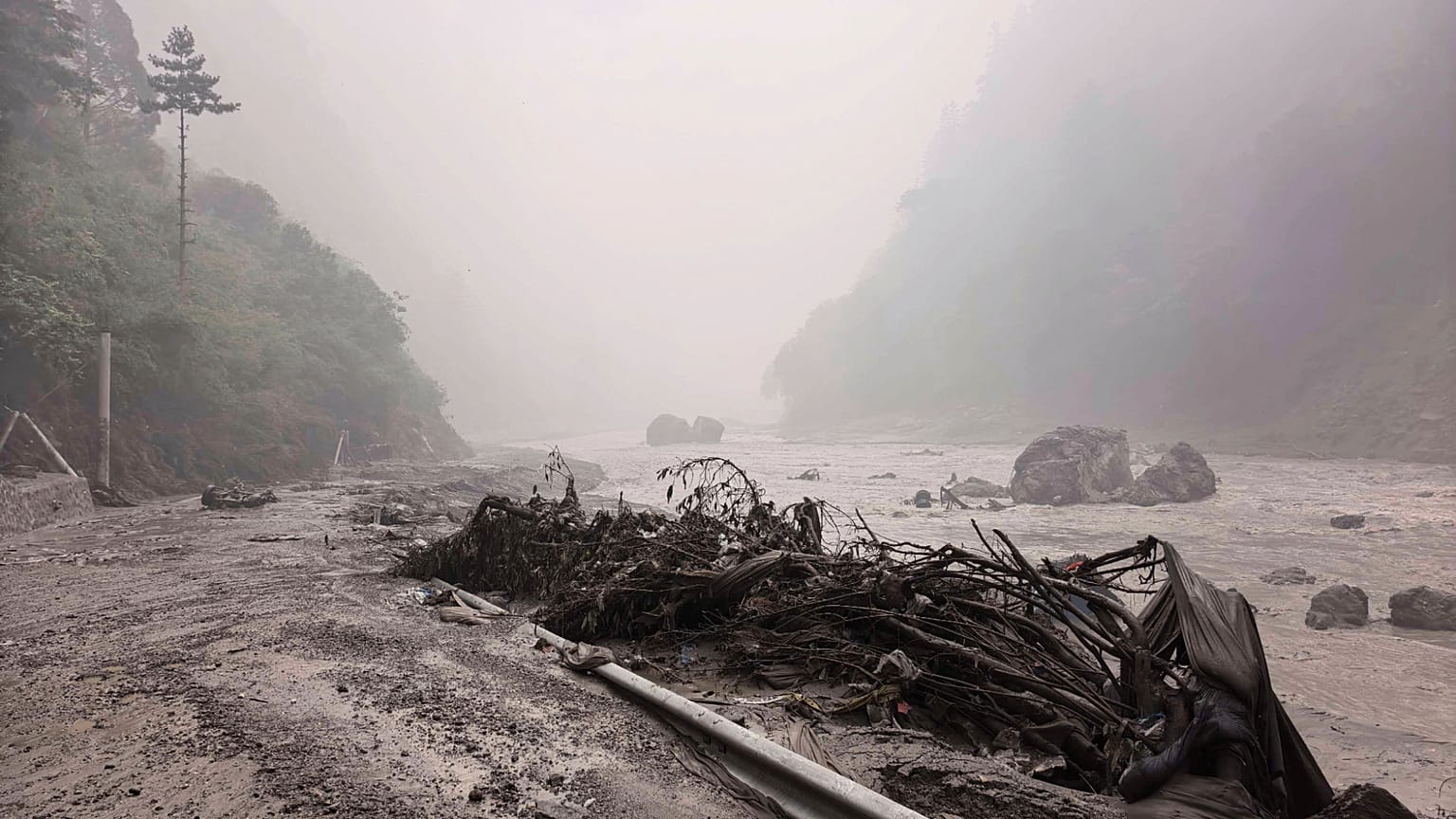
Nuwakot district in central Nepal has suffered extensive destruction after flash floods and landslides struck the region on 26 August. The disaster followed a glacial collapse near the Nepal-Tibet border the previous day, sending torrents of mud, debris and water through communities in the Trishuli River basin. Bidur, Devighat and Trishuli Bazaar were among the affected areas, with images showing partially buried buildings, submerged vehicles and severely damaged infrastructure.
Nuwakot, along with neighbouring Rasuwa district, is one of the worst-hit areas. Hundreds of residents, tourists and security personnel remain unaccounted for as emergency teams continue search-and-rescue operations. The scale of the destruction and the isolation of some communities have complicated efforts to locate missing people and provide medical assistance.
The Nepal Army has deployed MI-17 helicopters to create an emergency airlift corridor to the District Hospital in Trishuli. The helicopters are being used to evacuate critically injured survivors and support rescue teams operating in areas cut off by the floods and landslides.
Authorities have issued high-alert warnings to communities along the Trishuli and Narayani rivers because unstable debris upstream could trigger additional flooding and landslides. Several bridges and major roads connecting Nuwakot with neighbouring districts and Kathmandu have been swept away or badly damaged, further restricting access and delaying relief operations. The continuing risk, combined with the large number of people still missing, makes the disaster an ongoing humanitarian and emergency-response crisis.
Entities: Nuwakot district, Central Nepal, Rasuwa district, Trishuli River basin, Bidur • Tone: urgent • Sentiment: negative • Intent: inform
28-08-2026
Survivors of devastating flash floods along the Nepal-Tibet border have described watching relatives, homes and livelihoods disappear in torrents of mud and water. At least 469 people have died and several hundred remain missing after the floods destroyed entire villages on Wednesday. The force of the flooding was so intense that seismologists initially mistook it for an earthquake.
In Nepal’s Nuwakot district, Kalpana Malla said her father, mother, sister and her sister’s children were swept away in front of her. She and her son, Sugam, survived by climbing onto the roof of a house. Sugam said he had pulled his mother to safety but was worried that his sister, whose phone was no longer reachable, had also been carried away. Another survivor, Goma Pandit, said the disaster destroyed her farmland, livestock and stored crops, leaving her with nothing.
At Kathmandu’s TU Teaching Hospital, relatives anxiously waited for news of missing family members. Ram Khumari Shrestha said her husband, who had travelled to Rasuwa for driving work, stopped answering his phone. Mani Shrestha Bishwa was searching for his younger brother, cousin, uncle and a friend.
Trekking guide Sonam Dorjee narrowly avoided the flood after leaving his village about an hour before it was struck. He said the sound of the water resembled an earthquake and that his home had collapsed. His sister and several other relatives remained missing. Dorjee described the disaster as sudden and devastating and said survivors urgently needed rescue, evacuation, food, temporary shelter and medical care. Meanwhile, rescuers worked through mud and debris as authorities rushed aid and relief supplies to affected areas.
Entities: Nepal-Tibet border floods, Nepal, Tibet, Nuwakot district, Kathmandu • Tone: emotional • Sentiment: negative • Intent: inform
28-08-2026
Massive landslides and flash floods along the Nepal-Tibet border have caused widespread destruction, killing at least 469 people in Nepal and leaving hundreds more missing. Chinese authorities have reported three deaths and 558 missing in Tibet’s Gyirong county, although it is unclear whether some people appear in both countries’ figures. Rescue and evacuation operations are continuing, while officials warn that additional flooding could occur if debris blocks rivers and creates temporary landslide dams.
The disaster was initially attributed to an earthquake, but the US Geological Survey says it was caused by a glacial collapse. The collapse generated a seismic signal equivalent to a magnitude-5.2 event and sent debris downstream, producing catastrophic flooding. Scientists are investigating whether rainfall, melting ice, glacier thinning, thawing permafrost, or a blocked river contributed to the sequence of events. Although climate change is accelerating glacier melt and weakening mountain slopes in the Hindu Kush Himalaya, experts caution that it is too early to establish a definitive link to this particular disaster.
Floodwaters and debris swept through northern Nepal, including the Nuwakot region and areas popular with tourists, mountaineers, and pilgrims. Buildings, roads, vehicles, and a border checkpoint were destroyed, while severe flooding affected the Bhote Koshi, Trishuli, and Narayani rivers.
Nepal, China, India, the United States, the United Kingdom, and the United Nations have pledged assistance. Nepalese officials report hundreds of missing foreign nationals, including tourists from India, China, the United States, Ukraine, Malaysia, and the UK. Chinese Premier Li Qiang visited Gyirong to oversee relief efforts, while China’s President Xi Jinping called for an extensive search and improved early-warning systems.
Entities: Nepal-Tibet border, Kathmandu, Nuwakot, Gyirong county, Trishuli River • Tone: urgent • Sentiment: negative • Intent: inform
28-08-2026
Rescue teams are searching for more than 1,000 people missing after catastrophic floods and mudslides swept through communities along the Nepal-China border following a reported glacial collapse. Nepal Police reported at least 360 deaths and more than 1,400 missing across Nepal and Tibet, while Chinese state broadcaster CCTV separately reported 558 missing and at least three dead in Tibet. The hardest-hit areas in Nepal include Nuwakot and Rasuwa, where homes, roads, bridges, dams, power plants and sections of the Trishuli hydropower project were destroyed or buried in mud.
The disaster has affected large numbers of foreign nationals, including Americans. Nepal Tourism Board chief Hikmat Singh Ayer said 65 U.S. nationals were among those missing in Nepal, although the U.S. State Department said it was tracking about 90 Americans who may have been affected. Three U.S. citizens had been rescued, and officials said they were not aware of any American deaths. The Nepal Tourism Board also reported that 27 foreign nationals, including two Americans, had been rescued from Rasuwa.
The Isha Foundation said about 80 pilgrims from 19 countries were missing, including 22 Americans. Many had been traveling from Mount Kailash in Tibet and were crossing into Nepal when the flooding struck. Families described desperately awaiting news of missing relatives, including Sridevi Vejella and U.S. citizen Venus Rajnikant Patel.
Nepalese army and private helicopters intensified rescue operations, evacuating more than 100 people and airlifting at least eight foreign nationals to Kathmandu. Bodies were found downstream in Chitwan, while injured survivors were transported to the capital. The United States offered assistance, deployed an adviser, and provided a $500,000 grant to Catholic Relief Services. Communications remained severely disrupted, complicating efforts to account for missing people.
Entities: Nepal, Tibet, Nepal Police, Nepal Tourism Board, U.S. State Department • Tone: urgent • Sentiment: negative • Intent: inform
28-08-2026
Nuwakot district in central Nepal is experiencing widespread destruction after flash floods and landslides struck on 26 August. The disaster followed a glacial collapse near the Nepal–Tibet border one day earlier, sending torrents of mud and debris through communities along the Trishuli River basin. Bidur, Devighat and Trishuli Bazaar are among the affected areas, where buildings have been partially buried, vehicles submerged and critical infrastructure severely damaged.
Nuwakot and neighbouring Rasuwa are reportedly among the worst-hit districts. Hundreds of residents, tourists and security personnel remain unaccounted for as emergency crews continue search-and-rescue operations. The article does not provide a confirmed death toll, but describes the destruction as catastrophic and says many people are still missing.
The Nepal Army has deployed MI-17 helicopters to create an emergency airlift corridor to the District Hospital in Trishuli. The operation is intended to evacuate critically injured survivors and support rescue teams working in isolated locations. Authorities have also issued high alerts for communities along the Trishuli and Narayani rivers because unstable debris upstream could trigger additional flooding and landslides.
Several bridges and major roads connecting Nuwakot with neighbouring districts and Kathmandu have been swept away or badly damaged, complicating access and relief efforts. The report emphasizes the scale of the infrastructure damage, the continuing risk to downstream communities and the urgent efforts to locate missing people and evacuate the injured.
Entities: Nuwakot district, Nepal, Trishuli River, Bidur, Devighat • Tone: urgent • Sentiment: negative • Intent: inform
28-08-2026
A France 24 live report describes an escalating disaster on the Nepal–Tibet border after a glacial collapse triggered landslides and a torrent of mud and water across parts of Nepal and China’s autonomous region of Tibet. Chinese authorities warned that a lake created by a mudslide could breach its banks, sending floodwaters downstream and causing additional destruction. Water levels were expected to rise over the following three days, increasing the risk to communities and people in the affected region. A total of 499 residents and 555 tourists had already been evacuated from the disaster zone.
The report says that rescue and search efforts were continuing for approximately 1,300 people after the landslides. Nepal and China had both issued warnings about further flooding, with two newly formed lakes—one on each side of the border—posing a potential risk of bursting. The disaster had killed at least 359 people, according to an update from Nepali police. The article includes a photograph showing rescuers using heavy machinery to clear a road leading to areas affected by the mudslide in Tibet.
Presented as a liveblog, the report provides a brief overview of the latest developments rather than a detailed account of the causes or long-term consequences. It identifies the Himalayas as the broader region affected and lists landslides, floods and climate change among its keywords. The report was published on August 28, 2026, and attributed material to France 24, Reuters, the Associated Press and Agence France-Presse.
Entities: Nepal, Tibet, China-Nepal border, Himalayas, Chinese authorities • Tone: urgent • Sentiment: negative • Intent: inform
28-08-2026
A catastrophic flash flood along the Nepal-Tibet border has killed at least 469 people, according to Nepalese police, while more than 1,300 remain missing. Hundreds of those missing are foreign tourists and pilgrims from India, the United States, Britain, Australia and Canada. The disaster struck on Wednesday after a glacier-related collapse and flood sent torrents of water, mud and debris through mountainous communities on both sides of the border.
Rescue operations are being hampered by the destruction of dozens of bridges and nearly 40km of roads. Nepalese army helicopters and ground teams are searching for survivors, including about 100 people trapped inside a tunnel at the Trishuli 3A hydropower project. Authorities say 350 people have been rescued from the project area, while more than 100 people have been evacuated by helicopter elsewhere. Injured survivors have been taken to Kathmandu, and bodies have been recovered as far downstream as Nepal’s Chitwan district.
The disaster is also creating a risk of further flooding. Chinese authorities warned that an artificial lake formed near the China-Nepal border could receive about 3 million cubic metres of water over the next three days and may breach, threatening Gyirong Port and downstream areas. Nepalese authorities separately warned that a debris-blocked lake could burst its banks.
China has evacuated hundreds of residents and tourists from Tibet, while its premier, Li Qiang, visited Gyirong to oversee rescue efforts. The Nepal Red Cross has shifted from immediate rescue to large-scale relief operations and estimates that about 93,000 people may have been affected. The International Federation of Red Cross and Red Crescent Societies launched a $31m emergency appeal. Families, including relatives of a missing Australian family, continue to wait anxiously for news as search teams race to locate survivors.
Entities: Nepal-Tibet flash flood disaster, Nepal, Tibet and China, Glacial lake outburst and glacier collapse, Flash flooding and downstream flood risk • Tone: urgent • Sentiment: negative • Intent: inform
28-08-2026
Preliminary scientific investigations indicate that a collapsed glacier, rather than an earthquake, triggered the devastating flash flood on the Nepal-Tibet border. Initial reports suggested that an earthquake had caused a landslide, but the US Geological Survey later identified the event as a glacial collapse. The impact of the falling ice and rock was so powerful that it registered as a magnitude-5.2 seismic event.
Scientists believe the collapse occurred on the lower section of a glacier near Nepal’s Langtang Lirung peak, about 15km from the flood site. An analysis by the International Centre for Integrated Mountain Development found that an ice-rock avalanche may have entered the Lende Khola, a tributary of the Bhote Koshi river. The resulting surge carried water, sediment and large boulders downstream, raising river levels by seven to nine metres in only 30 minutes and damaging or destroying monitoring stations.
Experts say the disaster may have involved several stages, including a landslide, the temporary damming of a river and the eventual release of a massive flood. The steep Himalayan terrain likely accelerated and concentrated the flow. The exact cause of the glacier’s sudden collapse remains unclear, but scientists point to the interaction of tectonic uplift and climate change. As the Himalayas rise, glaciers become steeper and less stable, while rising temperatures cause ice and permafrost to melt and weaken mountain slopes.
The article places the event within a broader pattern of increasingly frequent cryosphere hazards. Hindu Kush Himalaya glaciers are reportedly losing ice at twice the rate observed since 2000. Similar glacier-related disasters have occurred in India, Switzerland and Italy, including the deadly 2021 Chamoli collapse in northern India. Scientists caution that they cannot attribute any single event entirely to climate change, but warming is expected to increase the risks of landslides, debris flows, glacial lake outbursts and glacier collapses. The floods have killed at least 469 people, according to the article, while many others remain missing.
Entities: Nepal-Tibet border, Langtang Lirung peak, Lende Khola, Bhote Koshi river, Himalayan glaciers • Tone: analytical • Sentiment: negative • Intent: inform