31-10-2026
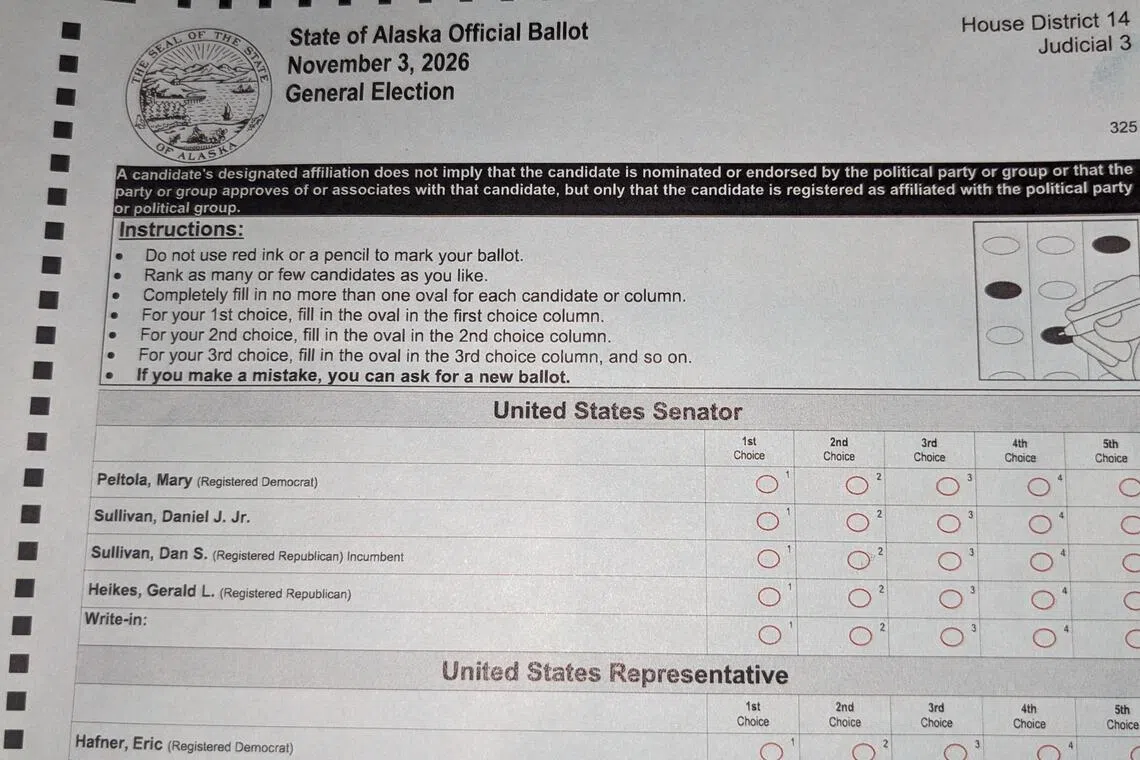
The article examines allegations that Democratic operatives tried to manipulate Alaska’s 2026 US Senate race by recruiting a second candidate named Dan Sullivan to divert votes from Republican incumbent Dan Sullivan. The New York Times reported that aides to Democrat Mary Peltola and others connected to her campaign and the Democratic Senatorial Campaign Committee coordinated a “ballot composition project.” Peltola denies knowing about or supporting the effort, while President Donald Trump ordered a Justice Department investigation, Alaska Governor Mike Dunleavy ordered a criminal investigation, and US Attorney Michael Heyman described the alleged recruitment as a serious conspiracy. The second candidate, Daniel J Sullivan Jr, also denies being recruited by Democrats.
The article explains that ballot stacking, or recruiting candidates chiefly to affect how votes are distributed, has occasionally influenced close elections. In Florida in 2020, Alex Rodriguez, a candidate sharing a surname with Democratic incumbent Jose Javier Rodriguez, received more than 6,000 votes as the incumbent lost by only 32. Alex Rodriguez pleaded guilty to campaign finance violations, and Republican operative Frank Artiles was later convicted in connection with the scheme. In Washington in 2024, two candidates named Ferguson entered a primary alongside Democratic Attorney General Bob Ferguson after an activist was alleged to have paid them; they withdrew after Ferguson threatened legal action.
The article also recounts historical and international examples. A second Joseph Russo ran against John F Kennedy’s opponent in a 1946 Massachusetts primary, though Kennedy’s personal involvement in the alleged scheme remains disputed. In India, namesake candidates appeared in races involving Rahul Gandhi and Hema Malini, who both won decisively. By contrast, multiple candidates named Chandu Lal Sahu collectively received many votes in a 2014 race, but the BJP’s Sahu still won. In another 2014 contest, two namesakes of Congress incumbent K Sudhakaran received enough votes collectively to exceed his narrow margin of defeat. These cases illustrate that the tactic can affect outcomes, but its effectiveness depends on the race and voter behavior.
Entities: Mary Peltola, Dan Sullivan, Daniel J Sullivan Jr, Donald Trump, Mike Dunleavy • Tone: analytical • Sentiment: neutral • Intent: analyze
31-10-2026
The Justice Department is investigating allegations that Democrats helped recruit Daniel J. Sullivan, a retired teacher, to run as a spoiler candidate in Alaska’s US Senate race. The race pits Democratic former representative Mary Peltola against Republican incumbent Daniel S. Sullivan, and the article notes that its outcome could affect control of the Senate. The department is seeking to prevent certification if the incumbent loses narrowly, while Peltola’s lawyers argue that the federal government has no authority to bring the case. The Democratic Senatorial Campaign Committee denies involvement, and both the retired teacher and Peltola’s campaign have denied or not confirmed coordination. The Justice Department has not announced a charging decision.
The legal dispute is complicated by Alaska’s ranked-choice voting system and the state’s control over election administration. State election officials initially barred Daniel J. Sullivan from the ballot, finding his candidacy was not in good faith, but state courts restored him, citing insufficient evidence of an intent to confuse voters and no state-law requirement of good faith. Legal experts say these rulings, and the constitutional allocation of election administration to states, make the federal government’s civil case difficult. A federal judge may soon decide whether to dismiss it.
Possible criminal theories include conspiracy to deprive people of constitutional rights, fraud, dishonesty, civil-rights violations, and perjury if someone lied under oath in earlier litigation. Experts question whether a prosecution could succeed: the First Amendment may protect running for office with improper motives, and political “dirty tricks” are often legal. However, deliberately deceiving voters about which candidate they are supporting could raise a distinct issue. A past conviction under a civil-rights conspiracy law for spreading election misinformation was overturned on appeal for lack of evidence of a conspiracy; the appeals court did not decide the First Amendment question.
Entities: US Department of Justice, Alaska US Senate race, Mary Peltola, Daniel S. Sullivan, Daniel J. Sullivan • Tone: analytical • Sentiment: neutral • Intent: analyze
31-10-2026
The Trump administration has accelerated criminal and civil investigations into allegations that Democrats helped recruit a third-party candidate to draw votes away from Republican Senator Dan Sullivan in Alaska’s closely watched Senate race. The Justice Department’s Alaska prosecutor, Michael Heyman, said a New York Times report prompted a surge of FBI resources and that investigators were moving “intensely and swiftly.” The department has asked a federal judge to preserve potentially affected ballots and obtain documents to assess whether Daniel J. Sullivan Jr’s candidacy was frivolous or fraudulent. It has also sued Alaska to block certification of the Senate result if Dan Sullivan loses in a race that includes the similarly named candidate.
The allegations stem from reporting that staffers for Democratic candidate Mary Peltola and the Democratic Senatorial Campaign Committee helped recruit the retired teacher Daniel J. Sullivan Jr. Reuters said it could not independently confirm that reporting. Peltola, the committee and the retired teacher have denied involvement or coordination. The article notes that both parties have used “ballot stacking” tactics, and that it remains unclear whether any laws were broken. President Donald Trump has called for Peltola’s prosecution and described the matter as voter fraud, while acknowledging that he directed the Justice Department to act.
The article frames the Alaska actions, along with a California case targeting alleged non-citizen voting, as an extraordinary federal intervention in elections normally administered by states. In California, an appeals court again rejected the administration’s bid to stop the counting of mail ballots from more than 20,000 voters it alleges may be noncitizens; a lower court warned that the effort could disenfranchise legal voters. Officials nationwide expect further disruption amid federal lawsuits seeking voter rolls. A non-partisan election-law advocate argued the litigation could create doubt and lay groundwork to challenge results. The report also notes that voter fraud is extremely rare and that a record 49 million people had already voted early, despite the uncertainty.
Entities: Donald Trump, Michael Heyman, Mary Peltola, Dan S. Sullivan, Daniel J. Sullivan Jr • Tone: analytical • Sentiment: neutral • Intent: inform
31-10-2026
As the US midterm campaign entered its final weekend, the Trump administration intensified legal activity around the closely contested Alaska Senate race, while early voting approached a record 50 million ballots. The Justice Department said it had accelerated an investigation after reports that aides to Democratic candidate Mary Peltola recruited retired teacher Daniel J. Sullivan Jr. to run as a nonpartisan candidate because he shares a name with Republican incumbent Dan S. Sullivan. Alaska’s US attorney called the man a “sham candidate,” although he did not identify a possible crime. Peltola and the retired teacher both denied knowledge of or coordination in the alleged effort. The DOJ also pursued a civil lawsuit seeking to block Alaska from certifying the Senate result if Sullivan loses a close race. The outcome could be pivotal to Democrats’ effort to take control of the Senate; all 435 House seats are also on the ballot, and control of either chamber would give Democrats opportunities to investigate the Trump administration.
The article describes other administration actions affecting elections nationwide. The federal government sued California over ballots cast by more than 20,000 voters it alleged could be noncitizens and sought unredacted voter rolls from about 30 states and the District of Columbia. A federal judge ordered the DOJ to stop threatening California election officials with prosecution over compliance with the administration’s directives. A Brennan Center for Justice voting-rights director said these measures resembled tactics used by election deniers in 2020 and could foster fear, distrust, and pressure on officials, even if the administration is unlikely to prevail in court.
Despite these disputes, a Reuters/Ipsos poll found that 76% of voters were confident their ballots would be counted accurately, with confidence nearly equal among Republicans and Democrats. More than 49 million people had already voted, exceeding the early-vote total before the 2022 midterms. President Donald Trump had campaigned across several states and was scheduled to resume rallies in Kansas and Iowa on Sunday.
Entities: Donald Trump, Mary Peltola, Dan S. Sullivan, Daniel J. Sullivan Jr., Michael Heyman • Tone: analytical • Sentiment: neutral • Intent: inform