30-09-2026
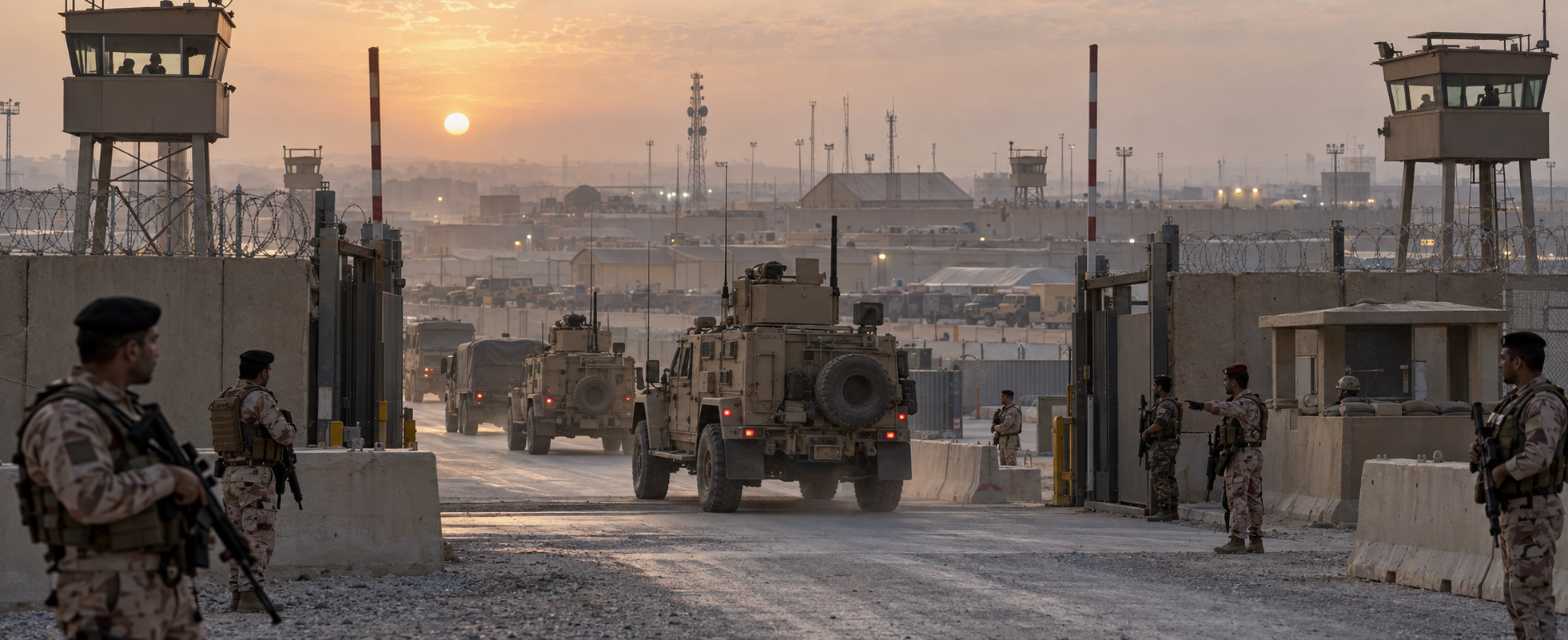
US forces are withdrawing from their remaining bases in Iraq, completing a pullout agreed in 2024 under then-President Joe Biden and carried out by President Donald Trump’s administration. Iraqi officials and analysts fear the departure could create a security vacuum, strengthen Iran-backed militias, and give Islamic State (IS) sleeper cells an opportunity to rebuild. Although the withdrawal is broadly popular among Iraqis, concerns persist about whether Iraqi security forces can independently protect the country and maintain capabilities previously supported by the US, including intelligence, aerial surveillance, and reconnaissance.
The article places the withdrawal in the context of the long US military presence in Iraq. US-led forces toppled Saddam Hussein in 2003, after which Iraq experienced upheaval and years of conflict. American forces withdrew in 2011, returned in 2014 to help Iraqi forces fight IS, and supported the campaign that defeated the group’s territorial caliphate by 2017. The article also notes the American deaths incurred across the wars in Iraq and Afghanistan, as well as US service members killed in this year’s conflict with Iran, including one who died near Erbil.
Iran and its regional allies portray the US departure as a victory for Tehran’s “axis of resistance.” Analyst Ahmed Younis warns that Iranian-backed groups may feel emboldened to expand their influence in Iraqi state institutions and policymaking. Separately, Iraqi security officials worry that IS retains a sleeper-cell network despite losing its territory. Retired General Mohammed al-Jubouri highlights the need for a viable post-coalition security plan and warns that armed or improvised explosive drones could pose a serious threat while Iraq lacks adequate air defences. The central concern is whether Iraq’s institutions can address these risks without the coalition’s support.
Entities: Iraq, United States, Iran, Donald Trump, Joe Biden • Tone: analytical • Sentiment: negative • Intent: inform
30-09-2026
Iran’s Islamic Revolutionary Guard Corps has issued a 26-page letter urging American voters to remove President Donald Trump’s allies from Congress, oppose US support for Israel and reject military intervention abroad. The appeal comes as US forces withdraw from their remaining bases in Iraq, a departure Tehran celebrates as a victory for its regional network of allied armed groups. The letter is unlikely to reach or sway many US voters, but it highlights issues that analysts say could hurt Trump and Republicans in the November 3 congressional elections: the war with Iran, rising fuel prices and the cost of living. Polling cited in the article found low approval of Trump’s handling of living costs and limited support for strikes on Iran.
The withdrawal, agreed in 2024 under former President Joe Biden, takes place 23 years after the US-led invasion toppled Saddam Hussein and ushered in a period of upheaval that eventually saw the rise of Islamic State. The wider war has involved Iranian-aligned groups, including Yemen’s Houthis, Lebanon’s Hezbollah and militias in Iraq. Saudi Arabia blamed Iraqi militias for an attack that temporarily knocked its East-West Pipeline offline.
Diplomatic efforts to end the seven-month conflict have not produced an agreement. Qatar is exchanging messages between Washington and Tehran and seeking common ground, while negotiations over reopening the Strait of Hormuz remain unresolved. Before the war, the strategic waterway carried about one-fifth of global oil and liquefied natural gas. Iran has proposed a seven-day countdown to reopening the strait alongside a pause in fighting; Trump rejected the proposal, though Iran’s foreign minister said Washington had not formally conveyed its rejection through mediators.
Trump predicts Iran will surrender soon and says preventing it from obtaining a nuclear weapon is a key war aim. The conflict has weakened Iran’s conventional forces and economy, but Iranian missile and drone strikes and restrictions on tanker traffic have raised energy prices. Iran denies seeking nuclear weapons and says it is entitled to peaceful nuclear technology under the Nuclear Non-Proliferation Treaty.
Entities: Iran, Islamic Revolutionary Guard Corps (IRGC), Donald Trump, Qatar, Iraq • Tone: analytical • Sentiment: neutral • Intent: inform
30-09-2026
The United States has officially concluded Operation Inherent Resolve in Iraq, ending a 12-year campaign against ISIS that began in August 2014. The operation helped dismantle ISIS’s self-proclaimed caliphate, and coalition estimates say more than 80,000 of the group’s fighters were killed. However, the end of the mission does not guarantee a simpler security environment for Iraq or the United States.
The withdrawal follows a September 2024 agreement between Washington and Baghdad. It could reduce attacks on US forces by removing a prominent target for Iran-backed militias, potentially easing one source of instability in the short term. At the same time, US departure removes a check on Tehran’s influence. Iran has spent years building connections with Iraqi political groups, security forces and the Popular Mobilisation Forces, and analysts expect its role to grow as American attention recedes.
Analysts describe the consequences as mixed. Michael Knights says the widening gap between sustained Iranian interest and declining US engagement is generally unfavorable. Jason Campbell notes that leaving may weaken the militias’ stated rationale for retaining weapons, but could also deliver a public-relations gain to Iran and its allies. He cautions that Kurdish forces around Erbil will be more exposed without US bases and the air defences protecting American troops. The withdrawal may not eliminate US influence, which also rests on Baghdad’s and Erbil’s desire to maintain good relations with Washington.
Iraq’s effort to disarm Iran-backed militias has been delayed: Prime Minister Ali Al Zaidi’s initial September 30 deadline was pushed to June 2027. US policy may remain pragmatic so long as militias do not attack American interests, though attacks on Saudi Arabia or US targets could draw renewed attention from the Trump administration.
The article also highlights the risk of an ISIS resurgence. Kurdish commander Sirwan Barzani said reduced access to US intelligence, logistics and drones could give the group room to regroup. He reported increased movement by sleeper cells after the withdrawal was announced, suggesting the end of the mission could embolden militants even as ISIS remains far weaker than it once was.
Entities: Operation Inherent Resolve, ISIS, Iraq, United States, Iran • Tone: analytical • Sentiment: neutral • Intent: analyze
30-09-2026
The supplied text is a brief article opening, not the full article, so it does not provide enough information to summarize the report’s detailed evidence, timeline, or analysis. In the excerpt, the Washington Post reports that U.S. military forces are scheduled to leave bases in Iraq on Wednesday, after roughly two decades of American involvement. The opening characterizes that involvement as having come at a great human cost, citing the deaths of hundreds of thousands of Iraqi civilians and thousands of U.S. troops. It presents the withdrawal as a significant regional turning point: the United States is departing while Iran, described as battered but increasingly influential, is positioned to play a central role in the region’s future. The article’s headline similarly frames the departure as a shift in the balance of power toward Iran. The excerpt identifies Baghdad as the dateline and names Mustafa Salim and Alex Horton as the authors. It does not explain which bases are involved, the circumstances or terms of the withdrawal, the condition of Iraq’s political or security institutions, or what specific developments have increased Iran’s influence. Those details cannot be inferred from the supplied text. Accordingly, this summary reflects only the article’s headline and opening sentence, rather than the full report.
Entities: Mustafa Salim, Alex Horton, Baghdad, Iraq, United States • Tone: analytical • Sentiment: negative • Intent: analyze