30-09-2026
The article reports that summer heatwaves and wildfires exposed half of Europe’s population to poor, very poor or extremely poor levels of ground-level ozone in 2026. Unlike the protective ozone layer high in the atmosphere, ground-level ozone is a harmful pollutant that can penetrate deep into the respiratory system and enter the bloodstream. People with asthma are especially vulnerable. Ozone forms through chemical reactions driven by sunlight and high temperatures, while nitrogen oxides from fossil-fuel combustion—including industry and road transport—contribute to its formation. Wildfires add to the problem, and smoke and other pollutants can travel across borders.
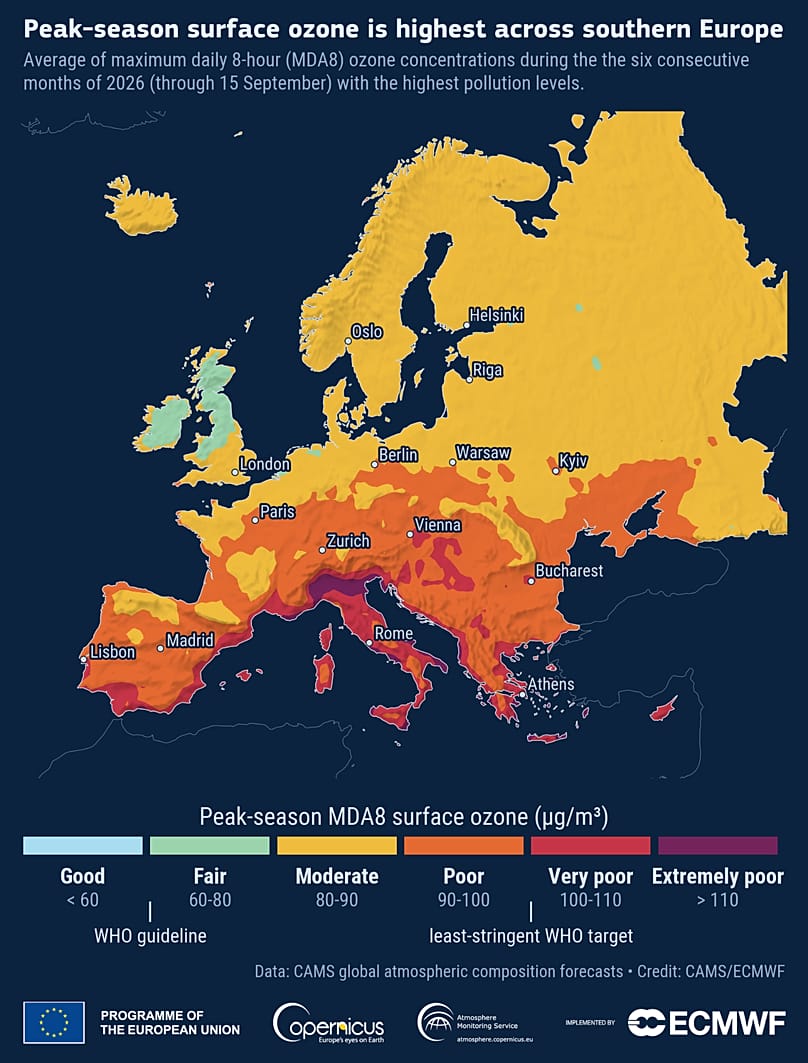
The article presents ozone as a link between air pollution and climate change: human-caused warming is making heatwaves more frequent and intense, conditions that encourage ozone formation. Ground-level ozone also contributes to warming itself, accounting for an estimated 0.23°C of present-day warming. Although European Union measures have reduced emissions of several other pollutants, ozone has shown no clear downward trend. Southern Europe experienced the highest peak-season surface ozone, and Milan is identified among cities with some of the world’s highest exposure levels. The article also notes high global exposure, especially in Asia.
EU rules set limits for ozone concentrations, and the article describes measures that can reduce precursor pollution, including better public transport, low- or zero-emission traffic zones, clean energy and lower meat consumption. It says governments ultimately hold responsibility for reducing ozone and calls for improved monitoring, reporting, forecasting and understanding of ozone sources. At the time of the report, only Croatia, France and Spain had ozone-specific air-quality plans.
Entities: Ground-level ozone, Heatwaves and wildfires, Copernicus Atmosphere Monitoring Service (CAMS), Atmosphere Watch, European Union Ambient Air Quality Directive • Tone: analytical • Sentiment: negative • Intent: inform
30-09-2026
A European Union report found that heatwaves, wildfires and human-caused emissions exposed 34 percent of the global population to “extremely poor” ozone air quality during the first eight months of 2026. The analysis, by the Copernicus Atmosphere Monitoring Service (CAMS), describes how heat and sunlight react with emissions from sources such as fires, vehicles and industry to produce ground-level ozone. Ozone can harm lung tissue, cause breathing difficulties and trigger asthma attacks. Unlike several other harmful pollutants, it has proved difficult to reduce, in part because climate change is making the conditions for ozone formation more common.
Asia had the highest exposure: 53 percent of its population experienced extremely poor ozone levels and another 22 percent experienced very poor levels. Industrialisation, transport, agricultural burning and wildfires contributed to the region’s pollution. New Delhi, Dhaka, Chongqing and Lahore were among cities with extremely poor ozone. Across North America, two thirds of the population experienced poor or very poor air quality; in Europe, the figure was 45 percent. The report also noted that ozone levels in North America remained relatively unchanged despite emissions-control policies. Ozone pollution is linked to about 60,000 premature deaths annually in Europe.
Exposure varied elsewhere. Eight percent of Africa’s population experienced extremely poor air quality, with smoke from fires, crop burning and cooking contributing to pollution and Saharan dust reaching Europe. Ozone levels were very high in São Paulo and extremely elevated in Rio de Janeiro, although 81 percent of South Americans had good or fair air quality. Oceania had the most favourable results: 66 percent of residents had good ozone levels and the rest had fair conditions. CAMS director Laurence Rouil emphasized that pollution travels across borders, while the report warned that the developing El Niño pattern could contribute to further fires in Southeast Asia.
Entities: Copernicus Atmosphere Monitoring Service (CAMS), European Union, World Health Organization (WHO), European Environment Agency, Laurence Rouil • Tone: analytical • Sentiment: neutral • Intent: inform
30-09-2026
A European Union analysis by the Copernicus Climate Atmosphere Monitoring Service (CAMS) found that 34% of the global population was exposed to extremely poor ozone air quality from Jan 1 to Sept 15, 2026. Another 17% experienced very poor ozone levels, while only 5% breathed air classified as good. The report links the high exposure to heatwaves and wildfires, alongside emissions from vehicles, industry and other human activities. Heat and sunlight react with airborne emissions to form ground-level ozone, which can damage lung tissue, cause breathing problems and trigger asthma attacks.
Asia had the highest exposure: 53% of its population faced extremely poor ozone and a further 22% very poor levels. Industrialisation, transport, economic development, fires and agricultural burning contribute to the problem. Cities including New Delhi, Dhaka, Chongqing and Lahore recorded extremely poor ozone. Exposure was also widespread in North America and Europe, despite efforts to cut emissions. CAMS said ozone has been harder to control than some other pollutants because climate change is increasing the conditions that favour its formation. Ozone pollution is linked to about 60,000 premature deaths annually in Europe.
The analysis also describes regional differences. In Africa, 8% of the population experienced extremely poor air, with smoke from fires, crop burning and cooking contributing to pollution; Saharan dust can travel as far as Europe. South America had mostly good or fair ozone conditions, although Sao Paulo and Rio de Janeiro recorded high levels. Oceania was the only clear bright spot: 66% of residents had good ozone levels and the remainder fair conditions. CAMS director Laurence Rouil stressed that pollution can travel thousands of kilometres across borders, continents and oceans.
Entities: Copernicus Climate Atmosphere Monitoring Service (CAMS), Laurence Rouil, Ian Marnane, European Environment Agency, World Health Organisation (WHO) • Tone: analytical • Sentiment: negative • Intent: inform