26-10-2026
Aleksandar Vucic, Serbia’s dominant political figure for more than a decade, conceded defeat after a student-led movement won snap parliamentary elections. Early estimates gave the Student List 135 to 140 seats in the 250-member parliament, against 105 for Vucic’s Serbian Progressive Party (SNS). Turnout was the highest in more than 30 years. The movement grew out of protests following the November 2024 collapse of a Novi Sad train station canopy, which killed 16 people. It campaigned on tackling corruption, depoliticising public institutions and restoring citizens’ rights. Vucic had dismissed demonstrators as “blockaders” and accused them of destabilising Serbia.
The article traces Vucic’s political evolution from the ultranationalist Serbian Radical Party, which he joined in 1993, to the SNS, founded with Tomislav Nikolic in 2008 and presented as more mainstream. It recalls Vucic’s nationalist rhetoric during the 1990s, including a 1995 threat against Muslims, and notes the later conviction of his political mentor Vojislav Seselj for crimes against non-Serbs during the Balkan wars. Vucic rose through government roles to become president in 2017, winning re-election in 2022. Although his presidential term was due to end in 2027, he resigned in September under protest pressure and called early elections. Critics say he made few promises good while consolidating control over state institutions, media and political life.
Serbia’s economy grew during Vucic’s time in power: unemployment fell, nominal GDP nearly tripled, foreign investment increased, and motorways were built. But the article notes that higher wages did not necessarily improve living standards proportionally, while living costs and public debt remained concerns. Analysts quoted in the report describe citizens’ anger as justified and argue that state institutions and independent public debate came under systematic pressure.
Entities: Aleksandar Vucic, Student List, Serbian Progressive Party (SNS), Ilija Srdanovic, Novi Sad train station canopy collapse • Tone: analytical • Sentiment: neutral • Intent: analyze
26-10-2026
Serbia’s long-standing leader Aleksandar Vučić conceded defeat in snap parliamentary elections, saying preliminary results made it clear that his Serbian Progressive Party (SNS) had lost. The victory went to the Student List, an anti-corruption movement that grew out of two years of protests following the collapse of a canopy at Novi Sad’s train station, which killed 16 people and became a symbol of alleged corruption and negligence. The election commission’s preliminary figures showed a record-high turnout, which commentators had said could benefit the student-led movement.
The Student List drew anti-government voters from across Serbia despite having no obvious leaders and little experience in electoral politics. Its candidates represented professions and backgrounds including medicine, acting, academia and sport. Lead candidate Ilija Srdanović said the movement hoped to make Serbia a free state and free the country from tyranny. Supporters celebrated in Belgrade and Novi Sad with dancing, chants, car horns and fireworks, describing the result as a miracle and expressing disbelief and relief.
The movement’s manifesto included removing officials who broke rules while cracking down on protesters, preventing party loyalists from leading public enterprises, and ending political control of the public broadcaster. Vučić and the SNS have repeatedly denied corruption allegations. Vučić, who could not seek a third presidential term after serving two, had called the snap election while seeking to return as prime minister, a post he left in 2017. His campaign also promised higher pensions and public-sector salaries and increased investment in state healthcare. He supports Serbia’s EU candidacy but has refused to impose sanctions on Russia over its invasion of Ukraine.
Turnout was high both inside Serbia and at polling stations abroad, including in Ljubljana, Munich, Los Angeles, Chicago and Paris. The vote took place amid heightened tensions, with police sealing streets around the Republic Electoral Commission in Belgrade.
Entities: Aleksandar Vučić, Ilija Srdanović, Radomir Saicic, Selena Lebovic, David Vasić • Tone: neutral • Sentiment: neutral • Intent: inform
26-10-2026
Aleksandar Vucic, Serbia’s dominant political figure for more than 14 years, conceded defeat after a student-led movement-backed political force won the October 25 snap parliamentary election. The article traces Vucic’s journey from an ultra-nationalist ally of Slobodan Milosevic—serving as information minister in 1998 and later supporting the Serbian Radical Party—to co-founding the conservative, pro-European Serbian Progressive Party (SNS) in 2008. The SNS won in 2012 and subsequently dominated Serbian politics; Vucic held several senior government roles before becoming president in 2017.
Vucic’s supporters credited him with stability, development, patriotism, investment and improved living standards in a country shaped by the 1990s wars and international isolation. He promoted infrastructure projects, including Belgrade’s waterfront development and preparations for Expo 2027, while presenting himself as a defender of Serbian sovereignty. He also tried to balance Serbia’s European Union ambitions with its close relationship with Russia.
Critics, however, regarded him as increasingly authoritarian and accused his government of corruption. The article notes that he did not clearly distance himself from nationalist associations or condemn Serbs convicted of wartime atrocities. His ministers’ attendance at a funeral gathering for Ratko Mladic also drew criticism from Brussels.
Public anger intensified in 2024, when a concrete canopy at a recently renovated train station collapsed, killing 16 people. The disaster revived accusations of corruption surrounding government projects and prompted student-led demonstrations demanding transparent investigations. The protests drew hundreds of thousands and became the largest since the Milosevic era. Authorities and Vucic’s allies pushed back, portraying student blockaders as agents of foreign powers. Vucic eventually called snap elections in September, meeting a central student demand. He had said the protests would end on election day; after the vote, he acknowledged that his party had lost.
Entities: Aleksandar Vucic, Serbia, Slobodan Milosevic, Serbian Progressive Party (SNS), Serbian Radical Party • Tone: analytical • Sentiment: neutral • Intent: inform
26-10-2026
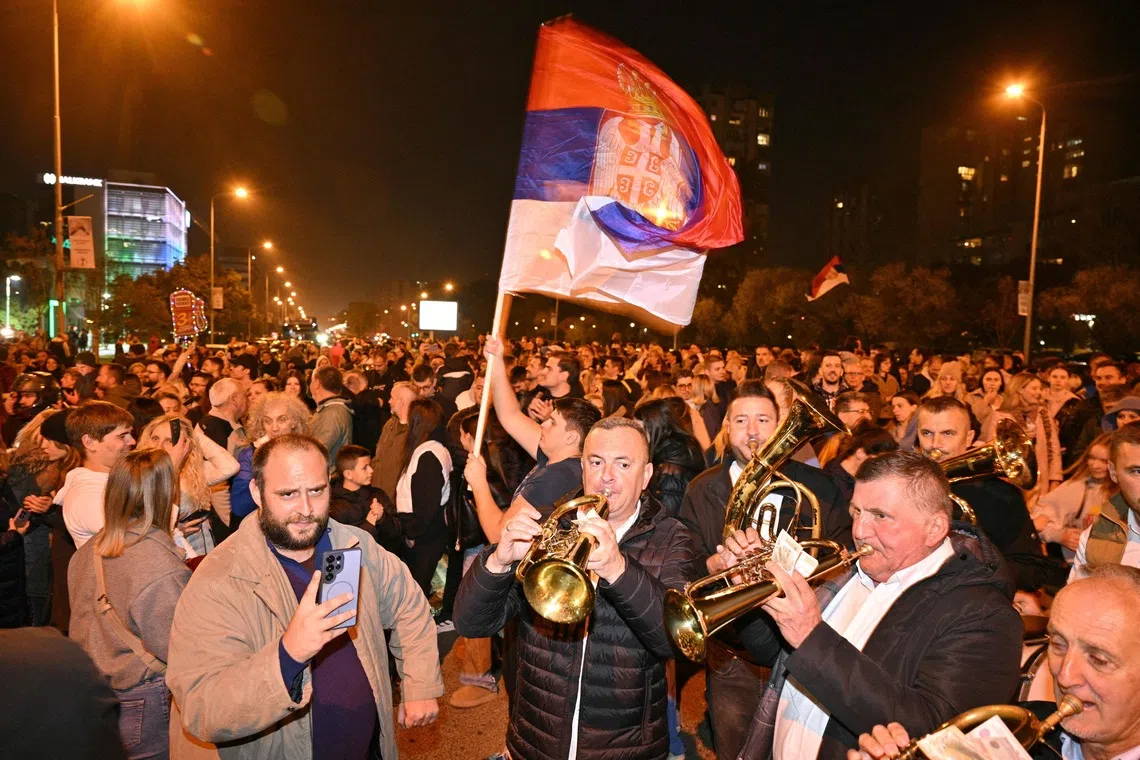
Serbia’s student-backed Students’ List celebrated a major victory in a snap parliamentary election on Oct. 25, 2026, after veteran leader Aleksandar Vucic’s party was defeated. Celebrations spread across Belgrade and other cities soon after Vucic conceded, with supporters waving Serbian flags, setting off fireworks and flares, gathering in public squares, and chanting “Victory, victory!” Some described the result as a chance for Serbia to become free of tyranny. The election capped nearly two years of student-led protests that began after a canopy collapsed at Novi Sad railway station in 2024, killing 16 people. The disaster was widely blamed on corruption and prompted some of the country’s largest demonstrations since Slobodan Milosevic fell from power in 2000. At the Students’ List headquarters, supporters embraced and cried with joy. Candidate and university professor Radomir Saicic urged them to celebrate peacefully and said that the serious work of building a country where the law applies equally to everyone would begin the next day. Meanwhile, crowds entered a park opposite parliament where a pro-government encampment had stood for months, dismantling the remaining tents. One tent was set on fire, but no clashes were reported. Riot-police trucks leaving the city centre were cheered by crowds. Students’ List candidate and University of Arts rector Mirjana Nikolic credited young people with making the victory possible. Broadcasters showed celebrations elsewhere, including a gathering of thousands in Novi Sad, where the protest movement began.
Entities: Students’ List, Aleksandar Vucic, Mila Martic, Radomir Saicic, Mirjana Nikolic • Tone: emotional • Sentiment: positive • Intent: inform
26-10-2026
Serbia’s student-led Student List won a snap parliamentary election, ending Aleksandar Vucic’s 12-year period of political dominance. The movement received more than two million votes, enough for a simple majority in the 250-seat parliament. Vucic conceded defeat after turnout reached 69 per cent, the country’s highest in 33 years. He had called the early election after months of protests and had hoped to return to power as prime minister after resigning as president; that strategy failed.
The protests began after a train station canopy collapsed in 2024, killing 16 people. Students blamed corruption and official incompetence for the disaster, and the Student List built support by pledging to combat graft and democratic backsliding. Its representatives have also promised judicial reform, better election conditions, more media diversity, an end to monopolies, and reviews of major infrastructure contracts, including the $2.4 billion Expo 2027 project. Serbia’s corruption score in Transparency International’s 2025 index was its lowest in two decades.
The result will reshape Serbia’s political landscape. The Socialists, previously led by Slobodan Milosevic, lost parliamentary representation for the first time in 18 years, while many established political groups were displaced. Vucic accused European countries and an American “deep state” of supporting the Student List, but offered no evidence, and vowed to return to power. The movement’s next steps remain uncertain: it has no single leader, its members have limited governing experience, and it has not named a prime ministerial candidate. A Croatian political analyst warned that organising the transfer of power could be difficult and that Vucic might seek to obstruct it. The movement has been cautious about contentious foreign-policy questions, including Kosovo and sanctions on Russia; EU membership is not an immediate priority. European Commission President Ursula von der Leyen welcomed the change and offered EU support for reforms.
Entities: Aleksandar Vucic, Student List, Serbia, Belgrade, Radomir Saicic • Tone: analytical • Sentiment: neutral • Intent: inform