25-10-2026
Al Jazeera reports that protests in several European countries turned violent for another day. Demonstrations in France, Italy and Spain were driven by concerns over rising living costs, reductions in public services and military spending. The report describes clashes between police and demonstrators, with officers using tear gas and batons. Protesters erected barricades and set fires in streets. The article presents these events as part of renewed unrest across Europe, but the supplied text does not provide details about specific cities, the number of people involved, injuries or arrests, or the sequence and scale of the clashes. It also does not identify particular protest groups or include responses from officials or demonstrators. Its focus is on the reported violence and the issues motivating the protests. The item is a brief Al Jazeera video/newsfeed report published on 25 October 2026. Overall, it informs readers of unrest connected to economic pressures and political spending priorities, without offering an extended analysis or commentary.
Entities: Al Jazeera, Europe, France, Italy, Spain • Tone: neutral • Sentiment: negative • Intent: inform
25-10-2026
Thousands of people demonstrated in major Italian cities on Saturday, 24 October, protesting the rising cost of living, Prime Minister Giorgia Meloni’s government and wars in the Middle East. The demonstrations were mostly peaceful, but isolated confrontations occurred in Turin, Florence, Bologna and Rome. After violence at protests the previous weekend, the government deployed a substantial security operation, including police and soldiers patrolling city centres; 500 soldiers were sent to Milan following attacks on shops the prior Saturday.
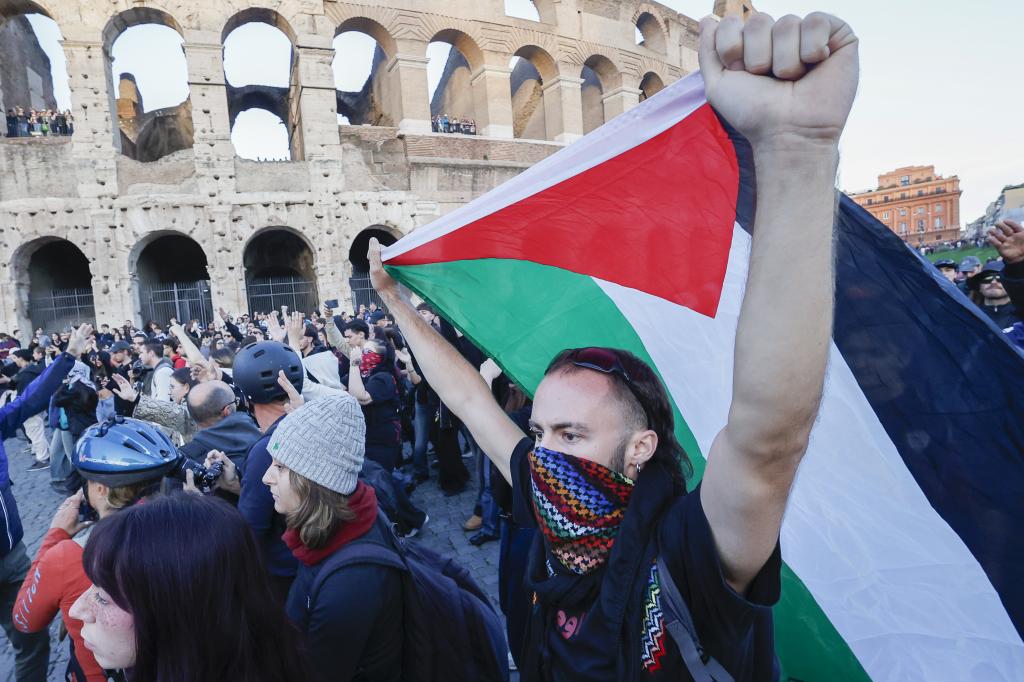
In several cities, protesters gathered in separate groups and attempted to reach central areas, where security forces blocked them. In Rome, a breakaway group entered the Colosseum, or Flavian Amphitheatre, chanting and displaying placards before authorities escorted them out. A separate confrontation occurred when a demonstrator stood in front of a police water-cannon vehicle, which moved forward briefly before officers pulled him away. In Florence, police used batons as protesters tried to cross the Santa Trìnita bridge. In Bologna, officers used a water cannon and tear gas after objects were thrown at them; one person was hospitalized after being struck by police. Milan’s marches were calmer, though protesters had verbal clashes with far-right activists.
Authorities reported nine arrests and 87 people reported to them nationwide. Another 371 people were taken to police stations for checks, including 110 minors and 69 foreign nationals. In Milan, Youssef Siher, 30, was detained and placed under investigation on suspicion of aggravated incitement to commit a crime. He is alleged to have been behind the “17 October Movement,” which reportedly facilitated information-sharing about participation in the previous weekend’s protests.
Meloni praised those who managed the demonstrations, saying the right to protest must be protected alongside residents’ right to safety. She said safety should extend to peaceful demonstrators, workers and people living in the cities, and that authorities should prevent those seeking confrontation and violence from dominating events.
Entities: Giorgia Meloni, Youssef Siher, Italy, Rome, Milan • Tone: analytical • Sentiment: neutral • Intent: inform
25-10-2026
Thousands of people demonstrated Saturday in cities across Europe, including Milan, Rome, Turin, Tirana, Madrid and Lisbon, amid protests over issues ranging from education and corruption to pensions, housing and war. Authorities in Italy deployed substantial security forces after violent protests and looting the previous weekend. In Milan, an additional 500 soldiers joined hundreds already stationed in the city, supporting about 5,000 police and other security personnel. Police used drone surveillance, railway-station checks and online monitoring, while some shops in the fashion district boarded up their windows. The Milan march remained peaceful and ended outside the Polytechnic, though demonstrators chanted against Premier Giorgia Meloni and staged symbolic protests over energy costs. Police had detained minors preventively, and officials were investigating a freelance journalist described as a possible organizer of the new Oct. 17 movement. In Rome, security was heightened around major sites and shopping streets. A small group tried to enter the Colosseum, and an anti-war march briefly clashed with police before retreating after water cannons were used. Other students marched peacefully, rejecting association with rioters. In Albania’s capital, Tirana, unrest was more severe: protesters set government buildings on fire and threw projectiles as riot police used water cannons. Students demanded lower tuition and greater education investment, while some joined calls for Prime Minister Edi Rama’s resignation. Rama said the government was preparing a response and invited dialogue, while warning that violence would be punished. In Madrid, thousands marched peacefully to defend public pensions. The article’s final section begins to describe protests in Lisbon but is cut off in the supplied text.
Entities: Milan, Rome, Turin, Tirana, Madrid • Tone: analytical • Sentiment: neutral • Intent: inform
25-10-2026
Hundreds of protesters entered the Roman Colosseum during demonstrations in Rome on Saturday, cheering and shouting inside the ancient arena before security forces pushed them out. Many of the demonstrators were young and carried Palestinian flags. The protests, which have spread from France to Italy, addressed both the cost-of-living crisis and the war in Gaza, as well as opposition to the Italian government.
Thousands of people marched in Rome, Milan, Turin and other Italian cities. The Colosseum had increased security ahead of the demonstrations and was designated a security “red zone” the previous month, following earlier clashes involving visitors at the historic site. Elsewhere in Rome, police used tear gas and water cannons during a confrontation near Piazza della Repubblica.
In Milan, protesters dumped manure outside the country’s energy regulator and set fire to an oversized electricity bill. Many shops boarded up their windows amid concerns about looting, after protesters in France had recently been caught stealing luxury goods. Prime Minister Giorgia Meloni sent about 500 soldiers to support the 5,000 officers deployed in Milan. Defense Minister Guido Crosetto said the soldiers had plastic restraint ties for arrests but were not equipped with pepper spray or Tasers.
The Italian demonstrations resemble protests that began in France the previous month and have spread across Europe amid economic hardship. Large demonstrations were also reported in the capitals of Spain, Portugal and Albania.
Entities: Roman Colosseum, Rome, Milan, Turin, Giorgia Meloni • Tone: analytical • Sentiment: negative • Intent: inform
25-10-2026
Protests and clashes with police spread across several European countries on Saturday, with demonstrations addressing education costs, government policy, living costs, and pensions. In Tirana, Albania, students called for lower tuition fees, increased public investment in education, and the resignation of Prime Minister Edi Rama. Protesters burned dumpsters and couch cushions that Rama had placed as a symbolic invitation to dialogue. More than 2,500 police officers were deployed, and authorities used water cannons against the crowd.
In Brussels, Belgium, police used water cannons and tear gas to clear student-made barricades. Retailers boarded up shops amid fears of renewed looting following destruction the previous week. Protesters reportedly tried to ignite a pile of rental scooters, signs, and bicycles; witnesses said an officer struck and kicked one demonstrator. At least five people were arrested, though police reported no major incidents.
Demonstrations also took place in Italian cities. Businesses boarded up windows in anticipation of possible looting, while Milan heightened security with 500 soldiers, drone surveillance, station checks, and rapid-response units. Clashes and property damage were reported in Rome, Turin, and Florence. The US Embassy and Consulates in Italy urged Americans to avoid Milan’s Piazza Duomo and major commercial streets.
In Spain, more than 25,000 people demonstrated in Madrid over pension reform. In Barcelona, masked protesters were filmed smashing a glass kiosk and setting fires. The article also reports that jihadists had called for attacks on demonstrators and police during protests in Spain and Portugal, citing EuroNews. Overall, the report describes unrest across multiple countries, emphasizing property damage, police responses, arrests, and heightened security precautions.
Entities: France, Albania, Tirana, Ministry of Education, Edi Rama • Tone: urgent • Sentiment: negative • Intent: inform
25-10-2026
Barcelona police arrested 100 people on the evening of Oct. 24 after demonstrators at an anti-establishment rally looted shops and set fires around Plaza de Catalunya, a busy central area popular with tourists and weekend shoppers. Catalonia’s interior minister, Núria Parlon, said about a quarter of those arrested were minors. She reported more than 30 fires and 14 stores vandalised or looted.
The article says social media posts had called people to join a movement “against the system” and used the slogan “Institut Indignats,” a translation of “Lycees Indignes,” associated with student protests in France in recent weeks. The phrases mean “Indignant High School Student” in English.
Videos posted online showed people trapped inside shops, including the department store El Corte Inglés, after shutters were lowered to deter looting. Other footage showed hooded demonstrators dressed in black breaking shop windows and taking goods; some online viewers appeared to encourage the actions.
Barcelona mayor Jaume Collboni condemned the vandalism and said it “will not go unpunished.” He also warned that guardians of minors involved could face legal consequences. The report describes the arrests, damage and official responses, while placing the rally’s online slogans in the context of recent student protests in France.
Entities: Barcelona, Plaça de Catalunya, Catalonia, Núria Parlon, Jaume Collboni • Tone: neutral • Sentiment: negative • Intent: inform