24-10-2026
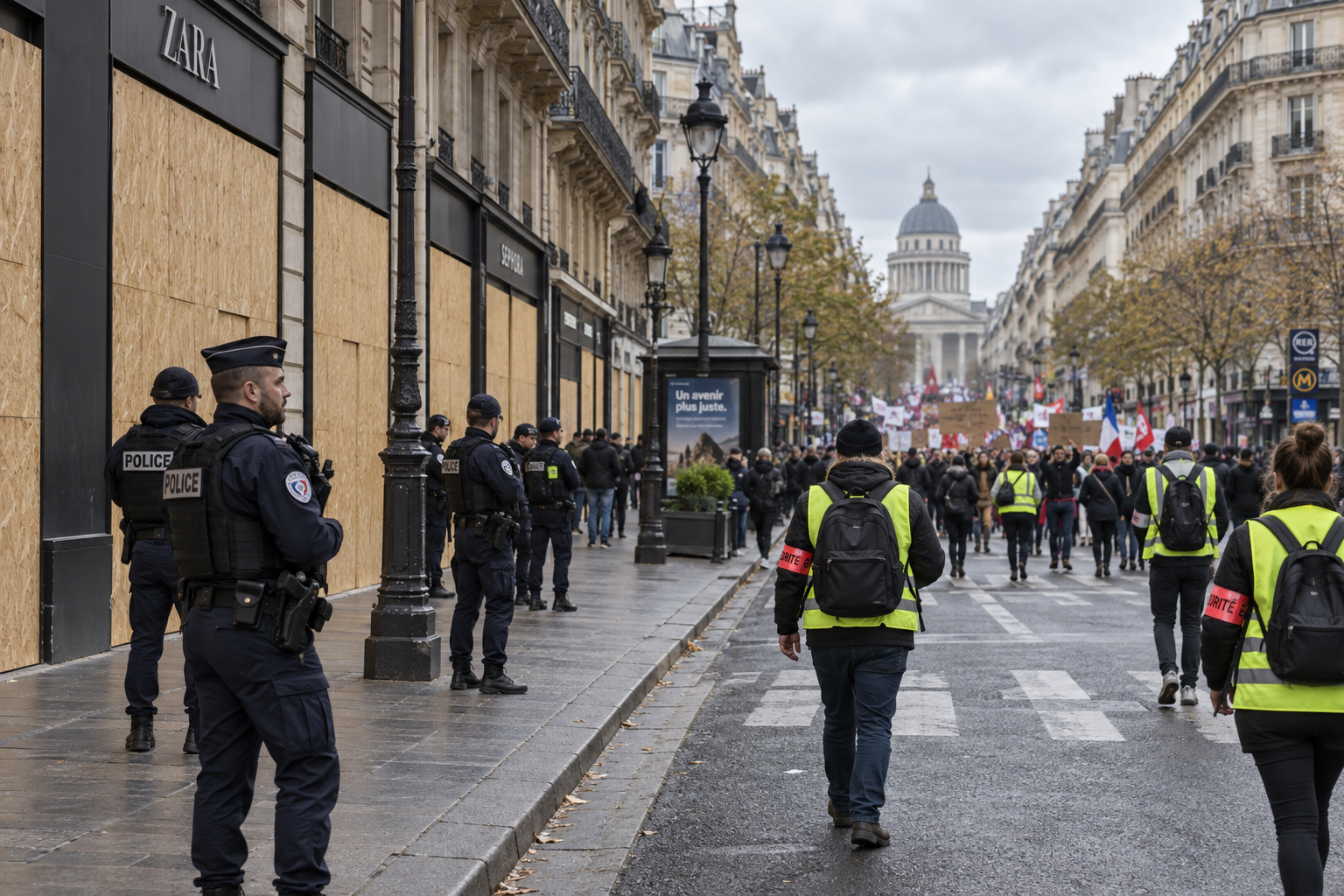
France is preparing for a second nationwide day of protests on Saturday, one week after riots involving looting, arson and clashes with police. Authorities have imposed restrictions on demonstrations and the interior ministry plans to deploy 70,000 police officers, following criticism that the government failed to anticipate the scale of the previous unrest. Interior Minister Laurent Nuñez has promised a firm response to violence, while Justice Minister Gérald Darmanin said 232 people had been imprisoned and more than 1,100 had appeared in court over the riots. Prosecutors have been directed to seek additional penalties for people convicted of looting or attacking police.
Despite restrictions and gathering bans in some cities, hundreds of demonstrations are planned. Their scale and permitted routes vary locally: some bans have been reversed, while Paris authorities have diverted a student- and union-backed march away from the city centre. Museums will close, a Paris Saint-Germain match has been postponed, and businesses have boarded up in anticipation of further disorder. The yellow-vest movement, which has supporters across the political spectrum, has also called for action and demanded President Emmanuel Macron’s resignation.
The protests come amid public frustration over living costs, national debt and the prospect of spending cuts, as well as political polarisation ahead of next spring’s presidential election. Macron’s centrist movement may struggle to reach the election’s second round, potentially leaving a contest between the National Rally and La France Insoumise. Both parties have blamed Macron’s government for the disorder. A National Rally conference in Orléans, where Marine Le Pen is due to speak, is another potential flashpoint, with left-wing counter-protesters expected and thousands of police to be deployed.
Entities: France, Emmanuel Macron, Laurent Nuñez, Gérald Darmanin, Paris • Tone: analytical • Sentiment: negative • Intent: inform
24-10-2026
France’s Interior Minister Laurent Nunez announced that 70,000 police officers would be deployed across the country ahead of Saturday’s protests, citing online calls for violence and looting. Police will be supported by specialist units, mounted officers, heavy vehicles, helicopters, water cannon, drones and anti-drone systems. Nunez said authorities would take a firm approach to rioting and would work to prevent a repeat of the previous weekend’s violence.
The protests began with students calling for better school facilities, more teachers and other education improvements, but have widened into anger over the cost of living. Demonstrations last Saturday escalated into riots in Paris and other cities. Authorities said radical militants and groups of young looters exploited protesters’ anger; masked groups reportedly burned cars and buildings, and thousands of stores were ransacked. Paris shopkeepers prepared for further unrest by boarding up windows, while the city council urged residents and businesses to remove items that could be used as fuel, projectiles or barricades.
Authorities maintained curfews in designated areas, including two central Paris squares from 11 p.m. to 6 a.m. They approved one march in Paris, organized by the CGT labor union, on a limited route, while rejecting requests from student union UNEF and the Yellow Vest movement. UNEF said it would protest regardless, and Yellow Vest supporters were expected to join the authorized march. A planned ban on demonstrations in Marseille was reversed to allow a union protest, while authorities sought to keep protesters away from central Lyon.
President Emmanuel Macron’s government distinguished peaceful protest from violent unrest. Macron rejected claims that Islamist extremists and migrants were driving the violence, while blaming far-left groups for attempting a coup. After meeting secondary-school representatives for the first time, Macron faced calls for further protests. Student representative Nathanael Combary said students were dissatisfied and were awaiting concrete proposals from the prime minister on Monday.
Entities: Laurent Nunez, Emmanuel Macron, Nathanael Combary, France, Paris • Tone: neutral • Sentiment: negative • Intent: inform
24-10-2026
France is preparing to deploy about 70,000 police and security personnel nationwide on Oct 24, following violent disorder that accompanied protests a week earlier. The demonstrations began with high school students protesting learning conditions but have expanded into a broader movement fuelled by anger over the rising cost of living. Interior Minister Laurent Nunez said authorities were responding in part to calls for violence and looting circulating on social media. The government has distinguished protesters’ demands from looting, arson and ransacking. Courts have sentenced 217 people, about half first-time offenders, to prison, while President Emmanuel Macron has called for “the utmost severity” against delinquency.
Authorities have imposed restrictions or bans on demonstrations in several cities. In Orleans, where Marine Le Pen is scheduled to attend her National Rally party congress, counter-protests are expected to draw 20,000 to 30,000 people and will be kept out of the city centre. Restrictions are also planned in Lyon and Paris, where unions object to an alternative route for a permitted march. Marseille authorities made an exception to a protest ban for one union-organised demonstration. Major Paris museums, including the Louvre, will close, and the Art Basel fair will end early.
The restrictions have prompted criticism from Amnesty International and Human Rights Watch, which raised concerns about peaceful protest rights, police conduct and reports of children injured by crowd-control weapons. The deployment is about 20 per cent larger than the previous weekend’s security presence, amid questions about police preparedness and intelligence gathering.
The unrest comes six months before elections to replace Macron and has affected the political climate. A poll conducted after the violence showed Le Pen leading in the first round at 33 to 35 per cent and projected her winning a runoff against hard-left leader Jean-Luc Melenchon. The article also notes that France’s rising government debt is worrying investors.
Entities: France, Emmanuel Macron, Marine Le Pen, Laurent Nunez, Gerald Darmanin • Tone: analytical • Sentiment: neutral • Intent: inform
24-10-2026
Paris shopkeepers and businesses in other French cities are reinforcing their premises ahead of a new round of anti-government demonstrations scheduled for Saturday. Their precautions follow violent unrest the previous weekend, when more than 2,500 people were arrested nationwide and about 450 Paris shops were damaged or looted, according to the French government. At Place de la République, businesses and public infrastructure were left with shattered windows, graffiti, and fire damage. Restaurant owner Abdul Mahmoud condemned vandalism while affirming the right to protest.
Authorities are preparing a major security response. Interior Minister Laurent Nuñez said about 70,000 police officers and gendarmes would be deployed across France, and warned that the government would act firmly against violence and looting. Restrictions on demonstrations have been imposed in several cities. President Emmanuel Macron said only marches organized by recognized trade unions would be allowed on Saturday, although hundreds of demonstrations and other actions were still planned. Some museums in Paris were set to close, and a Paris Saint-Germain home match was rescheduled.
Preparations extend beyond Paris. In Lyon, workers installed protective panels and fencing at public buildings and shops. In Orléans, businesses are boarding up along the planned protest route as the city hosts a congress of the far-right National Rally party. Organizers expect 20,000 to 30,000 opponents of the event, with nearly 3,000 police and security personnel deployed; left-wing groups also plan counter-protests.
The unrest began last month with high school student protests over school conditions and broadened into demonstrations involving wider groups angered by the rising cost of living and government policies. Protesters are divided over looting: some condemn it, while others defend it as an expression of grievances. Macron met student representatives on Friday, who said he had made commitments but urged continued mobilization. The protests have heightened political tensions ahead of France’s 2027 presidential election.
Entities: Paris, France, Abdul Mahmoud, Laurent Nuñez, Emmanuel Macron • Tone: analytical • Sentiment: negative • Intent: inform