23-06-2026
A decade after the U.K. voted to leave the European Union, CNBC reviews Brexit’s political and economic legacy through a series of charts and data points. The article recalls the 2016 referendum result, the immediate fallout in markets and government, and the years of difficult negotiations that followed, culminating in Brexit’s formal delivery under Boris Johnson in 2020. It argues that the promise of stronger growth, tighter control over immigration, and renewed prosperity through new trade deals has largely not materialized.
Economically, the piece says the U.K. has not experienced the post-Brexit boost many supporters expected. Instead, it cites research suggesting Brexit reduced GDP by 6% to 8% by 2025, largely because of uncertainty, reduced demand, management distraction, and resource misallocation during the drawn-out process. It also notes that immigration patterns changed in unexpected ways: migration from EU countries fell and turned negative, while non-EU migration rose, driven by labor shortages, international students, and special visa schemes.
The article highlights sterling as one of the clearest signs of Brexit’s impact, with the pound remaining well below its pre-referendum level and contributing to higher costs for imports. It also describes a split in stock market performance, where the globally exposed FTSE 100 outperformed the more domestic FTSE 250, though neither matched the gains seen in U.S. markets. Trade with the EU remains central to the U.K. economy, with the bloc still the country’s largest trading partner. Politically, the article emphasizes the instability that followed Brexit, noting that no prime minister since the referendum has lasted more than three years, underscoring how deeply Brexit continues to shape British public life.
Entities: Brexit, European Union, United Kingdom, David Cameron, Theresa May • Tone: analytical • Sentiment: negative • Intent: analyze
23-06-2026
The article argues that Britain’s recurring prime ministerial turnover is less a mystery of personalities than a reflection of chronic economic weakness. Drawing on Keir Starmer’s decision to step down after two years and the similarly brief tenures of his recent predecessors, the piece says British voters have repeatedly punished leaders because wages, living standards, and broader economic conditions have failed to improve enough to ease everyday pressures. Inflation has outpaced pay growth, taxes remain historically high, and growth has been stuck at around 1% for years, leaving governments with little room to solve other problems such as crumbling infrastructure and a housing shortage.
The article places Starmer’s fall in the context of a longer stretch of instability shaped by Brexit, austerity after the global financial crisis, the pandemic, and the war in Ukraine. While Labour returned to power in 2024 on a promise of “change,” the public’s cost-of-living frustrations quickly resurfaced as promised improvements proved slow to arrive. The local election losses in May are presented as a political verdict on that disappointment.
Economists quoted in the article say the next prime minister will face the same structural constraints: economic growth is hard to deliver quickly, infrastructure and energy reforms take time, and policy missteps can blunt potential gains. The International Monetary Fund’s downgraded forecast for UK growth underscores the scale of the challenge. The overall message is that Britain’s political instability is being driven by persistent economic stagnation, and that no new leader is likely to escape the same underlying pressures without restoring confidence, stability, and credible growth.
Entities: Keir Starmer, Rishi Sunak, Liz Truss, Boris Johnson, Theresa May • Tone: analytical • Sentiment: negative • Intent: analyze
23-06-2026
Ten years after the UK voted to leave the European Union, this France 24 analysis argues that Brexit continues to inflict substantial and measurable harm on the British economy. Drawing on recent economic studies, the article says economists now estimate the UK’s GDP is up to 8 percent lower than it would have been without Brexit, implying that the average Briton is significantly poorer and the government collects less tax revenue for public services. A second model cited in the piece places the loss closer to 6 percent by comparing firms with different levels of exposure to EU trade.
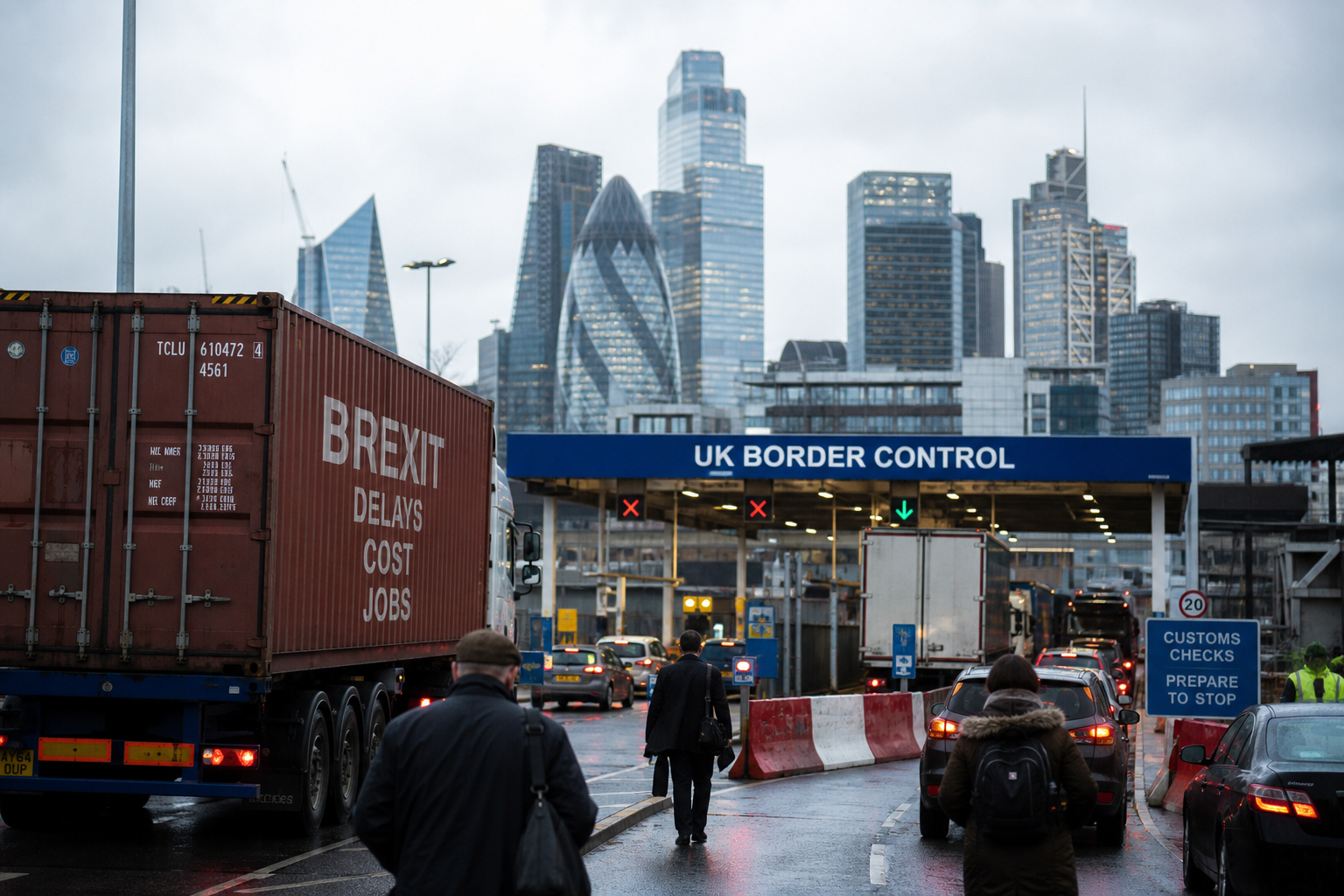
The article emphasizes that the damage is especially visible in goods trade, including cars and agri-food products, where new paperwork and customs requirements have made exporting more expensive and time-consuming. It highlights testimony from a logistics company owner who described the export process as “pure hell,” and notes that UK food exports to the EU have fallen by nearly a quarter since Brexit took effect. The piece also links Brexit to food price inflation, arguing that it has worsened pressures on lower-income households.
Beyond trade, the article frames Brexit as one factor among several that have held the UK back during a difficult decade marked by austerity, weak investment, slow growth, and underfunded public services. Economists quoted in the story say the broader economic damage is unlikely to disappear soon, and one predicts that the ongoing costs will continue at roughly their current level unless the UK negotiates a closer relationship with the EU and improves domestic policy. The overall message is that Brexit was a long-term economic setback whose effects are still unfolding.
Entities: Brexit, European Union, United Kingdom, UK economy, GDP • Tone: analytical • Sentiment: negative • Intent: analyze
23-06-2026
This NPR article marks the 10-year anniversary of Britain’s 2016 vote to leave the European Union and argues that Brexit has had deep, lasting consequences for British politics and governance. The piece says Brexit fractured not only the EU relationship but also Britain’s own party system, helping produce years of unstable leadership, internal party conflict, and public disillusionment. Since the referendum, the U.K. has cycled through multiple prime ministers, from David Cameron to Theresa May, Boris Johnson, Liz Truss, Rishi Sunak, and now Keir Starmer, each dealing with the fallout in different ways.
The article stresses that the promises made by Brexit campaigners — greater sovereignty, control over immigration, stronger trade, and more money for public services — collided with economic and political reality. Negotiations dragged on, the U.K. exited formally in 2020, and relations with the EU remain strained despite later attempts at a modest “reset.” At home, Brexit intensified divisions inside both Conservatives and Labour, while also helping fuel the rise of alternatives such as the Green Party and Nigel Farage’s Reform UK.
Beyond party politics, the article links Brexit to broader trends: slower economic growth, heightened immigration politics, lower trust in institutions, and rising cynicism. It also notes growing concern about anti-immigration violence and the erosion of norms separating political debate from street violence. Polls show many Britons now regret the decision and would favor rejoining the EU, but the article concludes that Brexit remains politically toxic and unresolved, leaving Britain in what one expert calls a continuing low-grade crisis.
Entities: Brexit, European Union, United Kingdom, Boris Johnson, David Cameron • Tone: analytical • Sentiment: negative • Intent: analyze
23-06-2026
The article argues that Brexit has imposed substantial and cumulative economic costs on the United Kingdom over the decade since the 2016 referendum, despite early warnings focusing on a more immediate shock. Economists cited in the piece generally agree that Britain’s economy is now meaningfully smaller than it would have been inside the European Union, with estimates ranging from 4% to 8% lower GDP relative to a counterfactual stay-in-EU scenario. The main mechanism has been reduced trade with the EU: even though tariffs largely remained at zero, new customs checks, paperwork, and regulatory barriers have raised friction, reducing exports and imports, especially in agriculture and food. The article also notes that business investment weakened amid prolonged uncertainty and that Brexit-related immigration changes have reshaped labor markets, creating labor shortages in sectors such as hospitality, food processing, and health and social care. While London remains Europe’s leading financial hub, some services and jobs have shifted to other cities such as Amsterdam and Dublin. The piece concludes that, with Britain still facing inflation, debt, and higher borrowing costs, interest in partially reversing Brexit’s effects has grown, but efforts to reset ties with Europe have so far made limited progress.
Entities: Brexit, United Kingdom, European Union, June 23, 2016 referendum, Keir Starmer • Tone: analytical • Sentiment: negative • Intent: inform