20-05-2026
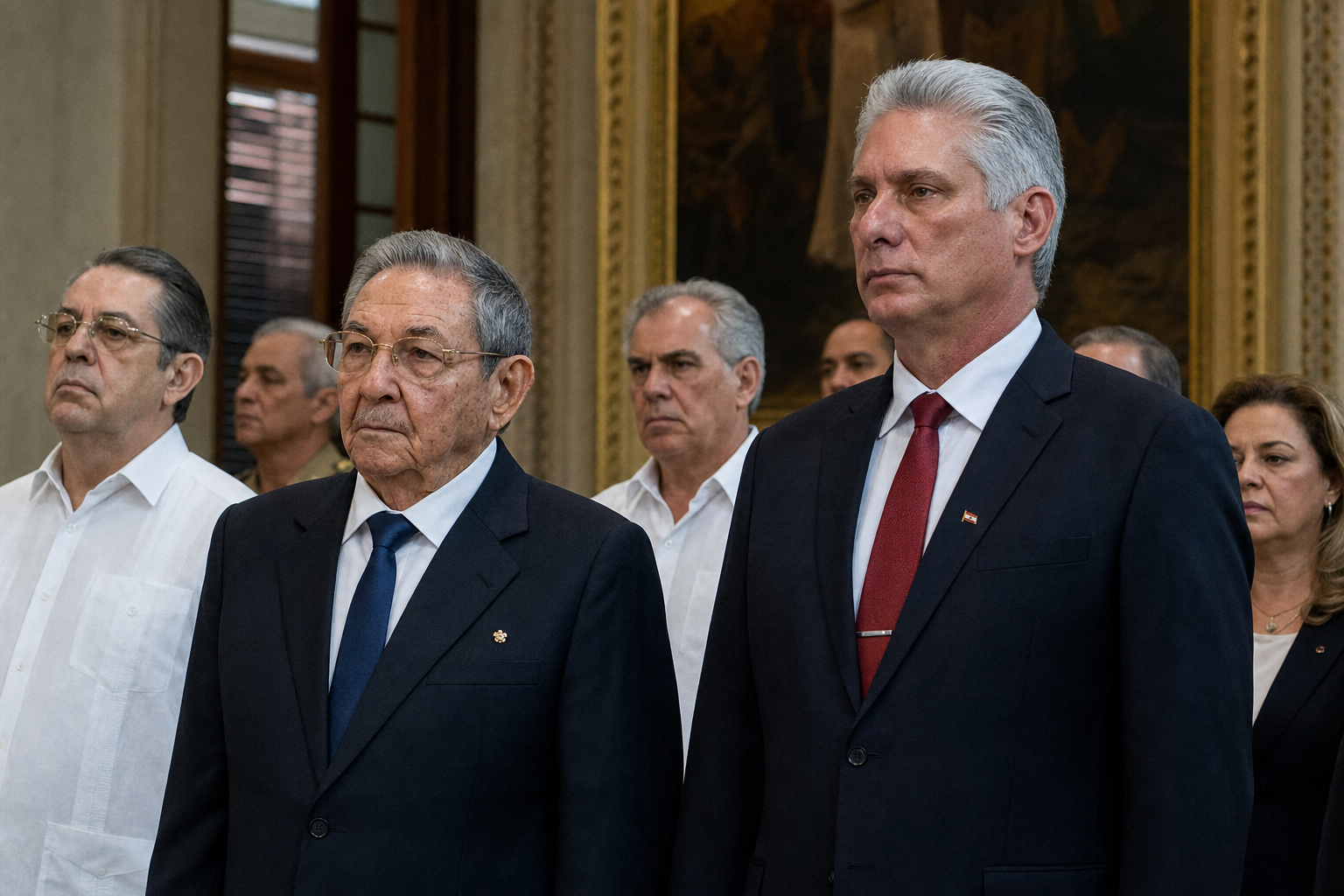
CBS News reports that, after the U.S. ousted Venezuelan leader Nicolás Maduro, President Trump has hinted that Cuba could be next and that Washington is looking for major political change there. The article focuses on the Castro family’s continuing influence in Cuba and identifies the main figures likely to matter in any transition. Raúl Castro, despite stepping down as president and Communist Party leader, is still portrayed as a central power broker because of his revolutionary legacy, his ties to the military, and his continued influence over decision-making. Miguel Díaz-Canel is the formal president and party leader, but experts quoted in the piece describe him as more of a loyal administrator than the real center of power. The article also highlights Oscar Pérez-Oliva Fraga, Raúl and Fidel Castro’s great-nephew and Cuba’s deputy prime minister and trade minister, as a potential future figure because he already holds government authority and has advanced limited economic openings, including allowing Cubans abroad to invest in businesses on the island. Another key figure is Raúl Castro’s grandson, Raúl Guillermo Rodríguez Castro, who serves as a bodyguard and adviser and is described as a gatekeeper to his grandfather, with some U.S. officials reportedly meeting him in recent months. The piece argues that any U.S. effort to influence Cuba may depend on finding an internal figure analogous to Venezuela’s Delcy Rodríguez, though analysts say Cuba lacks an obvious equivalent. Overall, the article frames Cuba’s leadership as still deeply intertwined with the Castro family even as the country faces potential U.S. pressure and possible political transition.
Entities: Cuba, Venezuela, Donald Trump, Nicolás Maduro, Raúl Castro • Tone: analytical • Sentiment: neutral • Intent: inform
20-05-2026
The article revisits the 1996 shootdown of two Brothers to the Rescue civilian planes by Cuban fighter jets, an incident that killed four people and sharply worsened U.S.-Cuba relations. The story has regained relevance because U.S. officials are taking steps to indict Raúl Castro, who at the time headed Cuba’s armed forces, over his alleged role in the events. Brothers to the Rescue was a Cuban exile organization founded by José Basulto and originally dedicated to searching for rafters fleeing Cuba, though Havana accused it of violating Cuban airspace and engaging in provocative political activity. Declassified records show U.S. officials had warned that unauthorized flights could provoke a lethal response, and international investigators later concluded that the planes were shot down over international waters, not inside Cuban airspace, and that Cuba did not attempt less drastic measures before firing. The article also recounts Cuba’s defense of the action, Fidel Castro’s later acknowledgment that he had given general orders to stop incursions, and the U.S. response, including new sanctions and harsh public condemnation from President Bill Clinton. It notes that the case previously led to criminal and civil proceedings in the U.S., and that renewed calls for accountability among Florida lawmakers and the Cuban American community come amid an already fraught moment in U.S.-Cuba relations, with the Trump administration intensifying economic pressure on the island.
Entities: Raúl Castro, Fidel Castro, José Basulto, Brothers to the Rescue, Cuba • Tone: analytical • Sentiment: neutral • Intent: inform
20-05-2026
CNN reports that the Justice Department is expected to indict former Cuban president Raúl Castro in a long-running case that prosecutors first began developing in the 1990s. The anticipated charges, to be announced in Miami, center on Castro’s alleged role as Cuba’s defense minister in the 1996 shoot-down of two civilian aircraft from the anti-Castro group Brothers to the Rescue, an attack that killed four people, including three Americans. The article explains that the case has roots in the post-Noriega era, when Miami prosecutors initially explored charges tied to allegations that Castro and other Cuban officials accepted cartel payments to protect drug shipments. Although the early effort stalled, the Brothers to the Rescue attack revived investigations into Cuban intelligence and government responsibility. The article traces how evidence gathered through the FBI’s investigation into the Wasp Network and related prosecutions helped sustain the case across decades. It also notes that the effort gained renewed momentum in Trump-era circles, with former prosecutors, Cuban-American activists, and officials like Secretary of State Marco Rubio revisiting the old memo and pushing for action. The expected indictment is framed not as a new idea, but as the culmination of a decades-old prosecutorial campaign that never fully disappeared from the files of federal investigators.
Entities: Raúl Castro, Fidel Castro, Todd Blanche, Marco Rubio, Jeff Sessions • Tone: analytical • Sentiment: negative • Intent: inform