20-05-2026
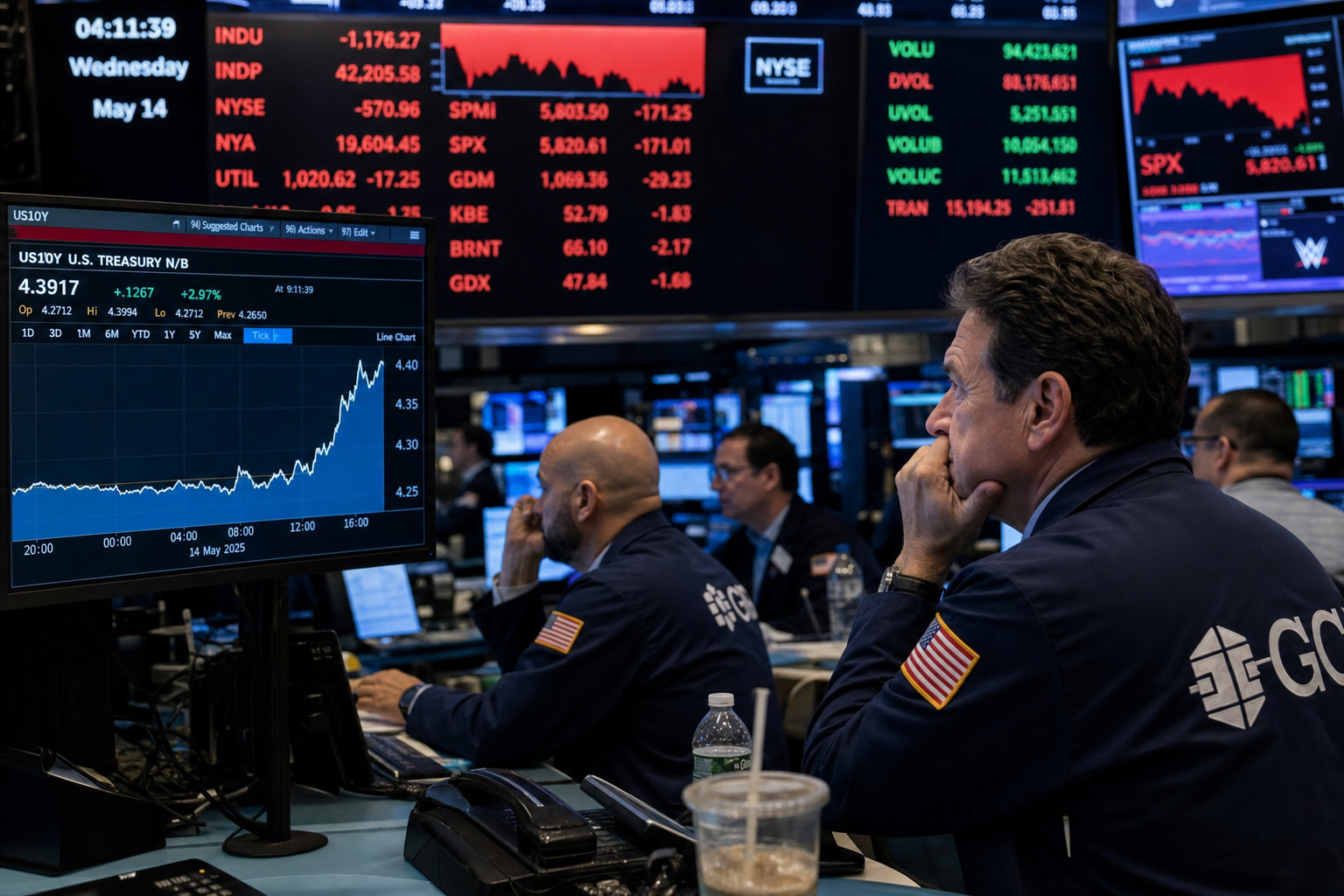
Asia-Pacific markets declined on Wednesday as investors grappled with a sharp rise in bond yields and fresh geopolitical uncertainty. The selling followed a turbulent U.S. session in which Treasury yields surged, with the 30-year Treasury briefly touching 5.197%, its highest level since July 2007, before easing slightly. The move in yields reflected renewed concern that inflation may be reaccelerating, prompting investors to dump longer-dated bonds and reevaluate risk across global markets.
The article also highlights pressure in Japan’s bond market, where long-term government bond yields had recently hit record highs before easing modestly on Wednesday. The 30-year Japanese government bond yield fell more than 3 basis points, while the 5-year yield climbed to a record 2.041%, signaling broader stress in Japan’s fixed-income market. State Street’s Masahiko Loo framed the move as part of a global “duration reset,” suggesting it would tighten financial conditions gradually rather than trigger systemic instability. He emphasized that Japan’s debt market remains largely domestically financed and supported by large household savings.
Asian equities mostly traded lower in response. Japan’s Nikkei 225 and Topix both fell, South Korea’s Kospi and Kosdaq declined, and Australia’s S&P/ASX 200, Hong Kong’s Hang Seng, and China’s CSI 300 also posted losses. Samsung Electronics dropped after wage talks collapsed, raising the prospect of a strike by more than 47,000 workers. U.S. stock futures were modestly higher, but Wall Street had already closed lower for a third straight session, with the S&P 500, Nasdaq Composite, and Dow all retreating as rising yields weighed on sentiment and threatened the broader bull market.
Entities: Asia-Pacific markets, U.S. Treasury yields, 30-year Treasury bond, Japan, Japanese government bonds (JGBs) • Tone: analytical • Sentiment: negative • Intent: inform
20-05-2026
European markets were set for a weak opening Wednesday as investors weighed several overlapping risks: elevated global bond yields, persistent inflation pressures, and geopolitical tensions involving Iran. Futures data indicated declines across major European benchmarks, with the U.K.'s FTSE 100 expected to open 0.6% lower, Germany's DAX down 0.7%, France's CAC 40 down 0.5%, and Italy's FTSE MIB down 0.4%. The cautious tone followed losses in Asia-Pacific markets and a rise in U.S. Treasury yields, including the 30-year yield climbing above 5.19%, its highest since 2007, and the 10-year yield moving toward 4.69%. In the background, geopolitical uncertainty intensified after President Donald Trump said he was close to authorizing an attack on Iran before delaying the decision. Investors were also awaiting U.K. inflation data later in the day, with April consumer prices expected to cool to 3% from 3.3% in March, helped by measures supporting household energy bills. The article also noted that Experian was due to report earnings. Overall, the piece frames the European session as one shaped by macroeconomic pressure, bond-market stress, and geopolitical risk.
Entities: European markets, Stoxx 600, FTSE 100, DAX, CAC 40 • Tone: analytical • Sentiment: neutral • Intent: inform
20-05-2026
U.S. stock futures were lower in early Wednesday trading as investors awaited Nvidia’s first-quarter earnings and the Federal Reserve’s April meeting minutes, both of which could shape near-term market sentiment. The market was coming off a difficult Tuesday session in which rising Treasury yields pressured equities, pushing the S&P 500, Nasdaq Composite, and Dow lower for a third straight day. Bond yields climbed sharply amid renewed concerns that inflation may be reaccelerating, with the 30-year Treasury yield briefly topping 5.19% and the 10-year yield reaching its highest level since January 2025. Nvidia was the center of attention because of its outsized influence on the market and on the AI trade; Goldman Sachs strategist Ben Snider emphasized that the chipmaker’s results matter not just for its own stock but as a signal of broader AI infrastructure demand. The article also notes several notable after-hours earnings moves, including gains for Toll Brothers, Cava, Red Robin Gourmet Burgers, and Keysight Technologies after each company reported results or guidance that beat expectations. Separately, Asia-Pacific markets fell as higher U.S. bond yields and rising geopolitical tensions involving Iran weighed on sentiment. In that region, Japanese, South Korean, Australian, and Hong Kong markets all declined, reflecting global investor caution.
Entities: S&P 500, Nasdaq Composite, Dow Jones Industrial Average, Nvidia, Federal Reserve • Tone: analytical • Sentiment: neutral • Intent: inform
20-05-2026
U.S. Treasury markets came under heavy pressure as long-term yields climbed sharply, prompting strategists to warn that bonds have entered a “danger zone” that could begin weighing on equities and other risk assets. HSBC said the rise in the 10-year Treasury yield, along with the 30-year yield moving above 5.19% and to its highest level since 2007, could force a broader repricing of markets if investors continue to adjust expectations for the terminal Fed funds rate. The move reflected concern that sticky inflation and hawkish rate expectations are not staying confined to the bond market. Although Treasury yields jumped, strategists noted that stocks have remained relatively resilient so far because corporate earnings have been strong, valuations had already partly adjusted before renewed Middle East tensions, and investors largely expect the conflict to affect oil more than the broader economy. Still, market observers said the recent levels are psychologically important. Interactive Brokers strategist Steve Sosnick characterized conditions as a “yellow alert,” warning that more stress could emerge if the 10-year yield approaches 4.65% or the 30-year reaches 5.5%. BMO Capital Markets’ Ian Lyngen added that a move toward 5.25% on the 30-year yield could trigger a more durable decline in equity valuations.
Entities: U.S. Treasurys, Treasury yields, 30-year Treasury yield, 10-year Treasury yield, HSBC • Tone: analytical • Sentiment: negative • Intent: inform
20-05-2026
CNBC’s Daily Open reports that global markets are increasingly being pressured by a sharp sell-off in government bonds, with rising Treasury yields pushing major stock indexes lower across the U.S., Europe, and Asia. The article notes that the 30-year U.S. Treasury yield climbed to 5.19%, its highest level in nearly 19 years, while the 10-year yield reached 4.687%, a level last seen in January 2025. HSBC strategists warned that U.S. Treasuries are in the “Danger Zone,” suggesting higher yields could weigh on a broad range of risk assets. That pressure is already visible in equities, as the S&P 500 and Nasdaq posted a third straight losing session and Asia-Pacific markets also traded lower.
Beyond markets, the newsletter highlights several geopolitical developments. Russian President Vladimir Putin and Chinese President Xi Jinping emphasized the deepening of mutual trust and strategic cooperation during a meeting in Beijing, with Putin inviting Xi to visit Russia next year. In the U.S., the Senate advanced a resolution aimed at halting military action in Iran, though the measure still faces additional legislative hurdles and a likely veto by President Donald Trump. The article also points to major corporate news centered on Nvidia, which is set to report earnings after the market close, with investors watching for updates on its AI infrastructure buildout and expansion in Singapore. The piece closes with a brief note on Vice President JD Vance defending Trump’s stock-trading disclosures, underscoring the broader political backdrop surrounding the day’s financial news.
Entities: bond market sell-off, U.S. Treasury yields, HSBC, S&P 500, Nasdaq • Tone: analytical • Sentiment: negative • Intent: inform