19-03-2026

Escalating Middle East Conflict and Global Implications

Date: 19-03-2026
Sources: cbsnews.com: 2 | foxnews.com: 1 | news.sky.com: 2
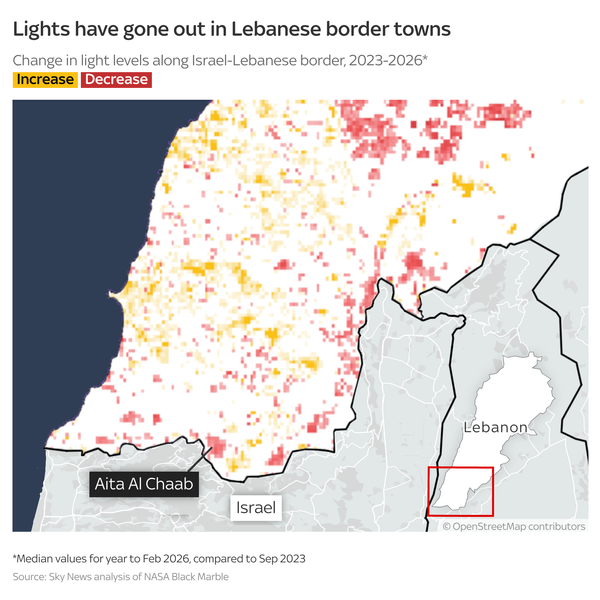
Image for cluster 16
Image Source:

Source: news.sky.com

Image content: The image presents a map illustrating the change in light levels along the Israel-Lebanese border between 2023 and 2026. * The main subject or scene shown is a map of the Israel-Lebanese border. + The map is labeled "Lights have gone out in Lebanese border towns" and subtitled "Change in light levels along Israel-Lebanese border, 2023-2026." + The map displays a color-coded representation of changes in light levels, with red indicating a decrease and yellow indicating an increase. + A key is provided to explain the color coding, with red representing a decrease and yellow representing an increase. * Visible people, objects, locations, or events include: + The countries of Israel and Lebanon. + The Aita Al Chaab town in Lebanon. + The Israel-Lebanese border. + A body of water, likely the Mediterranean Sea, to the west. * News-worthy elements or context identifiable from the

Summary

The conflict between Israel and Iran has intensified, with significant developments including the killing of top Iranian security official Ali Larijani in an Israeli airstrike, Iran's retaliatory missile strike near Tel Aviv, and Israel's ground operations in Lebanon. The European Union has rejected calls for military deployments to reopen the Strait of Hormuz, instead seeking diplomatic solutions. The conflict has raised fears of a regional war, potential disruptions to global energy supplies, and a humanitarian crisis in Lebanon.

Key Points

  • The European Union has rejected President Trump's calls for military deployments to reopen the Strait of Hormuz, opting for diplomatic solutions instead.
  • Top Iranian security official Ali Larijani was killed in an Israeli airstrike, which is seen as a significant blow to Iran's leadership and could harden attitudes within Tehran.
  • Iran retaliated with a missile strike near Tel Aviv, killing at least two people, and claimed responsibility for targeting central Israel to avenge Larijani's killing.
  • Israel has intensified its military campaign in Lebanon, resulting in over a million displaced people and 900 killed, with the IDF claiming to target Hezbollah's infrastructure.
  • The conflict has raised concerns over a regional war, potential disruptions to global energy supplies, and a humanitarian crisis in Lebanon.

Articles in this Cluster

European Union rejects Trump's calls for military deployments to reopen Strait of Hormuz - CBS News

The European Union has rejected President Trump's calls for military deployments to reopen the Strait of Hormuz, a vital shipping lane that has been disrupted due to the conflict between the US, Israel, and Iran. EU foreign policy chief Kaja Kallas stated that the EU would not put its people in harm's way and instead sought diplomatic solutions to keep the strait open. British Prime Minister Keir Starmer also declined to commit to specific assistance, emphasizing the need for a collective plan to restore freedom of navigation in the region. The US and Israel launched a war against Iran, causing a sharp rise in global energy prices due to the closure of the strait.
Entities: European Union, Donald Trump, Iran, Strait of Hormuz, United StatesTone: neutralSentiment: negativeIntent: inform

Iran's top security official, Ali Larijani, was killed in an airstrike. Here's why his death is so significant. - CBS News

Top Iranian security official Ali Larijani was killed in an Israeli airstrike, along with several others including his son. Larijani was a highly influential figure in Iran's government and security apparatus, having served as the head of the Supreme National Security Council, speaker of parliament, and chief nuclear negotiator. His death is significant as he was one of the few individuals who could manage both the military and political aspects of the ongoing conflict with Israel. The Israeli military confirmed the strike, stating that Larijani was 'eliminated.' The Iranian Supreme National Security Council also confirmed his death. Larijani's killing is seen as a major blow to Iran's leadership and could harden attitudes within Tehran, potentially complicating any future political resolution to the conflict.
Entities: Ali Larijani, Israel, Iran, Ali Khamenei, Morteza LarijaniTone: neutralSentiment: negativeIntent: inform

Aftermath of Iran missile strike near Tel Aviv caught on video | Fox News

The article reports on the aftermath of an Iranian missile strike near Tel Aviv, Israel, which killed at least two people. The strike was part of a rapidly escalating conflict between Iran and Israel, which began in late February following US and Israeli strikes on Iran that killed multiple senior Iranian officials. Iran's Revolutionary Guard claimed responsibility for the missile launch, stating it targeted central Israel to avenge the killing of Ali Larijani, a high-ranking Iranian official. The conflict has raised fears of a regional war and potential disruptions to global energy supplies, with Iran threatening to disrupt shipping through the Strait of Hormuz.
Entities: Iran, Israel, Tel Aviv, Ramat Gan, Ali LarijaniTone: neutralSentiment: negativeIntent: inform

Did America and Israel just ramp up the war in the Middle East? | World News | Sky News

The article discusses the recent escalation of the war in the Middle East, with a focus on the involvement of America and Israel. The podcast 'The World with Richard Engel and Yalda Hakim' examines the latest developments in Iran, the killing of Ali Larijani, and Israel's ground operations against Hezbollah in southern Lebanon. The hosts assess the reaction of Gulf states to the war and the potential impact of deploying troops on the ground.
Entities: America, Israel, Iran, Donald Trump, Ali LarijaniTone: analyticalSentiment: neutralIntent: inform

Inside Lebanon: Strikes, displacement and Israeli troops | World News | Sky News

The article reports on Israel's intensified military campaign in Lebanon, resulting in over a million displaced people and 900 killed. Israel has launched hundreds of strikes across Lebanon, mainly in the south, and has ordered the evacuation of areas south of the Zahrani river. The Israeli Defense Forces (IDF) claim they are targeting Hezbollah's infrastructure, but human rights experts argue that the tactics could be illegal. The IDF has also announced plans to strike remaining bridges across the Litani river, which they claim are being used by Hezbollah. Israeli officials have stated that displaced individuals will not be allowed to return until Hezbollah's infrastructure is dismantled and the safety of northern Israel is guaranteed. The article highlights concerns over the humanitarian crisis, with many experiencing displacement for the second time since 2024.
Entities: Lebanon, Israel, Hezbollah, IDF (Israeli Defense Forces), BeirutTone: neutralSentiment: negativeIntent: inform