18-10-2026
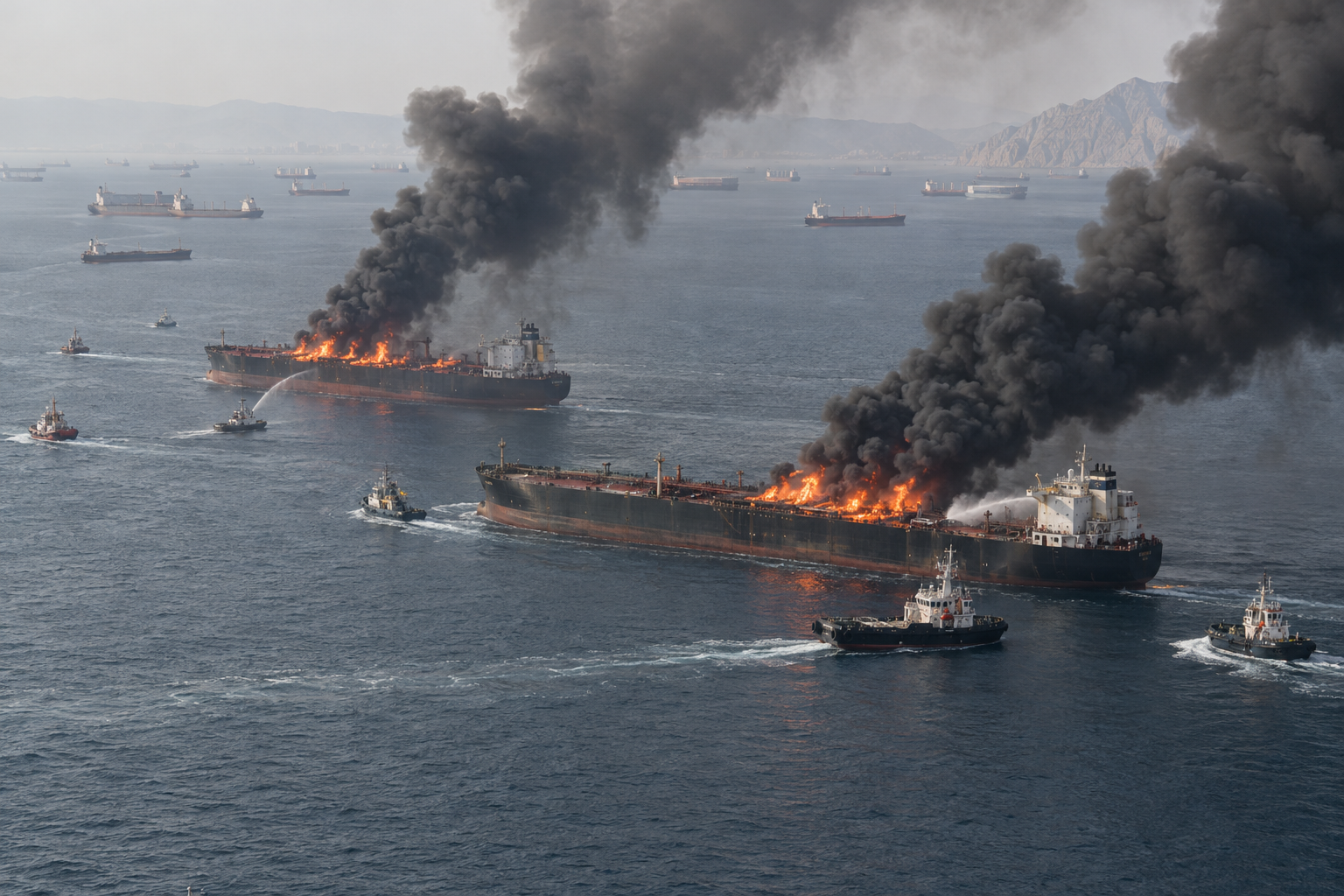
Iran’s Islamic Revolutionary Guard Corps (IRGC) says two oil tankers, each carrying about two million barrels of crude, caught fire after striking naval mines in the Strait of Hormuz. According to Iran’s official IRNA news agency, one vessel suffered an explosion and a “fierce fire,” while the other was engulfed in a “massive blaze.” The ships’ names and the origins of their cargo were not immediately known. IRNA said the tankers had turned off positioning and radar systems and attempted to take a route Iran had not authorised. The IRGC claimed one tanker tried to cross with US support, while the other was immobilised. These claims were reported amid competing maritime restrictions: Iran has demanded that ships obtain its approval to transit the strait, while the United States has imposed a naval counter-blockade on Iranian oil exports. Iran’s army had previously reported two tankers burning in a “prohibited zone” in the Gulf of Oman. The incidents are part of a broader rise in attacks around the waterway. Maritime monitors reported two tankers struck off Saudi Arabia, and six vessels were attacked in or near the strait on a single day the previous Sunday, the highest daily total since the war began, according to cited monitoring and maritime organizations. Iran says it has increased strikes in response to the US blockade and tougher sanctions. The disruption has sharply reduced oil flows: Kpler data showed 20.8 million barrels passed through on October 8, compared with 2.9 million on October 11. The article says the disruption has raised global energy prices and inflation. It also reports that US President Donald Trump ruled out using nuclear weapons and said he was not considering sending ground troops to Iran, while predicting a deal could follow the November 3 US midterm elections.
Entities: Islamic Revolutionary Guard Corps (IRGC), IRNA, Strait of Hormuz, Gulf of Oman, Iran • Tone: analytical • Sentiment: negative • Intent: inform
18-10-2026
Iranian Foreign Minister Abbas Araqchi said on Sunday that Tehran’s proposal for reopening the Strait of Hormuz within seven days remains available to the United States. Iran submitted the proposal in mid-September, after an interim ceasefire collapsed. Although Tehran received a US response, an Iranian security official said negotiations had stalled because Washington had not addressed all seven Iranian conditions.
Araqchi said the conditions include lifting the US blockade on Iranian ports, removing sanctions on Iran’s oil exports, and ending hostilities across regional fronts. He argued that if the United States accepted the terms, the strait could reopen within six days, with negotiations resuming the next day. He also questioned whether Washington was acting honestly.
A key disagreement is the timing of discussions about Iran’s nuclear programme. The United States wants the issue addressed from the outset. Vice President JD Vance has said Iran must make a “meaningful” reduction in its uranium-enrichment capacity to meet US demands and end the countries’ eight-month war. Tehran, by contrast, says initial negotiations should prioritize reopening the waterway and restoring its security.
The dispute has implications for international energy trade: before the war, the Strait of Hormuz carried about one-fifth of global oil and liquefied natural gas trade. Araqchi made his remarks in Baghdad, where he was attending a meeting of the Organisation of Islamic Cooperation.
Entities: Abbas Araqchi, JD Vance, Iran, United States, Strait of Hormuz • Tone: analytical • Sentiment: neutral • Intent: inform
18-10-2026
Iranian Foreign Minister Abbas Araqchi says Tehran’s offer to reopen the Strait of Hormuz remains available, but only if the United States accepts Iran’s conditions. Speaking to Iranian media in Baghdad during an Organisation of Islamic Cooperation meeting, Araqchi said Iran was reviewing Washington’s response and accused the US of lacking the honesty needed to reach an agreement. He said the strait could reopen within six days of US acceptance, with negotiations resuming the next day. Iran first presented its seven-day proposal in mid-September, after an interim ceasefire collapsed. Iranian officials say talks have stalled because the US has not addressed all seven conditions.
Iran’s demands include lifting the US blockade on Iranian ports, removing sanctions on Iranian oil exports, and ending hostilities across all regional fronts. The US wants Iran’s nuclear programme addressed from the start of negotiations; Tehran instead wants the initial focus to be reopening the strait and restoring maritime security. The disagreement matters to global trade because the waterway carried about a fifth of the world’s oil and liquefied natural gas before the war. US Vice President JD Vance has said Iran must meaningfully reduce its uranium-enrichment capacity.
Araqchi accused Washington of undermining diplomacy through military and economic pressure, while saying Iran would not accept coercion but remained open to dialogue with mutual respect and credible guarantees. He also met Iraqi Prime Minister Ali al-Zaidi. Iranian Deputy Foreign Minister Saeed Khatibzadeh said hostilities must end on all fronts for lasting peace.
Separately, US President Donald Trump predicted the war would end “very quickly” and said energy costs for American consumers would fall afterward. Speaking at a Kentucky campaign rally, he defended US strikes on Iranian targets and claimed they had damaged Iran’s nuclear capabilities. The article concludes that the two governments remain divided over both the order and terms of negotiations.
Entities: Abbas Araqchi, Donald Trump, JD Vance, Saeed Khatibzadeh, Ali al-Zaidi • Tone: analytical • Sentiment: neutral • Intent: inform
18-10-2026
Iran’s Revolutionary Guards said two oil tankers caught fire in the Strait of Hormuz on Saturday after striking naval mines. The Guards described the vessels as “offending” or violating regulations and said each carried more than two million barrels of crude oil. They alleged that one tanker was trying to cross the strait illegally with US support while disabling its tracking systems. The Guards did not identify the ships’ flags, the origins of their cargo, or the precise location of either incident, and the report does not independently verify their account. The Guards also released a nighttime video showing a vessel on fire.
Iran took control of the strategically important strait after a war began in late February, disrupting a waterway that ordinarily carries about one-fifth of global oil consumption. Tehran has required ships to obtain its authorization before transiting. The strait, bordered by Iran to the north and Oman to the south, is about 30 kilometres wide at its narrowest point. Iran’s army had also reported fires aboard two tankers on Thursday and Friday in what it calls a prohibited zone in the Gulf of Oman, extending into the Arabian Sea.
The article also reports Houthi media claims that Saudi airstrikes in Yemen killed at least 12 people, including three children. Houthi sources said strikes on civilian homes in Taiz governorate killed nine and injured 16, while overnight strikes in Dhamar province killed three children and wounded 17. They alleged that cluster bombs, which they said are internationally banned, were used. These casualty and weapons claims are attributed to Houthi media and are not independently confirmed in the article.
Entities: Iran’s Revolutionary Guards, Iran, Strait of Hormuz, Oman, Gulf of Oman • Tone: neutral • Sentiment: negative • Intent: inform