18-07-2026
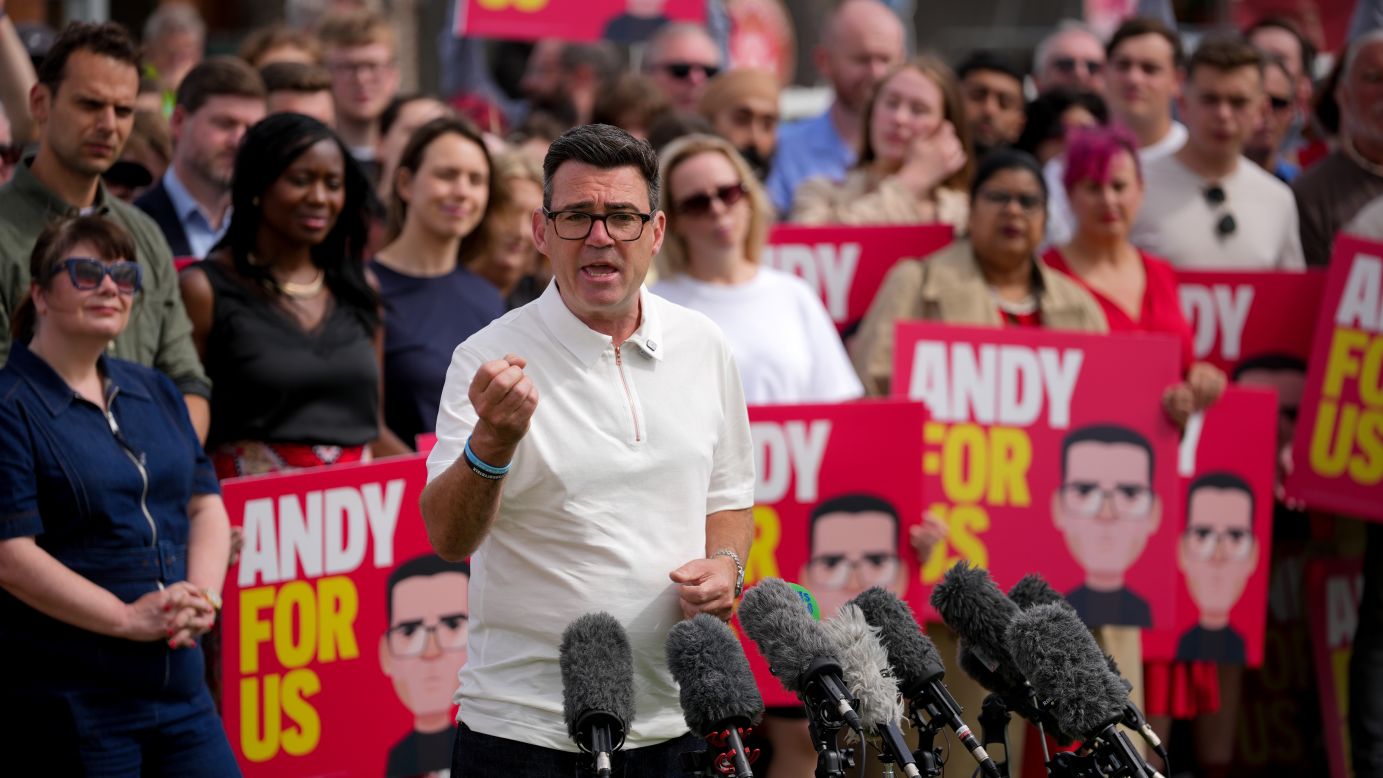
Andy Burnham has been officially declared leader of Britain’s governing Labour Party, removing the last obstacle to becoming prime minister on Monday after Keir Starmer formally resigns. Burnham was effectively unopposed in the leadership contest, having secured support from the vast majority of Labour lawmakers in the House of Commons. In his first remarks as leader, he struck an optimistic tone, promising to “give them hope back” and saying he is ready for the role.
The article explains that Starmer’s departure follows weeks of mounting pressure after a poor set of local election results in May and internal political strain within Labour. Burnham, formerly the mayor of Greater Manchester, is presented as a less formal and more communicative figure than Starmer, but one who will inherit many of the same difficulties, including a weak economy, persistent cost-of-living pressures, and overstretched public services. He has not yet detailed a full policy platform, though he has emphasized economic renewal, greater public control of key sectors, and more even distribution of growth across the country.
Burnham also signaled that social care will be a priority, calling attention to the patchy system for older people and those with illness or disabilities. The article additionally notes his previous criticism of Donald Trump, linking his warnings about political instability and polarization in the U.S. to broader concerns about democratic and social fragmentation. Overall, the piece frames Burnham’s rise as a major political transition for the U.K., while emphasizing uncertainty about how he will govern once in office.
Entities: Andy Burnham, Keir Starmer, Labour Party, House of Commons, King Charles III • Tone: analytical • Sentiment: neutral • Intent: inform
18-07-2026
The article explores why many in Britain are looking to Andy Burnham, the former mayor of Greater Manchester, as a possible political and economic catalyst as he becomes Labour leader and is set to replace Keir Starmer as prime minister. It argues that Burnham’s appeal comes from a mix of charisma, pragmatic politics, and his association with Manchester’s widely praised urban revival. Manchester is presented as a case study in how long-term planning, political stability, and cooperation between government and business can transform a struggling industrial city into a vibrant destination for investment, culture, hospitality, and young talent.
The article contrasts Manchester’s renaissance with Britain’s broader stagnation: slow living-standard growth, strained public services, political instability, and a lack of national optimism. Burnham’s “Manchesterism” — described as business-friendly, locally empowered social democracy — is framed as an attempt to scale that model nationally. The piece highlights visible signs of Manchester’s success, including its booming café and hospitality scene, strong cultural institutions like Aviva Studios, and major investment from companies and institutions. It also notes that Burnham is credited with improving public transport and fostering a sense of momentum.
At the same time, the article tempers the optimism by noting that not all parts of Greater Manchester have benefited equally and that deprivation remains high in some areas. The central argument is that Manchester proves change is possible, but also that progress requires patience, stable leadership, and sustained strategy over many years rather than quick political fixes.
Entities: Andy Burnham, Keir Starmer, Labour Party, Greater Manchester, Manchester • Tone: analytical • Sentiment: neutral • Intent: analyze
18-07-2026
The article reports that Andy Burnham, former Greater Manchester mayor and a frequent critic of Donald Trump, is positioned to become the next U.K. prime minister after emerging as the only viable candidate to replace Labour leader Keir Starmer. According to the article, Burnham secured nominations from 322 of Labour’s 403 MPs on the first day of the leadership process, far exceeding the threshold needed to enter the contest and effectively clearing the field of rivals. The piece explains that under Britain’s parliamentary system, the governing party can replace its leader — and thus the prime minister — without calling a general election, though the next nationwide vote is not required until 2029.
The article also highlights criticism from opponents and analysts who argue that Burnham has not been subjected to the level of public scrutiny normally associated with becoming prime minister. Commentators cited in the article say he has not faced a general election as party leader and has not been forced to set out his positions in a full leadership contest. Reform UK leader Nigel Farage is quoted saying Burnham would enter office without a public mandate and that the country should instead have a fresh general election.
The article then provides background on Burnham’s political career, noting that he grew up in northwest England, studied at Cambridge, entered Parliament in 2001, and served in senior Labour roles including culture secretary and health secretary. It also recounts his previous failed Labour leadership bids in 2010 and 2015, his later tenure as mayor of Greater Manchester, and his work on regional transport reform and Hillsborough-related justice campaigns. The piece frames Burnham as a consequential but polarizing figure who could rise rapidly to national power amid political turmoil.
Entities: Andy Burnham, Keir Starmer, Donald Trump, Labour Party, British Parliament • Tone: analytical • Sentiment: neutral • Intent: inform