17-10-2026
The article reports that France is facing a new wave of nationwide protests involving students, unions and Yellow Vest activists. The demonstrators are rallying over high prices and inequality. The report connects the current mobilization to weeks of marches led by students and says authorities fear further unrest. That concern follows recent clashes, which the article describes as among the most violent in decades. The article does not specify the locations, size of the demonstrations, government response or particular incidents, so it provides only a brief overview of the situation. Published on October 17, 2026, the news item focuses on the scale and causes of the protests, alongside the risk of escalating unrest.
Entities: France, Students, Unions, Yellow Vest activists, Nationwide protests • Tone: urgent • Sentiment: negative • Intent: inform
17-10-2026
France is bracing for nationwide demonstrations as a student-led protest movement expands and may be joined by trade unions, teachers, university students and activists from the “yellow vest” movement. The protests began in September at a high school in Créteil, where students objected to deteriorating buildings, overcrowded classrooms, teacher shortages and inequality in education. Their concerns have since broadened amid economic stagnation, fiscal pressure and wider dissatisfaction with public services and living standards.
The article describes a tense and uncertain situation ahead of Saturday’s demonstrations. Authorities say more than 900 police officers have been injured since the protests began, while critics argue that violent acts by a minority risk eclipsing the wider movement’s grievances. The government has also been criticized for detaining thousands of minors and using force against young protesters. Reports say more than 6,700 children have been taken into police custody; two teenagers sustained severe injuries, one losing a hand and another losing his sight. Although stun grenades were suspended for student protests, the interior minister said police could use them in cases of “urban violence.”
The government has announced measures including scrapping planned increases to some higher-education fees, promising substitute teachers and surveying students. Educators interviewed by the article say these steps do not address structural inequality or the distribution of education funding. Students’ worries also reflect doubts that school qualifications will lead to stable work or social mobility, alongside poor performance in recent international assessments.
These protests arrive as Prime Minister Sebastian Lecornu’s government tries to reduce a large deficit and public debt with a 2027 budget that includes spending restraint, a public-sector pay freeze and limits on pension increases. The debate revives tensions over France’s welfare state and public services, already evident in the mass protests against Macron’s retirement-age reform. With parliament deeply divided and the 2027 presidential election approaching, the government faces the challenge of making savings without further eroding public confidence.
Entities: France, Paris and Créteil, Yellow vest movement, French student protests, Emmanuel Macron • Tone: analytical • Sentiment: negative • Intent: analyze
17-10-2026
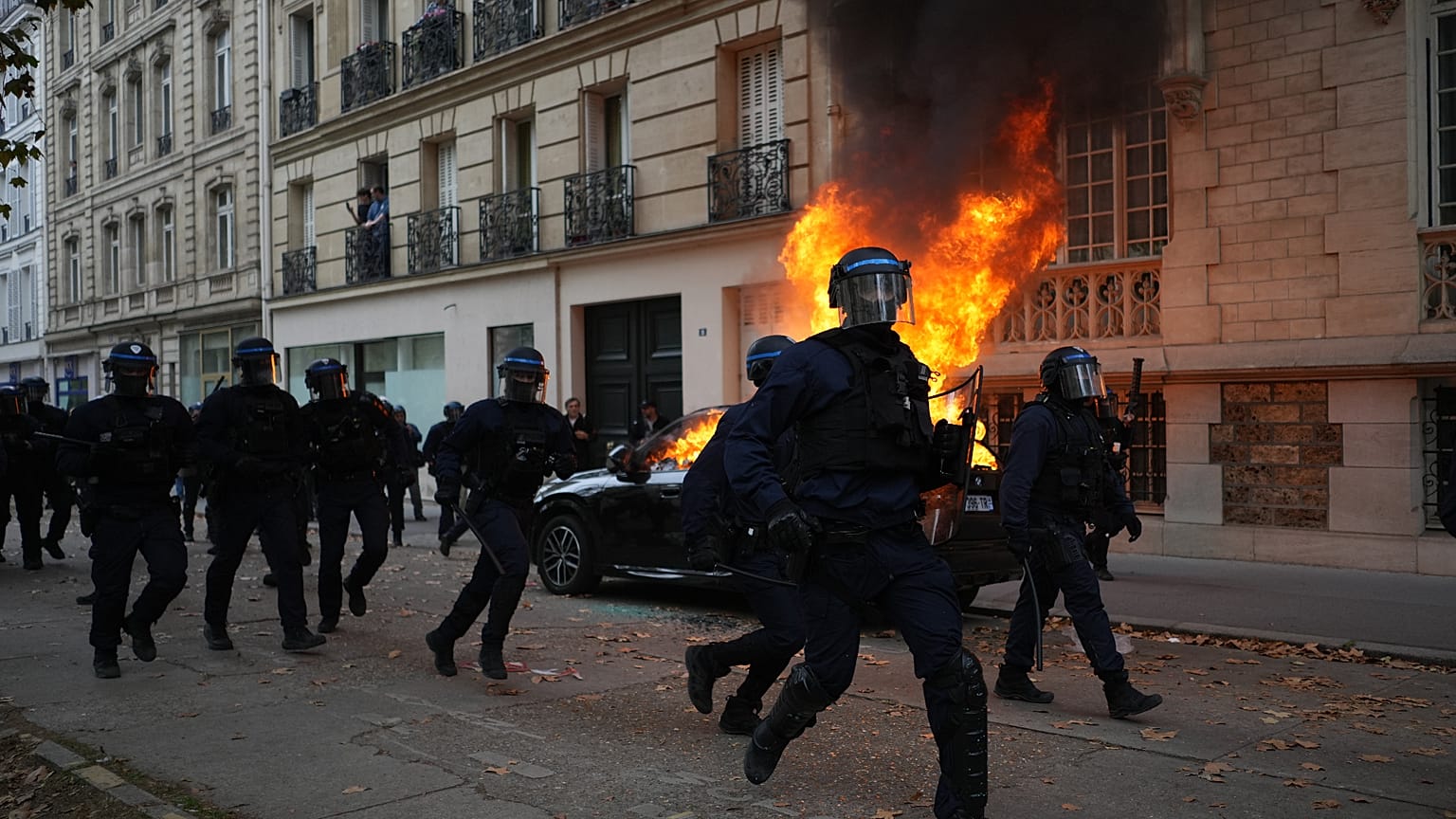
Protests took place across France on Saturday against rising living costs and in support of high school students whose demonstrations have been underway since mid-September. In Paris, clashes broke out between police and some protesters at Place de la République. Police used tear gas against masked or hooded people who threw fireworks and other objects, and authorities deployed large numbers of riot police. The demonstrations were promoted on social media as an effort to revive the “yellow vest” movement, which began in 2018 in response to social injustice. Student groups and the CGT labor union also urged participation; the union called for higher wages and pensions, lower prices, and protection of public services.
Interior Minister Laurent Nuñez’s office reported 140 protest actions outside the Paris region by midday, involving more than 30,000 people, and at least 166 arrests nationwide. Officials cited violence in several cities, including attempted looting, attacks on police, fires, and targeting of government institutions and media outlets. In Marseille, businesses and a municipal police station were damaged, and protesters briefly entered City Hall’s lobby. Mayor Benoît Payan characterized the damage there as limited.
President Emmanuel Macron called for calm, affirming the right to protest while emphasizing respect for people and property. Authorities prohibited some gatherings in central Paris, and many metro stations were closed at police request. The demonstrations unfolded amid weeks of student protests that have brought thousands of arrests, hundreds of injuries, and school fires, and have influenced France’s presidential election campaign. Concerns have also grown over injuries caused by police crowd-control weapons; Nuñez suspended use of a type of stun grenade after a 15-year-old lost a hand. Climate and social justice activist Greta Thunberg joined students at a Saint-Denis high school on Tuesday.
Entities: France, Paris, Place de la République, Yellow vest movement, High school student protests • Tone: analytical • Sentiment: negative • Intent: inform
17-10-2026
France is facing nationwide protests on Saturday, with more than 600 demonstrations planned, as students, trade unionists and others voice concerns about high prices, social inequality and the condition of public schools. The rallies follow weeks of student demonstrations that began over teacher absences and deteriorating school facilities. Police estimates cited in the article suggest nearly 200,000 people could attend, including about 40,000 in Paris.
Authorities have imposed restrictions on demonstrations in the capital, banning rallies near the presidential palace, the prime minister’s office and the Champs-Elysees, as well as a march through the city center. The main Paris march was scheduled to start at Place de la Republique and move north. Clashes were reported in Saint-Denis and near Gare du Nord, while police used tear gas in Paris and Marseille. Fires were set in Marseille, where protesters also targeted a police station.
Prime Minister Sebastien Lecornu warned of possible violence, describing the country as fatigued and facing a “perma-crisis” involving wars, inflation and pressure on purchasing power. National Rally leader Jordan Bardella also predicted clashes and called the prospect a day of chaos. Earlier school protests had already resulted in injuries to protesters and more than 900 police officers. One pupil was severely injured by a stun grenade, and the police watchdog is investigating at least two dozen alleged cases of police violence.
The protests bring together students, union members and people associated with the Yellow Vests movement, whose demonstrations began in 2018 over fuel prices and broadened to address the cost of living and inequality. France Unbowed leader Jean-Luc Melenchon has supported the student protests. The government has accused his party of aggravating public discontent; the party denies the charge.
Entities: France, Emmanuel Macron, Sebastien Lecornu, Laurent Nunez, Jordan Bardella • Tone: neutral • Sentiment: neutral • Intent: inform
17-10-2026
France deployed thousands of police officers and riot units ahead of nationwide demonstrations on 17 October, amid fears that protests over the cost of living and rising fuel prices could turn violent. Trade unions, people identifying with the Yellow Vest movement, and students took part. Students also demanded improvements to education, including better classrooms, facilities, staffing, and access to resources. In Paris, dozens of people were detained after clashes with security forces. In Marseille, masked protesters broke into the city hall, and bins were set alight; businesses boarded up storefronts in anticipation of possible vandalism or looting. Authorities expected hundreds of actions and around 90 protests nationwide, and warned that attempts to breach security perimeters or block essential routes would not be tolerated. President Emmanuel Macron affirmed the right to protest while calling for respect for people and property. The demonstrations follow weeks of student protests, most of which have been peaceful, though some have involved clashes and allegations of police brutality. Those allegations have drawn scrutiny after two young people reportedly suffered severe injuries involving police weapons. France suspended certain stun grenades, but Interior Minister Laurent Nuñez said they could be used if serious urban violence occurred. He also reported that 36 investigations into alleged police violence had been opened. Prime Minister Sébastien Lecornu cited injuries among police, students, and teachers, while warning that student protests were becoming a wave of urban violence. A major police union said it would file a complaint against the state, alleging that contradictory orders had exposed officers to danger. The article also situates the demonstrations amid the possible return of the Yellow Vest movement, France’s public debt crisis, and a divisive political debate over protest tactics. Hard-left party France Unbowed and its leader Jean-Luc Mélenchon have faced accusations of encouraging unrest, though Mélenchon later said he supported peaceful protest.
Entities: Paris, Marseille, France, Emmanuel Macron, Laurent Nuñez • Tone: analytical • Sentiment: negative • Intent: inform
17-10-2026
France faced nationwide protests over the cost of living on Saturday, October 17, 2026, as authorities detained dozens of people at the start of the demonstrations. The brief France 24 report presents the protests as both a response to economic pressures and a potential measure of the country’s broader social climate. It notes that the demonstrations come as France approaches elections to replace President Emmanuel Macron, making public reactions to the protests politically significant. The report does not provide further details about the number or locations of demonstrations, the circumstances of the detentions, the groups organizing the protests, or the specific cost-of-living concerns motivating participants. It also does not describe the authorities’ response beyond the arrests. France 24 correspondent Antonia Kerrigan provides additional reporting in the video, but the supplied article text contains no further quotations or details from her account. The available text therefore establishes the central facts—the start of nationwide cost-of-living protests, dozens detained, and the approaching succession elections—without offering enough information to assess the scale of the demonstrations or their likely political impact. Its framing emphasizes that the protests may serve as an indicator of France’s social climate ahead of the elections, rather than drawing a conclusion about what the demonstrations mean. The report is presented as a short news video issued at 13:47 on October 17, 2026.
Entities: France, French authorities, Antonia Kerrigan, France 24, Emmanuel Macron • Tone: analytical • Sentiment: neutral • Intent: inform
17-10-2026
France 24 reports that tens of thousands of people were expected to demonstrate across France on Saturday, October 17, 2026, protesting the rising cost of living. Students, trade union members, and people associated with the Yellow Vest movement were joining forces. In Paris, Marseille, and Lyon, police used tear gas and batons in attempts to clear protesters from streets. Demonstrators held unsanctioned marches and tried to block traffic using improvised barricades. The article’s image caption describes a protester looking at Lyon’s tourism office after it was set on fire during a demonstration. The report identifies clashes in several cities, but the supplied page contains no further live updates: after the introductory report and keywords, it displays a notice that the requested content is unavailable. Consequently, the available text does not provide details about arrests, injuries, the scale of damage, government responses, or how the demonstrations developed. The article frames the protests as a convergence of student, union, and Yellow Vest participants around concerns about living costs, while describing confrontations between demonstrators and police. It is a short liveblog introduction rather than a complete account of the day’s events.
Entities: France, Paris, Marseille, Lyon, FRANCE 24 • Tone: neutral • Sentiment: negative • Intent: inform
17-10-2026
France 24 reports that tens of thousands of people are expected to take part in protests across France on Saturday, October 17, 2026. The anticipated demonstrations bring together students, trade unionists and people associated with the Yellow Vest movement. According to the article, participants are protesting high prices and what it describes as the country’s “fraying social model.” The report presents the planned demonstrations as a convergence of several groups and movements, rather than an event led by one organization alone.
The article gives only a brief account of the expected protests. It does not provide details about the planned routes, locations, organizers, specific demands, police preparations or any incidents during the demonstrations. Its wording describes the Yellow Vest participants as “remnants” of the movement, suggesting that the movement continues to have a presence but is not necessarily represented at its earlier scale. The page also lists related coverage, including reports about France preparing for protests and the Yellow Vests joining students, but those headlines are not additional reporting within this article.
Overall, the report informs readers about the expected scale and composition of the protests and identifies the economic and social concerns behind them. Because the demonstrations are described as upcoming, the article reports expectations rather than confirmed attendance or outcomes.
Entities: France, Students, Trade unionists, Yellow Vest movement, Tens of thousands of expected protesters • Tone: analytical • Sentiment: neutral • Intent: inform
17-10-2026
French police fired tear gas at demonstrators in Paris protesting rising prices and what they see as the erosion of France’s social model, including the social protections and opportunities it is intended to provide. Clashes were also reported in Marseille, where protesters threw projectiles at police and officers responded with tear gas. Demonstrations were expected in cities across the country, with tens of thousands anticipated to join a nationwide movement focused on soaring fuel prices and the broader cost-of-living crisis.
The protests began last month among high-school students in poorer northern suburbs of Paris. Initial frustration over teacher shortages and deteriorating school facilities developed into a wider campaign addressing inequality, inadequate public spending and declining standards. In central Paris, police maintained a substantial presence around prominent sites, including the Champs-Elysees and the Arc de Triomphe; both were excluded from the routes assigned to the two official demonstrations.
Prime Minister Sebastien Lecornu said authorities feared unrest. The government accused the hard-left France Unbowed party of inflaming the protests, an allegation the party denies. The report describes demonstrations combining economic grievances with concerns about public services and the country’s social welfare system, alongside episodes of confrontation with police.
Entities: France, Paris, Marseille, Champs-Elysees, Arc de Triomphe • Tone: neutral • Sentiment: negative • Intent: inform