16-09-2026
Prime Minister Mark Carney is presenting Canada as a stable “safe harbour” for major global investors amid geopolitical uncertainty, economic disruption and an escalating trade dispute with the United States. He has set a goal of attracting C$1tn in investment over the next five years, partly to reduce Canada’s dependence on the US and build stronger economic links with Europe, Asia and the Middle East.
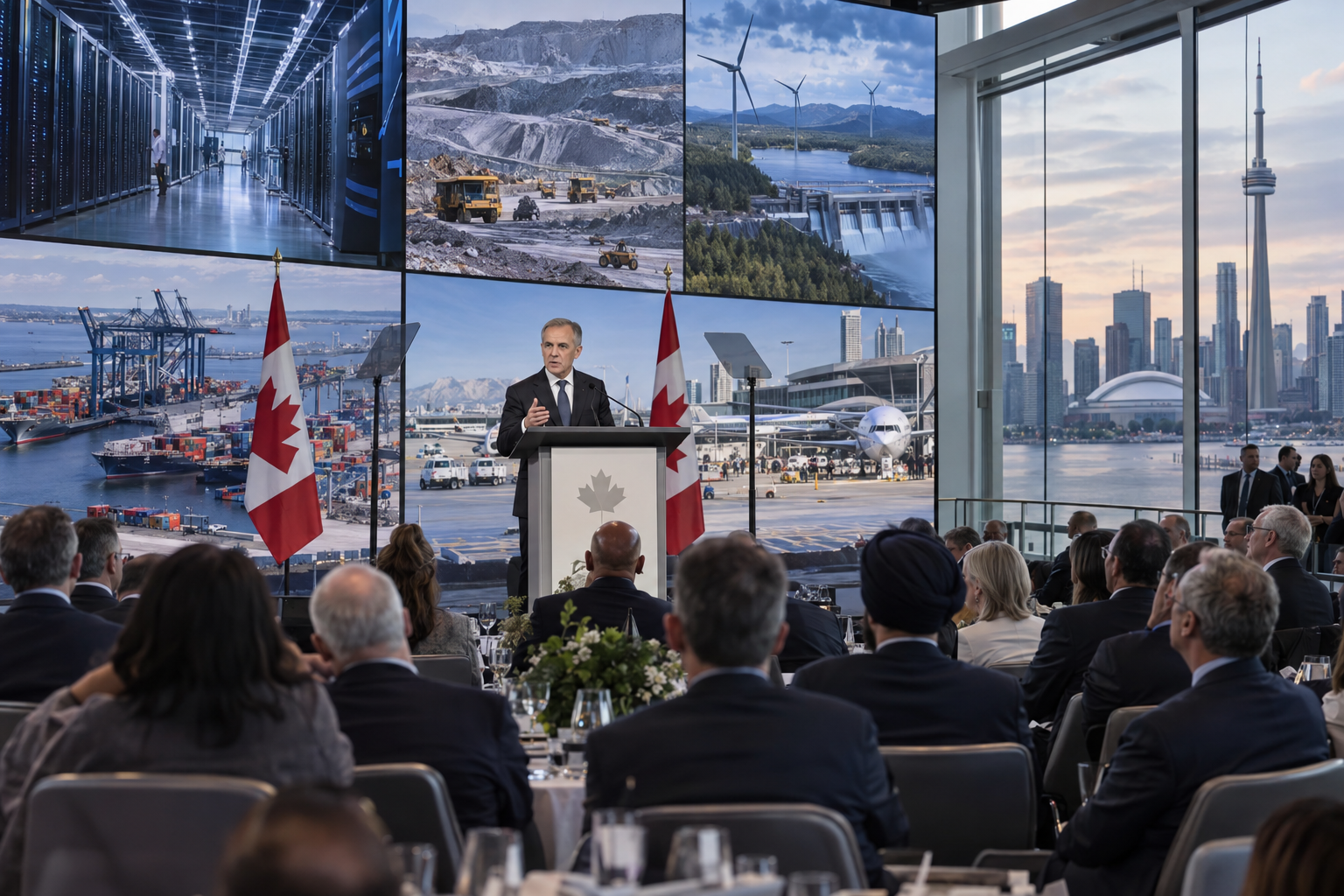
At a Toronto investment summit attended by more than 100 major investors, the Canadian government promoted over 160 potential projects, including data centres, pipelines and port expansions. Ottawa also highlighted new tax incentives and promised faster, more predictable approval processes, potentially completing reviews within a year. Carney held meetings with senior executives from BlackRock and Blackstone, while analysts said Canada must improve its tax, regulatory and labour-market conditions to remain competitive.
A major announcement was a plan to permit private investment in the operations of four major airports in Toronto, Vancouver, Montreal and Calgary. The government says this could raise billions for transport infrastructure, but labour unions and other critics called the plan privatization and warned it could harm workers, passengers and public ownership.
The summit reportedly generated nearly C$500bn in new investment commitments or interest, with artificial intelligence infrastructure attracting particular attention. Canada’s cold climate, available land and relatively clean electricity grid were presented as advantages for data-centre development.
Although Carney has taken a firm position against the US in the trade dispute, he also offered American investors a conciliatory message, emphasizing Canada’s enduring relationship with its neighbour. At the same time, protests accused his government of selling public assets to corporate and American interests. Carney’s next step is a trip to Europe, where he plans to pursue a broader economic and security partnership with the European Union while maintaining close ties with the US.
Entities: Mark Carney, Canada, Toronto, United States–Canada trade dispute, C$1tn investment target • Tone: analytical • Sentiment: neutral • Intent: inform
16-09-2026
Prime Minister Mark Carney presented Canada as an attractive destination for international investment while acknowledging that the country’s economic and political relationship with the United States remains essential. Speaking at the Canada Investment Summit in Toronto, Carney argued that Canada must diversify its economy because it has become too dependent on a US market that is growing more protectionist amid an escalating trade war.
The summit brought together representatives from Gulf sovereign wealth funds, European banks, the China Investment Corporation, US investors and Nigerian businessman Aliko Dangote, identified as Africa’s richest man. The broad international attendance reflected Carney’s effort to promote Canada beyond its traditional reliance on American capital and trade.
Carney set an ambitious target of catalysing C$1 trillion, or approximately US$720 billion, in investment over the next five years. To reach that goal, he promised tax deductions and reductions in regulatory red tape intended to make Canada more attractive to foreign investors.
At the same time, Carney did not portray diversification as a replacement for cooperation with Washington. He said ties with the United States remained crucial, despite current trade tensions. The article’s introduction also refers to an anecdote involving US President Donald Trump, who reportedly gave Carney a key to the White House while joking, “maybe they’ll shoot you.” This episode illustrates the complicated tone of the relationship: close and strategically important, but also marked by political uncertainty and tension.
Overall, the article describes Carney’s investment campaign as an attempt to balance two priorities: reducing Canada’s vulnerability to US protectionism and preserving the longstanding US relationship that remains central to the Canadian economy.
Entities: Mark Carney, Canada, United States, Toronto, Canada Investment Summit • Tone: analytical • Sentiment: neutral • Intent: inform
16-09-2026
Canadian Prime Minister Mark Carney used the Canada Investment Summit in Toronto to present Canada as an attractive destination for global capital, despite an intensifying trade dispute with the United States. He set a target of catalysing C$1 trillion in investment over the next five years and promised tax deductions, reduced regulation and infrastructure opportunities to encourage foreign investment.
Carney highlighted Canada’s critical-mineral reserves and clean-energy resources as foundations for greater strategic autonomy. He also promoted plans for a new pipeline capable of moving one million barrels of low-emission Alberta oil per day to Asian markets and said the country’s four largest airports would be opened to private investment. BlackRock chief executive Larry Fink said international investors would likely pursue these opportunities if the government implemented its proposals.
The summit took place only hours after US President Donald Trump imposed new tariffs on certain Canadian goods. Although Carney argued that Canada must diversify its economy and reduce its dependence on the increasingly protectionist United States, he stressed that the two countries would remain important partners. He described their relationship as close but unpredictable, recalling an incident in which Trump gave him a White House key and joked that security personnel might shoot him if he used it.
Former Canadian prime minister Stephen Harper also supported reducing reliance on the United States to protect Canadian sovereignty and industrial capacity. Carney subsequently travelled to Strasbourg, where he was scheduled to become the first head of government to attend the State of the European Union address. Canada is seeking a closer relationship with the European Union, including a proposed “unique alliance” to be discussed at an October summit in Montreal. Carney said Canada needed dependable international partners while maintaining stronger and more independent ties with Washington.
Entities: Mark Carney, Donald Trump, Canada, United States, European Union • Tone: analytical • Sentiment: neutral • Intent: inform