15-05-2026
Israeli air strikes in southern Lebanon killed 22 people on Wednesday, including eight children, according to Lebanon’s health ministry, as cross-border fighting with Hezbollah continued despite an existing ceasefire. The reported deaths occurred across several locations, including coastal towns near Beirut and farther south in Sidon, Arab Salim, Roumine, and Harouf. The Israeli military said it was targeting Hezbollah weapons storage facilities, rocket launchers, and a Hezbollah operative, while Hezbollah said its fighters attacked Israeli troops in southern Lebanon with drones, rockets, and explosive devices. The violence has heightened concern for civilians and UN peacekeepers, with UNIFIL warning that drone activity near its positions has put peacekeepers at risk.
The article also notes that, one day earlier, two paramedics were among 13 people killed in strikes, prompting Lebanon to accuse Israel of deliberately targeting rescue workers, which Israel denied. Lebanese officials say the toll since the ceasefire was announced by US President Donald Trump has surpassed 400 dead and that more than 10,600 homes have been damaged or destroyed. Meanwhile, Israel says it has intensified strikes because it is trying to hit Hezbollah fighters and infrastructure. The piece places the latest attacks within the broader war that began on 2 March after a US-Israeli attack on Iran, and reports that Israeli and Lebanese officials were expected to hold direct talks in Washington in an effort to reduce the fighting, though Hezbollah’s leader said the group would not abandon the battlefield.
Entities: Israel, Lebanon, Hezbollah, Lebanese health ministry, UNIFIL • Tone: urgent • Sentiment: negative • Intent: inform
15-05-2026
The article reports from Rmeish, a predominantly Christian border town in southern Lebanon, where residents say their refusal to allow Hezbollah fighters to operate from the village helped spare it from the widespread destruction seen elsewhere in the Israel-Hezbollah war. According to locals interviewed by Jusoor News and Fox News Digital, Hezbollah repeatedly tried to use the area to launch rockets at Israel, but young men in the town confronted and blocked them. Residents argue that this local resistance prevented Israeli strikes, since, in their view, Israel targets launch sites rather than attacking indiscriminately. The piece presents Rmeish as a rare example of open opposition to Hezbollah inside southern Lebanon, where such criticism is often treated as collaboration with Israel. A Christian activist from the town says the community has long been stigmatized as pro-Israel because it was not devastated like neighboring villages. The article expands the discussion to broader regional politics, noting that U.S.-brokered talks are underway between Israel and Lebanon about border stability and Hezbollah’s military role. It also includes residents’ and activists’ claims that Hezbollah’s power is deeply tied to Iran, arguing that weakening Iran is necessary to reduce Hezbollah’s influence. Overall, the article frames Rmeish as a town that tried to stay out of the war and preserve its homes, churches, and community by resisting Hezbollah’s presence.
Entities: Rmeish, Lebanon-Israel border, southern Lebanon, Hezbollah, Israel • Tone: analytical • Sentiment: neutral • Intent: inform
15-05-2026
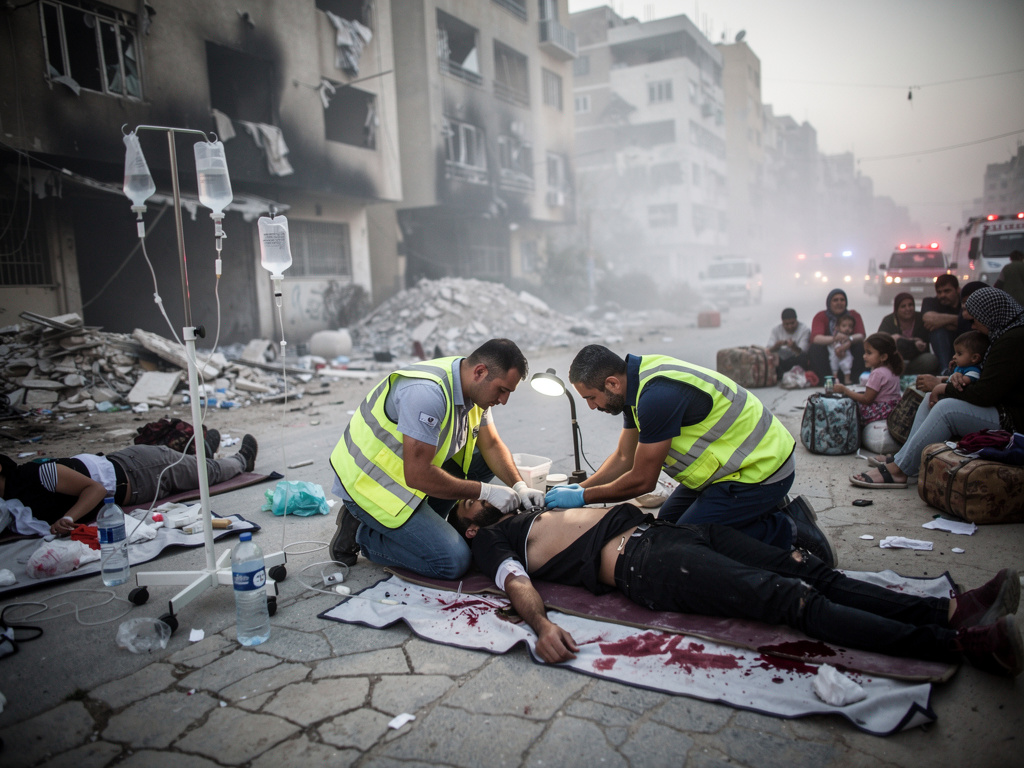
The article is a photo-driven report from southern Lebanon showing how the Israel-Hezbollah war has transformed the work and lives of Lebanese medics in Nabatieh. After repeated airstrikes damaged their original base, dozens of volunteer first responders were forced to live and work from a cramped hospital near the Israeli border. They now operate under constant threat, listen for the next strike, and take precautions against “double-tap” attacks that hit rescuers after an initial explosion. Their duties have expanded beyond emergency care to include food distribution and humanitarian aid for the civilians who remain in an evacuation zone that has largely emptied out due to Israeli warnings and bombardment.
The article emphasizes the human cost of the conflict through the deaths of medics and civilians alike. The chief medic, Mohammed Suleiman, says he lost his son Joud and another volunteer, Ali Jaber, in a March airstrike while they were in uniform. Lebanon’s Health Ministry says more than 100 medical workers have been killed in the current fighting and nearly 2,900 people overall have died since March, despite a U.S.-brokered ceasefire that has not ended exchanges of fire between Israel and Hezbollah. The story also focuses on the grief of civilians, including the Ibrahim sisters, Fatima and Sara, who were killed in an airstrike while baking bread at home, and on the makeshift funeral that followed amid ongoing shelling and cemetery damage.
Despite injuries, fear, and repeated losses, the medics say they will remain in Nabatieh because the people who are still there need help. Their resolve frames the article’s central message: in a war marked by destruction, displacement, and persistent danger, local volunteers continue serving their community even as the conflict consumes it.
Entities: Lebanon, Nabatieh, Israel, Hezbollah, Mohammed Suleiman • Tone: analytical • Sentiment: negative • Intent: inform