11-09-2026
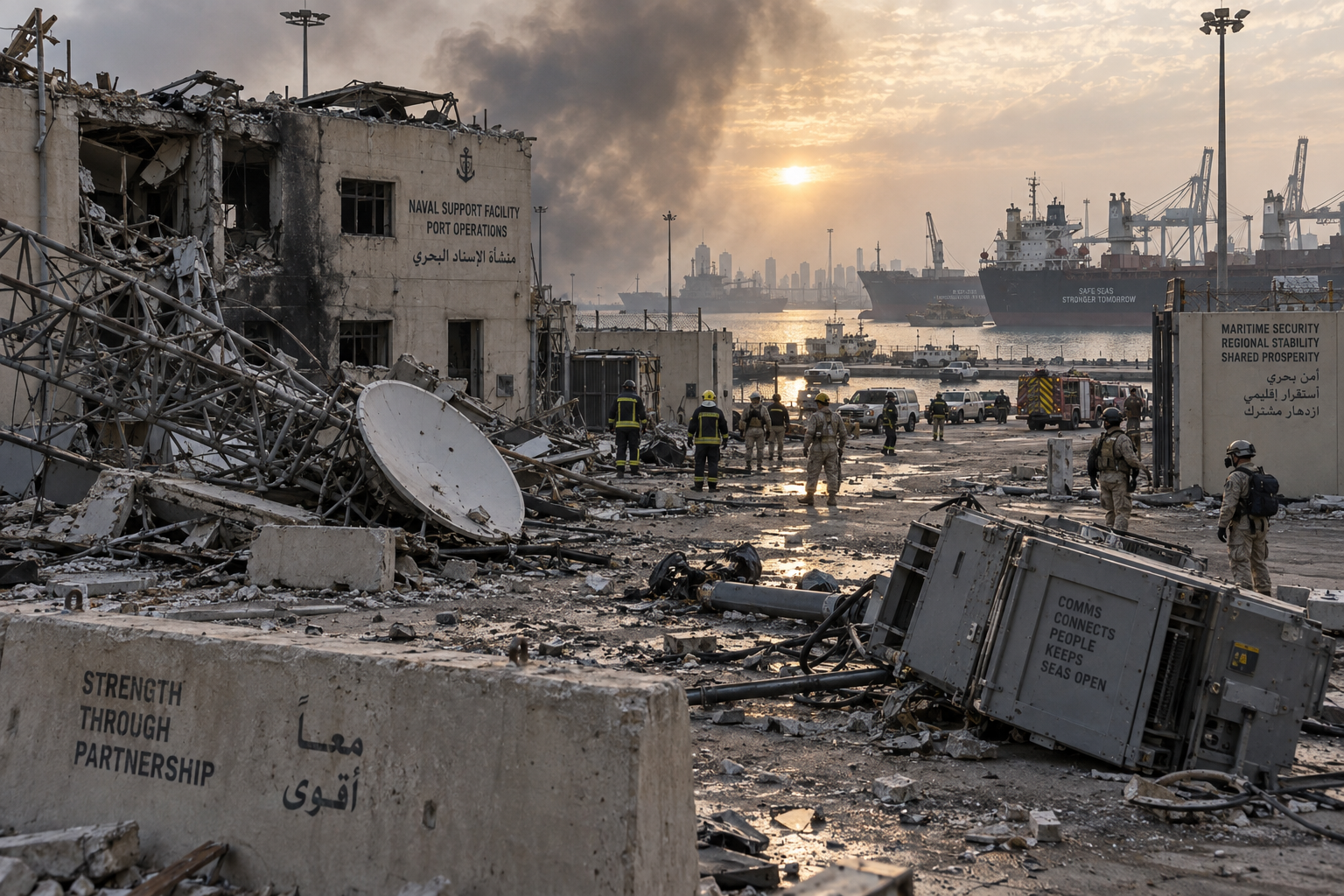
The article examines the damage Iranian strikes reportedly inflicted on United States military facilities in Bahrain and Jordan during the ongoing US-Israel war on Iran. Acting US Navy Secretary Hung Cao acknowledged that the Naval Support Activity Bahrain had been severely damaged, saying, “They blew the hell out of Bahrain.” The base, located near Manama, previously hosted the US Fifth Fleet and Naval Forces Central Command and served as a major logistics and operational hub for US naval activity across the Middle East.
Open-source imagery, satellite analysis, social media footage, and interviews cited by The Wall Street Journal indicated that the command center and at least a dozen other buildings were heavily damaged during repeated attacks between February and June. The Navy is assessing whether to repair the installation, while its top uniformed officer said it would not resume operations soon. Damage also disrupted support for the USS Abraham Lincoln aircraft carrier, whose extended deployment reportedly contributed to a mental health crisis among its crew.
The article also details Iranian missile strikes on Jordan’s Muwaffaq Salti Air Base, or Al-Azraq. Although Jordan said it intercepted 18 of 20 missiles, the attack reportedly damaged several US aircraft. One A-10 Thunderbolt lost a wing, while eight F-15s sustained lighter damage. Iran has claimed repeated attacks on the base since March, including strikes on aircraft, hangars, and command centers. Two US service members were reportedly killed in one July attack.
More broadly, the article says Iran has targeted US facilities in eight Middle Eastern countries. A Congressional Research Service report cited in the article said 42 US aircraft had been lost or damaged by May, while 18 US service members had been killed and more than 800 injured. Iranian strikes have also damaged facilities and missile-defense systems in Saudi Arabia, Kuwait, and the United Arab Emirates, raising questions about the sustainability and security of the US military presence in the region.
Entities: Iran, United States Navy, Hung Cao, Abbas Araghchi, Bahrain • Tone: analytical • Sentiment: negative • Intent: inform
11-09-2026
This CBS News live report tracks escalating military, political and economic consequences of the Iran war on September 10, 2026. Sources told CBS News that several U.S. fighter jets at a Jordanian military base were damaged in Iranian strikes. Iran’s state media said the attacks were retaliation for U.S. strikes on Iranian oil tankers. The report also says Yemen’s Houthi movement seized the Red Sea port of Mokha, a development that could improve its ability to threaten shipping near the Bab el-Mandeb Strait, an important route for Saudi oil exports.
At the United Nations, Yemen’s envoy Hans Grundberg warned that the Houthi takeover marked the end of more than four years of relative calm and could begin a more dangerous phase of the conflict. Yemen and Saudi Arabia called for international action against the Houthis, including stronger enforcement of sanctions and restrictions on weapons supplies. The United States also urged efforts to cut off resources supporting Houthi attacks.
The report covers broader regional developments. Israel said it destroyed Hezbollah tunnels and weapons infrastructure on the Ali al-Taher ridge in southern Lebanon, while acknowledging that it has not yet transferred control of the area to the Lebanese army. Iran’s Revolutionary Guard claimed it destroyed a U.S. Saildrone in the Strait of Hormuz, following an earlier Iranian seizure of an underwater U.S. drone that Washington said had malfunctioned.
The conflict is also affecting the U.S. economy, with the national average diesel price approaching $6 per gallon. In Washington, House Democrats criticized President Trump’s handling of the war, citing the deaths of 18 service members and the financial costs of the conflict. Trump said Iran was trying to influence the midterm elections and predicted that the war would end immediately afterward. The supplied article ends during an incomplete quotation from Rep. Madeleine Dean.
Entities: Iran war, President Donald Trump, United States, Jordanian military base, Iranian strikes on U.S. assets • Tone: urgent • Sentiment: negative • Intent: inform
11-09-2026
The live report covers escalating military and geopolitical tensions surrounding the Iran war and its effects on regional security and global energy markets. Several U.S. fighter jets were reportedly damaged at a Jordanian military base in Iranian strikes, while Iran said it had targeted American assets in retaliation for attacks on Iranian oil tankers. Iran’s Revolutionary Guard also claimed to have destroyed a U.S. Saildrone Explorer unmanned surface vessel in the Strait of Hormuz. The U.S. military previously said an underwater drone captured by Iran had malfunctioned.
The conflict is also spreading through Yemen and southern Lebanon. Yemen’s Iran-backed Houthi movement reportedly seized the Red Sea port of Mokha, potentially improving its ability to threaten shipping through the Bab el-Mandeb Strait, an important route for Saudi oil exports. At the United Nations, Yemen’s envoy warned that the seizure marked the end of a fragile period of calm and urged international action against the Houthis. Saudi Arabia warned it would take measures to deter further attacks, while the United States called for stronger enforcement of sanctions.
Israel said it had destroyed Hezbollah tunnel and weapons infrastructure on the Ali al-Taher ridge in southern Lebanon, though it has resisted transferring security control of the area to the Lebanese army. Meanwhile, South Korea and Iran discussed the Strait of Hormuz after President Trump pressured Seoul to assist with securing the waterway. Iran warned that South Korean military involvement could have serious consequences.
The conflict is contributing to severe energy-price pressures. U.S. diesel prices approached $6 per gallon, up 61% from the previous year, raising concerns about higher transportation, farming, construction and consumer costs. Trump predicted that the war would end immediately after the U.S. midterm elections, claiming Iran could not sustain the conflict and was trying to influence the vote.
Entities: Donald Trump, Iran, United States military, Jordanian military base, Houthi movement • Tone: urgent • Sentiment: negative • Intent: inform
11-09-2026
Acting Navy Secretary Hung Cao acknowledged that Iran’s attacks severely damaged Naval Support Activity Bahrain, the US Navy installation that serves as the headquarters of the Fifth Fleet. In an interview with The Epoch Times, Cao said, “They blew the hell out of Bahrain,” and expressed uncertainty about whether maintaining a long-term US presence at the facility remains feasible. He said a task force was evaluating whether the base could or should be restored.
Cao’s remarks followed comments by Chief of Naval Operations Adm. Daryl Caudle, who reportedly told a displaced service member that US personnel would not be returning to the installation “anytime soon.” The service member had asked when personnel might retrieve their belongings.
The base was struck in an Iranian retaliatory attack on Feb. 28, following initial US and Israeli strikes on Tehran. Although the Pentagon initially said the attack had not significantly affected military operations and caused no deaths, a Wall Street Journal report in June said Iran had hit the base’s command headquarters and at least 12 other buildings, including two satellite communications terminals. The damage was estimated to cost approximately $400 million to repair.
The disruption has also affected naval operations. Ships including the USS Abraham Lincoln aircraft carrier reportedly could not replenish essential supplies in Bahrain, contributing to shortages and declining morale aboard the vessel.
Iranian Foreign Minister Abbas Araghchi seized on Cao’s remarks, asserting that Iranian forces had damaged the Fifth Fleet headquarters and other facilities supporting US operations. He also criticized American taxpayers funding what he described as Israel’s wars. If the US military decides not to return to Bahrain, it may relocate its regional presence elsewhere in the Middle East, potentially including Israel, though that would place forces farther from Iran’s missile range.
Entities: Hung Cao, Naval Support Activity Bahrain (NSA Bahrain), US Fifth Fleet, Iranian attacks on Bahrain, Daryl Caudle • Tone: urgent • Sentiment: negative • Intent: inform
11-09-2026
The supplied material does not contain the substantive text of the Al Jazeera live article. Instead, it consists almost entirely of website interface and advertising language, including repeated “Advertisement” notices and a prompt encouraging readers to receive personalized alerts. The available headline identifies the article as a live news report concerning an alleged Iranian Revolutionary Guard Corps (IRGC) attack on a United States unmanned vessel in or near the Strait of Hormuz, as well as reported damage to two ships. It also places the report within the broader context of the Iran war and associates it with Donald Trump-related news coverage.
Because no liveblog updates, statements from officials, operational details, locations beyond the headline, casualty figures, timelines, or reactions are included, it is not possible to verify or comprehensively summarize the reported events from the supplied content. The headline indicates a developing military and maritime-security story, but it does not establish the circumstances of the alleged attack, the identities or condition of the two ships, the response by the United States or Iran, or the wider implications for shipping through the Strait of Hormuz.
The available text therefore supports only a limited metadata-level assessment: the article’s apparent purpose is to provide real-time information about a conflict-related incident, and its headline uses urgent language associated with breaking news. The article body is missing, so any fuller account would require access to the original liveblog or additional source material. The advertising and notification text has been excluded from the cleaned version because it is not part of the article’s substantive reporting.
Entities: Iran, Islamic Revolutionary Guard Corps (IRGC), United States, Strait of Hormuz, Iran war • Tone: urgent • Sentiment: negative • Intent: inform