09-04-2026
President Donald Trump has announced a two-week ceasefire with Iran, narrowly avoiding a deadline that would have seen massive US strikes on Iranian energy and transportation infrastructure. The agreement allows both nations to engage in negotiations for a permanent settlement, with Iran agreeing to suspend hostilities and reopen the Strait of Hormuz to commercial shipping. This development provides Trump with a political 'off-ramp,' allowing him to avoid either a catastrophic escalation or a perceived retreat that would undermine his credibility.
However, the ceasefire follows highly inflammatory rhetoric from Trump, who threatened that a 'whole civilisation will die tonight.' This language has sparked significant backlash, not only from Democrats—some of whom have called for his removal—but also from several high-profile Republicans who viewed the threats as counter-productive and inconsistent with American principles. While the White House may argue that this extreme pressure worked to secure the ceasefire, critics suggest it has fundamentally damaged the global perception of the US as a stabilizing force.
Despite the temporary reprieve, the path to a permanent peace remains precarious. Iran's 10-point plan for a settlement includes demands such as the total withdrawal of US military forces from the region and the lifting of economic sanctions—terms that are unlikely to be accepted by the Trump administration. Furthermore, key US objectives, such as the status of Iran's enriched uranium and the neutralization of regional proxies like the Houthi rebels, remain unresolved. While oil prices have dipped and markets have reacted positively, the long-term geopolitical cost of the conflict and the president's rhetoric remains uncertain.
Entities: Donald Trump, Iran, United States, Seyed Abbas Araghchi, Strait of Hormuz • Tone: analytical • Sentiment: negative • Intent: inform
09-04-2026
The Strait of Hormuz, a critical global shipping lane carrying approximately 20% of the world's oil and liquefied natural gas, remains in a state of high uncertainty despite a recently agreed two-week ceasefire between Iran and the US-Israel coalition. While the ceasefire was intended to guarantee 'safe passage,' Iran's navy has issued warnings that vessels crossing without permission will be 'targeted and destroyed.' This has led to a drastic drop in traffic; BBC Verify analysis shows only three bulk carriers crossed on April 8th, compared to a pre-conflict average of 138 ships per day.
Shipping analysts and industry experts express deep skepticism regarding the immediate reopening of the strait. Concerns include the lack of clear transit protocols, the potential presence of sea mines, and the risk of ships becoming trapped once the short ceasefire window expires. Furthermore, reports suggest that Iran may demand toll payments for passage. This creates a legal dilemma for international shipping lines, as such payments could violate US sanctions against Iran.
Economically, the disruption has already caused significant volatility, pushing up energy prices and threatening the supply of chemicals essential for pharmaceuticals and microchips. Although oil prices dropped sharply following the ceasefire announcement, experts warn that normal flow levels are unlikely to return quickly. The situation remains precarious, with ship owners facing immense risk and the IRGC maintaining effective control over the waterway.
Entities: Iran, Strait of Hormuz, United States, Israel, IRGC (Islamic Revolutionary Guard Corps) • Tone: analytical • Sentiment: negative • Intent: inform
09-04-2026
The article details the political fallout following President Trump's threat to eradicate a 'whole civilization' if Iran did not reopen the Strait of Hormuz by a Tuesday deadline. The threat, posted on Truth Social, sparked a sharp divide in Congress. While the majority of Republicans remained silent, a small minority, including Rep. Nathaniel Moran, Sen. Lisa Murkowski, and former Republican Rep. Kevin Kiley, expressed unease or condemned the rhetoric as inconsistent with American principles and an inappropriate negotiating tactic.
In contrast, Democrats reacted with urgency and condemnation. Over 70 Democratic lawmakers, including former House Speaker Nancy Pelosi, called for Trump's removal from office via the 25th Amendment, citing his instability as a danger to national security. Additionally, Rep. John Larson introduced articles of impeachment, despite the likelihood of failure due to the Republican majority. The controversy extended beyond Congress, with former supporters like Marjorie Taylor Greene and Alex Jones also calling for his removal. The tension culminated shortly before the deadline when President Trump announced a two-week ceasefire, contingent upon the complete and safe opening of the Strait of Hormuz, thereby averting the threatened large-scale attack.
Entities: Donald Trump, Iran, Strait of Hormuz, 25th Amendment, Nancy Pelosi • Tone: urgent • Sentiment: negative • Intent: inform
09-04-2026
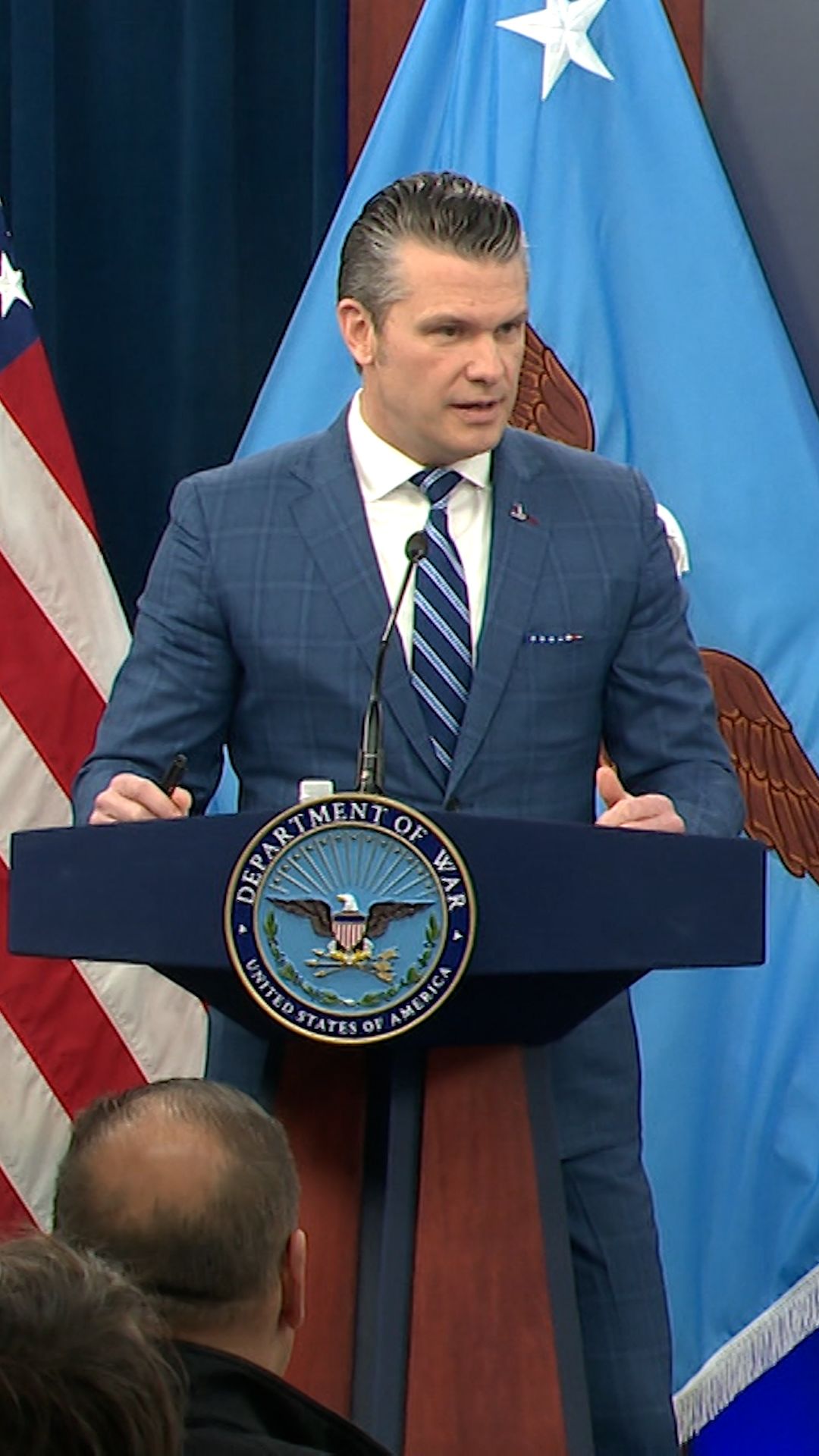
Defense Secretary Pete Hegseth and Joint Chiefs Chairman Dan Caine have detailed the U.S. military's position following President Trump's announcement of a conditional two-week ceasefire with Iran. Hegseth asserted that the U.S. military operation, dubbed 'Epic Fury,' was a historic victory that decimated Iran's military capabilities in under 40 days, rendering them combat ineffective. While Hegseth stated that the Pentagon's primary job in Iran is currently 'done,' he emphasized that U.S. forces will remain in the region ('hanging around') and are prepared to resume offensive operations immediately if Iran fails to comply with the terms of the agreement.
The ceasefire terms, as described by President Trump, include a suspension of U.S. bombing and a requirement that Iran cease uranium enrichment and allow the removal of nuclear materials. Hegseth attributed the deal to the president's severe threats against Iranian infrastructure and energy exports. Meanwhile, Iranian Foreign Minister Seyed Abbas Araghchi confirmed the halt of 'defensive operations' and coordination for safe passage through the Strait of Hormuz, which has already seen a resumption of vessel activity.
Despite the truce, the situation remains volatile. Reports of explosions at Iran's Lavan Island Oil Refinery emerged shortly after the announcement, though the perpetrators remain unconfirmed. Additionally, while Israel supports the ceasefire, Prime Minister Benjamin Netanyahu's office clarified that the agreement does not extend to the ongoing conflict between Israel and Hezbollah. Economically, the announcement led to a surge in stocks and a dip in oil prices, though they remain above pre-war levels.
Entities: Pete Hegseth, Donald Trump, Dan Caine, Seyed Abbas Araghchi, Benjamin Netanyahu • Tone: urgent • Sentiment: positive • Intent: inform
09-04-2026
During a visit to Hungary, Vice President JD Vance characterized the current U.S.-Iran ceasefire as a 'fragile truce.' While acknowledging that the Iranian foreign minister has responded positively to the agreement, Vance warned that other factions within the Iranian government are 'lying' about the terms. He emphasized that while President Trump has opted for negotiation over the immediate use of military, diplomatic, and economic leverage, the U.S. remains prepared to act if Iran does not reciprocate in good faith. Vance further noted that while primary U.S. military objectives in Iran have been largely met, the U.S. still seeks to further limit Iran's ability to manufacture weapons.
Beyond the geopolitical tension with Iran, the article highlights Vance's explicit support for Hungarian Prime Minister Viktor Orbán's reelection bid. Speaking to a crowd in Budapest shortly before parliamentary elections, Vance urged Hungarians to reelect Orbán to defend 'Western civilization,' sovereignty, and democracy against 'bureaucrats in Brussels.' This endorsement comes despite Freedom House's designation of Hungary as only 'partly free' and widespread criticism of Orbán as an 'illiberal democrat.' The event included a speakerphone call from President Trump, who expressed his affection for both Hungary and Orbán, reinforcing the administration's alignment with the Hungarian leader's nationalist agenda.
Entities: JD Vance, Donald Trump, Viktor Orbán, Iran, Hungary • Tone: urgent • Sentiment: negative • Intent: inform
09-04-2026
Vice President JD Vance addressed claims made by Iranian Parliament Speaker Mohammad Bagher Ghalibaf regarding alleged U.S. violations of a ceasefire agreement. Ghalibaf asserted that the U.S. violated three specific clauses: the continuation of military action in Lebanon, a drone intrusion into Iranian airspace, and the denial of Iran's right to enrich uranium. Vance dismissed these claims, characterizing the situation as a 'reasonable misunderstanding' and suggesting that Ghalibaf may have misinterpreted the negotiations due to language barriers.
Vance specifically clarified that the United States never promised that Lebanon would be included in the ceasefire deal, which was intended to focus on Iran and U.S. allies, including Israel and Gulf Arab states. He argued that if Iran chooses to let the negotiations collapse over the conflict in Lebanon—which he claims is separate from the deal—it would be a 'dumb' decision. Regarding the reports of drone activity and explosions, Vance defended the instability by stating that 'ceasefires are always messy' and typically involve a period of 'choppiness.'
Furthermore, Vance dismissed Iran's claims regarding the 'right' to enrich uranium, stating that the U.S. is concerned with Iran's actual actions rather than their claimed rights. Despite the friction, Vance maintained that the overall trajectory is moving in the right direction toward stopping the bombing, though he acknowledged the truce remains fragile.
Entities: JD Vance, Mohammad Bagher Ghalibaf, United States, Iran, Lebanon • Tone: positive • Sentiment: neutral • Intent: inform
09-04-2026
Asia-Pacific stock markets declined on Thursday as investors reacted to the fragility of a newly announced ceasefire between the United States and Iran. The tension follows a 'double-sided' two-week ceasefire announced by U.S. President Donald Trump, which aimed to pause a five-week conflict that had previously disrupted global energy supplies by closing the Strait of Hormuz. While the U.S. viewed a 10-point proposal from Iran as a workable basis for negotiation, the agreement quickly came under fire. Iran's parliamentary speaker, Mohammed Bagher Ghalibaf, accused the U.S. of breaching the terms, citing the denial of Iran's right to enrich uranium, continued Israeli attacks on Lebanon, and a drone violation of Iranian airspace.
The geopolitical instability triggered a downward trend across major Asian indices: South Korea's Kospi fell 1.53%, Japan's Nikkei 225 dropped 0.77%, and China's CSI 300 declined 0.64%. Japanese Finance Minister Satsuki Katayama warned that cross-market volatility could lead to rapid, unexpected interest rate increases. Meanwhile, India's central bank flagged concerns regarding inflation and economic growth risks stemming from the conflict.
In contrast to the Asian slump, oil futures rose, with West Texas Intermediate climbing to $97.10 per barrel and Brent reaching $96.62. This volatility follows a massive surge in U.S. markets on Wednesday, where the Dow Jones Industrial Average jumped over 1,300 points upon the initial news of the ceasefire. However, the subsequent accusations of breach have dampened that optimism, leading to slight slips in U.S. index futures.
Entities: Donald Trump, Mohammed Bagher Ghalibaf, Satsuki Katayama, United States, Iran • Tone: analytical • Sentiment: negative • Intent: inform
09-04-2026
President Donald Trump has signaled a precarious stance regarding the current ceasefire with Iran, stating on Truth Social that U.S. military forces will remain deployed in the region until Tehran fully complies with the 'real agreement.' Trump warned that any breach of the truce would result in a military response 'bigger, and better, and stronger than anyone has ever seen before,' while cryptically noting that the military is looking forward to its 'next conquest.'
Simultaneously, tensions have resurfaced regarding Greenland. Following a meeting with NATO Secretary General Mark Rutte, Trump expressed frustration with the alliance, claiming NATO had failed the U.S. and referring to Greenland as a 'poorly run piece of ice.' This diplomatic friction coincides with accusations from Iranian parliamentary speaker Mohammad Bagher Ghalibaf, who claims the U.S. has already violated three parts of the 10-point ceasefire agreement, citing Israeli attacks on Lebanon and drone incursions.
These geopolitical instabilities are impacting global markets; oil prices are rising due to fears of supply disruption, while Asian equities have turned negative. Additionally, the article notes a legal setback for AI company Anthropic, as a federal appeals court denied its request to block the Pentagon's blacklisting of the company, prioritizing national security and the Department of War's management of AI technology during active conflict.
Entities: Donald Trump, Iran, Greenland, NATO, Mark Rutte • Tone: urgent • Sentiment: negative • Intent: inform
09-04-2026
A temporary two-week ceasefire between the United States and Iran, which initially sparked a massive global market rally, is already facing significant instability. While the agreement led to the Dow Jones Industrial Average's best day since April 2025 and a sharp drop in crude oil prices, tensions resurfaced almost immediately. Iranian Parliamentary Speaker Mohammad Bagher Ghalibaf accused the U.S. of violating the truce, citing continued Israeli attacks in Lebanon, a drone intrusion into Iranian airspace, and the U.S. refusal to recognize Iran's right to enrich uranium.
In response, Vice President JD Vance characterized the agreement as a 'fragile truce,' acknowledging that such arrangements are often 'messy.' He clarified that the ceasefire did not extend to Lebanon and maintained the U.S. position against Iranian uranium enrichment. A central point of contention remains the Strait of Hormuz; the White House insists the waterway must be open without limitations or tolls to ensure global energy security. While some ships have begun navigating the strait, traffic remains low due to ongoing confusion.
The volatility of the diplomatic situation has already begun to impact markets again, with Brent and WTI crude futures rising in Asia trading following Tehran's accusations. Separately, the article notes that a federal appeals court denied AI company Anthropic's request to block a Pentagon blacklist, ruling that the government's need to secure AI technology during military conflict outweighs the financial harm to the private company.
Entities: Donald Trump, Mohammad Bagher Ghalibaf, JD Vance, United States, Iran • Tone: analytical • Sentiment: neutral • Intent: inform
09-04-2026
U.S. President Donald Trump has renewed his criticisms of NATO and expressed renewed interest in acquiring Greenland, amidst deepening diplomatic tensions following a month of conflict with Iran. Following the announcement of a two-week ceasefire with Iran, Trump took to Truth Social to label NATO as unreliable, claiming the alliance failed the U.S. during the recent war effort. This friction is rooted in the refusal of several NATO members to support the U.S.-Israeli military campaign, specifically by denying the use of their airspace and refusing to provide naval forces to secure the Strait of Hormuz.
Trump has described NATO as a 'paper tiger' and has threatened to withdraw from the 32-member alliance, arguing that European nations rely too heavily on U.S. security guarantees without providing reciprocal support. Simultaneously, Trump has targeted Greenland—a Danish autonomous territory—calling it a 'poorly run piece of ice' and signaling a desire for its acquisition. This rhetoric coincides with reports that the Pentagon is seeking to expand its military presence in Greenland by negotiating for three additional bases with Denmark, a move analysts suggest is intended to intimidate allies.
Meanwhile, the fragile ceasefire with Iran is already under threat. Iran's parliamentary speaker has accused Washington of violating the terms of the truce, while heavy Israeli strikes in Lebanon have prompted Iran to question the viability of further peace talks with the U.S. Geopolitical experts warn that Trump's persistent attacks on the alliance risk hollowing out NATO's effectiveness at a time when adversaries are actively testing Western unity.
Entities: Donald Trump, NATO, Greenland, Iran, Mark Rutte • Tone: positive • Sentiment: negative • Intent: inform
09-04-2026
U.S. stock futures remained relatively flat on Thursday morning following a massive relief rally on Wednesday. The market surge was triggered by President Donald Trump's announcement of a two-week 'double-sided' ceasefire with Iran, intended to end a five-week conflict and reopen the strategically vital Strait of Hormuz. On Wednesday, the Dow Jones Industrial Average surged over 1,300 points, marking its best day since April 2025, while the S&P 500 and Nasdaq Composite also saw significant gains. The Dow Jones Transportation Average specifically hit new record highs.
However, the optimism is tempered by immediate geopolitical instability. Iran's parliamentary speaker, Mohammed Bagher Ghalibaf, has already accused the U.S. of violating the ceasefire, citing continued Israeli attacks on Lebanon and restrictions on uranium enrichment. This tension has already spilled over into Asia-Pacific markets, where indices in Japan, South Korea, and China traded lower on Thursday due to fears that the fragile deal may collapse.
While some analysts, such as Eric Johnston of Cantor Fitzgerald, view the current dip as a buying opportunity, they warn that significant risks remain until the Strait of Hormuz is fully open and compliance is verified. Additionally, investors are awaiting key economic data on Thursday, including the personal consumption expenditure (PCE) price index—the Federal Reserve's preferred inflation gauge—and weekly jobless claims. In corporate news, Constellation Brands saw a slight dip in share price despite beating earnings expectations, due to forward guidance that fell short of analyst estimates.
Entities: Donald Trump, Mohammed Bagher Ghalibaf, Iran, United States, Israel • Tone: analytical • Sentiment: neutral • Intent: inform
09-04-2026
President Donald Trump has announced that U.S. military forces will remain deployed in and around Iran until Tehran fully complies with a 'real agreement.' Following a two-week ceasefire brokered by Pakistan that ended six weeks of active fighting, Trump warned via Truth Social that any breach of the agreement—specifically regarding Iran's nuclear ambitions and the safety of commercial shipping in the Strait of Hormuz—would trigger a military response 'bigger, and better, and stronger than anyone has ever seen before.'
Despite the ceasefire, significant diplomatic friction remains. Trump dismissed a reported 10-point peace plan from Iran as 'totally fake,' while Tehran continues to demand the lifting of all sanctions and an end to Israeli strikes against Hezbollah in Lebanon. The fragility of the peace is further highlighted by Israel's intensified offensives in Lebanon, which killed at least 182 people on Wednesday, prompting Iran to question the viability of permanent peace talks.
Economic repercussions are already evident, as oil prices climbed on Thursday due to regional instability. Brent crude and WTI futures both rose toward the $97 mark as markets reacted to the uncertainty. Meanwhile, Lebanese officials have expressed the devastating toll of the conflict, claiming the country was forced into the war by external actors. The U.S. and Iran are scheduled to meet for further negotiations in Islamabad this Friday to attempt to resolve these disputes.
Entities: Donald Trump, Iran, United States, Strait of Hormuz, Pakistan • Tone: urgent • Sentiment: negative • Intent: inform
09-04-2026
The article reports on a fragile, last-minute agreement between the United States and Iran to pause their ongoing conflict. While a two-week truce has been established, the situation remains highly volatile and unstable. The ceasefire is characterized by significant gaps in implementation and a lack of comprehensive agreement, leaving many questions unanswered regarding a long-term peace deal.
Adding to the complexity, the truce has not halted all regional violence; Israel has continued its bombing campaigns against Hezbollah in Lebanon. This ongoing aggression has prompted retaliatory actions from Iran, including the obstruction of oil tankers in the Strait of Hormuz and reported missile and drone attacks against Gulf states. Furthermore, the diplomatic process between Washington and Tehran is notably occurring without the involvement of Israeli Prime Minister Binyamin Netanyahu, highlighting a rift in the coalition. The geopolitical landscape is further strained by the rhetoric of Donald Trump and the potential for escalation should American captives in Iran not be released. Ultimately, the 'victory' claims from both the U.S. and Iran are viewed as bombast intended to obscure the devastating scale of the damage caused by the war.
Entities: Iran, United States, Israel, Hizbullah, Lebanon • Tone: analytical • Sentiment: negative • Intent: inform
09-04-2026
The article discusses the immediate market reactions following President Donald Trump's announcement of a two-week ceasefire in the Gulf and the reopening of the Strait of Hormuz. For six weeks, a blockade by Iran had trapped approximately 15% of global oil production and 20% of liquefied natural gas (LNG) output, leading to extreme volatility in energy markets. This conflict, referred to as the 'third Gulf war,' caused Brent crude prices to spike before dropping 12% to $91 a barrel upon the news of the truce.
Prior to the ceasefire, the markets showed significant distress; West Texas Intermediate (WTI) traded at a premium to Brent, indicating a desperate rush by buyers to secure reliable supplies. Dated Brent reached a record high of $144 per barrel just hours before the announcement. While the ceasefire provides temporary relief, the article suggests that the long-term scars on energy markets—including ruined infrastructure and residual geopolitical risks—will likely keep energy prices elevated for an extended period. The volatility experienced is compared to the shocks seen during the onset of the COVID-19 pandemic in 2020, highlighting the severity of the disruption to global energy security.
Entities: Donald Trump, Iran, Strait of Hormuz, Brent crude, West Texas Intermediate (WTI) • Tone: analytical • Sentiment: negative • Intent: inform
09-04-2026
The article discusses the escalating tensions between the United States and Iran, specifically focusing on the potential military operation to reopen the Strait of Hormuz. Amidst conflicting reports regarding diplomatic negotiations between Donald Trump and Iranian leadership to end a bombing campaign, the U.S. is actively preparing for a military alternative. The deployment of two amphibious Marine units—one originating from Japan and another from California—alongside a specialized elite parachute infantry division, indicates that the U.S. administration is seriously contemplating the use of force to ensure the passage of ships through the strategic waterway. The author characterizes this potential operation as a 'daunting task,' suggesting that such a battle would require a significant commitment of personnel and hardware over an extended period with highly uncertain outcomes. The broader context suggests a region in turmoil, where the risk of a global trade nightmare looms if one of the world's most critical shipping chokepoints remains closed.
Entities: Donald Trump, Iran, United States, Strait of Hormuz, US Marines • Tone: analytical • Sentiment: negative • Intent: inform
09-04-2026
The provided text is a compilation of news briefs and video segments centered around a newly announced two-week ceasefire between the United States and Iran. US Vice President JD Vance, speaking from Budapest, Hungary, noted that his involvement in the final hours of the negotiations provided significant insight into the Iranian system, echoing a sentiment from President Donald Trump that Iran is more proficient at negotiation than actual combat.
Beyond the primary ceasefire, the reports highlight several geopolitical ramifications and related conflicts. Pakistan is positioned as a potential diplomatic hub, with Prime Minister Shehbaz Sharif indicating that US and Iranian delegations are expected to meet in Islamabad this coming Friday to further discussions. Meanwhile, the US military remains on high alert; General Dan Caine, Chairman of the Joint Chiefs of Staff, emphasized that US forces are prepared to resume combat operations immediately if ordered.
Concurrent with the ceasefire, the region remains volatile. The Israeli Defense Forces (IDF) have conducted what they describe as the largest coordinated strike in Lebanon since the start of the war last month, targeting over 100 Hezbollah command centers in Beirut. Additionally, there is significant uncertainty regarding the reopening of the Strait of Hormuz and skepticism among Iranian citizens in Tehran regarding the longevity and sincerity of the ceasefire agreement. A separate brief also mentions increasing Chinese investment in North Korea's infrastructure despite ongoing UN sanctions.
Entities: JD Vance, Donald Trump, Iran, United States, Budapest, Hungary • Tone: neutral • Sentiment: neutral • Intent: inform
09-04-2026
The provided text outlines a volatile geopolitical situation following the announcement of a two-week ceasefire between the United States and Iran. While the agreement was brokered with the assistance of Vice President JD Vance, there is significant regional anxiety regarding its stability. Saudi Arabia has expressed fears that the ceasefire is 'fragile,' particularly in light of reported Iranian strikes in the Gulf and massive Israeli military operations in Lebanon. The Israeli Defense Forces (IDF) have reportedly conducted their largest coordinated strike in Lebanon since the start of the war last month, targeting over 100 Hezbollah command centers and military sites in Beirut.
International diplomatic efforts are continuing, with Pakistan's prime minister indicating that US and Iranian delegations are expected to meet in Islamabad to discuss the details of the agreement. Meanwhile, the US military remains on high alert; General Dan Caine, Chairman of the Joint Chiefs of Staff, stated that forces are ready to resume combat operations if ordered. Public reaction within Iran is mixed, with citizens in Tehran expressing skepticism about the longevity of the deal. Additionally, the ceasefire has raised questions regarding the reopening of the Strait of Hormuz, a critical global shipping lane. The report also briefly touches upon unrelated developments in North Korea, noting increased Chinese investment in Pyongyang despite existing UN sanctions.
Entities: Saudi Arabia, United States, Iran, Israel, Lebanon • Tone: urgent • Sentiment: negative • Intent: inform
09-04-2026
The provided text is a compilation of news briefs and video transcripts from CNN regarding a geopolitical crisis involving the United States and Iran. The primary focus is on the aftermath of a conflict between the two nations, which has recently entered a two-week ceasefire announced by President Donald Trump. During a briefing, General Dan Caine, Chairman of the Joint Chiefs of Staff, lightened the mood by joking about the massive quantities of caffeine and nicotine consumed by US military personnel during the war, citing nearly a million gallons of coffee and two million energy drinks. Despite the ceasefire, General Caine emphasized that US forces remain on high alert and ready to resume combat operations if ordered.
Beyond the US-Iran dynamic, the reports cover several related regional developments. Pakistan is positioned as a potential mediator, with talks involving US and Iranian delegations expected in Islamabad. Meanwhile, the conflict's ripple effects are seen in Lebanon, where the Israeli Defense Forces (IDF) conducted a massive coordinated strike against Hezbollah command centers in Beirut. Additionally, the ceasefire has raised questions regarding the reopening of the Strait of Hormuz, a critical global shipping lane. Political commentary from Vice President JD Vance suggests that the negotiations revealed insights into the Iranian system, while citizens in Tehran expressed skepticism about the longevity of the peace agreement. The content also briefly touches upon unrelated economic developments in North Korea, noting Chinese investment in Pyongyang despite UN sanctions.
Entities: Gen. Dan Caine, Donald Trump, JD Vance, United States, Iran • Tone: analytical • Sentiment: neutral • Intent: inform
09-04-2026
The provided text is a collection of news briefs and video summaries centered around a geopolitical crisis involving the United States and Iran. The primary focus is the announcement of a two-week ceasefire between the US and Iran, which has raised questions regarding the reopening of the Strait of Hormuz, a critical global shipping lane. The ceasefire negotiations involved high-level officials, including Vice President JD Vance, who noted that the process provided insights into the Iranian political system. While the ceasefire is in place, the US military remains on high alert; General Dan Caine of the Joint Chiefs of Staff stated that forces are ready to resume combat operations if ordered by President Donald Trump.
Beyond the US-Iran ceasefire, the reports highlight regional instability and diplomatic efforts. Pakistan is positioned as a mediator, with expected talks in Islamabad involving both US and Iranian delegations. Simultaneously, the conflict extends to Lebanon, where the Israeli Defense Forces (IDF) have conducted massive coordinated strikes against Hezbollah command centers in Beirut. On the domestic front in Iran, citizens in Tehran have expressed skepticism regarding the longevity and sincerity of the ceasefire agreement. Additionally, the content touches upon a separate geopolitical development regarding Chinese investment in North Korea, specifically the construction of a massive shopping complex in Pyongyang despite existing UN sanctions.
Entities: United States, Iran, Strait of Hormuz, Pakistan, Islamabad • Tone: urgent • Sentiment: neutral • Intent: inform
09-04-2026
The provided text consists of a series of news briefs and video transcripts centered on a high-tension geopolitical conflict between the United States and Iran. The primary focus is on a recent two-week ceasefire agreed upon by President Donald Trump and the Iranian government. A central point of contention is the Strait of Hormuz; White House Press Secretary Karoline Leavitt confirmed that President Trump's social media threat stating 'a whole civilization will die tonight' if Iran did not open the strait was 'not an empty threat.'
Beyond the ceasefire, the reports highlight the fragility of the peace, with Saudi Arabia expressing anxiety over continued Iranian strikes in the Gulf and massive Israeli military operations in Lebanon targeting Hezbollah command centers. While the US military has paused strikes, Chairman of the Joint Chiefs of Staff Gen. Dan Caine emphasized that forces remain ready to resume combat operations if ordered. The reports also touch upon the logistical toll of the war, with Gen. Caine noting the massive consumption of caffeine and nicotine by troops. Interspersed with these geopolitical updates are unrelated news items, including a report on a teenager's experience with online forums glorifying school shooters and the results of a special election runoff in Georgia where Republican Clay Fuller defeated Democrat Shawn Harris.
Entities: Donald Trump, Karoline Leavitt, Gen. Dan Caine, Iran, United States • Tone: urgent • Sentiment: negative • Intent: inform
09-04-2026
The provided text is a transcript/description of a CNN news segment from 'Erin Burnett OutFront' reporting on the geopolitical dynamics surrounding a ceasefire deal with Iran. The core of the report focuses on the White House's revelation that discussions were held with Beijing prior to the establishment of the ceasefire. The segment, reported by Will Ripley, examines China's strategic role and influence in the conflict between the United States and Iran. Additionally, the report touches upon the domestic atmosphere in China, noting that social media posts depicting the war have gone viral in Beijing, suggesting a high level of public interest or state-driven narrative regarding the conflict. While the provided text is primarily a video landing page with numerous unrelated video suggestions, the central news event is the diplomatic coordination between the U.S. and China to stabilize the situation in the Middle East.
Entities: White House, Beijing, Iran, China, CNN • Tone: neutral • Sentiment: neutral • Intent: inform
09-04-2026
Following a two-week ceasefire between the United States and Iran, Tehran has proposed a 10-point plan to end the conflict, which includes a controversial demand for formal control over the Strait of Hormuz. Central to this proposal is the implementation of a transit toll, potentially as high as $2 million per container ship, to fund the reconstruction of Iranian infrastructure damaged by US and Israeli attacks. Iran intends to share a portion of these proceeds with Oman.
The conflict began in February 2026 with US-Israeli strikes that killed Supreme Leader Ayatollah Ali Khamenei and other high-ranking officials, prompting Iran to block the strategic waterway. This blockade caused the most severe global oil supply disruption in history, leading to soaring fuel prices. While a ceasefire is currently in place, the strait remains effectively shut, with the Iranian navy threatening to sink ships that enter without permission.
Analysts suggest that Iran is using its geostrategic leverage to break economic isolation and mitigate the impact of long-term Western sanctions. However, legal experts argue that charging tolls for passage through the strait would be fundamentally contrary to international customary law and the United Nations Convention on the Law of the Sea (UNCLOS). Negotiators from the US and Iran are scheduled to meet in Islamabad to discuss a permanent peace agreement, though President Donald Trump has remained vague about whether the 10-point plan will form the basis of the final deal.
Entities: Iran, United States, Israel, Strait of Hormuz, Donald Trump • Tone: analytical • Sentiment: neutral • Intent: inform
09-04-2026
President Trump has issued a stern warning to Iran, stating that US military forces will remain deployed in and around the region until Tehran fully complies with a newly reached peace agreement. In a post on Truth Social, Trump threatened that if the agreement is not upheld, the US will launch a military assault that would be 'bigger, and better, and stronger' than any previous conflict, explicitly stating that 'the shootin' starts.' The President emphasized that the core tenets of the agreement include a ban on nuclear weapons and the guaranteed safety and openness of the Strait of Hormuz.
This escalation comes during a fragile two-week ceasefire. Trump has indicated that a 10-point proposal from Iran serves as a workable basis for negotiations, though he has criticized major news outlets like CNN and the New York Times for reporting what he calls a 'fake' version of the plan. Diplomatic efforts are currently underway, with Vice President JD Vance scheduled to lead a US delegation to Islamabad, Pakistan, this Saturday for talks facilitated by Pakistani mediators.
Supporting this stance, Air Force Gen. Dan Caine, chairman of the Joint Chiefs of Staff, confirmed that the US military remains in a state of readiness. Caine noted that while the ceasefire provides a pause, the joint force is prepared to resume combat operations with speed and precision if ordered, reflecting the high-tension environment following 38 days of active conflict.
Entities: Donald Trump, Iran, JD Vance, Dan Caine, Pete Hegseth • Tone: urgent • Sentiment: negative • Intent: warn
09-04-2026
The article discusses the accelerating global transition toward renewable energy sources, driven by severe energy insecurity resulting from the conflict between the US, Israel, and Iran. The primary catalyst is the disruption of the Strait of Hormuz, a critical waterway for global oil and gas supplies. Despite a recently announced two-week ceasefire brokered by US President Donald Trump, tensions remain high as the US and Iran disagree on the specific terms for reopening the strait.
Adding to the economic instability, Tehran has reportedly proposed implementing a new fee for commercial vessels transiting the strait upon its reopening, which would likely increase the cost of Middle Eastern crude oil. This financial pressure, combined with the physical risk of blockade, is incentivizing import-dependent nations to prioritize domestic energy sovereignty through investments in solar and wind power. Fatih Birol, head of the International Energy Agency (IEA), has highlighted the severity of the current crisis, claiming that the current oil and gas shocks are more significant than those experienced in 1973, 1979, and 2022 combined. Consequently, the geopolitical volatility in the Middle East is acting as a catalyst for a faster global pivot away from fossil fuels and toward a more diversified, sustainable energy portfolio.
Entities: United States, Israel, Iran, Strait of Hormuz, Donald Trump • Tone: urgent • Sentiment: negative • Intent: inform