08-04-2026
President Donald Trump and Iran have agreed to a two-week ceasefire to allow for negotiations toward a definitive peace agreement, narrowly avoiding a deadline that would have seen massive US strikes on Iranian infrastructure. The deal requires Iran to suspend hostilities and reopen the Strait of Hormuz to commercial shipping. While the ceasefire provides Trump with a political 'off-ramp' and has led to a temporary dip in oil prices and a rise in stock futures, it follows a period of extreme rhetoric in which Trump threatened that a 'whole civilisation will die tonight.'
This inflammatory language has sparked significant backlash, not only from Democrats—some of whom have questioned Trump's fitness to lead—but also from several members of his own Republican party, who viewed the threats as counter-productive and contrary to American principles. Despite the immediate reprieve, the long-term stability of the agreement is precarious. Iran's 10-point plan for peace includes demands such as the total withdrawal of US forces from the region and the lifting of economic sanctions—terms that are unlikely to be accepted by the US administration. Furthermore, key American objectives, including the status of Iran's enriched uranium and the neutralization of regional proxies, remain unresolved. While the White House may argue that the aggressive rhetoric provided necessary leverage, the article suggests that the conflict and the nature of the diplomacy used have fundamentally altered the global perception of the United States as a stabilizing force.
Entities: Donald Trump, Iran, United States, Strait of Hormuz, Seyed Abbas Araghchi • Tone: analytical • Sentiment: negative • Intent: inform
08-04-2026
Global oil prices have plummeted and stock markets have surged following a conditional two-week ceasefire agreement between the United States and Iran. The deal centers on the reopening of the Strait of Hormuz, a critical waterway for global energy supplies that had been severely disrupted due to threats from Iran in retaliation for US and Israeli airstrikes. Brent crude fell approximately 13% to $94.80, and US-traded oil dropped over 15%, although prices remain significantly higher than the $70 per barrel mark seen before the conflict began on February 28.
President Trump announced the suspension of attacks on Iran contingent upon the immediate and safe opening of the strait, having previously issued a dire ultimatum. Iranian Foreign Minister Abbas Araghchi confirmed Tehran's agreement provided attacks cease. Market analysts suggest that Trump was motivated by the need to avoid a 'self-inflicted economic wound' caused by skyrocketing energy prices, which could have damaged his approval ratings.
While the ceasefire provides immediate relief and allows stranded tankers to move, experts warn that full energy production recovery may take months or even years. Significant damage to infrastructure, including Qatar's Ras Laffan industrial hub, has reduced export capacities and could cost over $25 billion to repair. The conflict has disproportionately affected Asian nations, such as the Philippines, which declared a national energy emergency due to its heavy reliance on Middle Eastern oil. While the ceasefire is viewed as a positive step, long-term stability depends on a lasting peace deal.
Entities: Donald Trump, Abbas Araghchi, Strait of Hormuz, Iran, United States • Tone: analytical • Sentiment: neutral • Intent: inform
08-04-2026
The article details the political fallout following a threat by President Donald Trump to eradicate a 'whole civilization' if Iran did not reopen the Strait of Hormuz, a vital artery for global oil trade. Trump had set a strict deadline of 8 p.m. Tuesday for the reopening, warning on Truth Social that a civilization would likely die if the demand wasn't met. While Trump eventually announced a two-week ceasefire shortly before the deadline—contingent on the immediate opening of the strait—his rhetoric sparked significant backlash.
Reaction within the Republican party was largely muted, though a few notable exceptions emerged. Rep. Nathaniel Moran, Sen. Lisa Murkowski, and former Republican Rep. Kevin Kiley all condemned the threat, stating that destroying civilizations is inconsistent with American principles and an inappropriate negotiating tactic. In contrast, Democrats reacted with urgency and severity; over 70 Democratic lawmakers, including former Speaker Nancy Pelosi, called for Trump's removal from office via the 25th Amendment or through impeachment, citing his instability as a danger to national security. Rep. John Larson formally introduced articles of impeachment, despite the low probability of success given the Republican majority in Congress. Interestingly, the condemnation extended to some former staunch allies, including Alex Jones and former Rep. Marjorie Taylor Greene, who also called for his removal. The event highlights a deep divide in the U.S. government regarding the boundaries of presidential rhetoric and the use of existential threats in international diplomacy.
Entities: Donald Trump, Iran, Strait of Hormuz, Republican Party, Democratic Party • Tone: urgent • Sentiment: negative • Intent: inform
08-04-2026
President Trump has agreed to a two-week 'double sided ceasefire' with Iran, narrowly avoiding a deadline that would have seen massive U.S. strikes on Iranian power plants and bridges. The agreement, brokered in part by Pakistan, is contingent upon Iran ensuring the complete and safe opening of the Strait of Hormuz. Iranian Foreign Minister Seyed Abbas Araghchi confirmed the halt of 'defensive operations,' while Israel has also agreed to the ceasefire, though Prime Minister Benjamin Netanyahu clarified that the accord does not extend to ongoing conflicts with Hezbollah in Lebanon.
The ceasefire follows nearly six weeks of intense warfare that began on February 28, characterized by joint U.S.-Israeli strikes and Iranian retaliation. The announcement led to a sharp decline in oil futures, which had spiked due to the closure of the Strait of Hormuz. While Trump claims the U.S. is close to a 'definitive Agreement' based on a 10-point peace plan from Iran, significant diplomatic hurdles remain. Iran's demands include the total withdrawal of U.S. forces from the region, the lifting of all sanctions, and an end to hostilities against the 'Axis of Resistance.'
Negotiations are scheduled to begin this Friday in Islamabad, Pakistan. However, deep distrust persists. Key points of contention include the control of the Strait of Hormuz and the status of Iran's nuclear program. While Trump seeks the total abandonment of uranium enrichment, Iran maintains its program is peaceful and refuses to stop enrichment, leaving the long-term stability of the region uncertain.
Entities: Donald Trump, Seyed Abbas Araghchi, Benjamin Netanyahu, Iran, United States • Tone: urgent • Sentiment: neutral • Intent: inform
08-04-2026
President Trump, accompanied by top national security officials, held a White House news conference to detail the rescue of two U.S. airmen shot down over Iran. An F-15E fighter jet was downed by a handheld heat-seeking missile; while the pilot was rescued quickly, the weapon systems officer remained missing for nearly 48 hours in mountainous terrain. The rescue operation was described as one of the most complex in military history, involving over 150 planes and a CIA-led deception campaign to confuse Iranian forces. The second airman survived by scaling cliffs and treating his own wounds before being extracted by U.S. forces without any American casualties, although one A-10 pilot had to eject over friendly territory after taking fire.
Beyond the rescue, the conference focused on escalating tensions regarding the Strait of Hormuz. President Trump issued a deadline of Tuesday at 8 p.m. ET for Iran to reach an agreement to reopen the strait. He threatened 'complete demolition' of Iranian power plants and bridges if a deal is not reached, claiming the U.S. could disable the country's infrastructure in a single night. Despite these threats, Trump noted that Iranians appear to be negotiating 'in good faith' and mentioned a potential Pakistani proposal for a 45-day ceasefire to avoid further escalation.
Entities: Donald Trump, Pete Hegseth, Gen. Dan Caine, John Ratcliffe, Iran • Tone: urgent • Sentiment: positive • Intent: inform
08-04-2026
President Donald Trump has issued a stark ultimatum to Iran, stating that 'a whole civilization will die tonight' if a deal is not reached by a Tuesday night deadline. The primary demand is for Iran to reopen the Strait of Hormuz. Trump threatened that failure to comply would result in military strikes aimed at destroying Iran's power plants and bridges, claiming the entire country could be 'taken out in one night.' Despite this aggressive rhetoric, Trump also noted that Iran has made a 'significant' proposal and suggested that 'smarter, and less radicalized minds' are now leading the country, hinting at the possibility of a 'revolutionarily wonderful' outcome.
Simultaneously, U.S. officials confirmed that American forces conducted strikes on military targets on Kharg Island, though they specified that oil infrastructure was not targeted. This escalation has sparked intense backlash from Democratic leaders in Congress. Senate Minority Leader Chuck Schumer and House Minority Leader Hakeem Jeffries have condemned the rhetoric, with Jeffries calling on Republicans to prioritize patriotic duty over party loyalty to stop the 'madness.' Some members of Congress have gone as far as calling for impeachment or the invocation of the 25th Amendment, arguing that the threats could constitute war crimes. Even some Republicans, such as Senator Ron Johnson, expressed concern over the potential destruction of civilian infrastructure. The situation remains volatile as the world awaits the outcome of the deadline.
Entities: Donald Trump, Iran, Strait of Hormuz, Kharg Island, Chuck Schumer • Tone: urgent • Sentiment: negative • Intent: inform
08-04-2026
Asia-Pacific stock markets experienced a significant rally on Wednesday following an announcement by U.S. President Donald Trump regarding a temporary ceasefire with Iran. Trump stated that the United States has agreed to suspend planned attacks on Iranian infrastructure for a period of two weeks, provided that Iran ensures the complete, immediate, and safe opening of the Strait of Hormuz. This diplomatic move was mirrored by Iranian Foreign Minister Abbas Araghchi, who confirmed via X that Tehran's armed forces would cease their defensive operations and coordinate safe passage through the strategic waterway.
The geopolitical de-escalation had an immediate and drastic impact on global energy markets, causing U.S. crude oil prices to plunge. West Texas Intermediate fell over 16% to $94.71 per barrel, while Brent crude dropped nearly 15% to $93 per barrel. This drop in energy costs is viewed by analysts, such as Josh Rubin of Thornburg Investments, as a positive signal for global inflation, potentially paving the way for central bank interest rate cuts.
Equity markets across Asia responded with sharp gains: South Korea's Kospi surged nearly 7%, Japan's Nikkei 225 rose over 5%, and significant gains were seen in China's CSI 300, Hong Kong's Hang Seng Index, Australia's S&P/ASX 200, and India's Nifty 50. The positive momentum extended to U.S. futures, with the Dow, S&P 500, and Nasdaq 100 all trending upward in anticipation of the market open.
Entities: Donald Trump, Abbas Araghchi, Iran, United States, Strait of Hormuz • Tone: analytical • Sentiment: positive • Intent: inform
08-04-2026
Asian technology and semiconductor stocks experienced a significant rally on Wednesday following the announcement of a conditional two-week ceasefire between the United States and Iran. A primary driver of this market surge was the agreement to temporarily reopen the Strait of Hormuz, a critical shipping route for global oil and industrial supplies. The conflict had previously sparked intense anxiety regarding the global supply of helium, a gas essential for cooling and photolithography in the production of semiconductor chips. With Iranian attacks targeting industrial sites in Qatar—which produces approximately 30% of the world's helium—industry analysts had warned of imminent production delays as stockpiles dwindled.
Major industry players saw substantial gains: Taiwan Semiconductor Manufacturing Company (TSMC) rose 4.84%, while China's SMIC jumped over 10%. Japanese firms like Tokyo Electron and Advantest saw gains of 9.6% and 13% respectively. South Korean giants SK Hynix and Samsung Electronics also surged, with Samsung further bolstered by a forecast of an eightfold increase in first-quarter profits due to the AI-driven demand for high-bandwidth memory chips. Beyond the helium supply relief, the ceasefire led to a plunge in oil prices, reducing potential inflationary pressures on semiconductor margins. The positive momentum extended to U.S. stock futures, suggesting a bullish opening for Wall Street as markets hope for a normalization of Middle Eastern tensions.
Entities: United States, Iran, Strait of Hormuz, Taiwan Semiconductor Manufacturing Company (TSMC), Semiconductor Manufacturing International (SMIC) • Tone: analytical • Sentiment: positive • Intent: inform
08-04-2026
A global relief rally has been triggered across financial markets following the announcement of a two-week ceasefire between the United States and Iran. U.S. President Donald Trump announced via Truth Social that he agreed to suspend attacks on Iranian infrastructure after receiving a 10-point proposal from Tehran, which the U.S. views as a workable basis for further negotiations. The market reaction was immediate and positive: Dow futures surged over 1,000 points, Asian equities climbed, and European markets showed strong upward momentum. Additionally, oil prices dropped below $100 a barrel for both Brent and WTI as Iran committed to allowing ship passage through the Strait of Hormuz.
Despite the optimistic market response, the geopolitical situation remains volatile. Shortly after the ceasefire took effect, several Middle Eastern nations—including the UAE, Saudi Arabia, Kuwait, Bahrain, and Qatar—reported intercepting Iranian missiles and drones. Israel also reported ballistic missile attacks in its central and northern regions. Furthermore, Israeli Prime Minister Benjamin Netanyahu explicitly stated that the truce does not extend to Lebanon, although Lebanon's Economy Minister expressed hope that his country would eventually be included in the peace process.
Separately, the article notes that AI company Anthropic is limiting the rollout of its new 'Claude Mythos' model. This advanced AI, part of 'Project Glasswing,' is designed to identify software security flaws, and the company is restricting access to prevent hackers from utilizing the tool for cyberattacks.
Entities: Donald Trump, Benjamin Netanyahu, United States, Iran, Israel • Tone: analytical • Sentiment: neutral • Intent: inform
08-04-2026
European stock markets are poised for a significant rally on Wednesday following the announcement of a conditional ceasefire agreement between the United States and Iran. Major indices, including the FTSE 100, DAX, CAC 40, and FTSE MIB, are expected to open sharply higher, with some projected gains as high as 5.3%. This market optimism follows a statement from U.S. President Donald Trump, who agreed to suspend planned attacks on Iranian infrastructure for a two-week period. The condition for this truce is the complete, immediate, and safe reopening of the Strait of Hormuz, a critical global oil transit point.
Iranian Foreign Minister Abbas Araghchi confirmed on behalf of the Supreme National Security Council that Tehran's armed forces would cease their defensive operations. The geopolitical tension had previously reached a peak with Trump threatening the destruction of Iran's 'whole civilization' to ensure the strait remained open. Consequently, global markets reacted positively and oil prices plummeted below $100 a barrel. Despite the diplomatic breakthrough, the situation remains volatile, as several Middle Eastern countries reported incoming missiles and drones on Wednesday, necessitating the activation of air defenses across the Gulf. Beyond the geopolitical news, investors are also focusing on upcoming earnings from Shell and economic data releases regarding German factory orders and EU retail sales.
Entities: Donald Trump, Abbas Araghchi, United States, Iran, European markets • Tone: analytical • Sentiment: positive • Intent: inform
08-04-2026
Despite a newly brokered two-week ceasefire between the United States and Iran, multiple Middle Eastern nations reported incoming missile and drone attacks from Iran on Wednesday. The truce, mediated by Pakistan, was intended to open a negotiating window in Islamabad and was contingent upon the safe opening of the Strait of Hormuz. However, the Israeli military and the UAE both confirmed ballistic missile and drone interceptions shortly after the announcement, while Saudi Arabia, Kuwait, Bahrain, and Qatar activated their air defenses in response to emerging threats.
The situation highlights the fragility of the ceasefire and the ongoing volatility of the region. Since the conflict began on February 28, the U.S. and Israel have conducted over 3,000 strikes on Iran, while Iran has retaliated with over 1,500 strikes. This prolonged conflict has severely strained the air defense inventories of Gulf states; reports indicate that Bahrain has depleted up to 87% of its Patriot missile stocks, while the UAE and Kuwait have used approximately 75%.
Beyond the immediate military threat, the conflict has caused significant economic damage, specifically to energy infrastructure, such as the destruction of 17% of output at Qatar's Ras Laffan LNG plants. Iranian officials have used these attacks as leverage, while Gulf leaders, including UAE presidential adviser Anwar Gargash, have expressed deep distrust of the Iranian regime, arguing that a temporary ceasefire is insufficient without a comprehensive, long-term security solution for the region.
Entities: United States, Iran, Israel, UAE, Saudi Arabia • Tone: urgent • Sentiment: negative • Intent: inform
08-04-2026
Oil prices experienced a significant plunge on Wednesday, with West Texas Intermediate (WTI) falling over 15% to $96.6 per barrel and Brent crude dropping more than 14% to $93.9 per barrel. This market reaction follows an agreement between U.S. President Donald Trump and Iran to implement a two-week ceasefire. The deal was reached just hours before a strict 8 p.m. ET deadline set by the U.S. administration.
Under the terms of the ceasefire, the United States has agreed to suspend attacks on Iran, while Tehran has agreed to ensure safe passage for commercial shipping through the Strait of Hormuz. This strategic waterway is critical to global energy security, as approximately 20% of the world's oil supplies pass through it. Prior to this agreement, attacks on commercial ships had caused the largest disruption of crude supplies in history, driving up the costs of gasoline, diesel, and jet fuel globally.
President Trump indicated that the ceasefire is based on a 10-point proposal from Iran, which he described as a 'workable basis for negotiations.' The agreement was facilitated in part by Pakistan Prime Minister Shehbaz Sharif, who urged both parties to delay the deadline and reopen the Strait as a gesture of goodwill. The ceasefire comes after a period of extreme escalation, during which President Trump had threatened to destroy Iran's 'whole civilization' and bomb its critical infrastructure if the Strait remained closed. While the market has reacted positively to the news, the two-week window is intended to allow for a final, formalized agreement to be consummated.
Entities: Donald Trump, Iran, Seyed Abbas Araghchi, Shehbaz Sharif, United States • Tone: urgent • Sentiment: neutral • Intent: inform
08-04-2026
U.S. and global stock markets surged on Wednesday following an announcement by President Donald Trump that he is suspending attacks on Iran for a two-week period. This ceasefire comes just before a critical 8 p.m. ET deadline and follows a five-week conflict that had severely disrupted global energy supplies by closing the Strait of Hormuz. The suspension is contingent upon Iran's agreement to reopen the waterway, a move that Iran's Foreign Minister has indicated is acceptable provided attacks cease and transit is coordinated with their Armed Forces. Israel has also reportedly agreed to the ceasefire.
The market reaction was immediate and dramatic. U.S. stock futures jumped significantly, with the Dow Jones Industrial Average futures rising over 1,000 points. Simultaneously, oil prices plummeted, with West Texas Intermediate and Brent crude both dropping over 13% as the threat of a prolonged energy blockade eased. Asian markets also rallied, led by South Korea's Kospi and Japan's Nikkei 225.
Analysts note that the market had been anticipating a reprieve, though some express concern over whether this short-term window will lead to a permanent resolution. The conflict had previously pushed the S&P 500 nearly 10% off its highs and drove U.S. gasoline prices above $4 a gallon. In separate corporate news, Levi Strauss shares rose following a first-quarter earnings beat and raised full-year guidance, and Delta Air Lines prepared to report its earnings.
Entities: Donald Trump, Iran, Strait of Hormuz, United States, Israel • Tone: urgent • Sentiment: positive • Intent: inform
08-04-2026
President Donald Trump and the Islamic Republic of Iran have agreed to a two-week ceasefire and a temporary opening of the Strait of Hormuz, averting an imminent escalation of conflict. The agreement follows a period of extreme tension in which Trump threatened the total destruction of Iranian civilization if the vital oil transit artery was not opened by a strict deadline. The ceasefire was brokered in part through the mediation of Pakistani officials, specifically Prime Minister Shehbaz Sharif and Field Marshal Asim Munir, who urged a pause to allow for diplomatic resolutions.
Under the terms of the pause, Iran has agreed to allow ships to safely pass through the Strait of Hormuz, coordinated via its Armed Forces. In exchange, the U.S. has suspended planned attacks on Iranian infrastructure. Both nations are framing the development as a victory: Trump claims the U.S. has already met its military objectives and is close to a definitive peace agreement, while Iran's Supreme National Security Council describes the move as the U.S. surrendering to the will of the Iranian people.
Negotiations are set to take place in Islamabad, Pakistan. Iran has presented a 10-point proposal that includes the withdrawal of U.S. combat forces from regional bases, the lifting of all sanctions, the release of frozen assets, and payment for war-related damages. The announcement led to immediate market reactions, with oil prices dropping by as much as 16% and U.S. stock futures rising, reflecting global relief that a catastrophic escalation was avoided.
Entities: Donald Trump, Iran, United States, Strait of Hormuz, Shehbaz Sharif • Tone: urgent • Sentiment: neutral • Intent: inform
08-04-2026
U.S. President Donald Trump has announced a two-week suspension of attacks on Iran, averting a critical deadline that could have led to massive strikes on Iranian civilian infrastructure. This '11th-hour' ceasefire follows a period of extreme escalation, during which Trump warned that a failure to reach an agreement could result in the death of 'a whole civilization.' The truce is contingent upon Iran ensuring the safe passage of oil and commercial traffic through the Strait of Hormuz, a vital artery for global energy markets.
Trump stated that the U.S. has received a 10-point proposal from Tehran which serves as a workable basis for further negotiations. Pakistan played a mediating role in securing this two-week pause. The agreement comes immediately after U.S. forces targeted military installations on Kharg Island, Iran's primary oil export terminal. While Iranian state media has framed the ceasefire as a U.S. retreat, the move has provided significant relief to global markets. U.S. stock futures surged, and oil prices plummeted over 14% to below $100 a barrel as the immediate threat of a wider regional war subsided.
The conflict has already caused significant disruption, including Iranian missile strikes on Saudi Arabia's Jubail industrial complex and a doubling of U.S. jet fuel prices. While the current pause is temporary, it offers a window for diplomacy to prevent a total collapse of regional stability and further economic shocks to global supply chains.
Entities: Donald Trump, Iran, United States, Strait of Hormuz, Pakistan • Tone: urgent • Sentiment: neutral • Intent: inform
08-04-2026
A two-week ceasefire agreement between the United States and Iran has triggered a global 'relief rally' across financial markets, though investors remain cautious. U.S. President Donald Trump announced the suspension of planned attacks on Iranian infrastructure, contingent upon Iran ensuring the complete and safe opening of the Strait of Hormuz. Iranian Foreign Minister Abbas Araghchi confirmed that Tehran would halt its defensive operations and coordinate safe passage for shipping.
The market reaction was immediate and widespread. Global equity markets surged, with significant gains in South Korea, Japan, Australia, Hong Kong, and China, while U.S. index futures also climbed. Conversely, oil prices plummeted, with both WTI and Brent crude falling below $100 per barrel as geopolitical risk premiums evaporated.
Interestingly, the rally in risk assets did not lead to a typical sell-off in safe-haven assets. Gold prices rose and U.S. Treasury yields fell, indicating that investors are hedging their bets. Analysts, such as Billy Leung of Global X ETFs, suggest that this is a 'positioning reset' rather than a full return to a risk-on environment. The coexistence of equity gains and safe-haven inflows suggests that the market views the ceasefire as a fragile tactical pause rather than a permanent resolution. Some analysts remain skeptical, noting that the short two-week deadline may be a pivot rather than a lasting peace, while broader macroeconomic concerns regarding inflation and growth persist.
Entities: Donald Trump, Abbas Araghchi, United States, Iran, Strait of Hormuz • Tone: analytical • Sentiment: neutral • Intent: inform
08-04-2026
The article examines the diverging economic trajectories within Iran amidst an ongoing conflict involving the United States and Israel. It highlights a stark contrast: while the civilian economy is crumbling under the pressure of war and sanctions, the military-industrial complex is becoming increasingly robust. The narrative describes a strategic approach by American and Israeli forces during the first month of the conflict, where bombers specifically targeted military and energy hubs—such as Kharg Island—while attempting to spare general civilian infrastructure to avoid total societal collapse or excessive regional instability. However, the tension remains high, as evidenced by strikes on the South Pars gasfield, which triggered Iranian retaliation against Qatari facilities and caused significant volatility in global energy markets. The piece suggests that the Iranian state is prioritizing the survival and growth of its military capabilities over the welfare of its civilian population, effectively splitting the country's economy into two distinct spheres: a decaying public sector and a fortified military machine.
Entities: Iran, United States, Israel, Donald Trump, Kharg Island • Tone: analytical • Sentiment: negative • Intent: inform
08-04-2026
The article examines the effectiveness of Israeli military strikes against Iran's missile capabilities, questioning whether Israel overestimated the damage inflicted. Despite previous assertions of success, Iran launched a significant salvo of at least ten missiles—and over 20 in total—on April 1st, just before the Jewish festival of Passover. While the Israel Defence Forces (IDF) intercepted the majority of these projectiles, the fact that Iran maintains a functional and active arsenal suggests that its missile programme remains resilient. The event caused alarm among Israelis who believed the Iranian arsenal had been depleted. The situation is further complicated by a volatile geopolitical climate, including a recently agreed-upon two-week ceasefire between the United States and Iran to ensure safe transit through the Strait of Hormuz, and ongoing tensions involving the Trump administration's threats toward Tehran.
Entities: Israel, Iran, United States, Israel Defence Forces (IDF), Strait of Hormuz • Tone: analytical • Sentiment: negative • Intent: critique
08-04-2026
The provided text is a fragment of an article from The Economist dated April 7th, 2026, focusing on the economic repercussions of a conflict involving Iran. The primary concern highlighted is the potential for a global food shock driven by soaring prices for fuel and fertilizer, which are critical inputs for global agriculture. The instability caused by the war has created panic among farmers worldwide, as the disruption of supply chains and energy markets threatens food security.
An important update included in the text notes that on April 7th, the United States and Iran reached a two-week ceasefire agreement. As part of this deal, Iran has indicated that safe transit through the Strait of Hormuz—a vital chokepoint for global oil and gas shipments—would be possible, provided it is coordinated with Iranian armed forces. This ceasefire represents a temporary reprieve from the immediate threat of total maritime blockade, though the underlying economic volatility regarding agricultural inputs remains a significant concern for the global economy.
Entities: Iran, America, Strait of Hormuz, The Economist, Global food shock • Tone: urgent • Sentiment: negative • Intent: inform
08-04-2026
The article reports on a high-tension diplomatic standoff between the United States and Iran that narrowly avoided a full-scale military conflict. Following a period of intense escalation, President Donald Trump had issued an ultimatum demanding the reopening of the Strait of Hormuz, threatening to destroy Iran's power plants and effectively reset the nation's infrastructure to the 'stone ages.' The situation reached a critical peak on Tuesday morning when the President posted a social media warning suggesting the potential death of an entire civilization.
However, just twelve hours before the deadline expired, the two nations reached an agreement to implement a two-week truce. While this armistice provides a temporary reprieve and a window for diplomacy, the article notes that significant uncertainty remains regarding whether this pause will lead to a more enduring and sustainable peace deal. The narrative highlights the volatility of the current geopolitical climate and the extreme rhetoric used by the U.S. administration to force Iranian compliance.
Entities: Donald Trump, Iran, United States, Doha, Strait of Hormuz • Tone: urgent • Sentiment: negative • Intent: inform
08-04-2026
The article discusses the escalating tensions and psychological warfare between the United States, under the leadership of Donald Trump, and Iran. The central conflict revolves around the Strait of Hormuz, with President Trump issuing aggressive, profanity-laden ultimatums demanding that Iran reopen the strategic waterway or face devastating attacks on its power infrastructure. The piece highlights a pattern of 'spinning stories' and bombast from both sides, where public threats and claims of victory serve to obscure the actual scale of damage and the humanitarian or economic costs of the conflict. The narrative emphasizes the volatility of the situation, noting that deadlines for compliance are repeatedly set and then delayed without explanation, creating a climate of instability. Furthermore, the article suggests that this rhetoric is part of a broader strategy of intimidation, though it questions the effectiveness and the long-term consequences of such 'blood-curdling' threats in the Middle East.
Entities: Donald Trump, Iran, United States, Strait of Hormuz, Doha • Tone: analytical • Sentiment: negative • Intent: critique
08-04-2026
The provided text is a curated landing page from The Economist's Middle East & Africa section, focusing heavily on the escalating geopolitical tensions between the United States and Iran. The central theme is a precarious state of conflict, highlighted by a last-minute two-week truce that offers a temporary reprieve but leaves the long-term stability of the region in question. Several articles explore the military dynamics of this conflict, questioning whether Israel has overestimated the damage to Iran's missile capabilities and analyzing the potential for American ground forces to seize Kharg Island.
There is a strong emphasis on the role of Donald Trump, specifically his 'blood-curdling' threats toward Iran and the looming deadlines he has imposed, which suggest that the current lull in fighting is unsustainable. The tension is further exacerbated by the captivity of an American citizen in Iran, which could serve as a catalyst for further escalation. Beyond the military aspect, the content touches upon the internal Iranian opposition's growing skepticism regarding the benefits of a prolonged war and the psychological warfare being waged through 'bombast' and exaggerated claims of victory by both nations.
Additionally, the section touches upon other regional crises, such as Senegal's denial of the severity of its debt crisis and its resistance to an IMF plan. In Israel, the political survival of Binyamin Netanyahu is analyzed, suggesting that despite his current struggles, the ongoing war and a fractured opposition might provide him with a political lifeline ahead of the October elections.
Entities: Iran, United States, Israel, Senegal, Donald Trump • Tone: urgent • Sentiment: negative • Intent: inform
08-04-2026
The provided text is a newsletter introduction and a curated list of headlines from The Economist's 'Middle East Dispatch.' The primary focus is on the volatile relationship between the United States, under the leadership of Donald Trump, and Iran. The lead segment highlights a 'blood-curdling threat' from Trump to 'erase' Iran, suggesting a period of extreme tension and uncertainty.
Beyond the lead story, the newsletter outlines several critical geopolitical developments. It mentions a fragile two-week truce between Iran and America, though it questions the longevity of such a deal. There is also a discussion regarding the efficacy of Israeli strikes on Iran's missile program, suggesting that Iran remains resilient despite claims of victory from both sides. Additionally, the text touches upon the risk of further escalation due to the captivity of an American citizen in Iran, which could trigger Trump's more aggressive impulses. The newsletter briefly expands its scope to include Senegal's denial of its debt crisis and the potential dangers associated with Iran's 'party islands' should American troops be deployed. Overall, the content paints a picture of a region on the brink of significant conflict, characterized by diplomatic instability and high-stakes military posturing.
Entities: Donald Trump, Iran, United States, Israel, Senegal • Tone: urgent • Sentiment: negative • Intent: inform
08-04-2026
This analysis by Stephen Collinson examines a volatile day in U.S.-Iran relations during a 40-day war. The day began with President Donald Trump issuing a chilling threat that a 'whole civilization' of 90 million Iranians could die, only to end with a proclaimed 'double-sided ceasefire.' Trump claimed the agreement ensured the immediate opening of the Strait of Hormuz; however, Iranian officials contradicted this, asserting that passage would only be possible via coordination with Iranian forces and potentially subject to transit fees. This discrepancy highlights a recurring theme of credibility issues surrounding Trump's public statements.
The article explores the strategic implications of the ceasefire, noting that if Iran maintains control over the Strait of Hormuz, it would represent a strategic defeat for the U.S. and a global economic risk. Domestically, the event polarized reactions: critics viewed the climbdown as a 'TACO' (Trump Always Chickens Out) moment, while supporters framed it as a successful use of 'shark' negotiating tactics.
Beyond the geopolitical stakes, the author emphasizes the grave constitutional and moral concerns raised by Trump's rhetoric. The threat of mass civilian casualties sparked condemnation from across the political spectrum, including some Republicans, and led to calls from Democrats to invoke the 25th Amendment. The piece concludes that the day underscored a dangerous shift in the American presidency, where the U.S. has transitioned from a pillar of global stability to the world's most volatile force, operating with a perceived lack of checks and balances.
Entities: Donald Trump, Iran, Strait of Hormuz, Supreme National Security Council (Iran), Abbas Araghchi • Tone: analytical • Sentiment: negative • Intent: critique
08-04-2026
The United States and Iran have agreed to a two-week ceasefire to pause a spiraling conflict that has caused a global economic crisis and a historic spike in oil prices. A primary condition for President Donald Trump's agreement was the reopening of the Strait of Hormuz, a critical waterway for 20% of the world's oil supply, which Iran has agreed to coordinate. Both nations are framing the deal as a victory; Trump views Iran's 10-point proposal as a 'workable basis' for negotiation, while Iran claims it forced the US to accept its terms. These terms include the lifting of sanctions, withdrawal of US forces, and potential recognition of Iran's right to nuclear enrichment. Conversely, the US has presented a 15-point plan demanding that Iran renounce nuclear weapons and limit its defense capabilities.
While the ceasefire is welcomed globally by leaders from the UK, Germany, Japan, and Australia, significant tensions remain. Israel has agreed to stop bombing Iran but explicitly excludes Lebanon from the ceasefire, a claim contradicted by Pakistan's prime minister. This tension was evidenced by Israeli airstrikes in southern Lebanon and evacuation warnings in the city of Tyre shortly after the announcement. Diplomacy is expected to continue with delegations from the US and Iran invited to Islamabad, Pakistan, for talks this Friday. Despite the deal, the aviation industry warns that jet fuel supplies will remain tight for months as refineries struggle to recover from the crisis.
Entities: Donald Trump, Iran, United States, Israel, Pakistan • Tone: urgent • Sentiment: neutral • Intent: inform
08-04-2026
Global financial markets reacted sharply to the announcement of a two-week ceasefire between the United States, under President Donald Trump, and Iran. The agreement led to a significant drop in oil prices, with US crude futures falling over 15% to under $95 a barrel and Brent crude declining 13.75%. Simultaneously, stock markets rallied globally; US futures for the Dow, S&P 500, and Nasdaq saw substantial gains, while Asian markets in Japan, South Korea, and Hong Kong experienced sharp increases.
The primary driver of this market volatility is the status of the Strait of Hormuz, a critical maritime chokepoint through which approximately 20% of the world's oil passes. The war had created the largest oil supply shock on record, stranding 187 tankers in the Gulf. While President Trump views the 10-point proposal from Iran as a workable basis for negotiation, analysts remain cautious. Concerns persist regarding whether the ceasefire will lead to a permanent peace or if Iran will implement a controversial fee for ships transiting the strait, which would be unacceptable to the US and its allies. Iran has framed the ceasefire as temporary and a victory for its regime, asserting its ability to disrupt global energy markets. Consequently, while investors are optimistic about the immediate potential for reopening the strait, experts warn that the geopolitical tension remains high and the long-term stability of oil supplies is not yet guaranteed.
Entities: Donald Trump, Iran, Strait of Hormuz, US crude futures, Brent crude • Tone: analytical • Sentiment: neutral • Intent: inform
08-04-2026
This news report details a series of volatile events in the Middle East following an announcement by President Donald Trump regarding a two-week ceasefire between the United States and Iran. Despite the ceasefire agreement, air raid sirens were reported blaring over Tel Aviv, Israel, indicating continued tension and instability in the region. The situation is further complicated by reports of US military strikes on Kharg Island in Iran; while US officials claim these strikes targeted military assets rather than oil facilities, the island remains a critical hub for Iranian oil exports.
Beyond the US-Iran direct conflict, the report highlights secondary flashpoints. In Istanbul, a shooting occurred near the Israeli consulate, resulting in several injuries and the death of one attacker. Meanwhile, Iranian police released footage claiming to show their forces engaging a US aircraft over the Esfahan province. The diplomatic atmosphere remains hostile, characterized by a profanity-laced demand from President Trump via Truth Social for Iran to reopen the Strait of Hormuz, which has been closed since the onset of the war. This demand was met with public ridicule from Iranian embassies globally. The report also touches upon the humanitarian toll in southern Lebanon and provides a reflective perspective from veteran journalist Christiane Amanpour on the long-term conflict in the region.
Entities: Donald Trump, Iran, Israel, Tel Aviv, Kharg Island • Tone: urgent • Sentiment: negative • Intent: inform
08-04-2026
The United States and Iran have agreed to a precarious two-week ceasefire to halt a month-and-a-half of escalating conflict in the Middle East. The agreement was reached just hours before a deadline set by President Donald Trump, who had previously threatened the total destruction of Iranian civilization. While both nations are framing the truce as a victory, a significant diplomatic gap remains. The ceasefire serves as a starting point for negotiations, potentially taking place in Islamabad, Pakistan, which acted as a mediator alongside its military chief.
A central point of contention is the Strait of Hormuz; the US demands its reopening to ensure global oil flow, while Iran intends to coordinate safe passage and potentially charge transit fees for reconstruction. The negotiations revolve around two competing frameworks: a 10-point Iranian proposal and a 15-point US proposal. Iran's plan calls for the withdrawal of US forces from the region, the lifting of sanctions, compensation, and the recognition of its right to nuclear enrichment. Conversely, the US plan reportedly demands that Iran abandon nuclear weapons, hand over enriched uranium, limit its defense capabilities, and end its support for regional proxy groups, potentially including an acknowledgment of Israel's right to exist.
Israel has joined the ceasefire by suspending bombings against Iran, though there is conflicting information regarding whether Lebanon is included in the truce. While President Trump has described the deal as a 'total and complete victory,' the Iranian Supreme National Security Council views it as an 'enduring defeat' for Washington. The next two weeks will determine if these opposing demands can be reconciled into a permanent peace deal or if the region will return to open warfare.
Entities: Donald Trump, Abbas Araghchi, Benjamin Netanyahu, United States, Iran • Tone: analytical • Sentiment: neutral • Intent: inform
08-04-2026
The article details a high-stakes diplomatic and military standoff between the United States and Iran. President Donald Trump set a deadline of 8 p.m. ET on Tuesday, April 7, for the Iranian regime to reopen the Strait of Hormuz, a critical global waterway for energy supplies. Trump warned that failure to comply would result in U.S. strikes against Iranian civilian infrastructure, including power plants and bridges. In a series of Truth Social posts, Trump used apocalyptic language, stating that 'a whole civilization will die tonight,' while simultaneously suggesting that 'Complete and Total Regime Change' could lead to a 'revolutionarily wonderful' outcome for the Iranian people.
In response, Iran's U.N. ambassador, Amir-Saeid Iravani, condemned Trump's rhetoric as 'deeply irresponsible' and 'profoundly alarming.' Iravani accused the U.S. president of brazenly threatening to commit 'crimes against humanity' by targeting civilian infrastructure. The White House defended the president's stance, with deputy press secretary Anna Kelly citing Iran's history of human rights abuses and its pursuit of nuclear weapons. Kelly asserted that the Iranian people would welcome the downfall of their oppressors and that further destruction could be avoided if the regime agreed to a deal with the United States. The situation is further complicated by international dynamics, as Russia and China recently vetoed a UN resolution aimed at reopening the Strait.
Entities: Donald Trump, Amir-Saeid Iravani, Anna Kelly, Iran, United States • Tone: urgent • Sentiment: negative • Intent: inform
08-04-2026
Russia and China have vetoed a United Nations Security Council resolution aimed at ensuring the reopening and security of the Strait of Hormuz. The vote took place on Tuesday, just hours before a strict 8 p.m. ET deadline set by President Donald Trump for Iran to cease its threats to the critical waterway. The resolution, originally introduced by Bahrain, sought to encourage coordinated defensive efforts to protect commercial maritime routes and demanded that Iran stop attacking merchant vessels and civilian infrastructure.
To avoid a veto, the resolution's language was significantly watered down. Initial drafts that would have authorized 'all necessary means' (including military action) were revised to focus only on 'defensive means,' and eventually stripped of any formal Security Council authorization for action. Despite these concessions, Russia and China exercised their veto power, with Iran's UN ambassador claiming the resolution would have only emboldened the U.S. and Israel.
U.S. Ambassador Mike Waltz and Bahrain's foreign minister criticized the veto, arguing that Russia and China are enabling a regime that holds the global economy 'at gunpoint.' Meanwhile, the White House has maintained that the deadline remains firm, with Press Secretary Karoline Leavitt stating that the President alone knows the subsequent course of action should Iran fail to reach a deal. The situation remains high-tension as the U.S. threatens strikes against Iranian power plants and bridges if the ultimatum is ignored.
Entities: Donald Trump, Russia, China, Iran, United Nations Security Council • Tone: urgent • Sentiment: negative • Intent: inform
08-04-2026
The United States and Iran have agreed to a two-week ceasefire, leading to a significant shift in global markets and regional geopolitics. US President Donald Trump revoked threats of devastating strikes on Iranian infrastructure, including bridges and power plants, just hours before a self-imposed deadline. A key component of the agreement is the reopening of the Strait of Hormuz, a vital artery for global oil and gas transit. Consequently, oil and gas prices have plunged while stock markets in Asia and Europe have rallied.
While the White House has labeled the deal a 'victory,' the agreement has not fully pacified the region. Israeli Prime Minister Benjamin Netanyahu stated that the truce does not include Lebanon, although the Prime Minister of Pakistan, who mediated the talks, suggested that the ceasefire calls for a halt in fighting between Israel and Hezbollah. In Iraq, the Islamic Resistance—an umbrella group of Iran-backed factions—has announced a corresponding two-week suspension of operations.
Internal tensions remain high in Iran, where pro-government protesters in Tehran burned American and Israeli flags and chanted slogans against the US and Israel, reflecting hard-line opposition to the compromise. Meanwhile, the ceasefire has highlighted fractures within NATO; President Trump has criticized Western allies as 'cowards' for their refusal to support his military campaign against Iran or provide full base access. NATO chief Mark Rutte is scheduled to meet with Trump in Washington to address these tensions. Additionally, US Secretary of State Marco Rubio confirmed the release of kidnapped American journalist Shelly Kittleson as part of the de-escalation.
Entities: Donald Trump, Benjamin Netanyahu, Mark Rutte, Marco Rubio, Shelly Kittleson • Tone: urgent • Sentiment: neutral • Intent: inform
08-04-2026
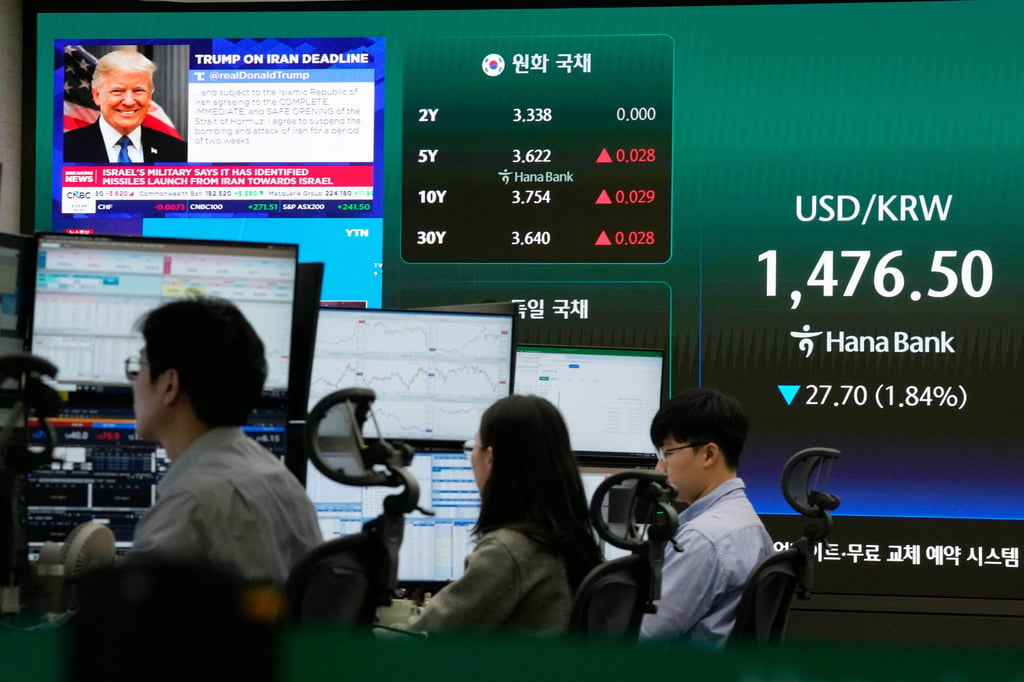
Asian financial markets experienced a significant surge on Wednesday following President Donald Trump's announcement of a two-week ceasefire between the United States and Iran. The agreement includes a critical commitment from Tehran to temporarily reopen the Strait of Hormuz, a vital maritime artery through which approximately one-fifth of the world's oil and gas supplies flow. This development comes after a period of intense escalation, during which Trump had issued severe threats of 'obliteration' and the bombing of Iranian civilian infrastructure if the waterway remained closed.
The market reaction was immediate and positive, with major indices in Seoul and Tokyo soaring over 5%, and gains seen across Taipei, Sydney, Hong Kong, Shanghai, and Singapore. Malaysian Prime Minister Anwar Ibrahim also expressed his support for the ceasefire, calling for a lasting peace in the Middle East. However, financial analysts, including Tim Waterer of KCM Trade, suggest that the current mood is one of 'cautious optimism' rather than total confidence. The brevity of the two-week truce and the fragility of the 10-point proposal mean that investors remain wary. The global economy, which has been shocked by the crisis for over a month, will be closely monitoring whether shipping operations actually normalize and if this temporary halt in hostilities can be leveraged into a permanent peace agreement.
Entities: Donald Trump, Anwar Ibrahim, Tim Waterer, United States, Iran • Tone: analytical • Sentiment: neutral • Intent: inform