08-10-2026
US stocks closed lower on Wednesday after reaching record highs in the previous session, as investors weighed renewed concerns about disruption to Middle East oil supplies and rising Treasury yields. Bond yields reportedly reached their highest level in more than 20 years, with investors concerned that costly oil could add to inflation and influence interest rates. Oil prices fluctuated amid reports of increasing attacks on shipping in the Gulf and the Strait of Hormuz. Brent crude rose to $101.53 a barrel and US West Texas Intermediate reached $89.39 early Thursday.
The International Energy Agency said its member countries were prepared to release more oil from reserves if needed, with diesel a priority because of tight supplies. The announcement followed a G7 agreement, coordinated with the IEA, to release 100 million barrels of diesel and crude oil to address supply concerns stemming from the United States-Iran war. The IEA statement helped calm markets after a report from the UK Maritime Trade Operations agency said nine tanker attacks had occurred in the Strait of Hormuz that month—half the combined September total for the strait and Gulf.
US Secretary of State Marco Rubio maintained Washington’s position that it controlled the strait and that oil flows were near normal. Shipping data indicate that Gulf oil exports excluding Iran recovered to more than 81 percent of pre-war levels in September, while exports from the wider Middle East exceeded pre-war levels on 14 days. However, the recovery is taking place alongside increased attacks and higher freight, insurance, and security costs. An attack by an unknown projectile injured 12 crew members aboard a Panama-flagged tanker crossing the Strait of Hormuz, according to India’s Ministry of External Affairs.
Entities: US stocks, Treasury yields, Nasdaq, S&P 500, Brent crude • Tone: analytical • Sentiment: negative • Intent: inform
08-10-2026
Oil prices rose on Thursday as investors weighed growing geopolitical risks in the Middle East and the possibility of renewed U.S. military action in Iran. December Brent crude futures gained 2.14% to $102.35 a barrel, while November West Texas Intermediate (WTI) futures rose 1.78% to $89.85 per barrel. NBC News reported, citing sources, that President Donald Trump and his national security team had discussed potentially restarting large-scale U.S. military operations in Iran in the coming weeks. The reported options include strikes before next month’s midterm elections. The article also points to recent attacks by Iran-backed Houthis on Saudi Arabia, including attacks on airports in Jazan and Najran, and reports that Tehran has been attacking tankers in the Strait of Hormuz. These events add to concerns about the security of Gulf shipping routes and energy infrastructure. In a comment cited by the article, Inki Cho, a financial markets consultant at Exness, said crude prices are likely to remain closely linked to the security of Gulf export routes and infrastructure. Cho warned that an escalation affecting traffic through Hormuz or Saudi energy infrastructure could threaten physical oil supplies and push prices higher. The article presents the price gains as a reaction to geopolitical uncertainty and potential supply disruption, rather than to changes in oil demand or production.
Entities: Brent crude, West Texas Intermediate (WTI), Donald Trump, Iran, NBC News • Tone: analytical • Sentiment: negative • Intent: inform
08-10-2026
The article reports that President Donald Trump has said he no longer wants a deal with Iran, even as U.S. officials reportedly consider renewed military action. Speaking Wednesday at a campaign rally in San Antonio, Texas, Trump said an agreement was not something he wanted, while also claiming Iran was willing to offer the United States anything to stop the conflict. He added that U.S. special envoy Steve Witkoff had been working on a deal and was doing well.
NBC News reported that Trump and his national security team have discussed resuming large-scale military operations in the coming weeks. Axios separately reported that a renewed campaign could involve extensive bombing of Iranian energy, infrastructure, and nuclear targets, and suggested that military action could affect the approaching midterm elections. The reports describe possible plans, not a confirmed decision to strike.
The article connects the conflict to domestic political and economic pressures. Trump’s approval ratings have fallen to a record low amid public concern about the cost of living and soaring gasoline and diesel prices. Crude oil prices remain elevated despite signs that Middle East exports are recovering toward pre-war levels.
Trump had earlier argued that Washington did not know who was in charge in Iran during efforts to end the conflict. Iran’s foreign ministry spokesperson, Esmaeli Baghaei, rejected that characterization, arguing instead that contradictory positions and mixed messaging from U.S. officials were the problem.
Data from Kpler indicate that combined crude volumes exiting the Gulf, excluding Iran, together with flows from Saudi Arabia and the United Arab Emirates, were around the pre-conflict level of 18.5 million barrels per day. Kpler analyst Matt Wright said that shipping and export activity could normalize gradually through operational adaptation, even if conflict continues, rather than needing to wait for a diplomatic agreement. The article therefore portrays a tense situation in which diplomacy, possible military escalation, oil-market recovery, and U.S. political concerns are intertwined.
Entities: Donald Trump, Steve Witkoff, Esmaeli Baghaei, Matt Wright, United States • Tone: analytical • Sentiment: negative • Intent: inform
08-10-2026
Oil prices rose on Thursday, October 8, 2026, after reports that the US Defence Department was identifying potential targets in Iran for strikes that could take place before the US midterm elections. Brent crude gained more than 2 per cent to $102.20 a barrel at 8.10am UAE time, recovering after briefly dropping below $100 earlier in the week. The article reports that West Texas Intermediate also moved, but the supplied text gives its price as “$8.73” and describes the increase as “1.64 per cent lower,” figures that appear inconsistent as written.
Crude had remained above $100 a barrel despite a lull in the US military campaign. President Donald Trump had previously suggested that US strikes would resume only after the midterms, amid domestic backlash over the war. However, increased Iranian attacks on oil and gas tankers in the Strait of Hormuz could affect that timing. The Atlantic, citing unnamed US officials, reported that the scale of any potential strikes was still under discussion. One possibility was a limited campaign before the elections, followed by a larger operation afterward.
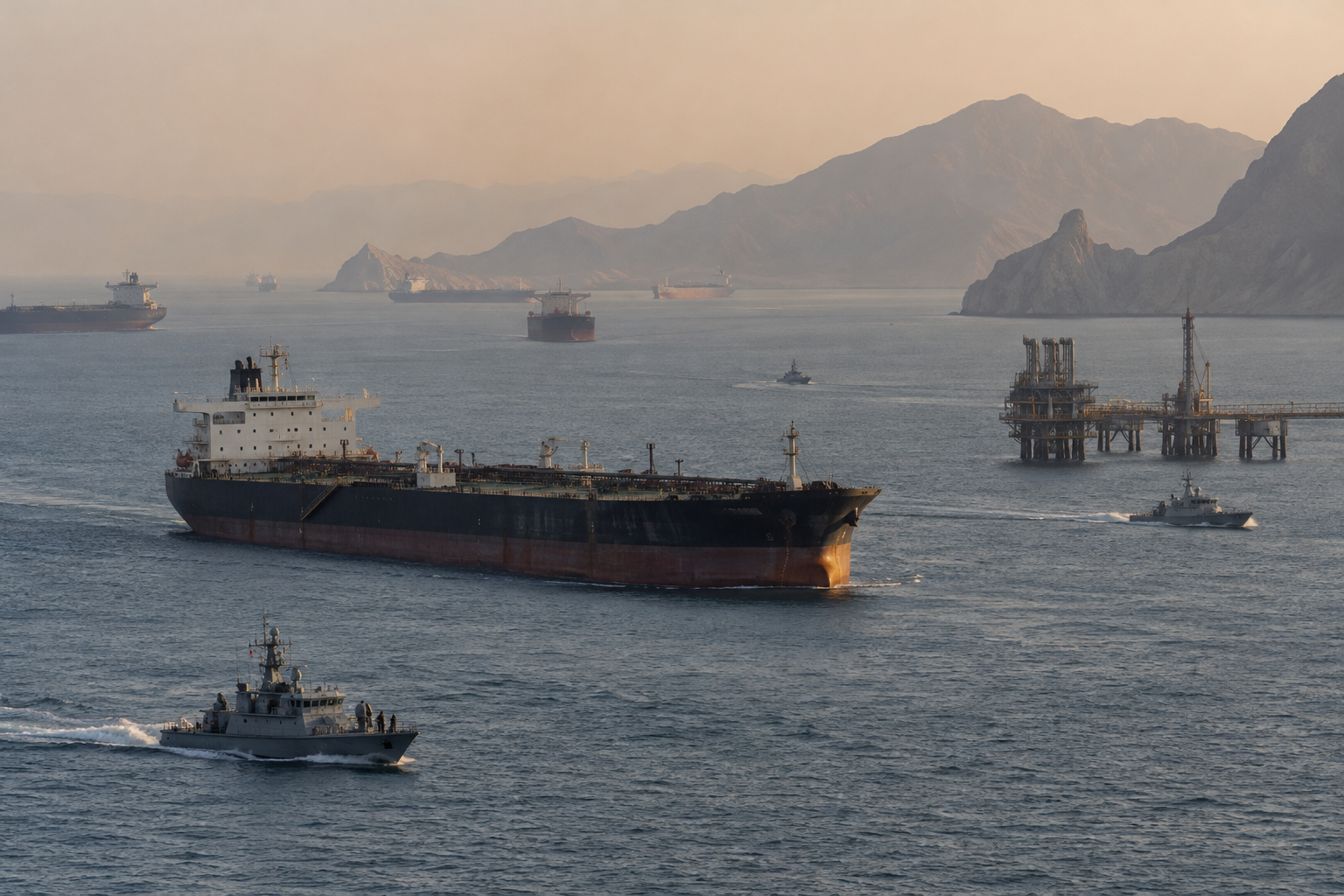
Shipping through the Strait of Hormuz—a key passage through which about a fifth of the world’s oil and gas travelled before the conflict—remained thin. Tanker attacks reached their highest weekly rate since the conflict began on February 28, while the number of vessels crossing the strait fell to its lowest level in more than two months, according to Kpler data. Only seven commodity ships transited on Tuesday, the lowest count since July 23. In the latest reported incident, a tanker north of Qatar was struck by multiple projectiles, causing casualties, according to the UK Maritime Trade Operations agency.
Entities: Sarmad Khan, Donald Trump, The Atlantic, US Defence Department (Pentagon), UK Maritime Trade Operations • Tone: analytical • Sentiment: negative • Intent: inform
08-10-2026
Ship traffic through the Strait of Hormuz fell to its lowest level in more than two months on Tuesday, with only seven commodity vessels recorded, according to data from analytics firm Kpler. The decline followed a week in which attacks on tankers in the strait reached their highest level since the Iran war began. Traffic rose to 10 vessels on Wednesday, but remained far below the more than 20 vessels recorded on Sunday and Monday. Kpler’s figures do not include ships that switched off their Automatic Identification System transponders to avoid detection. Separate LSEG data recorded eight crossings on Tuesday, down from 14 the day before, including five oil tankers and the liquefied natural gas carrier Al Mafyar, which had loaded in Qatar and was bound for Pakistan.
Crude oil volumes crossing the strait fell 27 per cent from a wartime high the previous week to at least 10.1 million barrels per day. This returned the flow to its September average and left it at 74 per cent of its prewar level. Much of the decline came from ship-to-ship transfers in the Gulf of Oman. At the same time, Gulf producers increased exports through routes on the Gulf of Oman coast and the Red Sea. Those shipments reached 6.7 million barrels per day—more than twice prewar levels—helping offset reduced Hormuz volumes and keep overall Middle East crude exports at prewar levels.
The latest reported attack involved projectiles striking a tanker 94 kilometres north of Madinat ash Shamal, Qatar; casualties were reported, according to the United Kingdom Maritime Trade Operations agency. Before the war began on February 28, about 125 large commercial vessels crossed the strait each day. Their cargoes represented roughly one-fifth of global crude oil and liquefied natural gas supplies, underscoring the strategic importance of the waterway.
Entities: Strait of Hormuz, Iran war, Kpler, Emmanuel Belostrino, Yui Torikata • Tone: analytical • Sentiment: negative • Intent: inform
08-10-2026
A tanker sailing in the Gulf off Qatar’s northern coast was hit by multiple projectiles, the United Kingdom Maritime Trade Operations (UKMTO) agency reported. The vessel was struck about 94 kilometres (58 miles) north of Madinat ash Shamal. UKMTO said casualties had been reported but did not provide a death or injury count, identify the ship’s origin, or say who was responsible. Authorities were investigating. Qatar had not commented, although the incident took place within its exclusive economic zone.
The attack is unusual because it occurred in the western half of the Gulf, rather than in the Strait of Hormuz, where vessels have more commonly been targeted. The Maritime Executive described it as the first reported tanker attack in that part of the Gulf in weeks. UKMTO has also reported a rise in attacks in the Strait: nine tanker attacks there this month, or half the total recorded across the strait and Gulf in September.
The article situates the incidents within the conflict involving Iran, the United States and Israel. Before the war began on February 28, the Strait of Hormuz typically handled about 125 large commercial vessels daily and carried roughly 20 percent of global crude oil and liquefied natural gas supplies. Iran effectively closed the strait in retaliation for US-Israeli attacks, while Washington maintained a blockade on Iranian ports.
Despite attacks and disruption, Middle Eastern oil exports have recently recovered to, and according to provisional data exceeded, pre-war levels. Kpler data put the seven-day average of regional crude exports at 18.3 million barrels per day on September 30, compared with an average of about 18 million barrels per day in the year before the war.
Entities: United Kingdom Maritime Trade Operations (UKMTO), Qatar, Madinat ash Shamal, Strait of Hormuz, Gulf of Oman • Tone: neutral • Sentiment: neutral • Intent: inform