08-05-2026
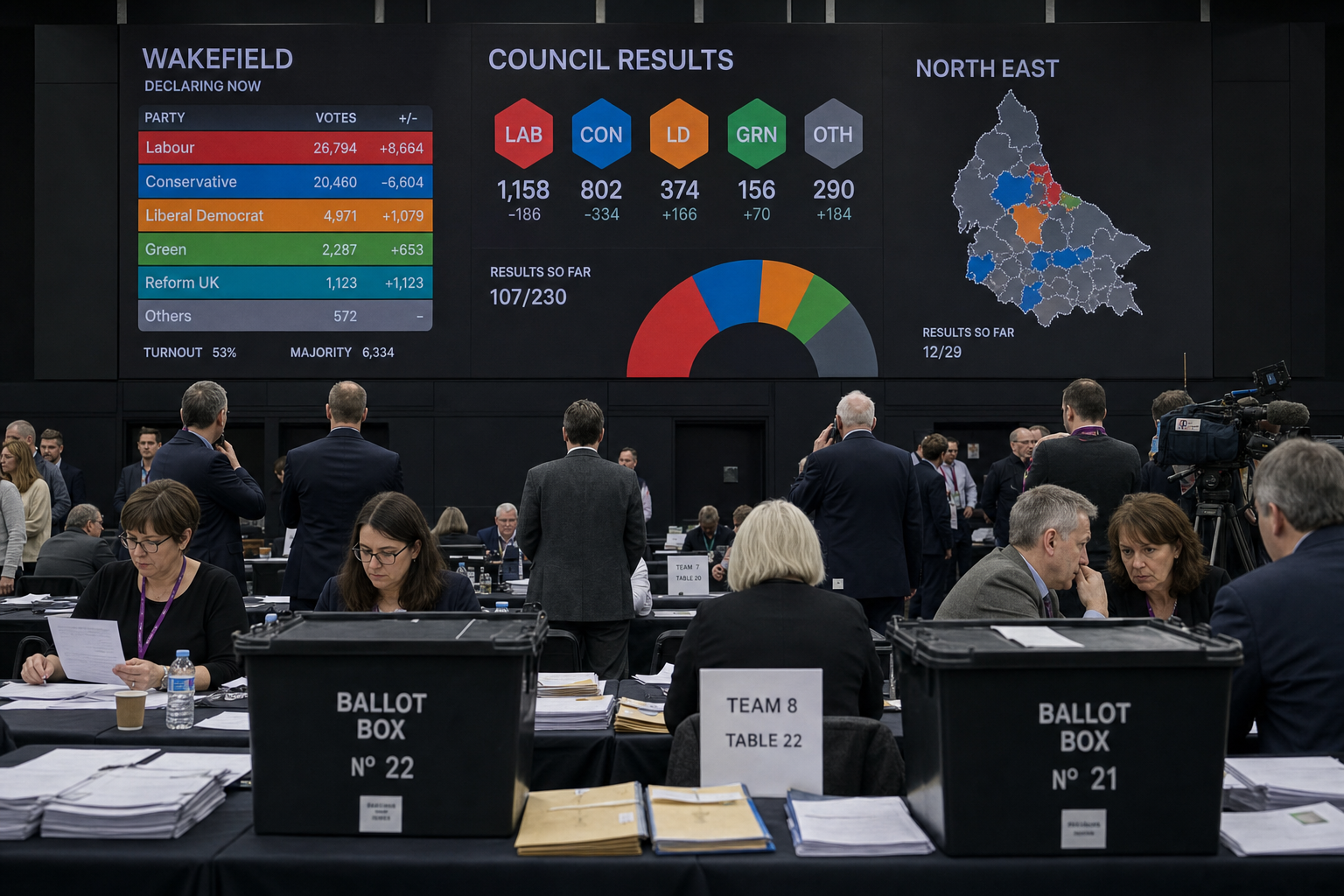
The article discusses the challenges faced by UK Prime Minister Keir Starmer as his Labour Party suffers significant losses in local elections. The party is losing control of major councils across the country, with right-wing Reform UK making the biggest gains. The losses add to the political pressure on Starmer, who is also facing discontent over domestic and foreign issues. Meanwhile, US President Donald Trump threatens Europe with higher tariffs, and tensions rise in the Middle East as the US and Iran exchange fire in the Strait of Hormuz. The situation in Iran is expected to be discussed during Trump's upcoming meeting with Chinese President Xi Jinping.
Entities: Keir Starmer, Labour Party, UK, Donald Trump, US • Tone: neutral • Sentiment: negative • Intent: inform
08-05-2026
Early local council election results in the U.K. pointed to significant losses for Labour and intensified speculation about Prime Minister Keir Starmer’s political future. Although the vote does not change the national government, it has become a market event because investors have been watching whether Starmer could be forced out by his own party. Starmer responded by insisting he would not resign, arguing that Labour was elected for a five-year term and that leaving now would plunge the country into chaos. His comments helped ease pressure on U.K. government bonds, or gilts, which had recently sold off amid reports of a possible coup inside Labour.
The article explains that gilt yields had climbed to multi-decade highs earlier in the week, especially at the long end of the curve, as traders priced in the possibility that a successor to Starmer might pursue looser fiscal policy and greater borrowing. Analysts and fund managers cited by CNBC said political uncertainty is directly affecting bond markets, especially because the U.K. already has the highest borrowing costs in the G7. Deutsche Bank, TS Lombard, AJ Bell, deVere Group, and Mattioli Woods all framed the election fallout as a test of market confidence in Labour’s fiscal direction.
The piece also notes that Labour’s internal tensions extend beyond the election results, with disagreements over welfare reforms, fiscal restraint, and controversial appointments adding to instability. Potential successors such as Angela Rayner, Andy Burnham, and Wes Streeting are mentioned, but markets appear to prefer Starmer and Chancellor Rachel Reeves remaining in place for now. The broader message is that the election has not altered government composition, but it has deepened doubts about Labour’s leadership and highlighted how closely U.K. bond markets are tied to political credibility.
Entities: Keir Starmer, Rachel Reeves, Labour Party, Conservative Party, Reform UK • Tone: analytical • Sentiment: negative • Intent: inform
08-05-2026
European markets fell sharply on Friday as investors reacted to renewed tariff threats from U.S. President Donald Trump and to political uncertainty in the United Kingdom. Trump said the European Union had failed to meet its commitments under a trade deal reached last July and warned that tariffs on EU goods could rise to “much higher” levels if the bloc did not deliver on promised concessions, including lowering tariffs on American goods to zero. The comments revived concerns about trade tensions after earlier disputes in which European lawmakers accused Washington of violating the terms of the agreement and even delayed a parliamentary vote, calling the situation “pure tariff chaos.”
The market backdrop was already cautious, with the pan-European Stoxx 600 down 0.8% and every major sector and regional index in negative territory shortly after the open. The article also notes that U.S.-Iran hostilities remain a concern, though Trump described the latest strikes as “just a love tap” and said the ceasefire was still holding. In the U.K., local election counting pointed to losses for both Labour and the Conservatives, while Reform UK and the Greens appeared poised to gain. Those results could intensify pressure on Prime Minister Keir Starmer, whose leadership was already under scrutiny. Despite the political turbulence, U.K. gilt yields were little changed and the pound was slightly stronger against the dollar.
Entities: Donald Trump, European Union (EU), Stoxx 600, Truth Social, Ursula von der Leyen • Tone: analytical • Sentiment: negative • Intent: inform
08-05-2026
British Prime Minister Keir Starmer says he will not resign despite a bruising set of local and regional election results that suggest Labour is heading for substantial losses in England, Scotland and Wales. In remarks on Friday, Starmer argued that voters had sent a message about wanting faster change and better improvements to their lives, but insisted he would not abandon the responsibilities of office or "plunge the country into chaos." The article describes widespread expectations that Labour would fare badly because of anger over the economy, immigration and Starmer’s leadership, but notes that partial results pointed to even worse losses than predicted.
The story highlights the rise of Reform UK, led by Nigel Farage, which gained more than 450 council seats in early counts and made gains in both traditional Labour strongholds and Conservative areas. It also notes internal pressure within Labour, including comments from one Labour MP who said Starmer should not survive the results and that the party needs new leadership. Deputy Prime Minister David Lammy urged colleagues not to topple Starmer, warning against changing leaders mid-flight.
Beyond England, Labour was expected to lose control of the Welsh Senedd for the first time since its creation, while in Scotland the SNP was projected to become the largest party. The article frames the results as part of a broader political collapse for Labour, fueled by public dissatisfaction with Starmer’s performance, policy reversals, a controversial appointment of Peter Mandelson as ambassador to Washington, and the government’s failure to deliver economic growth or ease the cost-of-living crisis.
Entities: Keir Starmer, Labour Party, David Lammy, Nigel Farage, Reform UK • Tone: analytical • Sentiment: negative • Intent: inform
08-05-2026
Early results from England’s local elections indicate a major setback for Prime Minister Keir Starmer’s Labour Party and a surge for Nigel Farage’s right-wing populist Reform U.K. Labour has already lost nearly 260 council seats in early returns, while Reform has gained close to 400, with thousands of seats still to be counted. Starmer acknowledged the results as a sharp rebuke from voters, said he takes responsibility, but rejected calls to resign and insisted he would continue as prime minister. Farage described Reform’s gains as historic and argued the party is becoming a national force capable of reshaping British politics.
The article frames the elections as an important test of Britain’s fractured political landscape, with Labour under pressure from multiple directions: Reform’s rise, Green and Liberal Democrat gains, and continued uncertainty in Scotland and Wales. Polling had already suggested Labour would do poorly, with Starmer suffering from low approval ratings and policy reversals on taxes, welfare, immigration, and digital IDs, as well as controversies including the appointment of Peter Mandelson as ambassador to the United States. The results may also weaken the Conservatives further and could have major implications for Labour’s dominance in Wales and the Scottish National Party’s position in Scotland.
Beyond the political implications, the article notes that some voters focused on local issues such as streets, traffic, and crime, while financial markets reacted calmly, with the pound rising and borrowing costs easing slightly after Starmer signaled he was staying on. Overall, the piece portrays the election as a potentially pivotal moment for British politics, especially for Labour’s leadership and Reform’s national ambitions.
Entities: Keir Starmer, Labour Party, Nigel Farage, Reform U.K., Conservative Party • Tone: analytical • Sentiment: negative • Intent: inform
08-05-2026
Early results from Britain’s local elections suggest a major political shift, with Nigel Farage’s right-wing populist Reform U.K. party making striking gains at the expense of Prime Minister Keir Starmer’s Labour Party and the Conservatives. Reform won more than 400 council seats in early returns across England, while Labour lost more than 260 seats by midday Friday and may ultimately lose far more. Starmer acknowledged voters had delivered a harsh verdict on his government’s first 22 months, but he rejected calls to resign, insisting he would stay in office to face the country’s challenges. Farage framed the results as evidence of a “historic” realignment in British politics and argued Reform should now be seen as a national force. The article describes a broader fragmentation of Britain’s political landscape, with gains also for the Greens and Liberal Democrats, and notes that results in Scotland and Wales could further reshape politics there. Analysts say the results may reflect deep dissatisfaction with Starmer rather than full-throated support for Farage, but Reform’s expansion gives it a much larger platform ahead of the next general election, due by 2029.
Entities: Keir Starmer, Nigel Farage, Reform U.K., Labour Party, Conservative Party (Tories) • Tone: analytical • Sentiment: negative • Intent: inform
08-05-2026
Sir Keir Starmer’s Labour Party suffered heavy early losses in England’s local elections, signaling strong voter backlash against the government less than two years after Labour’s landslide national victory. The biggest beneficiary was Reform UK, led by Nigel Farage, which made major gains across council contests and emerged as the most prominent challenger in several areas. Early results showed Labour losing long-held support in traditional strongholds in central and northern England, including Tameside, Wigan and Salford, while also underperforming in parts of London. Analysts described the results as a major setback for Labour and evidence of a broader fragmentation in British politics, with voters shifting away from the two main parties toward Reform and the Greens, while nationalist parties were expected to do well in Scotland and Wales. The article also notes that the elections are an important midterm test before the 2029 general election and may intensify pressure on Starmer amid criticism of policy U-turns and wavering authority. However, Starmer’s allies defended him, arguing that replacing him now would create chaos and that he could still recover politically.
Entities: Sir Keir Starmer, Labour Party, Reform UK, Nigel Farage, Sir John Curtice • Tone: analytical • Sentiment: negative • Intent: inform
08-05-2026
Sir Keir Starmer’s Labour Party suffered a sharp early setback in local elections across England, Scotland and Wales, with the results signalling widespread voter frustration and a major boost for the populist Reform UK party led by Nigel Farage. Early counts showed Labour losing heavily in former industrial strongholds in central and northern England, as well as some London areas, while Reform made major gains, adding hundreds of council seats and emerging as the biggest winner in England. Commentators said the results reflected a deepening fragmentation of Britain’s traditional two-party system, with voters also drifting toward the Conservatives’ other rivals, including the Greens and nationalist parties in Scotland and Wales. The losses intensified scrutiny of Starmer’s leadership only two years after Labour’s landslide national victory in 2024, especially given his government’s policy U-turns, internal tensions, and growing doubts among some MPs about his authority. Although some Labour figures suggested he could face pressure to set out a departure timetable if the party performs badly across the devolved nations and local councils, his allies insisted it was too early to challenge him and that he should remain in place through the next general election in 2029.
Entities: Keir Starmer, Labour Party, Reform UK, Nigel Farage, Sir John Curtice • Tone: analytical • Sentiment: negative • Intent: inform