07-10-2026
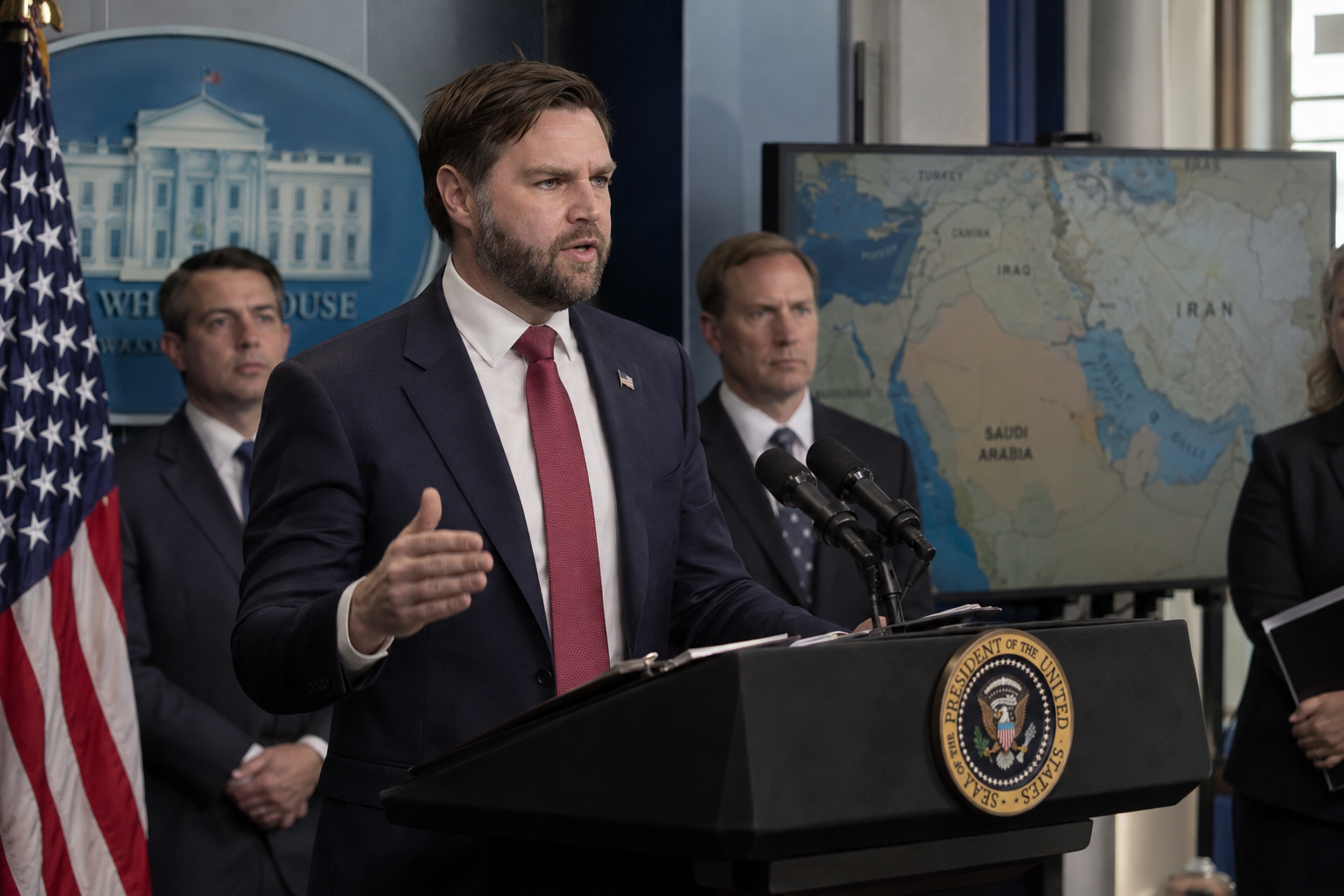
The article presents a lightly edited Reuters interview with US Vice President JD Vance, conducted in Fairbanks, Alaska, after a campaign rally for Republican Senator Dan Sullivan. The interview focuses mainly on Iran, its nuclear program, attacks on commercial shipping, and the US response. Vance says Iran is attempting to pressure the global economy by targeting shipping, but argues that these actions are causing greater harm to Iran than to the flow of oil and gas. He describes preventing Iran from obtaining nuclear weapons—and limiting wider regional nuclear proliferation—as the central US objective. According to Vance, Iran’s nuclear and enrichment facilities have been destroyed, and the United States intends to prevent their reconstruction.
Vance says decisions about renewed US military attacks belong to the president. He describes negotiations with Iran’s political leadership, including its foreign minister, but says it is unclear who actually makes decisions within the country. He claims Iran has failed to honor an earlier understanding to keep commercial shipping safe, and suggests some Iranian officials favor an agreement while others are undermining one. He argues that Iran’s 60-percent-enriched uranium is unnecessary for energy production and that a credible commitment against developing nuclear weapons would require meaningful limits on enrichment.
Vance says the administration is open to an agreement, but insists that Iran must take concrete steps rather than offer promises in exchange for US action. Asked about a reported Iranian operation involving RAF Fairford in the UK, he declines to discuss classified intelligence, saying no attack has occurred and that US military and intelligence personnel are monitoring potential threats. The supplied transcript ends during a question about whether military commanders have expressed concerns about ammunition stocks.
Entities: JD Vance, Jacob Bogage, Reuters, Iran, United States • Tone: analytical • Sentiment: neutral • Intent: inform
07-10-2026
US Vice-President J.D. Vance said Iran would have to make a “meaningful” reduction in its nuclear enrichment capacity for the United States to agree to an end to the seven-month war. In an interview with Reuters in Alaska, Vance argued that assurances about future reductions would not be enough: Washington wants concrete action, particularly an end to producing highly enriched fuel. The United States and Iran have exchanged proposals intended to end the conflict and reopen the Strait of Hormuz, but President Donald Trump rejected Tehran’s latest offer and warned that military operations could intensify after the US midterm elections.
Vance said negotiations are complicated by uncertainty in Washington about who has decision-making authority in Iran. US officials are speaking with President Masoud Pezeshkian and Foreign Minister Abbas Araqchi, but Vance said their influence within Iran’s power structure is unclear following the killing of Supreme Leader Ayatollah Ali Khamenei in joint US-Israeli strikes. Iran’s Foreign Ministry spokesperson Esmaeil Baghaei disputed that account, saying the difficulty stems instead from contradictory US positions and messaging.
Vance said he has spoken with field commanders about conditions on the battlefield. He dismissed concerns about shortages of critical munitions and said that although Iranian troops can sometimes strike commercial vessels in the Strait of Hormuz, they are largely unable to stop energy exports through the route.
The war has disrupted global energy markets and costs the United States about US$3 billion a month. Higher energy prices have become a political problem for Trump and Republicans before the November midterms, particularly in competitive states. Vance made the comments while campaigning in Alaska for Republican Senator Dan Sullivan, who faces Democratic challenger Mary Peltola. Vance, often viewed as a potential Republican successor to Trump, said he had not decided whether to run for president in 2028.
Entities: J.D. Vance, Iran, United States, Donald Trump, Masoud Pezeshkian • Tone: analytical • Sentiment: neutral • Intent: inform
07-10-2026
US Vice President JD Vance says Iran must make a substantive reduction in its nuclear enrichment capacity before Washington will agree to end the seven-month war. In an interview with Reuters, he said the United States remains open to a negotiated settlement but will not accept assurances without concrete action. Vance questioned why Iran would need fuel enriched to 60% if it does not intend to build a nuclear weapon, and said reducing enrichment would demonstrate that commitment.
Washington and Tehran have exchanged proposals intended to end the conflict and reopen the Strait of Hormuz, an important route for global energy shipments. US President Donald Trump has rejected Iran’s latest proposal and warned that military operations could intensify after the next month’s midterm elections.
Vance also said the United States is unsure how decisions are made within Iran, including how much authority President Masoud Pezeshkian and Foreign Minister Abbas Araghchi have. The uncertainty follows the killing of Supreme Leader Ayatollah Ali Khamenei in US-Israeli strikes at the start of the war. Iran disputes Washington’s account: Foreign Ministry spokesperson Esmaeil Baghaei said US officials understand Iran’s system and blamed the disagreement on Washington’s contradictory positions and mixed messages. Trump has also said that it is unclear who is running Iran.
The conflict is becoming a political liability for the Trump administration and Republicans before the November midterm elections. A Congressional Budget Office forecast cited by Reuters puts the war’s cost at about $3 billion a month, while higher energy prices have put Republicans on the defensive in competitive states. Vance has defended Trump’s approach on the campaign trail and urged voters not to let the war deter them from supporting Republican candidates.
Entities: JD Vance, Donald Trump, Iran, United States, Masoud Pezeshkian • Tone: analytical • Sentiment: neutral • Intent: inform