07-09-2026
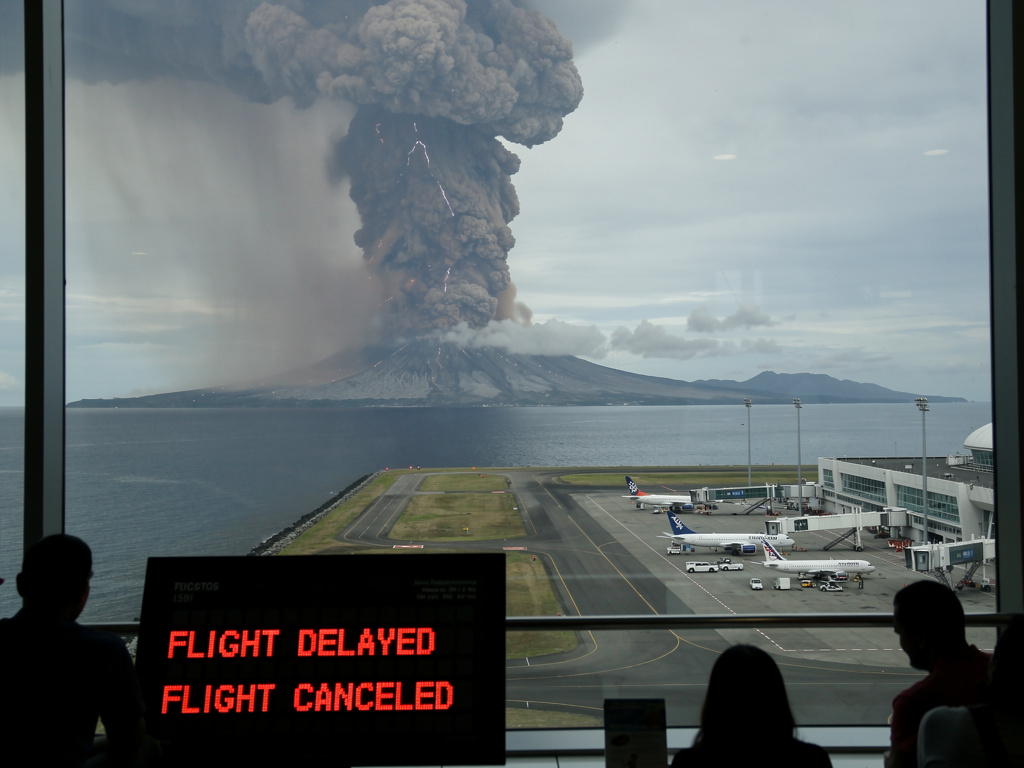
An eruption of Indonesia’s Anak Krakatau volcano on Sunday caused widespread disruption to air travel after volcanic ash drifted across parts of western Indonesia. AirNav Indonesia closed airspace around Jakarta’s Soekarno-Hatta and Halim Perdanakusuma airports, as well as six other airports, including Radin Inten II Airport in Lampung. By Sunday evening, 1,558 flights had been canceled, affecting approximately 170,000 passengers. The closures were scheduled to remain in effect until 8:59 a.m. Monday, although officials warned that disruptions could continue as airlines reorganized aircraft, crews and terminal capacity.
No deaths or injuries were reported, and authorities issued no evacuation orders because the nearest settlement is more than 10 miles from the volcano. However, officials urged people to remain at least two miles from the crater. Satellite data identified two ash clouds: one rose to 20,000 feet and moved northeast toward Jakarta and surrounding regions, while another reached 50,000 feet and spread across parts of Banten, Lampung and Bengkulu, the Sunda Strait and the Indian Ocean west of Sumatra.
Indonesia’s Geological Agency said Anak Krakatau had shown increased activity since July, with Sunday’s eruption the strongest during that period. Officials said repeated eruptions indicate an ongoing supply of magma and volcanic gases, but they could not predict whether a larger eruption would follow. Authorities identified volcanic ash, concentrated gases and hot rocks as the main hazards. Schools in affected areas were also permitted to shift temporarily to online learning to reduce exposure to ashfall.
The eruption highlighted Anak Krakatau’s dangerous history. The volcano emerged from the remains of Krakatau, whose 1883 eruption caused global cooling. An eruption in 2018 killed at least 430 people after an underwater landslide triggered a tsunami.
Entities: Anak Krakatau volcano, Indonesia, Jakarta, Sunda Strait, Java and Sumatra • Tone: analytical • Sentiment: negative • Intent: inform
07-09-2026
The eruption of Indonesia’s Mount Anak Krakatau caused widespread aviation disruption across the Jakarta region and neighboring countries over the weekend. Volcanic ash temporarily closed Jakarta’s Soekarno-Hatta International Airport, with airport suspensions extended several times on Sunday and cancellations continuing into Monday. At least 373 flights were affected by 10:35 a.m. Sunday, including 202 flights at Soekarno-Hatta, where 167 were canceled. The airport is Southeast Asia’s second-busiest by scheduled airline seat capacity this month, with approximately 3.24 million seats, amplifying the regional impact of the disruption.
Mount Anak Krakatau entered a continuous eruptive phase at 11:07 p.m. local time Friday. According to Indonesia’s Ministry of Energy and Mineral Resources, the activity continued for about 25 hours before ending at 12:04 a.m. Sunday. Despite the end of the continuous eruption, authorities said volcanic activity remained elevated and warned that the potential for additional eruptions was still high.
Ash was detected over Jakarta and nearby areas, reaching altitudes of up to 20,000 feet while moving east and 50,000 feet while moving west. The ash cloud extended as far as the Indian Ocean, creating continued risks for aircraft operations. Singapore Airlines canceled nine flights between Singapore and Jakarta scheduled for Monday, while its budget carrier Scoot also canceled flights on the route.
Authorities warned of possible incandescent rocks, heavy ashfall and lava flows if continuous eruptions resume. Anak Krakatau remains at Level III, or “Alert,” and a three-kilometer exclusion zone remains in place around the volcano.
Entities: Mount Anak Krakatau, Soekarno-Hatta International Airport, Jakarta, Indonesia, Singapore Airlines, Scoot • Tone: urgent • Sentiment: negative • Intent: inform
07-09-2026
Mount Anak Krakatau in Indonesia erupted over the weekend, sending lava and large ash plumes into the air and disrupting air travel across the region. The volcano is located approximately 150 kilometres from Jakarta. Ash drifting into nearby airspace led to the suspension of operations at eight airports and the cancellation or disruption of hundreds of flights, leaving more than 170,000 passengers stranded. Jakarta’s Soekarno-Hatta International Airport, the capital’s primary airport, was among the facilities affected. Three other airports, including Halim Perdanakusuma, also extended their closures until 6 p.m. local time on Monday. Halim handles both commercial and military flights.
Airport operator Angkasa Pura advised passengers to monitor their flight status directly with their airlines, citing increasing activity at Mount Anak Krakatau. Indonesia’s national geology agency said the possibility of additional eruptions remained high through Monday morning. The closures were intended to limit the risks posed by volcanic ash, which can threaten aircraft operations and visibility.
Mount Anak Krakatau has been intermittently active since it emerged from the sea within the caldera created by the catastrophic 1883 eruption of Mount Krakatau. Its activity has previously produced deadly consequences. In 2018, a partial collapse of the volcano triggered a tsunami that killed 429 people and displaced thousands. The latest eruption caused significant travel disruption but the article does not report any deaths or injuries connected to the current event.
Entities: Mount Anak Krakatau, Indonesia, Jakarta, Soekarno-Hatta International Airport, Halim Perdanakusuma Airport • Tone: urgent • Sentiment: negative • Intent: inform
07-09-2026
Eight Indonesian airports, including Jakarta’s main airport and another airport serving the capital, remained closed on September 7 because volcanic ash from Mount Anak Krakatau was creating unsafe flying conditions. The volcano, located between Java and Sumatra, began erupting late on Friday, sending ash across Jakarta and nearby areas and disrupting air travel. Indonesia’s Transport Ministry said approximately 170,000 people had been affected by flight cancellations.
Jakarta’s main airport was expected to remain closed until 6 p.m. local time, although officials said the reopening schedule was uncertain because of changing weather conditions. Transport Minister Dudy Purwagandhi said seven additional airports, including those serving the provinces of Lampung and West Java, would remain closed until at least 8:59 a.m. The closures were imposed as a safety measure because volcanic ash can threaten aircraft operations and visibility.
Indonesia’s volcano monitoring agency recorded another Anak Krakatau eruption at 8:23 p.m. on Sunday and warned that the likelihood of further eruptions remained high. The country’s meteorological agency, BMKG, reported that ash had reached altitudes of up to 20,000 feet on the Java side and 50,000 feet on the Sumatra side, affecting parts of Banten province as well.
Authorities advised residents to wear masks outdoors to avoid inhaling ash. Schools in Jakarta and Lampung were instructed to switch to remote learning because of potential health risks. The article places the event in the broader context of Indonesia’s location on the Pacific Ring of Fire, where earthquakes and volcanic eruptions are common. It also recalls that Anak Krakatau emerged from the site of the volcano formerly known as Krakatoa, whose 1883 eruption caused deadly tsunamis and killed more than 36,000 people.
Entities: Mount Anak Krakatau, Jakarta, Soekarno-Hatta International Airport, Indonesia Transport Ministry, Dudy Purwagandhi • Tone: urgent • Sentiment: negative • Intent: inform