07-08-2026
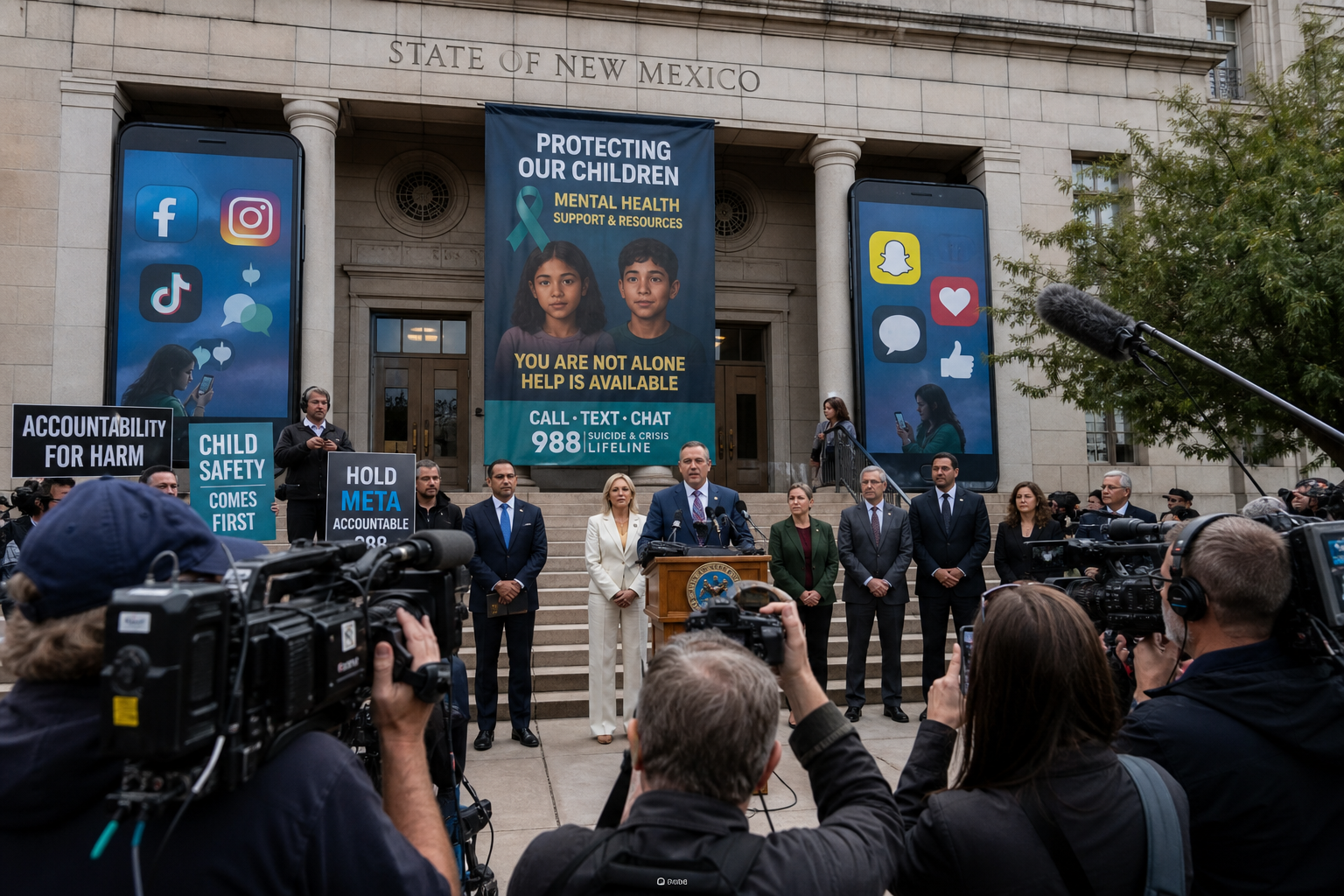
A New Mexico judge ordered Meta to pay an additional $567 million in a child safety lawsuit, bringing the total judgment in the case to $942 million. Judge Bryan Biedscheid ruled that Meta’s platforms created harms to children serious enough to constitute a “public nuisance,” comparing the company’s role to a factory whose pollution must be abated. The decision is the largest child-safety ruling against Meta and, according to the article, may be the first time a social media company has been legally deemed a public nuisance.
The case began with a 2023 lawsuit by New Mexico attorneys general, who argued that Meta’s platforms exposed children to sexually explicit material and contact with sexual predators. In an earlier phase, the court found Meta repeatedly violated the state’s Unfair Practices Act by using recommendation algorithms that steered young users toward harmful content and contacts. In this second phase, the court ordered Meta to create a fund to reduce future harms, with $420 million earmarked for treatment and clinical or behavioral health programs, and additional money for training teachers and health professionals on prevention and response.
The judge also imposed a series of behavioral restrictions for under-18 users, including limits on adult messaging, nudity, like counts, push notifications, and a 90-hour monthly usage cap across Instagram and Facebook. Meta said it disagreed with the ruling and planned to appeal, arguing it works to keep users safe and has been transparent about the challenges of removing harmful content. The ruling arrives as Meta faces thousands of similar lawsuits in the US, including another major trial beginning in California next week involving child privacy claims.
Entities: Meta, Mark Zuckerberg, Instagram, Facebook, WhatsApp • Tone: analytical • Sentiment: negative • Intent: inform
07-08-2026
A New Mexico judge ordered Meta to pay $567 million into an abatement fund after finding the company’s platforms were a significant contributing factor to a youth mental health crisis in the state and that Meta willfully violated New Mexico’s unfair practices act. The order follows the second phase of a child safety lawsuit brought by New Mexico Attorney General Raúl Torrez, who argued that Meta’s apps exposed children to harmful content and predatory contact. Most of the new fund will be used for treatment services, while smaller portions will support awareness, prevention, screening, referrals, coordination, and evaluation. The ruling also requires Meta to improve age-assurance tools in New Mexico, including AI-based efforts to develop a model that can predict under-13 users within two years, and to make underage reporting easier. It further directs Meta to work with schools or a child safety organization on a reporting portal for suspected underage accounts. However, the judge stopped short of ordering changes to Meta’s recommendation algorithms or requiring the company to halt end-to-end encryption, citing possible conflicts with Section 230 and First Amendment protections. Meta said it disagrees with the ruling and will appeal. The case is part of a broader wave of litigation over alleged harms from social media platforms, with experts likening it to a “Big Tobacco” moment for the industry.
Entities: Meta, New Mexico, Judge Bryan Biedscheid, Raúl Torrez, New Mexico Attorney General • Tone: analytical • Sentiment: negative • Intent: inform
07-08-2026
A New Mexico judge ordered Meta to pay $567 million into a child mental health fund and to implement stricter safeguards for minors on its platforms, in a case focused on allegations that Facebook and Instagram contributed to youth mental health harms. The ruling adds to a growing legal and political backlash against social media companies over child safety, privacy, and addiction concerns. Earlier in the case, a jury had already found Meta liable on multiple counts of unfair and deceptive or unconscionable trade practices and ordered it to pay $375 million in damages.
New Mexico Attorney General Raúl Torrez sued Meta in 2023, accusing the company of creating a “breeding ground” for child predators. Meta denied wrongdoing and said it disagreed with the ruling, promising to appeal. Beyond the financial penalty, the judge ordered Meta to delete accounts and personal information belonging to users under 13, disable push notifications during school and nighttime hours for users under 18, automatically set teen accounts to private, and prevent New Mexico users from engaging in romantic or sexualized interactions with Meta’s AI chatbots.
The judge also rejected a broader request to change Meta’s algorithm design, saying it would likely violate the First Amendment and Section 230. In explaining the decision, Judge Bryan Biedscheid likened Meta’s harms to pollution from a factory, arguing that the effects extend beyond the platform itself and impose broader social costs on families, schools, hospitals, and law enforcement. The case is part of a wider wave of lawsuits and settlements involving Meta and other tech companies over youth mental health and child safety.
Entities: Meta, Facebook, Instagram, New Mexico, Raúl Torrez • Tone: analytical • Sentiment: negative • Intent: inform
07-08-2026
A New Mexico judge has ordered Meta, the parent company of Instagram and Facebook, to pay $567 million in an abatement measure aimed at addressing harms to young people linked to social media use. The ruling, issued by Judge Bryan Biedscheid in the second phase of a landmark trial, allocates most of the money—$420 million—for treatment services for youth, with the remainder directed toward awareness, prevention, screening, and related costs over five years. This comes on top of a separate $375 million civil penalty awarded by jurors in March after they found Meta knowingly harmed children’s mental health and concealed what it knew about child sexual exploitation on its platforms.
The court also ordered Meta to make operational changes in New Mexico, including clearer banner and informational screens about safety tools, stronger age-assurance systems, possible use of AI-based age prediction, proof-of-age requests for suspected underage users, and a reporting portal for schools to flag potentially under-13 accounts. Meta must delete data collected from under-13 users and report compliance twice a year. However, the court said federal privacy law limits how far it can go in mandating age verification for children.
The decision adds to mounting legal pressure on Meta, which faces a wave of lawsuits across multiple states and upcoming trials over allegations that Instagram and Facebook were designed to be addictive and harmful to children. Meta said it would appeal, while New Mexico officials called the ruling a victory for parents and children and a step toward holding tech companies accountable for product design that endangers young users.
Entities: Meta, Instagram, Facebook, New Mexico court, Judge Bryan Biedscheid • Tone: analytical • Sentiment: neutral • Intent: inform